Tag: Healthy Ways to Lose Weight

  • Good Cheer For Holiday Dieting 2

    Weight Control

    Image of holiday inspired strawberries.

    Big holiday coming up? Don’t panic. With a good game plan and strategic planning you and your diet can not only survive holidays but you can actually thrive on them. Holidays do not have to be a time of feast or famine-you can strike a happy balance between gorging and self-sacrifice.

    *  Review your eating habits from the previous year’s celebration. Does food take center stage at Thanksgiving, Christmas, Fourth of July, and other big holidays? Do you genuinely enjoy foods like fruitcake, for example, or do you just eat them out of custom and tradition?

    *  Decide which customary holiday food habits you could easily change. (If you like to cook out for the Fourth of July, for example, consider barbecued chicken without skin instead of hot dogs.)

    *  Before digging in at a big holiday feast, imagine how you will feel after eating it. Visualize the bloated, uncomfortable, and guilty feelings you’ve experienced on past occasions.

    *  Forget about being “perfect” on holidays. Stringent dieting may be unrealistic and you could sabotage your efforts by setting standards that are too high. Don’t set yourself up for failure by only thinking of what you can’t have. Concentrate instead on what is available on your diet plan.

    *  Learn to be festive without depending on alcohol. A drink here, a toast there-the calories of alcohol can add up. Substitute club soda or mineral water for alcohol.

    *  If you’re invited to someone’s home for dinner, ask if you can contribute a dish, then make it low-calorie. (And be sure to make plenty. Low-calorie foods are usually very popular.)

    *  Remember that the major purpose of the holidays is to enjoy family and friends. Food and alcohol are secondary factors.
    Page from A Year of Health Hints book by the American Institute for Preventive Medicine. www.HealthyLife.com. All rights reserved.

    © American Institute for Preventive Medicine

  • How To Help A Heavy Child Lose Weight

    Weight Control

    Image of 2 kids holding a healthy snack in one hand and a thumbs up with the other hand.

    A heavy child or teenager carries a psychological burden, especially if he or she is the only family member with a weight problem. What’s more, people who are heavy as children have more difficulty in controlling their weight later on, as adults.

    Concerned family members can take positive actions that help the child lose weight and promote emotional support at the same time. The basic premise is to make weight control a group effort and not focus on the child. In other words, rather than single out the heavy child for his or her eating habits, the entire family should try to adopt a healthy diet and other weight-control habits. Focus attention on these activities.

    *  Family participation in fitness or sports activities. Going for a hike or bike ride as a family not only creates an opportunity to exercise, but can bring family members closer together.

    *  Make it a household rule to limit the amount of high-calorie snack foods brought into the home.

    *  Teach all family members how to prepare healthy meals and snacks. Make a commitment to avoid high-fat foods for everyone’s well-being.

    Page from A Year of Health Hints book by the American Institute for Preventive Medicine. www.HealthyLife.com. All rights reserved.

    © American Institute for Preventive Medicine
  • How To Survive A Dieting Setback

    Weight Control

    Image of women in front of a cupcake and apple on a scale.

    Everyone experiences occasional setbacks, especially people on diets. The trick is to prevent a minor slip from becoming a major disaster that thwarts your long-term weight-loss goals.

    The most determined dieter cheats once in a while-it’s only human. Don’t chastise yourself or give up because you’ve had a slip-up in your eating plans. Remember, a temporary setback does not equal a permanent failure!

    Here’s what to remember when you go astray.

    *  Setbacks are a natural part of learning self-control.

    *  Acknowledge your mistake and plan how you’ll respond to a similar situation the next time. Make it work to your advantage.

    *  Remember, long-term success is still quite possible.

    *  Give yourself positive feedback. If you eat half of a candy bar, for instance, praise yourself for not eating the whole thing.

    Page from A Year of Health Hints book by the American Institute for Preventive Medicine. www.HealthyLife.com. All rights reserved.

    © American Institute for Preventive Medicine
  • Lean On Friends For Weight Loss Support

    Weight Control

    Find a friend or a room full of others on similar paths.

    Getting support as you change lifestyle habits is important. It could be from a buddy who will listen to your woes, applaud your successes, and help you stay on track. Or you could find the support you need in a group program where others’ successes inspire and motivate you.

    Friends don’t let friends eat junk.

    Image of two friends eating healthy.

    It’s okay to be choosy. While your best friend might be great for laughs, if she’s a junk food junkie without weight issues, her own eating habits could rub off on you. Spend more time with a friend who is on a similar weight loss path or supports your efforts. If you don’t know anyone, find an online buddy in a weight-loss chat room or join a local weight loss support group.

    Use common sense for fee-based programs.

    Find out what you are paying for. One-on-one counseling? Group sessions? Medication? Pre-packaged foods and/or supplements that promise to speed up metabolism. Make sure the program you choose fits in with your budget, your lifestyle, and your personal goals.

    Questions to ask:

    *  Is a medical doctor on staff? Does the program have certified professionals, such as registered dietitians and exercise physiologists?

    *  Do I have one-on-one counseling?

    *  Do I attend group meetings?

    *  Will I have to buy special foods and/or supplements?

    *  Is there a start-up fee and/or membership fees?

    *  What is the average cost per month?

    *  How will I get help to make healthy behavior changes?

    *  How much weight does the average member lose and how long does he or she keep the weight off?

    Action Step

    Don’t keep your weight loss goals a secret. Post it on Facebook. Tweet it. Sharing will give you that push to stay on track and provide some much needed encouragement when you feel like quitting.

    Page from Ways to Well-Being book by the American Institute for Preventive Medicine. www.HealthyLife.com. All rights reserved.

    © American Institute for Preventive Medicine
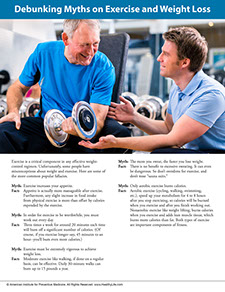
  • Debunking Myths On Exercise And Weight Loss

    Weight Control

    Exercise is a critical component in any effective weight-control regimen. Unfortunately, some people have misconceptions about weight and exercise. Here are some of the more common popular fallacies.

    Myth: Exercise increases your appetite.

    Fact: Appetite is actually more manageable after exercise. Furthermore, any slight increase in food intake from physical exercise is more than offset by calories expended by the exercise.

    Myth: In order for exercise to be worthwhile, you must work out every day.

    Fact: Three times a week for around 20 minutes each time will burn off a significant number of calories. (Of course, if you exercise longer-say, 45 minutes to an hour–you’ll bum even more calories.)

    Myth: Exercise must be extremely vigorous to achieve weight loss.

    Fact: Moderate exercise like walking, if done on a regular basis, can be effective. Daily 30-minute walks can burn up to 15 pounds a year.

    Myth: Only aerobic exercise burns calories.

    Fact: Aerobic exercise (cycling, walking, swimming, etc.), speed up your metabolism for 4 to 8 hours after you stop exercising, so calories will be burned when you exercise and after you finish working out. Nonaerobic exercise like weight lifting, burns calories when you exercise and adds lean muscle tissue, which burns more calories than fat. Both types of exercise are important components of fitness.

    Myth: The more you sweat, the faster you lose weight.

    Fact: There is no benefit to excessive sweating. It can even be dangerous. So don’t overdress for exercise, and don’t wear “sauna suits.”

    Page from A Year of Health Hints book by the American Institute for Preventive Medicine. www.HealthyLife.com. All rights reserved.

    © American Institute for Preventive Medicine

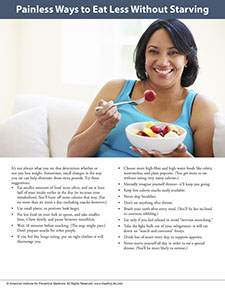
  • Painless Ways To Eat Less Without Starving

    Weight Control

    It’s not always what you eat that determines whether or not you lose weight. Sometimes, small changes in the way you eat can help eliminate those extra pounds. Try these suggestions.

    *  Eat smaller amounts of food more often, and eat at least half of your intake earlier in the day (to increase your metabolism). You’ll burn off more calories that way. (Eat no more than six times a day-including snacks-however.)

    *  Use small plates, so portions look larger.

    *  Put less food on your fork or spoon, and take smaller bites. Chew slowly, and pause between mouthfuls.

    *  Wait 10 minutes before snacking. (The urge might pass.) Don’t prepare snacks for other people.

    *  If you feel like binge eating, put on tight clothes-it will discourage you.

    *  Choose more high-fiber and high-water foods like celery, watermelon, and plain popcorn. (You get more to eat without eating very many calories.)

    *  Mentally imagine yourself thinner–it’ll keep you going.

    *  Keep low-calorie snacks easily available.

    *  Never skip breakfast.

    *  Don’t eat anything after dinner.

    *  Brush your teeth after every meal. (You’ll be less inclined to continue nibbling.)

    *  Eat only if you feel relaxed to avoid “nervous munching.”

    *  Take the light bulb out of your refrigerator–it will cut down on “search-and-consume” forays.

    *  Drink lots of water every day, to suppress appetite.

    *  Never starve yourself all day in order to eat a special dinner. (You’ll be more likely to overeat.)

    Page from A Year of Health Hints book by the American Institute for Preventive Medicine. www.HealthyLife.com. All rights reserved.

    © American Institute for Preventive Medicine
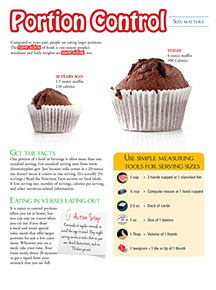
  • Portion Control

    Weight Control

    Size matters.

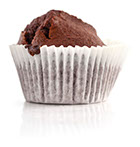
    Image of a small muffin size from 20 years ago.
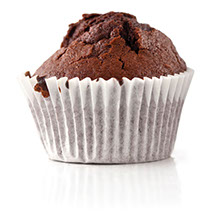
    Image of large muffin served today.

    Compared to years past, people are eating larger portions. The super-sizing of foods is one reason people’s waistlines and body weights are super-sizing , too.

    20 years ago:

    1.5 ounce muffin

    210 calories

    Today:

    4 ounce muffin

    500 Calories

    Get the facts

    One portion of a food or beverage is often more than one standard serving. Get standard serving sizes fromwww.choosemyplate.gov. Just because soda comes in a 20-ounce size doesn’t mean it counts as one serving. (It’s actually 2½ servings.) Read the Nutrition Facts section on food labels. It lists serving size, number of servings, calories per serving, and other nutrition-related information.

    Eating in verses eating out

    It is easier to control portions when you eat at home, but you can stay on course when you eat out if you share a meal and avoid special value meals that offer larger portions for just a few cents more. Wherever you eat a meal, take your time. Your brain needs about 20 minutes to get a signal from your stomach that you are full.

    Use simple measuring tools for serving sizes:

    1 cup = 2 hands cupped or 1 clenched fist

    ½ cup = Computer mouse or 1 hand cupped

    2-3 oz. =  Deck of cards

    1 oz. = Size of 1 domino

    1 Tbsp. = Volume of 1 thumb

    1 teaspoon = 1 die or tip of 1 thumb

    Action Step

    Eat meals at regular intervals to avoid the urge to snack. Buy single-serving snacks or make them on your own. Avoid distractions, such as TV when you eat.

    Page from Ways to Well-Being book by the American Institute for Preventive Medicine. www.HealthyLife.com. All rights reserved.

    © American Institute for Preventive Medicine
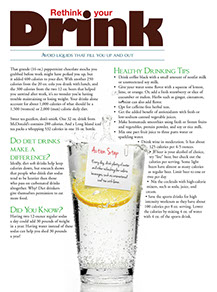
  • Rethink Your Drink

    Weight Control

    Avoid liquids that fill you up and out.

    That grande (16 oz.) peppermint chocolate mocha you grabbed before work might have perked you up, but it added 400 calories to your diet. With another 250 calories from the 20 oz. cola you drank with lunch, and the 300 calories from the two 12 oz. beers that helped you unwind after work, it’s no wonder you’re having trouble maintaining or losing weight. Your drinks alone account for about 1,000 calories of what should be a 1,500 (women) or 2,000 (men) calorie daily diet.

    Sweet tea guzzlers, don’t smirk. One 32 oz. drink from McDonald’s contains 280 calories. And a Long Island iced tea packs a whopping 532 calories in one 16 oz. bottle.

    Did You Know?

    Having two 12-ounce regular sodas a day could add 30 pounds of weight in a year. Having water instead of these sodas can help you shed 30 pounds a year!

    Healthy Drinking Tips

    *  Drink coffee black with a small amount of nonfat milk or unsweetened soy milk.

    *  Give your water some flavor with a squeeze of lemon, lime, or orange. Or, add a fresh strawberry or slice of cucumber or melon. Herbs such as ginger, cinnamon, or mint can also add flavor.

    *  Opt for caffeine-free herbal teas.

    *  Get the added benefit of antioxidants with fresh or low-sodium canned vegetable juices.

    *  Make homemade smoothies using fresh or frozen fruits and vegetables, protein powder, and soy or rice milk.

    *  Mix one part fruit juice to three parts water or sparkling water.

    *  Drink wine in moderation. It has about 125 calories per 4-5 ounces.

    *  If beer is your alcohol of choice, try “lite” beer, but check out the calories per serving. Some light beers have almost as many calories as regular beer. Limit beer to one or two per day.

    *  Nix the cocktails with high-calorie mixers, such as soda, juice, and cream.

    *  Save the sports drinks for high intensity workouts as they have about 100 calories per 8 oz. serving. Lower the calories by mixing 4 oz. of water with 4 oz. of the sports drink.

    Do diet drinks make a difference?

    Ideally, diet soft drinks help keep calories down, but research shows that people who drink diet sodas tend to be heavier than those who pass on carbonated drinks altogether. Why? Diet drinkers give themselves permission to eat more food.

    Action Step

    Every day, drink plenty of water and other refreshing low-calorie beverages, such as unsweetened iced tea with lemon.

    Page from Ways to Well-Being book by the American Institute for Preventive Medicine. www.HealthyLife.com. All rights reserved.

    © American Institute for Preventive Medicine

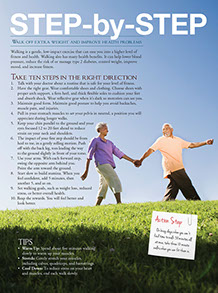
  • Step-By-Step

    Weight Control

    Walk off extra weight and improve health problems.

    Walking is a gentle, low-impact exercise that can ease you into a higher level of fitness and health. Walking also has many health benefits. It can help lower blood pressure, reduce the risk of or manage type 2 diabetes, control weight, improve mood, and increase fitness.

    Take ten steps in the right direction:

    1.  Talk with your doctor about a routine that is safe for your level of fitness.

    2.  Have the right gear. Wear comfortable shoes and clothing. Choose shoes with proper arch support, a firm heel, and thick flexible soles to cushion your feet and absorb shock. Wear reflective gear when it’s dark so motorists can see you.

    3.  Maintain good form. Maintain good posture to help you avoid backaches, muscle pain, and injuries.

    4.  Pull in your stomach muscles to set your pelvis in neutral, a position you will appreciate during longer walks.

    5.  Keep your chin parallel to the ground and your eyes focused 12 to 20 feet ahead to reduce strain on your neck and shoulders.

    6.  The impact of your first step should be from heel to toe, in a gently rolling motion. Push off with the back leg, toes leading the way to the ground slightly in front of your torso.

    7.  Use your arms. With each forward step, swing the opposite arm behind you. Point the arm toward the ground.

    8.  Start slow to build stamina. When you feel confident, add 5 minutes, then another 5, and so on.

    9.  Set walking goals, such as weight loss, reduced stress, or better overall health.

    10. Reap the rewards. You will feel better and look better.

    Tips

    *  Warm Up: Spend about five minutes walking slowly to warm up your muscles.

    *  Stretch: Gently stretch your muscles, including calves, quadriceps, and hamstrings.

    *  Cool Down: To reduce stress on your heart and muscles, end each walk slowly.

    Action Step

    On busy days when you can’t find time to walk 30 minutes all at once, take three 10-minute walks when you can fit them in.

    Page from Ways to Well-Being book by the American Institute for Preventive Medicine. www.HealthyLife.com. All rights reserved.

    © American Institute for Preventive Medicine
  • Diet Changes: Simple And Doable

    HEALTHY EATING

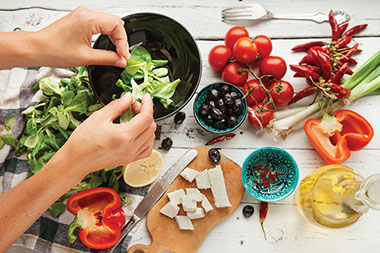
    Hand over table with bowls of different, healthy ingredients.

    If you try a complete diet overhaul at once, you may get overwhelmed. You can make it easier by not doing too much at once. Focus on one or two things you want to change and stick with those.

    Keep comfort foods, but tweak them

    Many people think they must give up all their favorite foods to be healthy. But if you have comfort foods you enjoy, this can cause even more stress. Here’s how to keep them while eating healthy:

    *Eat them less often.Aim to eat your comfort food once a week, rather than every day. Come up with healthier options to replace the comfort food.

    *Take a smaller portion.Put a smaller portion on your plate and eat it slowly. Enjoy the smell and taste of each bite, truly savoring it.

    *Modify the recipe.Switch out high fat and high calorie ingredients in your recipes. Use low-fat or fat-free dairy products instead of whole milk and cream. Use vegetable noodles instead of white pasta. All those little changes add up.

    Keep it simple

    If you’re already under stress, following an extreme diet plan could backfire. It could cause more stress, which could lead to frustration and more stress.

    Instead, celebrate one or two small victories each day. Write down when you snacked on fresh carrots instead of potato chips. Or you had a glass of water instead of soda. Whatever you did to make your diet a little bit better is a step in the right direction.

    Looking at the positive things you have accomplished may be the boost you need during times of stress. When you have slip-ups or bad days, don’t view it as a “failure.” It doesn’t mean all your healthy eating plans are over. Instead, forgive the mistake and look forward to a better and healthier day tomorrow.

    Source: Centers for Disease Control and Prevention

    © American Institute for Preventive Medicine