Tag: HealthyLife® Weigh

  • Relaxation Reflex

    Healthylife® Weigh

    Part 6

    Man stretching at desk.

    This skill relaxes four basic muscle groups. Tightening and relaxing these muscles produces a soothing effect that helps you relax. Take slow, deep breaths, drop your head, and place your shoulders forward to add to the effect.

    Practice every day for about 5 to 10 minutes. Divide the body into 4 muscle groups. Tense each group for 5 seconds, then release.

    1.Arms and Hands– Lift your arms, bending them at your wrists and elbows. Make fists and tighten your upper arms.

    2.Face and Neck– Squinch your eyes, nose, cheeks, and brow. Stretch your mouth and grit your teeth. Point your chin down toward your chest.

    3.Middle Torso– Push your shoulders back. Tighten your stomach and the middle of your back.

    4.Legs and Feet– Lift your legs off the floor and hold them straight out. Point your toes toward your face. Tighten your thighs.

    © American Institute for Preventive Medicine

  • Stretching And Rehabilitation

    Healthylife® Weigh

    Part 5

    Smiling women stretching.

    These exercises make your body more flexible. This helps you prevent injury during exercise and everyday activities. Stretching can also help you relax and is a tool for stress management. Tips:

    *  Stretch all muscle groups. Induce mild tension (not pain or burn) for 10 to 30 seconds.

    *  Don’t bounce while stretching. Make movements slow and controlled.

    *  Breathe slowly. Inhale while stretch is released. Exhale when moving into the stretch.

    *  Stretch after each cardio or resistance training workout.

    *  Stretch as a stand-alone workout or as a way to wind down at the end of the day.

    Examples of Stretching Exercises:

    Shoulder Shrug: Shrug your shoulders up toward your head. Then lower them. Repeat 4 times. Slowly circle your shoulders forward 8 times and then backward 8 times.

    Hamstring Stretch: Sit on the floor with your right leg straight. Bend your left leg and touch your foot against your straight leg. Stretch forward to touch the toes of your right foot. Hold for 4 counts. Then do this on the other side.

    © American Institute for Preventive Medicine

  • What Are You Waiting For?

    Healthylife® Weigh

    Part 5

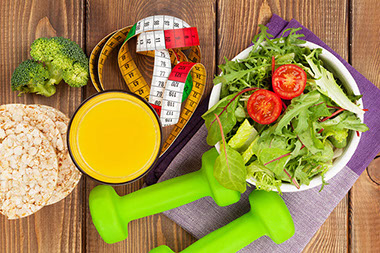
    Healthy salad, fitness weights, and tape measure.

    “I will start eating healthier foods when my spouse decides to also change.”

    This exact scenanio may not apply to you. However, perhaps you are also putting off making a change. Complete each statement with excuses you catch yourself making.

    *  I will start a daily exercise routine when…

    *  I will start eating breakfast when…

    *  I will meet my daily recommendation for vegetables when…

    *  I will drink enough water every day when…

    Reflect. What did you write after “when” in the prompts above? Does “I” come first? Or, does another person or thing?

    © American Institute for Preventive Medicine

  • Address Boredom

    Healthylife® Weigh

    Part 6

    Man changing channels and feeling bored at home.

    Being bored means being tired of doing the same thing over and over again. It may also mean having nothing to do or nothing that seems interesting to do. Write these ideas on sticky notes. Post reminders in places you often get bored.

    *  Shake up your daily routines! If you normally make dinner immediately after work, go for a short walk instead.

    *  Listen to music or an audio book while commuting, cleaning, or doing another boring task.

    *  Do something that keeps your hands busy! (e.g., cleaning, yard work, polishing your nails)

    *  Take your work outside on a nice day or sit in a conference room instead of at your desk.

    *  Do 10 jumping jacks to get your blood flowing!

    *  Put up with non-exciting tasks but look forward to times when you will be doing something you want to do!

    *  Go to your boredom jar and pick a task!

    Create a Boredom Jar

    Write down the things you want to do and will feel proud of doing when you complete them. These activities can be big or small, but try to write down at least a dozen activities. Write down some activities that take a short amount of time and some activities that take longer. Write these down on individual slips of paper and put them in a jar. When you feel boredom could lead to an unhealthy food choice, pick an activity from your jar. Do the activity written on the slip. Write down things you like to do:

    *  Short Activities (10-30 minutes)

    *  Longer Activities (30+ minutes)

    © American Institute for Preventive Medicine

  • Cardio Training

    Healthylife® Weigh

    Part 5

    Man swimming.

    Short for cardiovascular training, “cardio” helps strengthen your heart and other muscles. Cardio also causes the brain to release natural substances, called endorphins, that give you a natural “high.” Aerobic exercise also promotes brain health and challenges your mind.

    Cardio training uses large movements that involve multiple muscle groups, such as your legs, buttocks, and abdominals, all at once. Popular aerobic activities are brisk walking, running, cycling, swimming, and low-impact aerobic dancing.

    Low-Intensity, Steady-State (LISS) Cardio

    Do this type of cardio at a low-to-moderate intensity level. With LISS cardio, you should be breathing at a rate that still allows you to be able to talk to someone. Some examples are walking around your neighborhood or riding a bike at a moderate pace. This type of cardio is most helpful when maintained for 30-45 minutes. Work up to this length of time.

    Group Exercise Classes (e.g., Zumba®, step, kick-boxing, spin)

    *  Find a class through your local community center, YMCA, or another fitness center. Many classes are offered in the mornings and evenings and on weekends to accommodate busy work schedules.

    *  Find an instructor who teaches in a style and tempo you feel comfortable with.

    *  For your first class, arrive early and let the instructor know it is your first time. They may help you set up your equipment or introduce you to someone else in the class who can help you.

    *  High-impact aerobics can strain the knees, hips, and ankles. Step aerobics is lower-impact but should still be avoided by anyone with knee problems.

    *  Modify exercises to a level that you can do comfortably. Ask the instructor for advice.

    Walking

    *  Find a safe place to walk. Your neighborhood, a large shopping mall, or local park may offer safe options. Many fitness centers also have indoor walking tracks or treadmills.

    *  Hold your head up and keep your back straight.

    *  Bend your elbows as you swing your arms.

    *  Take long, easy strides.

    Swimming

    *  Swim in a pool or lake supervised by a lifeguard. If the area is unsupervised, do not swim alone.

    *  Take lessons to learn to swim safely and to improve your technique.

    *  Rest frequently and drink water. It can be harder to notice that you are sweating in the pool and becoming dehydrated.

    *  Wear goggles to protect your eyes.

    *  Wear a swim cap if you have long hair. This will help keep hair out of your face and reduce drag.

    *  Rinse off after swimming and use lotion to keep your skin from drying out.

    High-Intensity Interval Training (HIIT)

    LISS is a good place to start with cardio training. Within a few weeks, start to incorporate HIIT training as well. This type of cardio is much more effective at boosting your metabolism and helping with fat loss.

    To do HIIT, alternate between longer periods of low-intensity exercise and shorter bursts of high-intensity exercise. The high-intensity parts should be short, such a walking as fast as you can for 30 seconds, to get your heart rate up. You should feel like you are working at 90% of your maximum effort. Immediately switch to low-intensity exercise, like walking at a medium pace, for a minute or two to bring your heart rate down. Repeat this pattern several times. Work up to 15 to 20 minutes of HIIT. You can also do intervals of 30 seconds of high-intensity exercise and 30 seconds of low-intensity exercise.

    HIIT revs up your metabolic furnace and you can burn a lot of calories in a short period of time. This may be more interesting and enjoyable than exercising at the same rate for your entire workout.

    You can use the same types of exercises that you enjoy for LISS (like running or biking). Or, you can use other full-body exercises, such as jumping jacks and push-ups. Search “HIIT ideas” online or download an app that provides workouts on a timer.

    Plan a HIIT Workout with Popsicle Sticks

    1. Get at least a dozen popsicle sticks.

    2. Write one short exercise on each popsicle stick. Write exercises you know how to do and enjoy. Ideas:

    – Jumping jacks – Push-ups

    – Lunges – Bicep curls

    – Squats – Side leg lifts

    – Front leg lifts – Mountain climbers

    – Bicycle kicks  – Tricep dips

    – Reverse lunges – Jumping rope (or pretending to)

    3. Put the sticks in a cup or a jar.

    4. Pull out 4 sticks. You will be doing these activities after a short warm up.

    5. Warm up for 5 minutes by briskly walking or doing jumping jacks. Notice that your heart rate is higher.

    6. Set a timer for 15 minutes.

    7. Do the 1st activity as many times as you can in one minute.

    8. Walk for one minute.

    9. Do the 2nd activity as many times as you can for one minute.

    10. Walk for one minute.

    11. Do the 3rd activity as many times as you can for one minute.

    12. Walk for one minute.

    13. Do the 4th activity as many times as you can for one minute.

    14. Walk for one minute.

    15. Repeat steps 7 through 14.

    Ideas Using Your Popsicle Sticks

    Keep your jar of exercise ideas out where you can see it. Pull a stick:

    *  When a commercial break comes on TV or the radio.

    *  In the morning after you wake up.

    *  While studying or reading and you need a break.

    *  When you feel anxious or overwhelmed.

    Do the activity on the stick for one minute. Or, set a goal to do a certain number of that exercise. For example, 25 jumping jacks. Keep your popsicle sticks fresh! Add new ideas and things you like to do. Remove sticks that you dread pulling.

    © American Institute for Preventive Medicine

  • Eating At A Restaurant

    Healthylife® Weigh

    Part 3

    Two people eating at a restaurant.

    Use the same guidelines for choosing food at the grocery store to help you make healthy choices at a restaurant. Compared to preparing food at home, you have less control over what is in your food, how it is prepared, and how much you are served. However, you DO have some control. Here are a few tips to help you follow your eating goals when you eat out:

    1. Choose a restaurant that offers healthy options.

    *  If you are dining with a group, offer to make the reservation.

    *  Read reviews to learn about experiences other people have had at the restaurant.

    *  Avoid all-you-can-eat buffets or anything that is offered in an “endless” supply.

    2. Look up menus ahead of time. Many restaurants, especially fast-food restaurants and other chain restaurants, offer nutrition information online for items on their menu.

    3. Look for clues in the menu. Menus can offer information about what is in the food and how it is made.

    *  Look for meat, poultry, and seafood that has been baked, broiled, steamed, poached, or grilled. Avoid fried choices. Or, ask if a fried food can be prepared with one of these healthier cooking methods.

    *  Pictures, if on the menu, can show you the size of the food groups on the plate. If you need more vegetables to meet your daily needs, ask for an extra serving or order a side salad.

    *  Choose from the “heart healthy” section of the menu, if available. These choices are usually lower in saturated fat and sodium.

    4. Ask for changes to an item, if needed. Menu items can usually be modified by the restaurant. Use the menu to learn what the restaurant has in the kitchen. Mix and match to create a meal that fits your goals. *Be kind and tip your wait staff generously if you are asking for a lot of changes to your order!

    5. Follow your healthy eating plan during the day. Skipping meals or ignoring hunger earlier in the day can lead to overeating or choosing foods higher in sugar, saturated fat, and salt at the restaurant.

    6. Choose your portion. Order your meal as a half-size order or split a meal with a friend. Take some of your food home for another meal.

    7. Set yourself up to be successful. Decline the bread basket, politely. If you are with a group that wants the basket on the table, keep it at the other end to avoid grabbing a piece out of habit. Or, share a piece.

    8. Limit alcohol. This can be a big source of added calories. Stick with one glass of wine or one beer. Or, avoid alcohol altogether.

    Most importantly, enjoy yourself!

    Restaurants can be places to try new foods and flavors and make wonderful memories with family and friends. Take your time. Use your napkin between bites and sip your water often. Engage in conversation. Appreciate the restaurant’s décor and the courtesy of the staff.

    © American Institute for Preventive Medicine

  • Grow A Garden

    Healthylife® Weigh

    Part 7

    Family tending to backyard garden.

    Growing your own food is a great way to know where your food comes from. Garden-fresh vegetables and fruits can have more flavor and nutrients than what is at the supermarket. You can also skip the drive to a store and get some sunshine and fresh air!

    Tips for Growing a Garden:

    1.Keep It Small.Keep the size of your garden small and choose a few vegetables to grow. You’ll need fewer supplies to get started. It’ll also take less time to maintain and you’ll have fewer issues to troubleshoot. Pick foods you like. Buy small seed packets at a grocery or gardening store.

    2.Use Containers.Containers can be moved around as needed. Containers can be flower pots, buckets, wooden boxes, or leftover food containers. Cut off the top of a gallon milk jug and use the bottom for a planter. If you are starting from seeds, start plants indoors and move the containers outside when they have started to sprout. Many plants can also be planted directly in the ground outside.

    3.Allow Drainage.Make sure water can drain from the containers. Poke holes in the bottom of containers that don’t already have holes. If plants are indoors or on a patio, put a dish under the pot to catch the water.

    4.Use Quality Soil.Fill the pots with dirt. Use organic potting soil to avoid chemical add-ins. Mix in peat moss to help the soil drain. Go to a store that carries garden supplies. Ask for advice. Or, talk to neighbors who have gardens to learn what works well for them.

    5.Season + Sunlight.Read the label on the back of a seed packet. It will tell you the right time of year to start your seeds. It will also tell you how much sunshine is needed. Some plants may grow best in hot, direct sunlight. Others may prefer shade and cooler temperatures. Most vegetables, on average, need about 6 hours of sunlight per day.

    6.Give Plants Space.Read the back of your seed packet. Plant your seeds according to package directions. Be sure to leave enough space between seeds. This will give plants enough room to develop strong root systems and produce healthy, tasty crops. If you are planting more than one vegetable in a container, look at tips on the seed packet for companion planting. Companion planting is putting plants next to each other that grow well together. Some vegetables, like tomatoes and kale, don’t like sharing pots but tomatoes and spinach are quite happy sharing space.

    7.Water Regularly.Give your plants the right amount of water. Check by sticking your finger in the dirt about an inch. If it feels wet or damp, the plant is probably getting enough water. If it feels dry, add some water. Don’t leave your plants in standing water. If water came out the bottom into another container you’re using to catch the water, empty this out. If the leaves are wilting or drooping, water may perk them up!

    8.Harvest When Ready.Keep up the care of your seeds and plants and before you know it, you’ll be eating what you grow!

    Visit these websites for more information:

    National Agricultural Library (USDA)

    www.nal.usda.gov/topics/home-gardening

    Centers for Disease Control and Prevention (CDC)

    www.cdc.gov/family/gardening

    © American Institute for Preventive Medicine

  • Limit Added Sugars 2

    Healthylife® Weigh

    Menus & Recipes

    A variety of flavored water.

    Your body can get all the sugar it needs by eating foods that naturally contain sugar, including fruit, dairy, and grains. However, sugar is added to many processed foods and drinks that we consume. While it’s okay to eat a sweetened food or treat once in a while, eating too much can lead to obesity and other health problems. The American Heart Association recommends daily limits for added sugars: 9 teaspoons (36 grams) for men and 6 teaspoons (24 grams) for women.

    Ways to Limit Added Sugars

    *  Reduce sugar-sweetened drinks (pop/soda, bottled tea and coffee drinks, fruit drinks, flavored waters, etc.).

    *  Read the Nutrition Facts label on the package or container. Many products now list added sugars.

    *  Check the ingredients list on the package. Words that mean sugar include syrup, molasses, nectar, malt, honey and words that end in “-ose.” If a sweetener is listed as one of the first 3 ingredients, avoid this product.

    *  Cut back on added sugar in coffee and tea.

    *  Flavor water with slices of lemon or a few berries.

    © American Institute for Preventive Medicine

  • Myplate

    Healthylife® Weigh

    Menus & Recipes

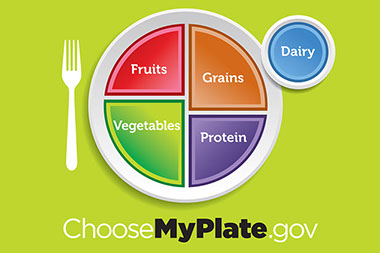
    Choose MyPlate logo.

    The nutrition guidelines in HealthyLife® Weigh and this menu planning guide are based on USDA’s MyPlate and the 2015-2020 Dietary Guidelines for Americans. MyPlate helps to identify how much food makes up a healthy and balanced meal by showing how different food groups take up space on a plate:

    *  Make ½ of your plate fruits and vegetables.

    * ¼ of your plate is lean protein.

    * ¼ of your plate is a whole grain or high-fiber starch.

    * Drink low-fat dairy or consume other calcium-rich foods or drinks.

    Menus & Recipes

    QUICK LINKS: PART 1

    MyPlate

    Plan a Balanced Day

    Fruits & Vegetables

    Grains & Starches

    Protein

    Dairy

    Healthy Fats & Oils

    Limit Added Sugars

    Limit Sodium

    Getting Started with Menu Planning

    Plan MyPlate

    Plan Your Week

    Suggestions for Meals & Snacks

    Improve a Packaged Meal

    Eating Out

    Map Your Meal Plan

    © American Institute for Preventive Medicine

  • Picky Eaters

    Healthylife® Weigh

    Part 3

    Women having lunch.

    Perhaps you buy food or cook for a picky eater. Perhaps that picky eater is you! Vegetables tend to be one of the biggest sticking points with picky eaters, though picky eating can apply to all food groups. Don’t give up!

    Here are some tips for managing picky eating:

    *  Set an example by trying it yourself and using positive language. Even if you don’t like the taste, you can express gratitude or pat yourself on the back for trying a new food.

    *  Add the new food to a food you already like. For example, if peanut butter and jelly is a favorite, swap white bread for whole grain bread. This will add extra nutrients while keeping the preferred peanut butter & jelly filling!

    *  Stock up on healthy choices. Limit junk food and unhealthy options.

    *  Try new foods. Serve a variety of foods at meals to provide a choice. Encourage kids to pick out a new vegetable when grocery shopping. To make it fun, have a child pick a color first. Then, have the child pick out a vegetable that matches that color.

    *  Don’t force a food that is disliked. Part of managing weight is developing a healthy relationship with food.

    *  If it has been more than 6 months since you tried it, try it again! Tastes can change.

    Appreciate your own willingness and effort to try something new! If you have children, they are watching and learning the value of openness.

    © American Institute for Preventive Medicine