Tag: HealthyLife® Weigh

  • Create Self-Enhancing Feelings 2

    SleepWell® Program

    Week 5

    Split image with arrows, one pointing to positive side and the other to a negative side.

    Take responsibility for your thoughts, feelings, and actions. You will feel better about yourself and your life. Blaming others is a natural, child-like reaction. It is more adult-like to figure out the amount of control you have in a given situation and respond to it in a mature way. You may not have control in every situation, but you can choose how you respond to others.

    One reason to become more accountable for your responses is that a “victim” response forms negative, draining feelings. Self-responsibility creates positive energy. With it you can manage every event in a more positive, self-nurturing manner. One way to do this is to look at your language and see if you use “victim” or “accountability” phrases.

    Example “victim” phrase:

    I can’t improve my sleep until my boss gives me a better work shift.

    Example “accountability” phrase:

    I can schedule a meeting with my boss to discuss my shift and my sleep needs.

    The Power of a Phrase

    Fill in after the victim phrase with something you have caught yourself saying or are feeling right now. Use an accountability phrase to re-write this statement.

    Victim Phrase

    *  I can’t…

    *  It’s useless…

    *  I have to…

    *  Why am I always the one who…

    Accountability Phrase

    *  I can…

    *  There’s always a chance…

    *  I choose to…

    *  I’ll be the one who…

    © American Institute for Preventive Medicine

  • Mindfulness 3

    SleepWell® Program

    Week 4

    Image of women sitting out in nature.

    Mindfulness means you are fully aware of all aspects of what you are sensing in the present moment.

    *  You focus on current thoughts without judging them.

    *  You put past thoughts and what the future has in store out of your mind.

    Mindfulness Exercise

    *  Set aside five (or more) minutes. Find a place with no distractions. Get comfortable.

    *  Focus on your breathing or anything in the present, such as the sounds you hear or an object in your sight.

    *  As thoughts pop up in your mind, let them go without judging them. Return your focus to what you see, hear, feel, or are doing in the moment.

    You can also practice mindfulness while you listen to music, walk, run, garden, or with any activity.

    Take a Rest from Your Emotions

    Detach yourself from your thoughts and emotions. Imagine sitting on a hill and viewing your thoughts and feelings at the bottom of the hill. Observe your thoughts as they pass by. Or, you can stop and think about them. Tell yourself: “I have control over when and how I think about a situation.”

    Allow your emotional reactions to a situation or issue take a rest for a bit. This helps your mind use logical thinking.

    © American Institute for Preventive Medicine

  • Practice Relaxation Techniques 3

    SleepWell® Program

    Week 4

    Image of man deep breathing.

    Learn These Three Skills to Relax

    1.  Relaxation Reflex: Get rid of muscle tension.

    2.  Mental Imagery: Think of calm, restful places.

    3.  Deep Natural Breathing: Feel relaxed by breathing in more oxygen.

    Plan Relaxation Time

    If possible, use the hour before you sleep to wind down and prepare your body and mind for sleep. You can also do relaxation exercises as needed throughout the day. Relaxation techniques can help reduce stress-related health problems, such as high blood pressure, headaches, and pain. These tools also help you to exercise greater mental and physical control and reduce negative emotions.

    How the mind can control the body:

    *  It can slow brain wave patterns.

    *  It can reduce heart and breathing rates.

    *  It can increase blood flow to your limbs.

    *  It can relax muscles.

    Prepare for Relaxation

    Remove external factors that could be causing your body and mind to be overly alert. Watching TV is ok, but avoid loud, violent, or exciting programs. Mindless programs are better. Dim the lights. Play a quiet game (though not on your phone or computer), read a book, or organize your sock drawer or the clothes in your closet.

    A bath taken two hours before bedtime allows your body temperature to drop to a sleep-inducing level.

    Relaxation Reflex

    This skill relaxes four basic muscle groups. Tightening and relaxing these muscles produces a soothing effect which helps you relax. Take slow deep breaths, drop your head, and place your shoulders forward to add to the effect.

    Practice this every day for about five to 10 minutes. Divide the body into four muscle groups. Tense each group for five seconds, then release.

    1. Arms and Hands – Lift your arms, bend them at your wrists and elbows, make fists, and tighten your upper arms.

    2. Face and Neck – Squinch your eyes, nose, cheeks and brow. Stretch your mouth and grit your teeth. Point your chin down toward your chest.

    3. Middle Torso – Push your shoulders back, tighten your stomach and the middle of your back.

    4. Legs and Feet – Lift your legs off the floor and hold them straight out. Point your toes towards your face. Tighten your thighs.

    Mental Imagery

    Choose a peaceful scene like a beach, forest, or sunrise. You can even choose a place of fantasy. Then take an imaginary visit there and relax in the process. Imagine this place using the following 10 steps:

    1. Find a comfortable sitting or reclining position.

    2. Gently close your eyes.

    3. Notice nothing but your own gentle breathing pattern.

    4. Begin to think about your peaceful scene. Picture where you are and what you do when your mind and body are very, very relaxed. Pause to create and capture the image of your soothing place.

    5. Pretend that you are really there in your special relaxing environment. Picture all the colors… Hear the sounds… Smell the aromas… Taste… Touch your surroundings as if you are really there… Enjoy… Relax…

    6. Find the calm and peace. Allow yourself to feel good… Let your whole body relax and enjoy the moment.

    7. Pause for five to 10 minutes and become filled with relaxation.

    8. Allow the relaxation to re-energize your body and mind.

    9. As you feel comfortable, slowly open your eyes, feeling totally refreshed.

    10. Escape to your special place anytime you wish to relax, if even for a moment.

    Deep Natural Breathing

    An increased amount of oxygen allows your heart rate to slow down. This produces a calming effect.

    1. Sit in a chair, arms at your sides, with your legs uncrossed.

    2. Note any tension in your muscles.

    3. Put one hand on your chest and the other hand on your abdomen.

    4. Take in a breath slowly and deeply through your nose allowing your abdomen to expand and push up your hand. After your abdomen is full of air, allow your chest to expand, pushing up your other hand. This is one long steady breath.

    5. Hold the air in for three seconds.

    6. Purse your lips and exhale through your mouth making a relaxing, whooshing sound.

    7. Continue to take long, slow, deep inhales through your nose and let out long, slow exhales through your mouth.

    8. Focus on the sound and feeling of deep breathing. Continue for three to five minutes.

    9. Your chest should feel less constricted. You should feel less stress and tension physically and mentally.

    © American Institute for Preventive Medicine

  • Modify Ingredients In Recipes 2

    Nutrition

    Image of different ingredients.

    Three Ways to Modify Ingredients

    1. Use less of ingredients that contain fat, saturated fat, sodium, and sugar.

    2. Substitute ingredients.

    3. Add new ingredients.

    All of the ingredients in a recipe add to the end product. You will need to look at each recipe to see where you can make changes. Only certain ingredients can be changed. Trial and error may be needed before you arrive at the recipe that works best.

    1. Use Less of These Ingredients

    These include:

    *  Oils, fats, such as butter, stick margarine, etc.

    *  Meats (e.g., cut ground meat by half in spaghetti sauce, lasagna, etc.)

    *  Cheese (e.g., put half of amount called for on pizza)

    *  Regular salad dressings

    *  Sugar (e.g., use up to half the amount called for in most recipes or use half regular sugar and half sugar substitute. See labels for correct amounts to use in place of sugar.)

    *  Salt and other seasonings with salt, such as garlic salt

    2. Substitute Ingredients

    * Diet margarine’s high water content may alter the texture of baked products. It works well, though, in sauces, as spreads, and for sauteing vegetables.

    ** When using yogurt for sour cream in heated sauces, mix 1 Tbsp. of cornstarch with 1 Tbsp. of the yogurt then add to the rest of the yogurt. Stir over medium heat until sauce thickens. This will prevent the yogurt from separating.

    3. Add New Ingredients

    Here are some examples:

    *  Vanilla and other flavor extracts. Adding vanilla or adding extra vanilla can make foods taste sweeter than they are.

    *  Vegetables to casseroles, stews, soups, etc. that are not in the original recipe. For example, add mushrooms and green pepper to lasagna and pizza and cut down on or don’t use any meats.

    *  Spices and herbs to add or enhance flavor. For example:

    – Sprinkle dill weed or tarragon on baked or broiled fish along with the lemon juice the recipe may call for.

    – Put pumpkin pie spice on cooked winter squash.

    – Add fresh ripe fruit or mashed cooked vegetables to muffins and quick breads for added flavor, moistness, and nutrients.

    *  Garnish dishes with fresh fruit slices and cut-up vegetables.

    *  Add grains, pastas, starchy vegetables, (potatoes, etc.) legumes (beans, peas, lentils) to thicken soups.

    *  Practice with changing recipes. The savings in total fat, saturated fat, trans fat, sodium, sugar, and calories can be great.

    Modify ingredients in the example below to lower fat, sugar, sodium, and calories.

    Resources

    American Heart Association

    www.heart.org/HEARTORG

    Search for “Nutrition Center.”

    National Heart, Lung, and Blood Institute (NHLBI)

    www.nhlbi.nih.gov

    Search for “Healthy Recipes.”

    NUTRITION.GOV

    www.nutrition.gov

    Search for “Healthy Eating.”

    Page from HealthyLife Weigh book by the American Institute for Preventive Medicine. www.HealthyLife.com. All rights reserved.

    © American Institute for Preventive Medicine

  • Seek Downtime Daily 2

    SleepWell® Program

    Week 4

    Image of man sitting on couch.

    Downtime is idle time between activities. Examples are the moments you have waiting at a red light, the time spent riding in an elevator, and the extra time during a lunch break.

    Idle time allows your brain to rest and process and store information (how you learn and form memories). If you’ve ever had a great idea come to you in the shower, you know how creative your mind is during this time.

    Often, multi-tasking steals this time away. The resulting “addiction to activity” does not let your mind rest during the day. The result can be a feeling of being busy all the time. You may feel like you need “time to think.” If you go all day without downtime, it can be harder to quiet your mind at night and go to sleep.

    Practice letting your mind rest every day. If you are used to filling your time with multiple tasks at once, the following exercise may be eye-opening!

    Try this: Sit in a room for 15 minutes and do nothing. Don’t look at your phone or seek any other distractions. Let thoughts enter your mind.

    Reflect:

    How did you feel at the end of 15 minutes?

    Natural Ways to Include Downtime Daily

    *  Turn off notifications on your phone. Set aside time for social media during the day-and avoid it at other times.

    *  Listen to music instead of the news or talk radio while driving. Or, sit in silence and let your mind wander.

    *  Set an alarm on your phone to remind you to take five minutes of “blank space” time in your day.

    © American Institute for Preventive Medicine

  • Address Anxiety 2

    Healthylife® QuitWell™

    Part 2

    Zen garden with massage stones and waterlily.

    Anxiety is a feeling of dread, fear, or distress over a real or imagined threat to your mental or physical well-being. Smoking, chewing, or vaping may be a way that you have coped in the past with these feelings. At all stages of change, you can learn to address anxiety in healthy ways.

    First, try to calm your body physically. Calming the physical body can make working through what is in your mind easier.

    *  Breathe deeply and evenly.

    *  Take a walk or get some other form of exercise.

    *  Take a long, warm bath or shower. Or, go for a swim.

    *  Listen to soothing music. Or, go somewhere quiet.

    *  Connect with people. Visit or call someone who will listen to you and support you.

    *  Drink a warm cup of decaf coffee or tea-avoid caffeine, which can make anxiety worse.

    As you take a step back, use these tips to manage the thoughts that are causing your anxiety:

    *  Ask: is your thought based on facts?

    *  Identify what you are trying to do. Know your purpose.

    *  Consider many different outcomes and their effects.

    *  View the situation from many perspectives.

    *  Don’t assume a situation will have the same outcome as it did in the past.

    *  Have good evidence for a generalization before you make it.

    *  Avoid assuming one event caused another just because they happened at the same time.

    You will likely feel calmer after you quit. Nicotine only makes you more nervous. Nicotine is a stimulant. After you get over the initial stress of quitting, you’ll find that without all that nicotine in your body, you feel calmer and more relaxed.

    © American Institute for Preventive Medicine

  • Set Goals 2

    SleepWell® Program

    Week 2

    Image of wood blocks with letters spelling "smart."

    View sleep improvement as a long-term project, especially if you have had poor sleep for a long time. First, define small steps you want to take. Continue to reflect on your efforts.

    Small Steps

    Think of the actions you take on a daily basis as small steps towards your bigger goal. This guide has already given you many ideas for small steps. Examples are limiting caffeine and dimming the lights one hour before bedtime. Identify your next change and use the following guidelines to improve your goal. All goals should be:

    Chart on S.M.A.R.T.

    Stay motivated with the small successes you achieve along the way. Use your SleepWell® Tracker every day for feedback on the effect your actions have on your sleep.

    Reminder:If your sleep issues are chronic (last longer than three weeks), your primary goal should be to schedule an appointment with your doctor or a sleep specialist.

    Practice Goal-Setting

    Strengthen your goal using the S.M.A.R.T. tool. Start with a simple statement about what you want to accomplish. Next, write how your goal will be specific, measurable, attainable, relevant, and timely.

    Barriers to Change

    As you think more about your goal, roadblocks may appear. You may need tools or skills to achieve your goal. Identify what is making it difficult for you to change. Barriers do not mean you can’t make the change. Identify challenges that must be overcome to succeed.

    © American Institute for Preventive Medicine

  • Be Assertive 2

    Healthylife® QuitWell™

    Part 5

    Image of cigarettes and money.

    Learn the differences between passive, aggressive, and assertive communication.

    Passive

    *  You lack expression for yourself.

    *  You do not stand up for your rights and needs.

    Result: You usually do not achieve your goal. You may feel like someone is walking all over you.

    Aggressive

    *  You stand up for your rights and needs, but at the expense of someone else.

    Result: You usually put down or hurt someone else. You gain no respect and may even start a conflict.

    Assertive

    *  You stand up for your rights and needs without putting down or hurting someone else.

    Result: You build self-respect and feel good about yourself. You are likely to achieve your goal.

    Example

    Your co-worker offers you a cigarette, saying that you can have just one, even though you recently quit. This person wants to smoke with you for old time’s sake. You know this could send you back to using tobacco.

    Passive Response:“All right, I’ll have a cigarette with you, but just this one.”

    Aggressive Response:“You really have some nerve offering me a cigarette. I hate cigarettes and I think it’s disgusting that you smoke. You should smell your breath. Don’t ever come near me with a cigarette again.”

    Assertive Response:“No, thank you. I have quit smoking and I plan to stay that way. Even one can trigger my old addiction. You can help me remain an ex-smoker by not offering me any.”

    © American Institute for Preventive Medicine

  • Appreciate The Journey

    Healthylife® Weigh

    Part 5

    Two women enjoying a run together.

    Know why you are being physically active. This will help get you motivated to start and to keep going.

    1.Connect with your interests.If you enjoy hiking, find a new trail to explore. If you are in a new place, plan a day with lots of walking to learn about your new neighborhood. You may find you can be active for much longer when you have distracting, interesting scenery around you.

    2.Be reflective.Take time to reflect as part of your workout or your cool-down. Appreciate your abilities and strengths. Express gratitude for those who encourage and guide you.

    3.Have fun.Find an organized fun run or “Couch to 5k” program in your community. Fun runs often have a theme, like color runs, glow-in-the-dark runs, and obstacle courses. Many can be done as a team. Having a goal that is bigger than the physical activity itself can motivate you, keep you accountable, and keep you moving longer than you may have otherwise!

    4.Connect with others.Make memories with your friends and family that revolve around being active. Have tough conversations while on a long walk or hike. You may be more likely to find a solution or think more clearly while being active.

    5.Listen to music.Music can be inspiring and distract you from a tough workout. It can also help you keep up your pace.

    © American Institute for Preventive Medicine

  • Coffee And Tea

    Healthylife® Weigh

    Part 3

    Herbal tea.

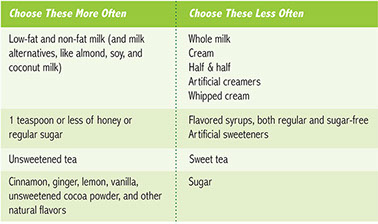
    Coffee and tea drinks made with added ingredients can be a major source of sugar and saturated fat in your diet. The calories can also add up, pushing you over what your body needs for the day and not leaving enough room for nutrient-dense foods. Without anything added, coffee and tea drinks have fewer than 5 calories.

    Example chart of what to choose and not choose.

    If your favorite coffee or tea drink has more add-ins from the column on the right, save this drink for a special treat. Or, start to gradually cut back on how much of these you add to your drink. You can get used to new tastes. You may even like the new version better!

    Different teas can have a lot of natural flavor and sweetness. Experiment with lemon, chai, chamomile, fruit, and herbal teas.

    © American Institute for Preventive Medicine