Tag: HealthyLife® Weigh

  • Identify Disordered Eating

    Healthylife® Weigh

    Part 5

    Sad young women.

    Disordered eating can be hard on your body and your mind. Follow the guidelines in this book to develop a realistic, patient approach to managing weight. Be self-kind, not   self-critical.

    Eating Disorders

    If you are concerned that you may have an eating disorder (e.g., anorexia nervosa, bulimia nervosa, or a binge eating disorder), contact your doctor immediately, as these are serious medical conditions. You can also find more information here:

    National Eating Disorders Association (NEDA)

    www.nationaleatingdisorders.org

    Helpline: 800-931-2237

    National Institute of Mental Health

    www.nimh.nih.gov/health/topics/eating-disorders/index.shtml

    © American Institute for Preventive Medicine

  • Make Your Kitchen A Healthy Eating Zone

    Healthylife® Weigh

    Part 4

    Three generation family eating dinner at home.

    You walk into the kitchen and see a box of cereal sitting out. You fill your cereal bowl and eye the leftover pie next to a bag of chips on the counter. It’s been a long day and you deserve a treat, right? When you are hungry, tired, bored, or stressed, food choices can be influenced by what is around you.

    First, learn about your kitchen. Your kitchen may be a place where you socialize with family and friends. It may be a place where you cook or pack lunches for children. Or, you have to walk through the kitchen to get to other rooms.

    *  How many times do you walk into your kitchen each day? If you aren’t sure, keep track for a day.

    *  List a few reasons you go into your kitchen.

    *  Without opening any doors (pantry, fridge, etc.), what foods can you see?

    *  If you were to select a snack right now, what would you choose? Why did you choose this snack?

    The kitchen can be one of your biggest allies in managing your weight. A kitchen can also be a battle zone that trips up your goals.

    © American Institute for Preventive Medicine

  • Overcome A Plateau

    Healthylife® Weigh

    Part 7

    Woman working out in forrest lifting weights.

    Weight loss can seem like a long, slow journey. Maintenance, when you are no longer trying to lose weight, can seem far away. It is important to remember that you won’t lose weight at the same rate each week. Weight loss can slow down or speed up for many reasons, including illness, stress, and other hormonal changes (like a menstrual cycle).

    *  When you are ill, try your best to get your body the nutrients it needs. Seek a doctor’s care if necessary.

    *  Don’t add stress to stress. Manage the challenge that is causing you stress. Avoid feeling stressed about weight loss efforts on top of this.

    If you have lost 10% of your initial body weight, aim to maintain that weight for at least 6 months. This helps stabilize your metabolism and makes it easier to lose weight in the future, if needed. It also gives you time to strengthen new, healthy habits. If you haven’t reached your 10% goal yet and your weight hasn’t changed for more than a week, you may be at a plateau. This is normal. Use the following strategies to overcome a plateau.

    1. Reduce the Struggle

    Imagine you are driving up a long, steep mountain road in top gear. The car struggles to get there and maybe stops moving altogether. This hill can be your weight loss goal. Expecting a lot of yourself may make it steeper. What worked when you started this journey may need to change.

    Change gears to reduce the struggle.

    *  Adjust your goals and expectations.

    *  Add cues to your environment that remind you to do the healthy behavior or make it easier to do it.

    *  Remove cues from your environment that are causing you to slip into old habits. Make it harder to do the unhealthy habit.

    Try This: Close your eyes and visualize changing gears. Now imagine the car starting to move a little easier. You may have more turns ahead as you wind up the mountain, but you are moving forward.

    2.  Find the Missing Pieces

    Look at the puzzle pieces that you have put together to get to this point. Look at your eating and exercise habits, social support, environmental cues, expectations, thoughts, and coping strategies.

    What pieces are missing? List areas that may need attention. Example: I am buying healthy snacks, but unhealthy options are still available in my pantry.

    Perhaps you skipped over a section because it didn’t seem to apply to you or you felt you knew the information already. Go back. Read this section and do the activities. Just knowing things is only a small part of your success. Do the activities in each section.

    3.  Take Bigger Steps

    Small steps help to build confidence and get you moving in the right direction. Many small steps can eventually get you to your goal. However, it may be time to take bigger steps, especially if the steps you have taken so far are now easy or boring. Success can be motivating when you are proud of the work it took to get there.

    *  Try a new healthy food or way of cooking.

    *  Exercise in a new way. Choose a new activity or add more metabolism-boosting resistance training.

    *  Tell others about what you are doing. Seek support from those who will build you up and hold you accountable.

    *  Address emotions that are affecting your health goals.

    Take a bigger leap. Trust that you have built a foundation that will support this jump!

    List a small step you have taken that now seems easy. How can you take this one step forward?

    4.  Set Process Goals

    Include the process of getting to your outcome as a goal. Deciding to make a change, committing to action, and enjoying foods are all worthy goals!

    *  Outcome Goal: I will exercise every day!

    *  Process Goal: I will commit to being more active each day and finding activities that I truly enjoy.

    *  Practice: Write a goal statement that celebrates the process.

    Detach from Negative Motivation

    A negative experience may have gotten you started – bad news from your doctor, a break-up, a job loss, or a feeling of hitting “rock bottom.” Holding onto these negative feelings may keep you tied to your old self and your old way of thinking and doing things.

    Instead of exercising because you “should” do it or doing it to make someone else happy, do it for your own reasons. Connect the things you are trying to do to your broader goals in life. You may find purpose-driven motivation lasts longer.

    5.  Celebrate Your “Wins”

    What is a “win” for you today? At the end of each day, give yourself credit for something you’ve accomplished. Some days, this may be meeting your basic needs or getting to work on time. It may mean taking care of someone, like an aging parent or child. Also, give yourself credit for repeating a new habit. Life can be challenging. Give yourself credit.

    Find at least one part of your day to celebrate as a success. List one of your “wins” for today.

    6.  Reward Yourself

    Any behavior that is followed by a reward is more likely to be done again. Behaviors that will help you manage your weight need to be repeated in order for them to become habits. Give yourself non-food rewards for meeting your goals. When was the last time you gave yourself a reward?

    Simple Ways to Reward Yourself

    1. Give yourself a pat on the back.

    2. Hug yourself or wrap yourself tightly in a blanket.

    3. Look at yourself in the mirror and say, “Yeah me!” or another affirmation.

    4. Set aside time to do one of your favorite activities.

    5. Reflect on changes in how you feel, including your mood, energy level, and physical comfort.

    6. Buy flowers or a plant.

    7. Buy something new to wear that fits you well.

    8. Buy a new tool or piece of equipment for one of your favorite activities.

    9. Buy something to brighten up your home or office.

    *  List rewards that are meaningful to you.

    *  What do you need to do to earn this reward?

    Rewards and Children

    Avoid rewarding children with eating in response to “good” or “bad” behavior (e.g., if you’re bad, you’re going to bed without dinner). This equates being able to eat freely with “good” behavior and limiting food consumption with “bad.” This can make it hard for children to develop a healthy relationship with eating.

    7.  Do Something Right Now

    What can you do to benefit your health right now? Set a self-care goal for something you can do in the next ten minutes. There is no time to procrastinate. Here are some ideas:

    *  Get up and move. Stretch, go for a short walk, do bodyweight squats, or do jumping jacks.

    *  Get a drink of water.

    *  Eat a healthy snack, if you are hungry.

    *  Write a meal plan for the week or a shopping list.

    *  Search for a local walking trail online. Make a plan to go there soon.

    *  Call a friend or write a card.

    *  Laugh.

    List your own ideas for “Do it Now” activities.

    Pick one and do it right now. Then, reflect: How do you feel?

    Ten minutes may seem like a small part of your bigger goal that covers several days, weeks, and months. Success is built on what you do in shorter amounts of time-or right now. Don’t take the present for granted.

    8.  Build or Modify Support

    It may have been enough to have one buddy to get you started. Connecting to a bigger community of healthy, like-minded people may help you keep going. You may need to go outside your current social network of family and friends to find these people.

    *  Have friends who like to do different things. Perhaps one friend likes to meet you for a morning walk and another friend likes to take a yoga class with you on the weekend.

    *  Start a club within your work place, religious group, or circle of friends. Make sure every gathering includes physical activity. If food is involved, make it the norm to eat at places that serve healthy options.

    *  Join a YMCA or community fitness center to meet other individuals who are also making healthy changes.

    *  Join an online community for weight management. Get advice from others on keeping exercise and healthy eating fresh and interesting.

    *  Follow inspirational fitness leaders and hashtags for daily tips and encouragement on social media sites like Facebook, Instagram, and Twitter.

    *  Communicate how your support needs have changed. The supportive things others said or did in the past may not be what you need now. Let them know.

    Talk positively about your changes to others. Positive energy draws others toward you and makes you feel better about what you are doing.

    How do you need to build or change your social support? Example: Work demands have increased and you have less time to prepare meals. To adjust, split meal planning duties with a co-worker who shares your goals. You’ll bring lunches for Monday and Tuesday, and they’ll bring lunches Wednesday and Thursday.

    9.  Avoid Processed Foods

    There may be parts of the foods you eat that make it harder for your body to run smoothly. Just because you can chew and swallow something does not make it real food! Lifelong weight management is challenging if you eat too many processed foods.

    Highly processed foods are designed to be tasty and addictive. Often, the pleasurable feeling ends when the foods and beverages are swallowed. This can lead to overeating to keep the flavor in your mouth.

    Highly processed foods with lots of artificial ingredients can be harder to digest, slowing down your digestive system. This may cause headaches, sluggishness, stomach aches, constipation, diarrhea and other uncomfortable symptoms.

    Think of processed foods as slow moving “sludge” in your system.

    Choose foods that:

    *  Are not processed (as close to their natural source as possible).

    *  Do not contain added sugars or only contain minimal natural sugars.

    *  Do not contain artificial sweeteners, colors, or dyes.

    *  Do not contain artificial starches, emulsifiers, stabilizers, or other synthetic ingredients.

    *  Do not contain nitrates (often found in processed meats and “smoked” meat products).

    *  Contain flavors that come from the actual source. Avoid foods where the primary flavor is not actually in the food (e.g., fake strawberry bits in a cereal or bacon bits containing only a small amount of meat).

    If you are used to eating these foods often, feeling tired and run down may seem “normal” to you. Choosing more natural, whole foods can open your eyes to a new way of energetic living!

    10.  Going “Free-From”

    Some foods in your diet may be “healthy” on paper, but they are not working well with your body. For example, whole grain bread contains many important nutrients. However, your digestive system may react poorly to gluten, a protein found in wheat.

    There are serious reasons to limit a food or part of a food from your diet.

    Tips for trying a “gluten free” or other “free-from” way of eating:

    *  This is not an easy solution to weight loss. Going “gluten free” or “dairy free” will probably not make it easier for you to lose weight. If your body did not have a problem with these foods before, you may not notice a difference. You also still need to make healthy choices with the foods and portions you DO eat.

    *  Avoid “free-from” junk food. Read food labels and look at the ingredient list, just like you would do for any food. Processed gluten-free foods often add a lot of artificial ingredients and sugars.

    *  Whenever something has been removed from your diet, ask yourself these two important questions:

    1. What nutrients did that food or food group provide? Example: Cutting out dairy eliminates major sources of calcium and vitamin D. Cutting out meat takes away a source of protein, vitamin B12, zinc, iron, and calcium. You’ll need to get these nutrients from other sources.

    2. What other foods can I eat that provide these nutrients? Look for other sources of the nutrients you need. Find other choices within the food groups on MyPlate. Talk to a health coach or dietitian to help you modify your diet. Make sure your diet is meeting your body’s nutritional needs.

    If you need to follow a “free-from” diet for medical reasons, be sure to follow your doctor or dietitian’s instructions. If you are following a “free-from” diet as a way to experiment with what works best for you, do this after you have made the changes covered in this guide. Following a restrictive diet can be hard or unhealthy to maintain over time if you don’t have to do it.

    © American Institute for Preventive Medicine

  • Plan Problem-Solving

    Healthylife® Weigh

    Part 6

    Problem, think, idea, solution diagram.

    Your worries and concerns take up time in your day. Many issues cannot simply be ignored or brushed aside. To avoid letting these thoughts trigger unhealthy eating habits, plan time to address them.

    Steps to Address Your Worries

    1. Write a worry at the top of a piece of paper.

    2. Divide the paper into three columns:

    a. What I can’t do. Recognize what is out of your control.

    b. What I can do. List possible actions that are within your control. Write things you know how to do and that are realistic actions for you to take.

    c. What I will do. Decide which action you are ready to take first. This action may not solve every part of the problem, but is a small step toward a solution. Write when you will do this.

    Mind Dump

    Use this tool when you feel you have too many thoughts to juggle and aren’t sure where to start. Use small pieces of paper or index cards to “mind dump” thoughts that come to mind. Write down concerns, ideas, and things you need to remember. Pull one card and use the steps above to address this worry. Don’t pull another card until you are satisfied with your plan to deal with the first worry.

    © American Institute for Preventive Medicine

  • Scramble Your Daily Behaviors

    Healthylife® Weigh

    Part 4

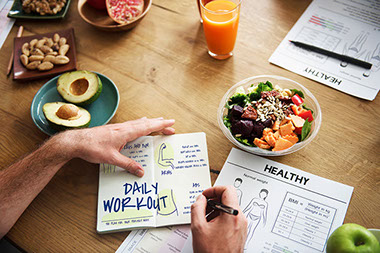
    Person writing in fitness notebook with healthy snacks on table.

    Changing how you go about your day can help get rid of eating cues and prepare you to establish new, healthy habits. Examples:

    *  Change the order of morning events: get up, shower, brush hair, eat breakfast, brush teeth, read paper, walk dog.

    *  Change the order of work events: take off coat, talk with co-workers, organize desk, review appointments or assignments, open email,  make calls.

    *  Alter driving routine: wear gloves, turn on/off radio, raise/lower volume, try listening to a new station, open/close windows, take a new route to work.

    *  Develop new telephone behavior. Stand instead of sit, hold phone with your opposite hand to your opposite ear, talk in a different room, walk as you talk.

    Be realistic.Allow time to establish a new habit. Some new habits are picked up quickly. Others may take several weeks or months of practice.

    Be consistent.Practice your new behaviors every day. This is how your new behavior will become a reliable habit.

    © American Institute for Preventive Medicine

  • Tips For Healthy Celebration

    Healthylife® Weigh

    Part 6

    Thanksgiving dinner and family eating at table.

    Happy times may also be triggers for overeating or making less healthy food choices. Holidays and other special occasions may also make it harder to fit in physical activity.

    Items that trip you up during a celebration:

    *  Drinks: soda, alcoholic beverages

    *  Foods: desserts, large helpings of “comfort foods”

    *  Gifts of candy, cookies, etc.

    *  Too many things to do and less time to prepare healthy meals

    *  Workplace parties and cookie exchanges

    *  More travel or a change of routine

    *  Events centered around large meals, or appetizers

    *  All-you-can-eat buffets on cruise ships or at resorts

    Approaches to Celebration

    There are many ways you can approach a celebration.

    1. Make choices that fit with your healthy eating goals. Choose this option most of the time.

    2. Make mostly healthy choices, but choose small treat foods. Choose small portions of these treats and eat them mindfully.

    3. Eat without restriction. Eat and drink what you would like without feeling guilty for choosing less healthy foods. Choose this option rarely and plan to make healthy choices the next day.

    If you have been making healthy choices for a while, you may notice your body’s negative response to certain unhealthy foods. Foods high in saturated fat seem to sit in your stomach longer and make you feel uncomfortable. Meals low in fiber may leave you constipated. Artificial sugars may give you a headache. Pay attention to this difference. It can help you choose less of these foods in the future.

    © American Institute for Preventive Medicine

  • Avoid Drowsy Driving

    Healthylife® Weigh

    Part 3

    Alert driver.

    Driving while sleepy can severely impair your driving and cause an accident. Studies have linked sleepiness and fatigue to decreases in reaction time, decision-making, and mind and body coordination. All of these factors are very important for safe driving.

    According to estimates from the National Safety Council in 2017, one out of every five deadly traffic crashes is due to drowsy driving.

    Drive when you feel alert. On long drives, plan 15-minute breaks to get out and stretch your legs every 2 hours. Avoid using food to stay alert. Closing your eyes for even a second (called microsleep) can be enough to travel blindly down the road (or off the road). If you drive while you are fatigued, you and anyone around you is at serious risk.

    Signs of Fatigue

    *  You can’t stop yawning.

    *  You have trouble keeping your head up.

    *  Your eyes close for a moment or go out of focus.

    *  You have wandering, disconnected thoughts.

    *  You have no memory of driving the last few miles.

    *  You miss seeing a sign or your exit.

    *  You slow down when you don’t mean to or brake suddenly or too late.

    *  You drift across the road or veer off onto rumble strips.

    What to do:

    *  Pull to the side of the road or go to a rest stop.

    *  Take a 15-20-minute nap. If you can, have 250-300 mg of caffeine (about 2 cups of coffee) before the nap.

    *  Get a non-drowsy person to drive or find some way of getting to your destination without driving yourself.

    *  Drive to a motel or place where you can sleep.

    © American Institute for Preventive Medicine

  • Create Self-Enhancing Feelings

    Healthylife® Weigh

    Part 4

    Man thinking.

    Take responsibility for your thoughts, feelings, and actions. You will feel better about yourself and your life. Blaming others is a natural, child-like reaction. It is more adult-like to figure out the amount of control you have in a given situation and respond to it in a mature way. You may not have control in every situation, but you can choose how to respond to others.

    One reason to become more accountable for your responses is that a “victim” response forms negative, draining feelings. Self-responsibility creates positive energy. With it you can manage every event in a more positive, self-nurturing manner. One way to do this is to look at your language and see if you use “victim” or “accountability” phrases.

    Example “victim” phrase:I can’t lose weight until my family also tries to lose weight.

    Example “accountability” phrase:I can talk with my family about how they can be supportive of my efforts. I can help with family meal planning so I have more control over the foods kept in the house and served during meals.

    Complete the chart on the next page to practice taking responsibility for your thoughts, feelings, and actions.

    © American Institute for Preventive Medicine

  • Feeling Full

    Healthylife® Weigh

    Part 6

    Man feeling full.

    Learn to better evaluate your fullness. It can take twenty minutes to start feeling physically full.

    1. Be satisfied in other ways. Enjoy the taste of food, the people you are with, or the place you are eating.

    2. Express gratitude for your food. This includes who prepared the food (it may be you!) and where it comes from.

    3. Drink a glass of water throughout the meal. This will help with digestion and feeling full.

    4. Make half your plate vegetables. It will take longer to eat these nutrient-dense foods.

    5. Keep consistent “food rules” like sitting at the table and drinking a glass of water with each meal or snack. This can be a built in “speed bump” for overeating. If you don’t want to sit at the table or drink water, you may not be physically hungry and emotional hunger is your trigger.

    6. When tracking your intake, also track your hunger-fullness using the scale to the right. Try to eat in the gray area (range 4-7). Avoid being too hungry or too full.

    The Hunger-Fullness Scale

    0: Empty

    1: Ravenous

    2: Over-hungry

    3: Hunger pangs

    4: Hunger awakens

    5: Neutral

    6: Just satisfied

    7: Completely satisfied

    8: Full

    9: Stuffed

    10: Sick

    7. Slow down. If you can, try to increase the time it takes you to finish your meal by 50%. If you currently finish dinner in 10 minutes, set a timer to stretch the meal out by 5 minutes-or longer!

    © American Institute for Preventive Medicine

  • Identify Emotions That Prompt You To Eat

    Healthylife® Weigh

    Part 6

    Top view of woman on the sofa eating a healthy salad.

    Indicate how often the following scenarios apply to you.

    *  When I’m angry or upset, I think, “I don’t care what I eat or how much I eat.”

    *  When I see something tasty, I eat it but regret it later. I find myself saying, “Why did I just do that? I didn’t really want it.”

    *  When I have a craving for something, it is very difficult for me not to satisfy it right away. I may feel frustrated until I have it.

    *  When I’m stressed, I tell myself, “I can take a break from eating healthy so I can focus on the stressful things. I will get back on track later.”

    *  When I am eating with my friends or family, I can’t seem to stick to my healthy plans.

    *  Once I start eating something I really like, I have a hard time stopping, even when I want to.

    *  I find myself saying, “Oh, what the heck, I blew it anyway. I might as well eat whatever I want.”

    © American Institute for Preventive Medicine