Tag: hearing

  • Listen To Your Ears

    SELF-CARE CORNER

    Workers with safety gear protecting head, eyes and ears.

    It’s easy to take hearing for granted. But without proper care of your ears, you could end up with hearing loss or ear problems.

    Worried about wax

    Your body makes ear wax to protect your ears. Wax keeps dust and other particles from getting inside.

    Only clean the outside of your ears with a tissue, washcloth or cotton swab. Never stick anything, including a cotton swab, in your ear. This will push wax farther down into the ear and can create a harmful blockage.

    If you feel that there’s a lot of wax in the ear, you can safely try to soften it with a drop of mineral oil or glycerin. Your doctor can also remove ear wax blockages without damaging your ear.

    Saying no to noise

    One of the most common reasons people lose their hearing is exposure to loud noises. This can happen very quickly after a loud sound like an explosion. Or, it can happen over time if a person is exposed to loud sounds for months or years.

    You can help prevent noise-induced hearing loss with one simple tool: ear plugs. Wear them when going to a loud concert, watching fireworks or attending loud events. Wear them when mowing the lawn or using loud power equipment at home.

    If you have a job where you are exposed to noise, make sure you are using the right hearing protection. You may need something more powerful than ear plugs for certain jobs. Talk about this with your employer.

    Use headphones with care

    The World Health Organization says people should limit how much they use headphones. Don’t use them more than one hour a day. Keep the volume as low as possible, but no louder than 60 percent.

    Noise-cancelling headphones help you keep the volume low because they block out sounds around you. But, you should not use these when driving, cycling or walking because you won’t be able to hear possible dangers nearby.

    Talk to your doctor about your hearing health. Together, you can decide when you may need a hearing test.

    Sources: American Academy of Family Physicians, National Institute on Deafness and Other Communication Disorders

    © American Institute for Preventive Medicine
  • Hearing Loss

    Ear, Nose & Throat Conditions

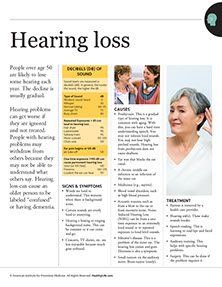
    People over age 50 are likely to lose some hearing each year. The decline is usually gradual. About 30% of adults age 65 through 74 and about 50% of those age 85 and older have hearing problems.

    Hearing problems can get worse if they are ignored and not treated. People with hearing problems may withdraw from others because they may not be able to understand what others say. Hearing loss can cause an older person to be labeled “confused” or “senile.”

    Signs & Symptoms

    *  Words are hard to understand. This worsens when there is background noise.

    *  Certain sounds are overly loud or annoying.

    *  Hearing a hissing or ringing background noise. This can be constant or it can come and go.

    *  Concerts, TV shows, etc. are less enjoyable because much goes unheard.

    Causes

    Presbycusis (prez-bee-KU-sis). This is a gradual type of hearing loss. It is common with aging. With this, you can have a hard time understanding speech. You may not tolerate loud sounds. You may not hear high pitched sounds. Hearing loss from presbycusis does not cause deafness.

    *  Ear wax that blocks the ear canal.

    *  A chronic middle ear infection or an infection of the inner ear.

    *  Medicines (e.g., aspirin).

    *  Blood vessel disorders, such as high blood pressure.

    *  Acoustic trauma, such as from a blow to the ear or from excessive noise. Noise-Induced Hearing Loss (NIHL) can be from a one-time exposure to an extremely loud sound or to repeated exposure to loud level sounds.

    *  Ménière’s disease. This is a problem of the inner ear. The hearing loss comes and goes. Dizziness is also a symptom.

    *  Small tumors on the auditory nerve. Brain tumor (rarely).

    Treatment

    *  Earwax is removed by a health care provider.

    *  Hearing aid(s). These make sounds louder.

    *  Speech reading. This is learning to read lips and facial expressions.

    *  Auditory training. This helps with specific hearing problems.

    *  Surgery. This can be done if the problem requires it.

    Questions to Ask

    Self-Care / Prevention

    For Gradual, Age-Related Hearing Loss

    *  Ask people to speak clearly, distinctly, and in a normal tone.

    *  Look at people when they are talking to you. Watch their expressions.

    *  Try to limit background noise when speaking with someone.

    *  In a church or theater, sit in the 3rd or 4th row with people sitting around you.

    *  Install a flasher or amplifier on your phone, door chime, and alarm clock.

    To Hear Sounds Better

    *  Use a hearing aid. There are many kinds. Examples are ones worn:

    – In-the-Ear (ITE).

    – Behind-the-Ear (BTE).

    – In-the-Canal (ITC).

    *  To find the hearing aid that works best for you, see an audiologist. Ask him or her about a trial period with different hearing aids to find one you are comfortable with.

    *  Use devices and listening systems that help you hear better when you use your telephone, mobile phone, TV, stereo, etc.

    To Clear Earwax

    Use only if the eardrum is not ruptured. Check with your doctor if you are not sure.

    *  Lie on your side. Using a syringe or medicine dropper, carefully squeeze a few drops of lukewarm water into your ear (or have someone else do this). Let the water remain there for 10 to 15 minutes and then shake it out. Now, squeeze a few drops of hydrogen peroxide, mineral oil, or an over-the-counter cleaner, such as Debrox, into the ear. Let the excess fluid flow out of the ear.

    *  After several minutes, put warm water in the ear again. Let it stay there for 10 to 15 minutes. Tilt the head to allow it to drain out of the ear.

    Repeat this entire procedure again in 3 hours if the earwax has not cleared.

    Resources

    American Speech-Language Hearing Association

    800.638.8255

    www.asha.org

    Better Hearing Institute

    800.EAR.WELL (327.9355)

    www.betterhearing.org

    Healthier at Home book by the American Institute for Preventive Medicine. www.HealthyLife.com. All rights reserved.

    © American Institute for Preventive Medicine

  • Help For Hearing Loss

    Mature Health: Over Age 50

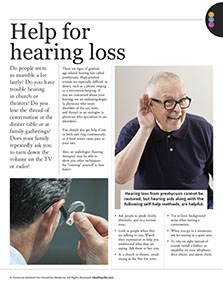
    Image of mature man with hand up to his ear trying to hear.

    Do people seem to mumble a lot lately? Do you have trouble hearing in church or theaters? Do you lose the thread of conversation at the dinner table or at family gatherings? Does your family repeatedly ask you to turn down the volume on the TV or radio?

    These are signs of gradual, age-related hearing loss called presbycusis. High-pitched sounds are especially difficult to discern. Another way to detect this problem is to hold a watch to your ear. If you can’t hear it ticking, see an otolaryngologist (a physician who treats disorders of the ear, nose, and throat) or an otologist (a physician who specializes in ear disorders).

    You should also get help if one or both ears ring continuously, or if loud noises cause pain in your ears.

    Hearing loss from presbycusis cannot be restored, but hearing aids. along with the following self-help methods, are helpful.

    *  Ask people to speak clearly, distinctly, and in a normal tone.

    *  Look at people when they are talking to you. Watch their expressions to help you understand what they are saying. Ask them to face you.

    *  Try to limit background noise when having a conversation.

    *  In a church or theater, sit near, but not in the front row. Sit in the third or fourth row with people sitting around you.

    *  To rely on sight instead of sound, install a buzzer, flasher, or amplifier on your telephone, door chime, and alarm clock.

    Also, an audiologist (hearing therapist) may be able to show you other techniques for “training” yourself to hear better.

    A Year of Health Hints book by the American Institute for Preventive Medicine. www.HealthyLife.com. All rights reserved.

    © American Institute for Preventive Medicine
  • Like It Loud? Your Ears Don’T

    WELL-BEING

    Image of man listening to music with headphones.

    What do a lawn mower, a motorcycle, and a music player have in common? They can all cause permanent hearing loss.

    Many people assume that only extremely loud sounds, such as gunshots, can damage the ears. But any loud noise, such as power tools, headphones turned up too loud, lawn equipment, or a concert, can lead to hearing loss. This is known as noise-induced hearing loss.

    Noise-induced hearing loss often happens gradually, so you don’t realize the damage that’s being done over time. For instance, being around loud machinery every day or listening to loud music in earphones regularly can cause hearing damage that adds up. The National Institutes of Health states that 26 million Americans between the ages of 20 and 69 have hearing loss caused by excessive noise.

    The Centers for Disease Control and Prevention (CDC) says anything over 85 decibels can damage hearing. The louder it is, the faster it can cause hearing loss if used regularly and/or for long periods. Normal conversation is 60 decibels, and a hair dryer is around 90.

    Save your hearing

    The best way to prevent noise-induced hearing loss is to avoid loud noises whenever you can. But, this may not be possible if your job requires you to be around certain equipment. If you can’t avoid it, always wear proper hearing protection. This includes earplugs and/or ear muffs that have a noise reduction rating (NRR) listed.

    If you notice you have trouble hearing, talk to your doctor.

    © American Institute for Preventive Medicine

  • Ringing In The Ears

    SELF-CARE CORNER

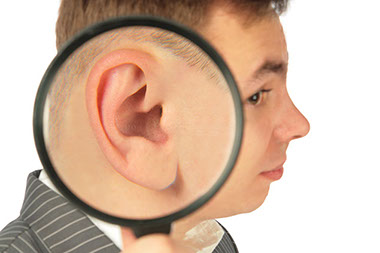
    Image of man holding a magnifying glass next to his ear.

    Developing tinnitus or ringing in the ears can be annoying at best. At worse, the condition can cause anxiety, depression, insomnia, and other serious medical issues. Tinnitus is often described as buzzing, ringing, hissing, humming, roaring, or whistling that someone hears. Imagine hearing something that seems to come from inside your head. More than 50 million people in the United States have the condition, according to the American Tinnitus Association.

    If you struggle with tinnitus, you may find help with these tips from Neuromonics:

    *Be good to yourself.Tinnitus can affect many areas of life.

    *Educate yourself.Tinnitus has several causes and affects each person differently. The more a tinnitus sufferer understands, the greater the chances of making the tinnitus less bothersome.

    *Educate others.Family members, friends, coworkers, and associates can benefit from understanding tinnitus and its effects. They can be more supportive if they understand the conditions that are difficult for a tinnitus sufferer.

    *Seek out support.A few individuals who understand the daily trials of tinnitus can be invaluable. Consider a formal support group-in-person or online-to find out about coping strategies.

    *Contact the ATA’s Support Networkatwww.ata.org/support.

    *Obtain counseling.For some people, a licensed therapist or counselor can help with techniques to make tinnitus symptoms less bothersome and with effects of tinnitus such as anxiety and depression.

    © American Institute for Preventive Medicine

  • Too Loud

    SELF-CARE CORNER

    Image of workers wearing proper safety glasses and headphones while working on machinery.

    Noise-induced hearing loss is the only type of hearing loss you can prevent. If you understand the hazards of noise and how to practice good hearing health, you can protect your hearing for life. Here’s how:

    *  Know which noises can cause damage (those at or above 85 decibels, such as a motorcycle).

    *  If you can’t reduce the noise or protect yourself from it, move away from the source.

    *  Wear earplugs or other protective devices when involved in a loud activity, even Zumba class (activity-specific earplugs and earmuffs are available at hardware and sporting goods stores).

    *  Be alert to hazardous noises in the environment.

    *  Protect the ears of children who are too young to protect their own.

    *  Have your hearing tested if you think you might have hearing loss.

    About sound

    Sound is measured in units called decibels. Sounds of less than 75 decibels, even after long exposure, are unlikely to cause hearing loss. But long or repeated exposure to sounds at or above 85 decibels can cause hearing loss. The louder the sound, the shorter the amount of time it takes for hearing loss to happen.

    © American Institute for Preventive Medicine