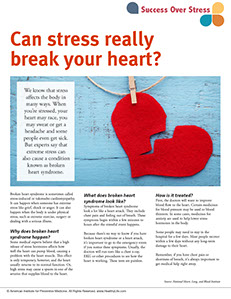
Tag: heart

  • Wine Confusion: Healthy Or Not?

    MEDICAL NEWS

    Image of a wine bottle with 2 glasses of wine and grapes.

    Wine has been making the headlines in recent months as a “healthy” choice. Some studies suggest the compounds and antioxidants in wine can reduce your risk of heart disease, cancer, and more.

    This can be confusing if you’ve been told that alcohol isn’t good for you. Should you drink wine to get healthier, or skip it?

    There is no perfect answer for everyone. It’s important to note that these studies are promising, but they’re not enough to say that wine is a healthy choice. Many of these studies were done in labs, on mice, or were done with supplements instead of real wine. And for some, the possible benefits of wine wouldn’t be worth the risk. Wine is also high in calories and sugar. This can add to obesity and affect blood sugar, especially in diabetics. In addition, wine and alcohol can interact with certain medicines.

    Many people can enjoy alcohol in  small amounts without problems. But if you have a history of alcoholism or your doctor has told you not to drink, you should not drink wine or any alcoholic beverage.

    The Centers for Disease Control and Prevention (CDC) says that drinking too much alcohol, even wine, can harm your health. So if you decide to drink, be sure you do it in moderation.

    So what is “moderation”? According to the Dietary Guidelines for Americans, moderation is up to one drink per day for women and up to two drinks per day for men-and only by adults of legal drinking age.

    The bottom line:

    If you already have a drink once in a while, switching to red wine may be healthier than other choices such as beer or spirits. But the health benefits of red wine are not fully understood. So, experts do not recommend it as a daily drink for everyone.

    © American Institute for Preventive Medicine

  • Chest Pain & Heart Disease

    Women’s Health

    Women making heart shape with hands and wearing a wear dress.

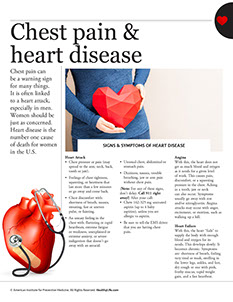
    Chest pain can be a warning sign for many things. It is often linked to a heart attack, especially in men. Women should be just as concerned. Heart disease is the number one cause of death for women in the U.S.

    Signs & Symptoms

    Angina

    With this, the heart does not get as much blood and oxygen as it needs for a given level of work. This causes pain, discomfort, or a squeezing pressure in the chest. Aching in a tooth, jaw or neck can also occur. Symptoms usually go away with rest and/or nitroglycerin. Angina attacks may occur with anger, excitement, or exertion, such as walking up a hill.

    Heart Attack

    *  Chest pressure or pain (may spread to the arm, neck, back, tooth or jaw).

    *  Feelings of chest tightness, squeezing, or heaviness that last more than a few minutes or go away and come back.

    *  Chest discomfort with: shortness of breath, nausea, sweating, fast or uneven pulse, or fainting.

    *  An uneasy feeling in the chest with: fluttering or rapid heartbeats, extreme fatigue or weakness, unexplained or extreme anxiety, or severe indigestion that doesn’t go away with an antacid.

    *  Unusual chest, abdominal or stomach pain.

    *  Dizziness, nausea, trouble breathing, jaw or arm pain without chest pain.

    {Note: For any of these signs, don’t delay. Call 911 right away!} After your call:

    *  Chew 162-325 mg uncoated aspirin (up to 4 baby aspirins), unless you are allergic to aspirin.

    *  Be sure to tell the EMS driver that you are having chest pain.

    Heart Failure

    With this, the heart “fails” to supply the body with enough blood and oxygen for its needs. This develops slowly. It becomes chronic. Symptoms are: shortness of breath, feeling very tired or weak, swelling in the lower legs, ankles, and feet, dry cough or one with pink, frothy mucus, rapid weight gain, and a fast heartbeat.

    Causes

    Heart disease is caused by atherosclerosis. This is the buildup of plaque in the inner walls of the arteries. The plaque is made up of blood, platelets, cholesterol, fibrous tissue, and sometimes, calcium. Blood flow to the heart is slowed or blocked. Besides heart disease, chest pain can also be a symptom of:

    *  Mitral valve prolapse (MVP), a heart-valve problem.

    *  Bronchitis, pneumonia, lung injuries, etc.

    *  Heartburn or a hiatal hernia.

    *  Shingles.

    *  A pulled muscle or even swallowing too much air.

    Treatment

    Heart disease needs medical treatment. It is not always easy to know whether or not to seek medical care for chest pain. When in doubt, check it out. Prompt medical treatment for a heart attack or severe lung injury could be life-saving.

    Questions to Ask

    Self-Care / Prevention

    Reduce the Risk of Heart Disease

    *  Have regular medical checkups. Get your blood pressure and blood cholesterol checked as often as advised by your doctor.

    *  Don’t smoke or use tobacco. If you do, quit.

    *  Be at a healthy weight.

    *  Take all medications, as prescribed.

    *  If you have diabetes, high blood pressure or high cholesterol, follow your treatment plan.

    *  Follow a diet low in saturated fats, trans fats, and cholesterol. Limit sodium to 1500 mg to 2,400 mg per day. Eat plenty of vegetables and fruit, fiber-rich whole grains, fatty fish, nuts, seeds, beans, lentils, and olive or canola oil. Limit processed meats and sugary foods and beverages.

    *  Do regular exercise.

    *  Avoid or limit alcohol to one drink per day.

    *  Manage stress. Practice relaxation techniques.

    Pulled Muscle or Minor Injury to the Rib Cage

    *  Do not strain the muscle or ribs while pain is felt.

    *  Rest.

    *  Take an over-the-counter medicine for pain.

    Heartburn or a Diagnosed Hiatal Hernia

    *  Lose weight, if you are overweight.

    *  Eat 5 to 6 small meals a day and chew thoroughly.

    *  Avoid tobacco and alcohol. Avoid “trigger” foods, such as caffeine, spicy foods, citrus juices, chocolate, and  carbonated drinks.

    *  Don’t bend over or lie down after eating.

    *  For heartburn, take antacids after meals and before going to sleep.

    *  Don’t have food 2 hours before bedtime.

    *  Do not wear tight clothes, tight belts or girdles.

    *  Sleep on a bed with the head raised about 6 inches.

    Anxiety and Hyperventilating

    *  Talk about your anxiety with someone you trust.

    *  When you hyperventilate: Open up a small paper bag. Loosely cover your nose and mouth with it. Breathe slowly into the bag. Rebreathe the air in the bag. Do this about 10 times. Set the bag aside. Breathe normally for a couple of minutes.

    *  Try to breathe slowly. Focus on taking one breath every 5 seconds.

    Inflammation of the Cartilage Where the Ribs Attach to the Breastbone (Costochondritis)

    *  Take aspirin, ibuprofen, or naproxen sodium for pain.

    Mitral Valve Prolapse (MVP)

    *  Follow your doctor’s guidelines for self-care.

    *  Eat healthy foods. Limit caffeine and alcohol.  Don’t smoke.

    *  After checking with your doctor, exercise regularly to improve cardiovascular fitness.

    *  Deal with and control stress and anxiety.

    Resources

    American Heart Association & Go Red For Women

    888.MY.HEART (694.3278)

    www.heart.org

    www.GoRedForWomen.org

    National Heart, Lung, and Blood Institute (NHLBI)

    www.nhlbi.nih.gov

    Women's Self-Care book by the American Institute for Preventive Medicine. www.HealthyLife.com. All rights reserved.

    © American Institute for Preventive Medicine

  • Chest Pain

    Heart & Circulation Problems

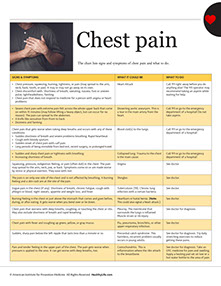
    Heart Attack

    Signs & Symptoms

    *  Chest pressure, squeezing, burning, tightness, or pain (may spread to the arm, neck, back, tooth, or jaw).

    *  Chest discomfort with: Shortness of breath; sweating; nausea; fast or uneven pulse; lightheadedness; fainting.

    *  Chest pain that does not respond to medicine for a person with angina or heart problems.

    What To Do

    Call 9-1-1!

    Dissecting Aortic Aneurysm

    This is a tear in the main artery from the heart.

    Signs & Symptoms

    *  Severe chest pain with extreme pain felt across the upper back (not just on one side) that came on within 15 minutes without an injury, back strain, etc. The pain can spread to the abdomen.

    *  A knife-like sensation from front to back.

    *  Dizziness and fainting.

    What To Do

    Call 9-1-1 or go to the emergency department of a hospital! Do not take aspirin.

    Blood clot(s) to the lungs

    Signs & Symptoms

    Chest pain that gets worse when taking deep breaths and occurs with any of these conditions:

    *  Sudden shortness of breath and severe problems breathing.

    *  Rapid heartbeat.

    *  Cough with bloody sputum.

    *  Sudden onset of chest pain with calf pain.

    *  Long periods of being immobile from bed rest, recent surgery, or prolonged travel.

    What To Do

    Call 9-1-1 or go to the emergency department of a hospital!

    Collapsed Lung

    Trauma to the chest is the main cause.

    Signs & Symptoms

    *  Sudden and sharp chest pain or tightness with breathing.

    *  Increasing shortness of breath.

    What To Do

    Call 9-1-1 or go to the emergency department of a hospital!

    Angina

    Signs & Symptoms

    Squeezing, pressure, indigestion feeling, or pain (often dull) in the chest. The pain may spread to the arm, neck, jaw, or back. Symptoms come on or are made worse by stress or physical exertion. They ease with rest.

    What To Do

    SeeAngina.

    Shingles

    Signs & Symptoms

    The pain is on only one side of the chest and is not affected by breathing. A burning feeling and a skin rash are at the site of the pain.

    What To Do

    SeeShingles.

    Tuberculosis (TB)

    Chronic lung infection with a certain bacteria.

    Signs & Symptoms

    Vague pain in the chest (if any). Shortness of breath; chronic fatigue; cough with phlegm or blood; night sweats; appetite and weight loss; and fever.

    What To Do

    See doctor.

    Heartburn or Hiatal Hernia

    {Note: This could also signal a heart attack.}

    Signs & Symptoms

    Burning feeling in the chest or just above the stomach that comes and goes before, during, or after eating. It gets worse when you bend over or lie down.

    What To Do

    SeeHeart Attack,Heartburn & Indigestion,Hiatal Hernia, andPeptic Ulcers

    Pleurisy

    The membrane that surrounds the lungs is inflamed. Muscle strain or rib injury.

    Signs & Symptoms

    Chest pain that worsens with deep breaths, coughing, or touching the chest or ribs.

    What To Do

    See doctor for diagnosis.

    Flu, Pneumonia, Bronchitis, or Other Upper Respiratory Infection

    Signs & Symptoms

    Chest pain with fever and coughing up green, yellow, or gray mucus.

    What To Do

    See doctor.

    Precordial Catch Syndrome

    This harmless, recurrent problem usually occurs in young adults.

    Signs & Symptoms

    Sudden, sharp pain below the left nipple that lasts less than a minute or so.

    What To Do

    See doctor for diagnosis. Try daily stretching exercises to reduce getting these pains.

    Costochondritis

    This is inflammation where the ribs attach to the breastbone.

    Signs & Symptoms

    Pain and tender feeling in the upper part of the chest. The pain gets worse when pressure is applied to the area. It can get worse with deep breaths, too.

    What To Do

    See doctor for diagnosis. Take an OTC medicine for pain and swelling. Apply a heating pad set on low or a hot water bottle to the area of pain.

    Healthier at Home book by the American Institute for Preventive Medicine. www.HealthyLife.com. All rights reserved.

    © American Institute for Preventive Medicine

  • Cholesterol Health

    Heart & Circulation Problems

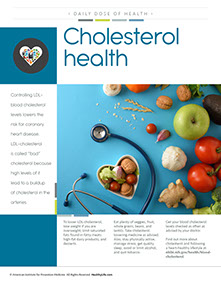
    Heart shape plate filled with walnuts, tomatoes, apple, garlic, etc.

    Controlling LDL-blood cholesterol levels lowers the risk for coronary heart disease. LDL-cholesterol is called “bad” cholesterol because high levels of it lead to a buildup of cholesterol in the arteries.

    To lower LDL-cholesterol, lose weight if you are overweight; limit saturated fats found in fatty meats high-fat dairy products, and desserts.

    Eat plenty of veggies, fruit, whole grains, beans, and lentils. Take cholesterol lowering medicine as advised. Also, stay physically active, manage stress, get quality sleep, avoid or limit alcohol, and quit tobacco.

    Get your blood cholesterol levels checked as often as advised by your doctor.

    Find out more about cholesterol and following a heart-healthy lifestyle atnhlbi.nih.gov/health/blood-cholesterol.

    Health at Home Lifetime book by the American Institute for Preventive Medicine. www.HealthyLife.com. All rights reserved.

    © American Institute for Preventive Medicine

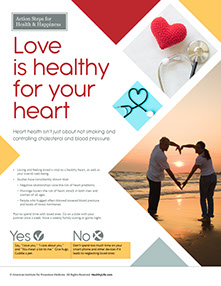
  • Love Is Healthy For Your Heart

    Heart & Circulation Problems

    Couple on beach making heart shape with their arms.

    Heart health isn’t just about not smoking and controlling cholesterol and blood pressure.

    *  Loving and feeling loved is vital to a healthy heart, as well as your overall well-being.

    *  Studies have consistently shown that:

    – Negative relationships raise the risk of heart problems.

    – Marriage lowers the risk of heart attack in both men and women of all ages.

    – People who hugged often showed lowered blood pressure and levels of stress hormones.

    Plan to spend time with loved ones. Go on a date with your partner once a week. Have a weekly family outing or game night.

    Say, “I love you,” “I care about you,” and “You mean a lot to me.” Give hugs. Cuddle a pet.

    Don’t spend too much time on your smart phone and other devices if it leads to neglecting loved ones.

    Health at Home Lifetime book by the American Institute for Preventive Medicine. www.HealthyLife.com. All rights reserved.

    © American Institute for Preventive Medicine

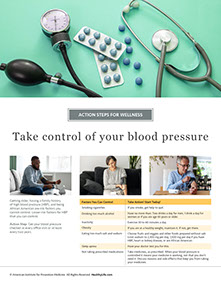
  • Take Control Of Your Blood Pressure

    General Health Conditions

    Part of a blood pressure cuff and medications.

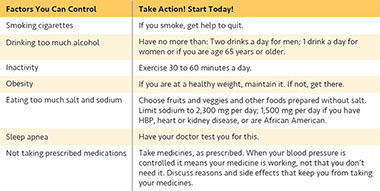
    Getting older, having a family history of high blood pressure (HBP), and being African American are risk factors you cannot control. Lower risk factors for HBP that you can control.

    Action Step:Get your blood pressure checked at every office visit or at least every two years.

    Health at Home Lifetime book by the American Institute for Preventive Medicine. www.HealthyLife.com. All rights reserved.

    © American Institute for Preventive Medicine

  • Cardio Training

    Healthylife® Weigh

    Part 5

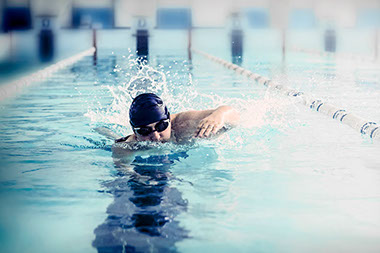
    Man swimming.

    Short for cardiovascular training, “cardio” helps strengthen your heart and other muscles. Cardio also causes the brain to release natural substances, called endorphins, that give you a natural “high.” Aerobic exercise also promotes brain health and challenges your mind.

    Cardio training uses large movements that involve multiple muscle groups, such as your legs, buttocks, and abdominals, all at once. Popular aerobic activities are brisk walking, running, cycling, swimming, and low-impact aerobic dancing.

    Low-Intensity, Steady-State (LISS) Cardio

    Do this type of cardio at a low-to-moderate intensity level. With LISS cardio, you should be breathing at a rate that still allows you to be able to talk to someone. Some examples are walking around your neighborhood or riding a bike at a moderate pace. This type of cardio is most helpful when maintained for 30-45 minutes. Work up to this length of time.

    Group Exercise Classes (e.g., Zumba®, step, kick-boxing, spin)

    *  Find a class through your local community center, YMCA, or another fitness center. Many classes are offered in the mornings and evenings and on weekends to accommodate busy work schedules.

    *  Find an instructor who teaches in a style and tempo you feel comfortable with.

    *  For your first class, arrive early and let the instructor know it is your first time. They may help you set up your equipment or introduce you to someone else in the class who can help you.

    *  High-impact aerobics can strain the knees, hips, and ankles. Step aerobics is lower-impact but should still be avoided by anyone with knee problems.

    *  Modify exercises to a level that you can do comfortably. Ask the instructor for advice.

    Walking

    *  Find a safe place to walk. Your neighborhood, a large shopping mall, or local park may offer safe options. Many fitness centers also have indoor walking tracks or treadmills.

    *  Hold your head up and keep your back straight.

    *  Bend your elbows as you swing your arms.

    *  Take long, easy strides.

    Swimming

    *  Swim in a pool or lake supervised by a lifeguard. If the area is unsupervised, do not swim alone.

    *  Take lessons to learn to swim safely and to improve your technique.

    *  Rest frequently and drink water. It can be harder to notice that you are sweating in the pool and becoming dehydrated.

    *  Wear goggles to protect your eyes.

    *  Wear a swim cap if you have long hair. This will help keep hair out of your face and reduce drag.

    *  Rinse off after swimming and use lotion to keep your skin from drying out.

    High-Intensity Interval Training (HIIT)

    LISS is a good place to start with cardio training. Within a few weeks, start to incorporate HIIT training as well. This type of cardio is much more effective at boosting your metabolism and helping with fat loss.

    To do HIIT, alternate between longer periods of low-intensity exercise and shorter bursts of high-intensity exercise. The high-intensity parts should be short, such a walking as fast as you can for 30 seconds, to get your heart rate up. You should feel like you are working at 90% of your maximum effort. Immediately switch to low-intensity exercise, like walking at a medium pace, for a minute or two to bring your heart rate down. Repeat this pattern several times. Work up to 15 to 20 minutes of HIIT. You can also do intervals of 30 seconds of high-intensity exercise and 30 seconds of low-intensity exercise.

    HIIT revs up your metabolic furnace and you can burn a lot of calories in a short period of time. This may be more interesting and enjoyable than exercising at the same rate for your entire workout.

    You can use the same types of exercises that you enjoy for LISS (like running or biking). Or, you can use other full-body exercises, such as jumping jacks and push-ups. Search “HIIT ideas” online or download an app that provides workouts on a timer.

    Plan a HIIT Workout with Popsicle Sticks

    1. Get at least a dozen popsicle sticks.

    2. Write one short exercise on each popsicle stick. Write exercises you know how to do and enjoy. Ideas:

    – Jumping jacks – Push-ups

    – Lunges – Bicep curls

    – Squats – Side leg lifts

    – Front leg lifts – Mountain climbers

    – Bicycle kicks  – Tricep dips

    – Reverse lunges – Jumping rope (or pretending to)

    3. Put the sticks in a cup or a jar.

    4. Pull out 4 sticks. You will be doing these activities after a short warm up.

    5. Warm up for 5 minutes by briskly walking or doing jumping jacks. Notice that your heart rate is higher.

    6. Set a timer for 15 minutes.

    7. Do the 1st activity as many times as you can in one minute.

    8. Walk for one minute.

    9. Do the 2nd activity as many times as you can for one minute.

    10. Walk for one minute.

    11. Do the 3rd activity as many times as you can for one minute.

    12. Walk for one minute.

    13. Do the 4th activity as many times as you can for one minute.

    14. Walk for one minute.

    15. Repeat steps 7 through 14.

    Ideas Using Your Popsicle Sticks

    Keep your jar of exercise ideas out where you can see it. Pull a stick:

    *  When a commercial break comes on TV or the radio.

    *  In the morning after you wake up.

    *  While studying or reading and you need a break.

    *  When you feel anxious or overwhelmed.

    Do the activity on the stick for one minute. Or, set a goal to do a certain number of that exercise. For example, 25 jumping jacks. Keep your popsicle sticks fresh! Add new ideas and things you like to do. Remove sticks that you dread pulling.

    © American Institute for Preventive Medicine

  • 5 Numbers You Need To Know By Heart

    SELF-CARE CORNER

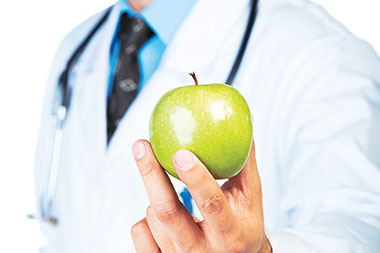
    Close-up image of doctor's hand holding a green apple.

    Pass codes, phone numbers, social security numbers, clothing sizes and addresses. We all have a lot of numbers in our heads, but heart experts at The Ohio State University Wexner Medical Center say there are 5 more numbers you need to know. These are the numbers your doctor will use to assess your risk for getting heart disease.

    1.Blood pressure.This is the force of blood against the walls of the arteries. It’s measured as two numbers-the systolic pressure, as the heart beats, over the diastolic pressure, as the heart relaxes between beats. A normal blood pressure is under 120/80. Talk to your doctor if it is higher than that. Simple lifestyle changes can help you lower your blood pressure and potentially avoid taking medication.

    2.BMI.This measures your weight for your body surface area. It is used as a reliable indicator of body fatness for most people. Use an online calculator to assess your risk. Search for “BMI” atwww.nhlbi.nih.gov.

    3.Waist circumference.Fat that is carried around the abdomen increases the risk of heart disease and type 2 diabetes. Measure your waist at the belly button, not where your clothing waistband sits. Women should be less than 35 inches and men should be less than 40 inches at the waist.

    4.Cholesterol.While the body makes all of the cholesterol it needs, it is also found in animal sources of food. High cholesterol can lead to heart disease and build-up of plaque in the arteries. Know your total cholesterol number and your low-density lipoprotein, or LDL, number. That’s the bad cholesterol that can cause problems. A healthy cholesterol number is below 200. A healthy LDL number is below 130, 100, or 70 depending on your heart disease risk.

    5.Blood sugar.This reading tells doctors how much glucose is in the blood. High levels of blood glucose cause diabetes, which increases the risk for cardiovascular disease. A healthy fasting blood sugar number is under 100 after not eating for 8 hours.

    © American Institute for Preventive Medicine

  • Cold Hearts (Why Shoveling Snow Is Extra Dangerous)

    WELL-BEING

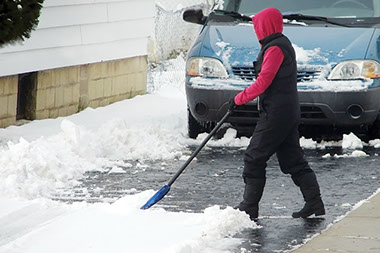
    Image of person shoveling snow from the driveway.

    While you may be used to battling frigid temperatures and the inevitable snowstorms that arrive every winter, are you aware of the dangers these pose to your heart?

    “When the temperature outside drops, our blood vessels narrow to prevent our bodies from losing heat. This is a natural response that can also put people with heart conditions and those involved in strenuous exercise at greater risk of having a heart attack,” says Dr. Holly Andersen of the Perelman Heart Institute at NewYork-Presbyterian Hospital/Weill Cornell Medical Center.

    Shoveling snow is one of the most strenuous and dangerous winter exercise activities. It can raise blood pressure, and coupled with the effects of colder temperatures, shoveling can increase heart attack risk drastically. Take these precautions:

    *Warm up.Warm up with stretching and light activity before shoveling, exercising or beginning more strenuous physical activities.

    *Bundle up.When going out to shovel, always wear a scarf over your mouth and nose to warm the air before you breathe in, and dress in layers. Layering clothes underneath a windproof and waterproof outer shell helps maintain body heat.

    *Push the shovel.It is less strenuous to push the snow rather than lifting it, and this reduces the risk of overexerting yourself.

    *Take breaks.You should take frequent breaks while shoveling to give your muscles, especially your heart muscle, a chance to relax. You may also consider sharing the work with a friend to make the workload lighter and ensure that you are not alone in the event of an emergency.

    *Consult a doctor.If you are over the age of 50, overweight, out of shape or have suffered a heart attack, you should consult a doctor before shoveling snow or starting any exercise routine.

    © American Institute for Preventive Medicine