Tag: helmet

  • Bike Safety

    BE FIT

    Bike up against a yellow wall.

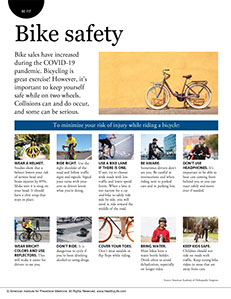
    Bike sales have increased during the COVID-19 pandemic. Bicycling is great exercise! However, it’s important to keep yourself safe while on two wheels. Collisions can and do occur, and some can be serious.

    To minimize your risk of injury while riding a bicycle:

    *Wear a helmet.Studies show that a helmet lowers your risk of serious head and brain injuries by 85%. Make sure it is snug on your head. It should have a chin strap that stays in place.

    *Ride right.Use the right shoulder of the road and follow traffic signs and signals. Signal your turns with your arm so drivers know what you’re doing.

    *Use a bike lane if there is one.If not, try to choose wide roads with less traffic and lower speed limits. When a lane is too narrow for a car and bike to safely ride side by side, you will need to ride toward the middle of the road.

    *Be aware.Sometimes drivers don’t see you. Be careful at intersections and when riding next to parked cars and in parking lots.

    *Don’t use headphones.It’s important to be able to hear cars coming from behind you so you can react safely and move over if needed.

    *Wear bright colors and use reflectors.This will make it easier for drivers to see you.

    *Don’t ride.It is dangerous to cycle if you’ve been drinking alcohol or using drugs.

    *Cover your toes.Don’t wear sandals or flip flops while riding.

    *Bring water.Most bikes have a water bottle holder. Drink often to avoid dehydration, especially on longer rides.

    *Keep kids safe.Children should not ride on roads with traffic. Keep young bike riders in areas that are away from cars.

    Source: American Academy of Orthopaedic Surgeons
    © American Institute for Preventive Medicine
  • Child Safety

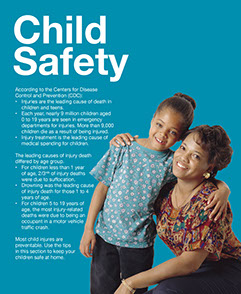
    Child Safety

    Do This, Not That

    According to the Centers for Disease Control and Prevention (CDC):

    *  Injuries are the leading cause of death in children and teens.

    *  Each year, nearly 9 million children aged 0 to 19 years are seen in emergency departments for injuries. More than 9,000 children die as a result of being injured.

    *  Injury treatment is the leading cause of medical spending for children.

    The leading causes of injury death differed by age group.

    *  For children less than 1 year of age, 2/3rds of injury deaths were due to suffocation.

    *  Drowning was the leading cause of injury death for those 1 to 4 years of age.

    *  For children 5 to 19 years of age, the most injury-related deaths were due to being an occupant in a motor vehicle traffic crash.

    Most child injures are preventable. Use the tips in this section to keep your children safe at home.

    General Guidelines

    Safe at Home - Do This, Not That Book. Published by the American Institute for Preventive Medicine. www.HealthyLife.com. All rights reserved.

    © American Institute for Preventive Medicine
  • Pedaling Safely With Your Toddler

    Child Safety

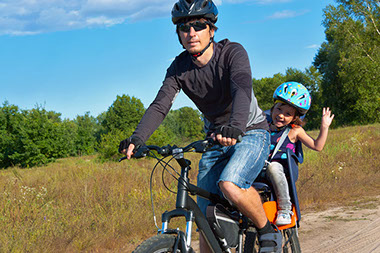
    Image of father and daughter on a bike.

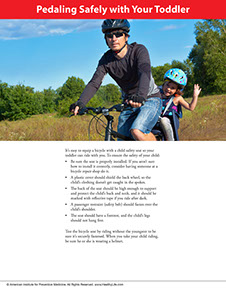
    It’s easy to equip a bicycle with a child safety seat so your toddler can ride with you. To ensure the safety of your child:

    *  Be sure the seat is properly installed. If you aren’t sure how to install it correctly, consider having someone at a bicycle repair shop do it.

    *  A plastic cover should shield the back wheel, so the child’s clothing doesn’t get caught in the spokes.

    *  The back of the seat should be high enough to support and protect the child’s back and neck, and it should be marked with reflective tape if you ride after dark.

    *  A passenger restraint (safety belt) should fasten over the child’s shoulder.

    *  The seat should have a footrest, and the child’s legs should not hang free.

    Test the bicycle seat by riding without the youngster to be sure it’s securely fastened. When you take your child riding, be sure he or she is wearing a helmet.

    A Year of Health Hints book by the American Institute for Preventive Medicine. www.HealthyLife.com. All rights reserved.

    © American Institute for Preventive Medicine
  • Kids And Concussions: What To Know

    WELL-BEING

    Image of mom holding child with a bump on the head.

    Many kids get a bump or blow to the head while playing sports or other activities. If the hit is hard enough, a child can have a concussion, which is a type of traumatic brain injury. During a concussion, the brain bumps against the inside of the skull. This can cause changes in the way the brain works and can lead to long-term problems.

    How do I know if my child had a concussion?

    Many people mistakenly think that if the child doesn’t “black out,” then they’re okay. Although losing consciousness is a sign that a concussion is likely, it’s not the only way to know. A concussion can happen even if the child never loses consciousness. Look for:

    *  Nausea and vomiting

    *  Dizziness

    *  Blurred vision

    *  Sensitivity to light

    *  Tiredness

    Some kids don’t show symptoms right away. If your child suffered a hit to the head, look for these problems that can occur days or weeks after a concussion:

    *  Trouble concentrating or problems with schoolwork

    *  Headaches

    *  Memory problems

    *  Confusion or changes in behavior

    *  Changes in their movement, coordination or walking

    Anything that seems unusual after a blow to the head should be checked by a doctor.

    What to do after a concussion

    Right after the injury, the child should:

    *  Stop the sport or activity.

    *  Get medical help immediately.

    *  Lie down on back with head and shoulders slightly raised while waiting for help to arrive.

    Parents or adults should watch the child’s breathing and whether they stay awake. If the child isn’t breathing or doesn’t have a pulse, begin CPR.

    Returning to sports or activities

    The brain needs time to heal after a concussion. If the child starts activities too soon, they are more likely to have another concussion and to suffer more serious brain damage. Ask the child’s doctor when they can gradually begin physical and mental activities again.

    Preventing concussions

    To prevent a brain injury like a concussion, make sure your child:

    *  Wears a helmet during all contact sports, such as football, or in cases where a fall could happen, such as while biking, skating, horseback riding, and skiing.

    *  Wears a seatbelt and/or has the right car seat for riding in a vehicle.

    Concussions can happen to the best athletes with the most careful parents. If it happens to your child, remember to give the child’s brain plenty of time to rest and recover. This can help avoid long-term problems down the road.

    Source: National Institutes of Health

    © American Institute for Preventive Medicine

  • More Than A Bump On The Old Noggin

    BE FIT

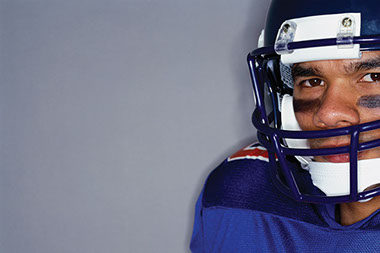
    Image of a football player.

    You’re hearing more about sports-related concussions. Why? Because there are simply more of them. Like 3 million each year, says the CDC.

    Does anyone suspected of having a concussion need a CT or MRI scan right away? Dr. Howard Derman, director of the Methodist Concussion Center in Houston, explains. While there is damage to the brain cells in a concussion, the damage is at a microscopic level and cannot be seen on MRI or CT scans. The injured brain looks normal on these tests, even though it has been seriously injured. Even if a CT scan or MRI shows you’re “okay,” your doctor should also perform a physical exam.

    The signs and symptoms of concussion can appear immediately after the injury or may not appear until days after. Some of the many apparent signs to note are these:

    * Appears dazed or stunned

    * Answers questions slowly

    * Has nausea or vomiting

    * Feels sensitivity to light or noise

    * Cannot recall events prior to the hit or fall

    With a concussion, athletes need to be medically cleared to return to activity. The brain is bruised. It needs time to heal.

    © American Institute for Preventive Medicine

  • Ride Your Bike To Work

    BE FIT

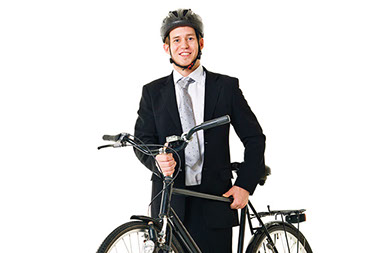
    Image of young man in a business suit with a bike and helmet on.

    Think of the money you’ll save on gas, train fare, and parking. If you live within 10 miles of your work, find solutions to overcome these popular excuses:

    *Not safe:Use less congested roads if rush-hour traffic clogs the main streets.

    *Have to dress nicely at work:Drive to work one day each week and leave a week’s worth of clean clothes.

    *No place to shower:To clean up, use a deodorant soap and washcloth in the restroom.

    *No secure place to park my bike:Check for a storage closet or furnace room, or stash your bike with a friend who lives nearby or at a bike shop.

    *I’d have to ride in the dark:Wear light-colored, reflective clothing, attach lights and reflectors and use a route that’s lit by streetlights.

    *Hate riding in cold and rainy weather:If it’s pouring or sleeting, leave the bike at home.

    *Too far:Drive part way and cycle the rest. Look for a park-and-ride commuter lot.

    Source: Bicycling magazine’s 1,000 All-Time Best Tips

    © American Institute for Preventive Medicine
  • Safe On 2 Wheels

    BE FIT

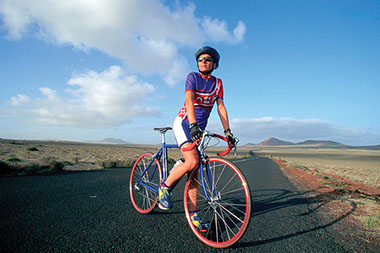
    Image of women on bike.

    Cycling is a good form of exercise. But with more than 1.4 million injuries reported in 2012 according to the Consumer Product Safety Commission, riders need to be safety conscious before hitting the pavement (literally).

    The American Academy of Orthopaedic Surgeons offers cycling safety rules:

    *  Use a bicycle that is the proper size.

    *  Make sure you are fit enough to ride before you  start pedaling.

    *  Change riding positions to reduce stress on pressure points on your body and avoid overstressing muscles.

    *  Always wear a helmet approved by the American National Standards Institute (ANSI). It should fit  snugly but comfortably and not obstruct vision.

    *  Check your bicycle’s mechanical components regularly (brakes, tires, gears).

    *  Follow traffic signs and lights. Signal your turns   so drivers can anticipate your actions.

    *  Ride in the direction of traffic. Be aware of all surroundings.

    *  Use caution on uneven or slippery surfaces.

    *  Do not listen to music with head phones, talk on  your phone, text or do anything else that can   obstruct your hearing and vision.

    *  Avoid loose clothing. Wear padded gloves and appropriate footwear. Never wear flip flops. Use padded cycling shorts for longer rides.

    *  At night, wear bright fluorescent colors; make sure to have rear reflectors. Both a working tail light and headlight should be visible from 500 feet away.

    © American Institute for Preventive Medicine