Tag: herbal

  • Does Tea Make You Healthier?

    HEALTHY EATING

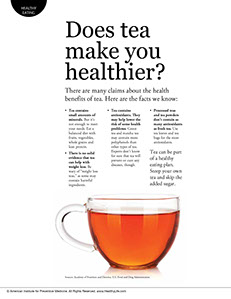
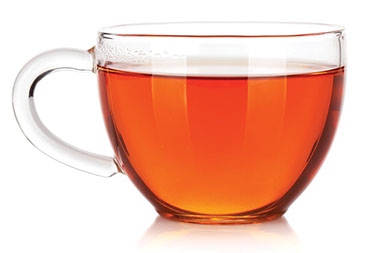
    A cup of tea.

    There are many claims about the health benefits of tea. Here are the facts we know:

    *  Tea contains small amounts of minerals. But it’s not enough to meet your needs. Eat a balanced diet with fruits, vegetables, whole grains and lean protein.

    *  There is no solid evidence that tea can help with weight loss. Be wary of “weight loss teas,” as some may contain harmful ingredients.

    *  Tea contains antioxidants. They may help lower the risk of some health problems. Green tea and matcha tea may contain more polyphenols than other types of tea. Experts don’t know for sure that tea will prevent or cure any diseases, though.

    *  Processed teas and tea powders don’t contain as many antioxidants as fresh tea. Use tea leaves and tea bags for the most antioxidants.

    Tea can be part of a healthy eating plan. Steep your own tea and skip the added sugar.

    Sources: Academy of Nutrition and Dietetics, U.S. Food and Drug Administration

    © American Institute for Preventive Medicine

  • Complementary & Integrative Health

    Alternative Medicine

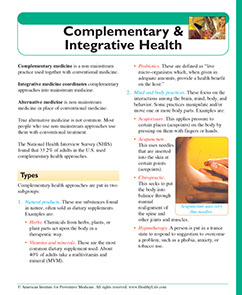
    Image of complementary medicine.

    Complementary medicine is a non-mainstream practice used together with conventional medicine.

    Integrative medicine coordinates complementary approaches into mainstream medicine.

    Alternative medicine is non-mainstream medicine in place of conventional medicine.

    True alternative medicine is not common. Most people who use non-mainstream approaches use them with conventional treatment.

    The National Health Interview Survey (NHIS) found that 33.2% of adults in the U.S. used complementary health approaches.

    Natural products.

    These use substances found in nature, often sold as dietary supplements. Examples are:

    *  Herbs. Chemicals from herbs, plants, or plant parts act upon the body in a therapeutic way.

    * Vitamins and minerals. These are the most common dietary supplement used. About 40% of adults take a multivitamin and mineral (MVM).

    * Probiotics. These are defined as “live micro-organisms which, when given in adequate amounts, provide a health benefit on the host.”

    Mind and body practices

    These focus on the interactions among the brain, mind, body, and behavior. Some practices manipulate and/or move one or more body parts. Examples are:

    *  Acupressure. This applies pressure to certain places (acupoints) on the body by pressing on them with fingers or hands.

    *  Acupuncture. This uses needles that are inserted into the skin at certain points (acupoints).

    *  Chiropractic. This seeks to put the body into balance through manual realignment of the spine and other joints and muscles.

    *  Hypnotherapy. A person is put in a trance state to respond to suggestion to overcome a problem, such as a phobia, anxiety, or tobacco use.

    *  Meditation. This increases calmness and physical relaxation by using:

    – A quiet location that is free of or has few distractions.

    – A comfortable posture.

    – A specific focus on a word or sensation.

    – An openness to let distractions come and go without judging them.

    *  Massage therapy. This uses touching and rubbing techniques to relieve sore muscles and promote relaxation.

    *  Qi gong (“chee-GUNG”). This is part of traditional Chinese medicine. It uses movement, meditation, and controlled breathing to enhance the flow of “qi” in the body. (Qi is an ancient term for vital energy.)

    *  Relaxation therapies. These include breathing exercises, guided imagery, and progressive muscle relaxation.

    *  Tai chi. This is a series of postures and exercises of moving the body slowly and gently, and with awareness while breathing deeply.

    *  Yoga. A system of exercising using postures, breathing, and meditation.

    Page from the Healthier at Home book by the American Institute for Preventive Medicine. www.HealthyLife.com. All rights reserved.

    © American Institute for Preventive Medicine

  • Supplements

    Healthylife® Weigh

    Part 7

    Doctor and patient talking.

    The term “dietary supplement” can be used for anything that you take orally to enhance your usual food intake. Dietary supplements include vitamins, minerals, amino acids, protein powders, and herbal products. Supplements do not have to be approved by the FDA.

    Reasons to Take a Supplement:

    *  Females who are pregnant or breastfeeding need more iron, folic acid, and calcium.

    *  Females with excessive menstrual bleeding may need to take an iron supplement.

    *  Some vegetarians may not get enough calcium, iron, zinc, and vitamin B12.

    *  Older adults and people with little exposure to sunlight may need a vitamin D supplement.

    *  People with certain disorders or diseases and people who take some medications may need a supplement. For example, people with high blood pressure who take a water pill may need to take a potassium supplement.

    Ask your doctor if you need any vitamin and/or mineral supplement due to a medical condition or any medication(s) you take. Supplements can interact with food and other medications.

    HealthyLife® Weigh Guidelines:

    1. Healthy adults and children can get the nutrients they need by choosing a variety of foods rather than taking supplements. This reduces the risk of deficiencies, as well as excesses.

    a. Do not take supplements that contain more than 10 times the Recommended Daily Intake (RDI) for a nutrient, particularly fat soluble vitamins (A, D, E, and K). The mineral selenium can also be harmful if taken in large amounts.

    b. The maximum value of vitamins is in food rather than supplements. It’s much better to get your vitamins and minerals from food rather than from pills. Unlike supplements, fruits, vegetables, and grains have dietary fiber that is beneficial, promotes regularity, and aids in the prevention of disease.

    2. Some supplement ingredients can be seriously harmful. Examples include high potency doses of some vitamins, such as niacin, amino acids (e.g., L-tryptophan) and herbs (e.g., chaparral, comfrey, and germander).

    3. Supplements may not be pure. If you have allergies, be sure to follow recommendations from your doctor or allergist before taking a supplement.

    Bottom Line: You should eat healthy foods to get needed nutrients. Consult your doctor or registered dietitian if you think taking vitamin/mineral supplements could benefit you.

    Resources for Supplement Information:

    Center for Food Safety and Applied Nutrition

    www.fda.gov/about-fda/fda-organization/center-food-safety-and-applied-nutrition-cfsan

    Food and Nutrition Information Center

    www.nal.usda.gov/fnic

    National Center for Complementary and Integrative Health (NCCIH)

    www.nccih.nih.gov

    National Institute of Health: Office of Dietary Supplements

    https://ods.od.nih.gov
    © American Institute for Preventive Medicine