Tag: hotline

  • Where To Get Help For A Drinking Problem

    Substance Use & Abuse

    Image of man seeking help.

    Problem drinkers have many options to help conquer their problem.

    *  Psychotherapy. Counseling, one-on-one with a therapist or in group sessions, focuses on feelings and situations related to drinking. The goal is to help an individual cope with emotional problems and other stresses so that he or she no longer relies on alcohol.

    *  Support groups. Organized groups like Alcoholics Anonymous provide assistance, encouragement, and guidance (including a 12-step recovery plan) for members who share an alcohol problem.

    *  Medication. One type blocks the craving for alcohol and the pleasure of getting high. A second type reduces the physical distress and emotional effects people usually get when they quit drinking. A third type causes physical reactions, such as vomiting, when drinking alcohol.

    *  Alcohol treatment centers. Affiliated with hospitals, medical clinics, or community health centers, alcohol treatment centers generally combine more than one approach. People who need help are either treated as an outpatient or admitted as an inpatient, depending on how serious the problem is.

    For help, consult the following resources.

    *  Your family physician. A doctor who knows the drinker (and the drinker’s family) can determine what type of treatment would be appropriate. Also, anyone with a history of heavy drinking should have a thorough medical exam to uncover any medical conditions that may have been caused or aggravated by alcohol abuse.

    *  Family service agencies. Most communities have agencies that run outpatient alcoholic treatment programs or can refer you to one. Look in your telephone directory or contact your local social services department.

    *  Your religious adviser. Talk with your priest, minister, or rabbi.
    Page from A Year of Health Hints book by the American Institute for Preventive Medicine. www.HealthyLife.com. All rights reserved.

    © American Institute for Preventive Medicine
  • Suicidal Thoughts 2

    Mental Health

    Signs & Symptoms

    *  Writing a suicide note.

    *  Suicidal threats, gestures, or attempts.

    *  Thoughts of suicide that don’t go away or occur often.

    Causes

    *  Depression.

    *  Bipolar disorder.

    *  Schizophrenia.

    *  Grief. Loss of a loved one.

    *  A side effect of some medicines. One is isotretinoin. This is prescribed for severe acne. Some antidepressants have this effect, too. This is more of a risk in the first days to the first month they are taken.

    *  A family history of suicide or depression.

    *  Money and relationship problems.

    *  Increasing use of alcohol and/or drugs.

    *  Withdrawing from others.

    *  Showing rage or seeking revenge.

    *  Behaving recklessly.

    *  Talking about feeling trapped, hopeless, or in unbearable pain.

    Treatment

    *  Emergency care.

    *  Treating the mental and/or physical problems that lead to thoughts and attempts of suicide. Examples are bipolar disorder and depression.

    *  Counseling.

    *  Talking with family and friends often.

    Questions to Ask

    Self-Care / Prevention

    For Suicidal Thoughts

    *  Call the National Suicide Prevention Lifeline at 800.273.8255.

    *  Let someone know. Talk to your doctor, a trusted family member, friend, or teacher. If it is hard for you to talk to someone, write your thoughts down. Let someone else read them.

    To Help Prevent a Suicide

    *  Keep firearms, drugs, etc., away from persons at risk.

    *  Take courses that teach problem solving, coping skills, and suicide awareness.

    *  If you think the person is serious about suicide, get help. Watch and protect him or her until you get help. Keep the person talking. Ask questions such as, “Are you thinking about hurting or killing yourself?”

    *  Urge the person to call for help (e.g., his or her health care provider, a suicide prevention hotline, EMS, etc.) Make the call yourself if the person can’t or won’t.

    *  Express concern. The person needs to know that someone cares. Most suicidal persons feel alone. Tell the person how much he or she means to you and others. Talk about reasons to stay alive. Don’t judge. The person needs someone to listen, not preach moral values.

    *  Tell the person that depression and thinking about suicide can be treated. Urge him or her to get professional care. Offer help in seeking care.

    Resources

    Mental Health America (MHA)

    800.969.6642

    mentalhealthamerica.net

    National Suicide Prevention Lifeline

    800.273.TALK (273.8255)

    suicidepreventionlifeline.org

    Healthier at Home book by the American Institute for Preventive Medicine. www.HealthyLife.com. All rights reserved.

    © American Institute for Preventive Medicine
  • In Case Of Accidental Poisoning, Act Fast

    First Aid

    Image of skull and bones that represent poison.

    To prevent accidental poisoning:

    *  Always read warning labels on pesticides, household cleaners, and other products that could be poisonous. Follow instructions for use and storage.

    *  Crush unused medications and mix them with water. Mix this with used coffee grounds or kitty litter. Put this in the garbage in a sealed plastic bag.

    *  Have the phone number of your local poison control center and National Poison Control Center (1.800.222.1222) posted near the telephone. It’s also a good idea to post the numbers of the nearest hospital emergency room, ambulance service, and your physician.

    If your child accidentally swallows or inhales poison, or spills poison on the skin or eyes, don’t panic. Instead:

    *  Call the Poison Control Center at 1.800.222.1222 (or hospital or physician). Explain the problem and identify the cause.

    *  Remain calm and quickly follow the instructions you’re given. Often, accidental poisonings can be handled at home.

    A Year of Health Hints book by the American Institute for Preventive Medicine. www.HealthyLife.com. All rights reserved.

    © American Institute for Preventive Medicine
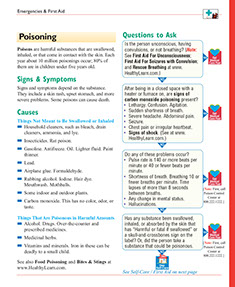
  • Poisoning

    First Aid

    Concept image of smoke forming a skull.

    Poisons are harmful substances that are swallowed, inhaled, or that come in contact with the skin. Each year about 10 million poisonings occur; 80% of them are in children under five years old.

    Signs & Symptoms

    Signs and symptoms depend on the substance. They include a skin rash, upset stomach, and more severe problems. Some poisons can cause death.

    Causes

    Things Not Meant to Be Swallowed or Inhaled

    *  Household cleaners, such as bleach, drain cleaners, ammonia, and lye.

    *  Insecticides. Rat poison.

    *  Gasoline. Antifreeze. Oil. Lighter fluid. Paint thinner.

    *  Lead.

    *  Airplane glue. Formaldehyde.

    *  Rubbing alcohol. Iodine. Hair dye. Mouthwash. Mothballs.

    *  Some indoor and outdoor plants.

    *  Carbon monoxide. This has no color, odor, or taste.

    Things That Are Poisonous in Harmful Amounts

    *  Alcohol. Drugs. Over-the-counter and prescribed medicines.

    *  Medicinal herbs.

    *  Vitamins and minerals. Iron in these can be deadly to a small child.

    Treatment

    Treatment depends on the poison and its effects. Information to give the Poison Control Center, emergency department, etc.:

    *  The name of the substance taken.

    *  The amount and when it was taken.

    *  A list of ingredients on the label.

    *  Age, gender, and weight of the person who took the poison. How the person is feeling and reacting. Any medical problems the person has.

    Prevention

    *  Buy household products, vitamins, and medicines in child-resistant packaging. Keep these and all poisons out of children’s reach.

    *  Put child-resistant latches on cabinet doors. Follow instructions for use and storage of pesticides, household cleaners, and other poisons.

    *  Keep products in original containers. Don’t transfer them to soft drink bottles, plastic jugs, etc.

    *  Teach children not to take medicine and vitamins unless an adult gives it to them. Don’t call these “candy” in front of a child.

    *  Wear protective clothing, masks, etc., when using chemicals that could cause harm if inhaled or absorbed by the skin.

    *  Install carbon monoxide detectors in your home and garage.

    Questions to Ask

    Self-Care / First Aid

    For Swallowed Poisons

    1.  If the person is unconscious, shout for help. Call 9-1-1!

    2.  For a conscious person, call the Poison Control Center (800.222.1222). Follow instructions. Do not give Syrup of Ipecac to induce vomiting unless the Poison Control Center tells you to. {Note: The American Academy of Pediatrics recommends that parents don’t give Syrup of Ipecac to children.}

    3.  Lay the person on his or her left side to keep the windpipe clear, especially if the person vomited. Keep a sample of the vomit and the poison container.

    For Inhaled Poisons

    1.  Protect yourself. Move the person to fresh air (outdoors if you can). Try not to breathe the fumes yourself.

    2.  Follow steps 1 and 2 above for Swallowed Poisons. Get medical care.

    For Chemical Poisons on Skin

    1.  Protect yourself. Flood the skin with water for 5 or more minutes. Remove clothing that was in contact with the person.

    2.  Gently wash the skin with soap and water. Rinse well. Get medical care.

    Healthier at Home book by the American Institute for Preventive Medicine. www.HealthyLife.com. All rights reserved.

    © American Institute for Preventive Medicine

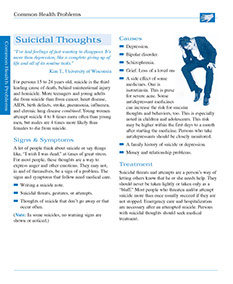
  • Suicidal Thoughts

    Student Health

    For persons 15 to 24 years old, suicide is the third leading cause of death, behind unintentional injury and homicide. More teenagers and young adults die from suicide than from cancer, heart disease, AIDS, birth defects, stroke, pneumonia, influenza, and chronic lung disease combined. Young women attempt suicide 4 to 8 times more often than young men, but males are 4 times more likely than females to die from suicide.

    Signs & Symptoms

    A lot of people think about suicide or say things like, “I wish I was dead,” at times of great stress. For most people, these thoughts are a way to express anger and other emotions. They may not, in and of themselves, be a sign of a problem. The signs and symptoms that follow need medical care.

    *  Writing a suicide note.

    *  Suicidal threats, gestures, or attempts.

    *  Thoughts of suicide that don’t go away or that occur often.

    (Note: In some suicides, no warning signs are shown or noticed.)

    Causes

    *  Depression.

    *  Bipolar disorder.

    *  Schizophrenia.

    *  Grief. Loss of a loved one.

    *  A side effect of some medicines. One is isotretinoin. This is prescribed for severe acne. Some antidepressant medicines can increase the risk for suicidal thoughts and behaviors, too. This is especially noted in children and adolescents. This risk may be higher within the first days to a month after starting the medicine. Persons who take antidepressants should be closely monitored.

    *  A family history of suicide or depression.

    *  Money and relationship problems.

    Treatment

    Suicidal threats and attempts are a person’s way of letting others know that he or she needs help. They should never be taken lightly or taken only as a “bluff.” Most people who threaten and/or attempt suicide more than once usually succeed if they are not stopped. Emergency care and hospitalization are necessary after an attempted suicide. Persons with suicidal thoughts should seek medical treatment.

    Questions to Ask

    Self-Care / Prevention

    If You Are Having Thoughts of Suicide

    *  Let someone know. Talk to a trusted family member, friend, or teacher. If it is hard for you to talk directly to someone, write your thoughts down and let someone else read them.

    *  Call your school’s Mental Health Service, your local Crisis Intervention Center or the National Suicide Prevention Lifeline at 800.273.8255. Follow up with a visit to your health care provider or your school’s Mental Health Service.

    How to Help a Friend Who May Be Suicidal

    *  Take him or her seriously. If your friend informs you of suicidal intentions, believe the threats.

    *  Keep firearms, drugs, etc. away from persons at risk.

    *  Take courses that teach problem solving, coping skills, and suicide awareness.

    *  If you think the person is serious about suicide, get help. Watch and protect him or her until you get help. Keep the person talking. Ask questions, such as, “Are you thinking about hurting or killing yourself?”

    *  Urge the person to call for help. If he or she is already under the care of a health care provider, have the person contact that provider first. If not, other places to contact are listed in the box below. Make the call yourself if the person can’t or won’t.

    *  Express concern. The person needs to know that someone cares. Most suicidal persons feel alone. Tell the person how much he or she means to you and others. Talk about reasons to stay alive. Don’t judge. The person needs someone to listen, not to preach moral values.

    *  Tell the person that depression and suicidal tendencies can be treated. Urge him or her to get professional care. Offer help in seeking care.

    Resources

    Your school’s Student Counseling or Mental Health Service or Student Health Service

    American Foundation for Suicide Prevention

    888.333.AFSP (2377)

    www.afsp.org

    (This is not a crisis hotline.)

    Metanoia Communications

    www.metanoia.org/suicide

    National Suicide Prevention Lifeline

    800.273.TALK (273.8255)

    www.suicidepreventionlifeline.org

    Student Self-Care book by the American Institute for Preventive Medicine. www.HealthyLife.com. All rights reserved.

    © American Institute for Preventive Medicine