Tag: hygiene

  • Stay Healthy At Work

    WORK LIFE

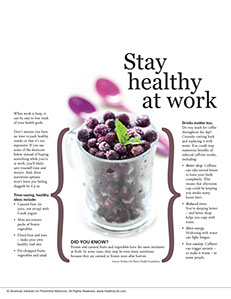
    Image of frozen berries in a glass.

    When work is busy, it can be easy to lose track of your health goals.

    Don’t assume you have no time to pack healthy snacks or that it’s too expensive. If you use some of the shortcuts below instead of buying something while you’re at work, you’ll likely save yourself time and money. And, these nutritious options won’t leave you feeling sluggish by 4 p.m.

    Time-saving, healthy ideas include:

    *  Canned fruit (in juice, not syrup) with Greek yogurt

    *  Mini microwave packs of frozen vegetables

    *  Dried fruit and nuts – make your own healthy trail mix

    *  Pre-chopped fruits, vegetables and salad

    Did you know?

    Frozen and canned fruits and vegetables have the same nutrients as fresh. In some cases, they may be even more nutritious because they are canned or frozen soon after harvest.

    Source: Produce for Better Health Foundation

    Drinks matter too.

    Do you reach for coffee throughout the day? Consider cutting back and replacing it with water. You could reap numerous benefits of reduced caffeine intake, including:

    *  Better sleep. Caffeine can take several hours to leave your body completely. This means that afternoon cup could be keeping you awake many hours later.

    *  Reduced stress. You’re sleeping better – and better sleep helps you cope with stress.

    *  More energy. Hydrating with water can fight fatigue.

    *  Less anxiety. Caffeine can trigger anxiety – or make it worse – in some people.

    © American Institute for Preventive Medicine

  • Work-Related Skin Problems

    WORK LIFE

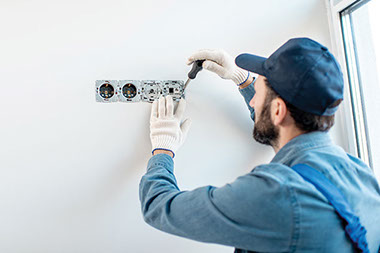
    Electrician wearing gloves while working.

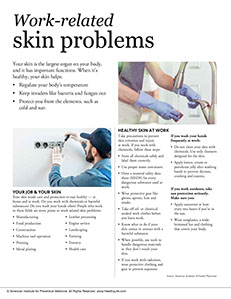
    Your skin is the largest organ on your body, and it has important functions. When it’s healthy, your skin helps:

    *  Regulate your body’s temperature

    *  Keep invaders like bacteria and fungus out

    *  Protect you from the elements, such as cold and sun

    Your job & your skin

    Your skin needs care and protection to stay healthy – at home and at work. Do you work with chemicals or harmful substances? Do you wash your hands often? People who work in these fields are more prone to work-related skin problems:

    *  Manufacturing

    *  Food production

    *  Construction

    *  Machine tool operation

    *  Printing

    *  Metal plating

    *  Leather processing

    *  Engine service

    *  Landscaping

    *  Farming

    *  Forestry

    *  Health care

    Healthy skin at work

    Take precautions to prevent skin irritation and injury at work. If you work with chemicals, follow these steps:

    *  Store all chemicals safely and label them correctly.

    *  Use proper waste containers.

    *  Have a material safety data sheet (MSDS) for every dangerous substance used at work.

    *  Wear protective gear like gloves, aprons, hats and masks.

    *  Take off oil- or chemical-soaked work clothes before you leave work.

    *  Know what to do if your skin comes in contact with a harmful substance.

    *  When possible, use tools to handle dangerous materials so they don’t touch your skin.

    *  If you work with radiation, wear protective clothing and gear to prevent exposure.

    If you wash your hands frequently at work:

    *  Do not clean your skin with chemicals. Use only cleansers designed for the skin.

    *  Apply lotion, cream or petroleum jelly after washing hands to prevent dryness, cracking and eczema.

    If you work outdoors, take sun protection seriously. Make sure you:

    *  Apply sunscreen at least every two hours if you’re in the sun.

    *  Wear sunglasses, a wide-brimmed hat and clothing that covers your body.

    Source: American Academy of Family Physicians

    © American Institute for Preventive Medicine

  • Eat, Drink, And Be Wary

    Healthy Travel

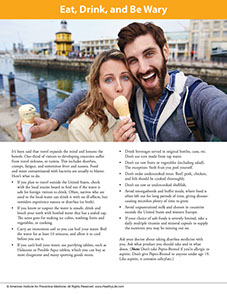
    Image of couple eating at a resturant.

    It’s been said that travel expands the mind and loosens the bowels. One-third of visitors to developing countries suffer from travel sickness, or turista. This includes diarrhea, cramps, fatigue, and sometimes fever and nausea. Food and water contaminated with bacteria are usually to blame. Here’s what to do.

    *  If you plan to travel outside the United States, check with the local tourist board to find out if the water is safe for foreign visitors to drink.  Often, natives who are used to the local water can drink it with no ill effects, but outsiders experience nausea or diarrhea (or both).

    *  If you know or suspect the water is unsafe, drink and brush your teeth with bottled water that has a sealed cap. The same goes for making ice cubes, washing fruits and vegetables, or cooking.

    *  Carry an immersion coil so you can boil your water. Boil the water for at least 10 minutes, and allow it to cool before you use it.

    *  If you can’t boil your water, use purifying tablets, such as Halazone or Potable Aqua tablets, which you can buy at most drugstores and many sporting goods stores.

    *  Drink beverages served in original bottles, cans, etc. Don’t use ice made from tap water.

    *  Don’t eat raw fruits or vegetables (including salad). The exception: fresh fruit you peel yourself.

    *  Don’t order undercooked meat. Beef, pork, chicken, and fish should be cooked thoroughly.

    *  Don’t eat raw or undercooked shellfish.

    *  Avoid smorgasbords and buffet meals, where food is often left out for long periods of time, giving disease-causing microbes plenty of time to grow.

    *  Avoid unpasteurized milk and cheeses in countries outside the United States and western Europe.

    *  If your choice of safe foods is severely limited, take a daily multiple vitamin and mineral capsule to supply the nutrients you may be missing out on.

    Ask your doctor about taking diarrhea medicine with you. Ask what  product you should take and in what doses. (Note: Don’t take Pepto-Bismol if you’re allergic to aspirin. Don’t give Pepto-Bismol to anyone under age 19. Like aspirin, it contains salicylate.)

    Page image from A Year of Health Hints book by the American Institute for Preventive Medicine. www.HealthyLife.com. All rights reserved.

    © American Institute for Preventive Medicine

  • A To Z Guide To Help Kids Be Healthy & Safe

    Child Safety

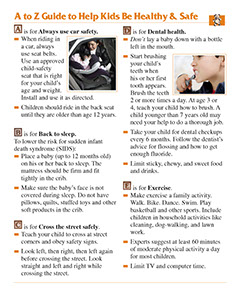
    A is for Always use car safety.

    *  When riding in a car, always use seat belts. Use an approved child-safety seat that is right for your child’s age and weight. Install and use it as directed.

    *  Children should ride in the back seat until they are older than age 12 years.

    B is for Back to sleep.

    To lower the risk for sudden infant death syndrome (SIDS):

    *  Place a baby (up to 12 months old) on his or her back to sleep. The mattress should be firm and fit tightly in the crib.

    *  Make sure the baby’s face is not covered during sleep. Do not have pillows, quilts, stuffed toys and other soft products in the crib.

    C is for Cross the street safely.

    *  Teach your child to cross at street corners and obey safety signs.

    *  Look left, then right, then left again before crossing the street. Look straight and left and right while crossing the street.

    D is for Dental health.

    Don’t lay a baby down with a bottle left in the mouth.

    Start brushing your child’s teeth when his or her first tooth appears. Brush the teeth 2 or more times a day. At age 3 or 4, teach your child how to brush. A child younger than 7 years old may need your help to do a thorough job.

    Take your child for dental checkups every 6 months. Follow the dentist’s advice for flossing and how to get enough fluoride.

    Limit sticky, chewy, and sweet food and drinks.

    E is for Exercise.

    *  Make exercise a family activity. Walk. Bike. Dance. Swim. Play basketball and other sports. Include children in household activities like cleaning, dog-walking, and lawn work.

    *  Experts suggest at least 60 minutes of moderate physical activity a day for most children.

    *  Limit TV and computer time.

    F is for Feed your child healthy foods.

    G is for Give positive feedback.

    *  Praise good behaviors.

    *  Hug, read, and play together.

    H is for Hand washing.

    Teach your child to wash his or her hands often. Show them how to do it the right way. Use soap and running water. Take at least 20 seconds to wash the hands. This is the amount of time it takes to sing “Happy Birthday” two times. Dry the hands with clean paper towels that can be thrown away.

    Hand washing is important before your child eats and after he or she goes to the bathroom, plays, handles pets, and sneezes or coughs.

    I is for Install.

    *  Install smoke alarms. Install carbon monoxide detectors, too.

    *  Follow the rules of the city you live in.

    *  Check to see that they work well. Do this every month.

    *  Ask your local fire department for help, if you need it.

    J is for Join.

    Join your child in being physically active and in eating healthy foods. Join group activities as a family.

    K is for Keep harmful things out of children’s reach. These include:

    *  Medicines and vitamins. Store these in “child- safe” bottles.

    *  Bleach and other household products. Read labels to find out which ones can harm a child and for first aid information.

    *  Matches, lighters, guns and bullets.

    *  All knives and sharp utensils.

    L is for Listen and Learn.

    Listen to your child.

    Learn about your child’s interests. Learn who their friends are, too.

    Learn child first aid and CPR.

    M is for Medicine safety.

    *  When you give medicine to your child, make sure it is the right kind and dose for your child’s weight.

    *  Give medicine as advised by your child’s doctor.

    *  Do not give aspirin to anyone under 19 years of age due to its link to Reye’s Syndrome.

    N is for Never leave a baby, toddler, or young child unattended.

    *  Never leave a baby alone on a bed or table.

    *  It takes only seconds for a toddler or curious children to get into something they should not be into.

    *  Never leave a child alone in a bathtub or baby bath.

    *  Never leave a child alone in a car and around cars.

    O is for Obey traffic laws and other rules.

    *  Laws and rules are made to keep people safe. Teach your child to obey them.

    *  Set rules that your child needs to follow.

    P is for Poison Control Center hotline.

    This number is 800.222.1222. Keep it by each phone. Program it in your cell phone.

    Q is for Quit Smoking!

    *  Smoking and secondhand smoke are very harmful to you and your child.

    *  Don’t smoke. Don’t let your child smoke.

    *  Do not allow smoking in your home.

    *  If needed, get help to quit smoking. Get help from your doctor or from 800.QUIT.NOW (784.8669) andwww.smokefree.gov.

    R is for Role model.

    *  Children copy what they see.

    *  Eat healthy foods. Do regular exercise.

    S is for Safety-proof the house.

    *  Set the thermostat on your water heater to 120ºF or less.

    *  Put safety plugs in outlets.

    *  Teach your child to stay away from the stove.

    *  Keep guard rails around space heaters. Gate off unsafe areas.

    *  Do not let young children get toys or other things with small parts. They could choke on them.

    *  Never leave a child alone near water. Wear life jackets when boating or near a lake. Empty buckets with water, etc. right away after use.

    *  Get more safety tips from Safe Kids Worldwide atwww.usasafekids.org.

    T is for Talk to your child.

    Talk about ways to be healthy and safe. Tell your child what you expect of him or her. Tell your child often that you love him or her.

    U is for Use products that are safety approved for kids.

    *  These include: Car seats, cribs, playpens, toys, and sleepwear.

    *  Find out if a product is safe or has been recalled from The U.S. Consumer Product Safety Commission atwww.cpsc.gov.

    V is for Vaccines.

    W is for Wear protective gear.

    *  Wear a helmet when riding a bike, rollerblading, skating, etc.

    *  Wear the right gear when practicing and playing team sports.

    *  Wear clothes or material that reflects the light when outdoors in the dark.

    X is for eXams from a health care provider.

    Children age 3 years and older should get a yearly checkup. Children under age 3 years need checkups when they are 1, 2, 4, 6, 9, 12, 15, 18, and 24 months old.

    Y is for Yearly flu vaccine.

    A yearly flu vaccine is the single best way to prevent getting the flu. All children ages 6 to 59 months should get a flu vaccine. So should others as advised by their doctors.

    Z is for ZZZZs (sleep).

    Get enough sleep each night:

    *  Adults need at least 7 to 9 hours.

    *  Teens need at least 8-1⁄2 to 9-1⁄2 hours.

    *  After 6 months of age, most children need 9 to 12 hours. Up to age 5 years, children may also take daytime naps for a total of 1⁄2 to 2 hours a day.

    Children's Self-Care book by the American Institute for Preventive Medicine. www.HealthyLife.com. All rights reserved.

    © American Institute for Preventive Medicine

  • How To Avoid Hospital Germs

    Medical Care

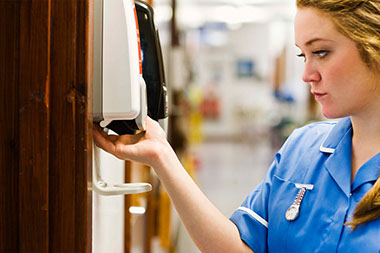
    Image of nurse using antibacterial dispenser.

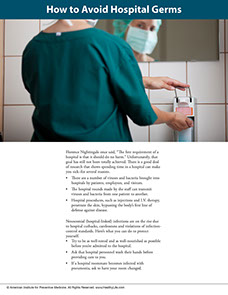
    Florence Nightingale once said, “The first requirement of a hospital is that it should do no harm.”

    Unfortunately, that goal has still not been totally achieved. There is a good deal of research that shows spending time in a hospital can make you sick-for several reasons.

    *  There are a number of viruses and bacteria brought into hospitals by patients, employees, and visitors.

    *  The hospital rounds made by the staff can transmit viruses and bacteria from one patient to another.

    *  Hospital procedures, such as injections and I.V. therapy, penetrate the skin, bypassing the body’s first line of defense against disease.

    Nosocomial (hospital-linked) infections are on the rise due to hospital cutbacks, carelessness and violations of infection-control standards. Here’s what you can do to protect yourself.

    *  Try to be as well-rested and as well-nourished as possible before you’re admitted to the hospital.

    *  Ask that hospital personnel wash their hands before providing care to you.

    *  If a hospital roommate becomes infected with pneumonia, ask to have your room changed.

    Page from A Year of Health Hints book by the American Institute for Preventive Medicine. www.HealthyLife.com. All rights reserved.

    © American Institute for Preventive Medicine

  • Handle Food With Care

    Home Safety

    Healthy eating starts with preparation.

    Your body will know if you’ve eaten harmful bacteria, because it can make you mildly to very sick. Bacteria spread easily onto hands, cutting boards, utensils, and countertops – all things that come into contact with food. To avoid problems, cook foods to  proper temperatures and follow some simple steps.

    Clean: Wash your hands and surfaces often.

    *  Wash your hands with warm water and soap for at least 20 seconds before and after handling food or touching other surfaces.

    *  Wash cutting boards, dishes, utensils, and countertops with hot soapy water after preparing each food item.

    *  Rinse fruits and vegetables with running tap water.

    Separate: Don’t cross-contaminate.

    *  Keep raw meat, poultry, seafood and eggs separate from other foods.

    *  Use one cutting board for fruits and vegetables and another for meat, poultry, seafood, or eggs.

    *  Never place cooked food on a plate that held raw food.

    Chill: Refrigerate perishable foods.

    *  Refrigerate or freeze meat, poultry, eggs, and other perishables as soon as you get home from shopping for foods.

    *  Don’t let raw meat, poultry, eggs, cooked food, or cut fruits or vegetables sit at room temperature more than two hours.

    *  Defrost foods in the refrigerator or cold water. Use the microwave on the defrost setting if you are cooking the food right away.

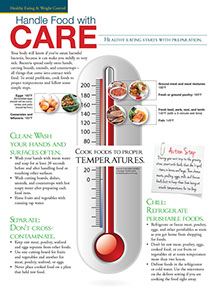
    Cook foods to proper temperatures.

    Eggs: 160ºF (Scrambled eggs should not be runny; whites and yolks should be firm.)

    Casseroles and leftovers: 165ºF

    Ground meat and meat mixtures: 160ºF

    Fresh or ground poultry: 165ºF

    Fresh beef, pork, veal, and lamb: 145ºF (with a 3-minute rest time)

    Fish: 145ºF

    Action Step

    During your next trip to the grocery store, start with foods that don’t spoil − items in boxes and bags. Then choose meats, poultry, eggs, milk, and frozen foods last to keep them from being at unsafe temperatures for too long.

    Ways to Well-Being book by the American Institute for Preventive Medicine. www.HealthyLife.com. All rights reserved.

    © American Institute for Preventive Medicine

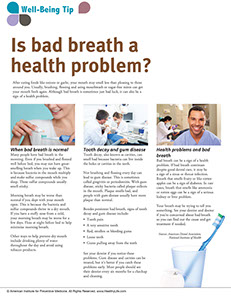
  • Is Bad Breath A Health Problem?

    WELL-BEING

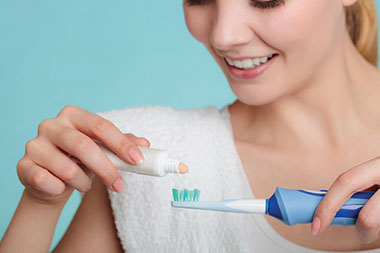
    Image of women placing tooth paste on tooth brush.

    After eating foods like onions or garlic, your mouth may smell less than pleasing to those around you. Usually, brushing, flossing and using mouthwash or sugar-free mints can get your mouth fresh again. Although bad breath is sometimes just bad luck, it can also be a sign of a health problem.

    When bad breath is normal

    Many people have bad breath in the morning. Even if you brushed and flossed well before bed, you may not have great-smelling breath when you wake up. This is because bacteria in the mouth multiply and make sulfur compounds while you sleep. These sulfur compounds usually smell stinky.

    Morning breath may be worse than normal if you slept with your mouth open. This is because the bacteria and sulfur compounds thrive in a dry mouth. If you have a stuffy nose from a cold, your morning breath may be worse for a few days. Floss at night before bed to help minimize morning breath.

    Other ways to help prevent dry mouth include drinking plenty of water throughout the day and avoid using tobacco products.

    Tooth decay and gum disease

    Tooth decay, also known as cavities, can smell bad because bacteria can live inside the holes or cavities in the teeth.

    Not brushing and flossing every day can lead to gum disease. This is sometimes called gingivitis or periodontitis. With gum disease, sticky bacteria called plaque collects in the mouth. Plaque smells bad, and people with gum disease usually have more plaque than normal.

    Besides persistent bad breath, signs of tooth decay and gum disease include:

    *  Tooth pain

    *  A very sensitive tooth

    *  Red, swollen or bleeding gums

    *  Loose teeth

    *  Gums pulling away from the teeth

    See your dentist if you notice these problems. Gum disease and cavities can be treated, but it’s better if you catch these problems early. Most people should see their dentist every six months for a checkup and cleaning.

    Health problems and bad breath

    Bad breath can be a sign of a health problem. If bad breath continues despite good dental care, it may be a sign of a sinus or throat infection. Breath that smells fruity or like rotten apples can be a sign of diabetes. In rare cases, breath that smells like ammonia or rotten eggs can be a sign of a serious kidney or liver problem.

    Your breath may be trying to tell you something. See your dentist and doctor if you’re concerned about bad breath so you can find out the cause and get treatment if needed.

    Sources: American Dental Association, National Institutes of Health

    © American Institute for Preventive Medicine

  • Mouth To Hand

    SELF-CARE CORNER

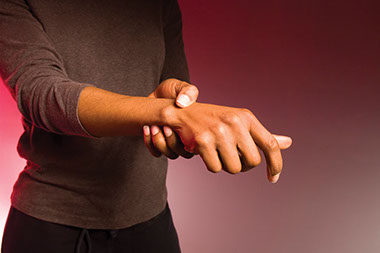
    Image of person holding their wrist.

    Tingling, numbness and pain in your fingers and wrists? Is it just tired hands or something more severe? While, these can all be signs of tired, overused hands, these symptoms can also indicate something serious, such as a repetitive stress injury, tendonitis, aggravation of arthritis or sprains, and even carpal tunnel syndrome.

    With over 152.7 billion text messages sent per month in the U.S. alone, according to CTIA-The Wireless Association, it is becoming clear that our society is shifting its primary method of communication from our mouths and voices to our hands and fingers. With this shift, there has also been an increase in the number of injuries related to these repetitive motions.

    “It is important that patients don’t dismiss symptoms of sore fingers, occasional numbness and tingling,” says George Kardashian, MD, an orthopedic surgeon and hand specialist at The Center for Bone and Joint Disease. “These symptoms are all the body’s way of saying it needs a break or a more serious injury will occur.”

    Since it is almost impossible to stop using mobile devices or computers completely, it is important to know how to prevent these symptoms from turning from sore, tired fingers into something more severe.

    *  Take frequent breaks from typing and texting.

    *  Stretch your hands and fingers.

    *  Use ice packs to reduce swelling.

    *  See your doctor if you have continuing symptoms.

    © American Institute for Preventive Medicine

  • Open Wide

    SELF-CARE CORNER

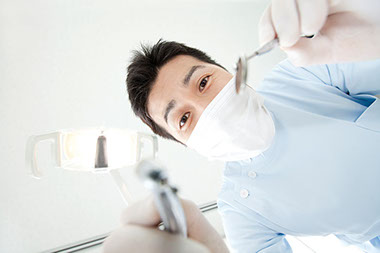
    Image of dentist.

    Your dentist and dental hygienist inspect your mouth for oral cancers when you show up for your regular dental cleanings. But between visits, take note of these early warning signs, and see your dental professional if they do not improve or disappear after 2 to 3 weeks:

    *  A sore, or soreness or irritation that doesn’t go away

    *  Red or white patches, or pain, tenderness, or numbness in your mouth or lips

    *  Lumps, thickening tissues, rough spots, crusty or eroded areas

    *  Difficulty chewing, swallowing, or moving your jaw or tongue

    *  A change in the way your teeth fit together when you close your mouth

    Always call your dental professional right away if you have any immediate concerns. Those at high risk of developing oral cancer have traditionally been heavy alcohol drinkers and smokers over age 50. But today, cancer is occurring in younger, nonsmokers. The sexually transmitted HPV is related to some cancers in younger people.

    © American Institute for Preventive Medicine

  • Wash Away The 5 Most Common Handwashing Myths

    WELL-BEING

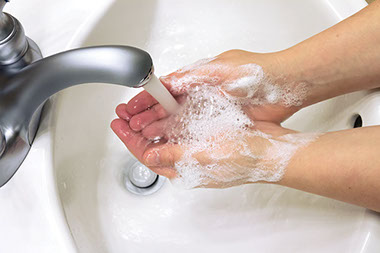
    Image of hands being washed with water and soup.

    Think you know how to wash your hands? Think again. A 2013 study in the Journal of Environmental Health showed that only 5% of people properly wash their hands on a daily basis. Cintas Corporation and Henry the Hand Foundation have teamed up to dispel the  5 most common handwashing myths.

    Keeping hands clean is one of the most important ways to avoid getting sick and spreading germs. Researchers at the NIH found that people touch their faces on average 3.6 times per hour. So handwashing is the answer. Test your knowledge about the best way to clean your hands.

    1. It doesn’t matter how long I wash my hands as long as I use soap – FALSE

    The next time you’re in the restroom and washing your hands, think of the chorus of your favorite song. Studies show that you should scrub your hands with soap for a minimum of 15-30 seconds in order to effectively remove germs.

    2. Hand sanitizers can replace washing your hands with soap and water – FALSE

    Washing hands with soap and water is the best and most effective way to reduce the number of microbes and germs on hands. Although alcohol-based (at least 60%) hand sanitizers can quickly reduce the number of germs on hands in some situations, they are not as effective as soap and water when it comes to removing and inactivating dangerous gastrointestinal illness-causing germs.

    3. The hotter the water you use for handwashing, the better – FALSE

    Studies show that water temperature does not affect germ removal. In fact, there is no research to prove that higher temperatures improve handwashing at all. Hotter water can also dry out skin, which leaves your skin more susceptible to germs and can make handwashing painful. It is best to wash your hands with the temperature that you find comfortable.

    4. You don’t have to dry your hands after washing them – FALSE

    Studies show that germs can be more easily transferred to and from wet hands, which is why drying hands is essential to staving off bacteria after handwashing.

    5. Hand dryers are more hygienic than paper towels – FALSE

    Researchers found that paper towels are superior to air dryers and can help remove bacteria, unlike air dryers, which can increase bacteria counts. Because air dryers have been shown to spread bacteria between 3 and 6 feet from the device, paper towels are also far less likely to contaminate other restroom users.

    © American Institute for Preventive Medicine