Tag: income

  • Debt-To-Income Ratio: Faqs

    FINANCIAL HEALTH

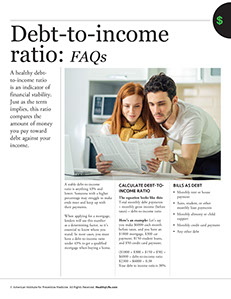
    Young couple looking over bills together.

    A healthy debt-to-income ratio is an indicator of financial stability. Just as the term implies, this ratio compares the amount of money you pay toward debt against your income.

    A stable debt-to-income ratio is anything 43% and lower. Someone with a higher percentage may struggle to make ends meet and keep up with their payments.

    When applying for a mortgage, lenders will use this number as a determining factor, so it’s essential to know where you stand. In most cases, you must have a debt-to-income ratio under 43% to get a qualified mortgage when buying a home.

    Calculate debt-to-income ratio

    The equation looks like this: Total monthly debt payments ÷ monthly gross income (before taxes) = debt-to-income ratio

    Here’s an example: Let’s say you make $6000 each month before taxes, and you have an $1800 mortgage, $300 car payment, $150 student loans, and $50 credit card payment.

    ($1800 + $300 + $150 + $50) ÷ $6000 = debt-to-income ratio

    $2300 ÷ $6000 = 0.38

    Your debt to income ratio is 38%.

    Bills as debt

    *  Monthly rent or house payment

    *  Auto, student, or other monthly loan payments

    *  Monthly alimony or child support

    *  Monthly credit card payment

    *  Any other debt
    © American Institute for Preventive Medicine
  • Build A Budget

    Financial Health

    Make a plan to live within your means.

    No matter what your income, having a budget helps you plan and manage your money. It also helps you get a grip on your spending. You can use a budget-making tool, such as a free one from the websitewww.mint.com. You can write one on your own with a pencil and paper.

    Track your expenses:

    First, list your fixed monthly must-haves − mortgage or rent, phone, cable, Internet access, car payment, or public transit costs. Include other regular set monthly expenses, such as loan payments, tuition and/or student loans, insurance premiums, church donations, and gym and other monthly membership fees. Next, identify your variable expenses. These include what you spend weekly, monthly, two or four times a year, and yearly for:

    *  Groceries

    *  Restaurant meals, snacks, coffee and other drinks

    *  Gas and upkeep for your car

    *  Electric, gas, and water bills

    *  Property taxes

    *  Credit card payments

    *  Entertainment – Movies, DVDs, concerts, golf, toys, and social events

    *  Clothes and shoes

    *  Haircuts, cosmetics, and toiletries

    *  Gifts for birthdays, holidays, weddings, etc.

    *  Household items and home improvements

    *  Vacation

    You can get amounts for many of these from monthly statements for your credit cards, debit cards, and checking and saving accounts. Otherwise, get and keep receipts for everything you pay for. You may be surprised by how much you spend on coffee drinks, food, liquor, and tips when eating out.

    Put some of your income into a savings account. Do this yourself from your take-home pay or have a pre-set amount automatically deposited into a savings account.

    Start by listing your total monthly income:

    Include your take-home pay, alimony, child support, unemployment, social security, and public aid. If you work on commission or freelance, your income can vary from month to month. Just estimate a monthly amount.

    Action Step

    If you are spending more than you earn, cut back on variable expenses. If you still have money left over after paying your bills and putting money into savings, carry over the extra for future expenses.

    Ways to Well-Being book by the American Institute for Preventive Medicine. www.HealthyLife.com. All rights reserved.

    © American Institute for Preventive Medicine

  • Disability Insurance

    Medical Care

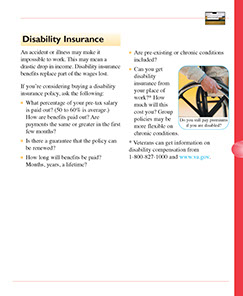
    Image of nurse with wheelchair bound women.

    An accident or illness may make it impossible to work. This may mean a drastic drop in income. Disability insurance benefits replace part of the wages lost.

    If you’re considering buying a disability insurance policy, ask the following:

    *  What percentage of your pre-tax salary is paid out? (50 to 60% is average.) How are benefits paid out? Are payments the same or greater in the first few months?

    *  Is there a guarantee that the policy can be renewed?

    *  How long will benefits be paid? Months, years, a lifetime?

    *  Are pre-existing or chronic conditions included?

    *  Can you get disability insurance from your place of work?* How much will this cost you? Group policies may be more flexible on chronic conditions.

    * Veterans can get information on disability compensation from 1-800-827-1000 andwww.va.gov.

    Page from the Health at Home Lifetime book by the American Institute for Preventive Medicine. www.HealthyLife.com. All rights reserved.

    © American Institute for Preventive Medicine