Tag: itch

  • Bites & Stings

    First Aid

    For Bites

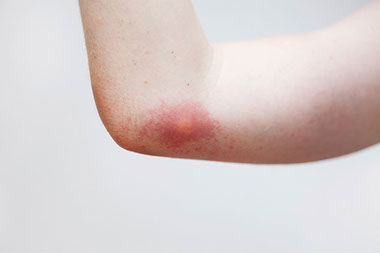
    Image of arm with an insect bite mark.

    Signs & Symptoms

    *  Swelling. Redness. Pain. Itching.

    *  Bleeding.

    *  Tissue loss, if the wound is severe.

    *  Skin rash.

    *  Lockjaw. This is a painful, persistent stiffness of the jaw due to a toxin. Tetanus shots can prevent this.

    *  Allergic reaction, such as with insect bites.

    Causes

    *  Dog, cat, and human bites are the most common animal bites in the U.S.

    *  Deer tick bites can cause Lyme disease, a bacterial infection.

    *  Bed bug bites cause redness, swelling, and large, red welts or raised areas on the skin.

    *  Black widow and brown recluse spider bites can cause severe reactions.

    *  Less common, but more dangerous, are bites from skunks, raccoons, bats, and other animals that live in the wild. These animals can have rabies – a serious viral infection. It can be fatal. Most house pets are vaccinated for rabies. It’s unlikely they carry the virus.

    *  Mosquito bites can cause West Nile virus if the mosquito is infected with it.

    *  Snake bites can be fatal if the bite is from a poisonous snake (e.g., rattlesnakes, cotton mouths, copperheads, and coral snakes).

    *  Shark bites are a potential problem when swimming in shark-infested waters.

    Treatment

    Self-care can be used for dog and cat bites that cause scratches on the skin and for insect bites that do not cause a severe allergic reaction. All human bites that break the skin should be checked by a doctor due to the high risk for infection.

    A series of rabies shots can prevent the spread of rabies to humans. The shots should begin soon after a bite from an infected animal.

    Antivenom can be given for poisonous snake bites at emergency medical facilities. It should be given within 4 hours of the bite.

    For Stings

    Signs & Symptoms

    *  Quick, sharp pain.

    *  Swelling, itching, and redness at the sting site. These can occur beyond the sting site.

    *  Raised bump (with or without pus).

    *  Signs of a severe allergic reaction.

    Causes

    *  Insect stings.

    *  Marine animals that sting include jellyfish, Portuguese Man-of-War, and sea nettles.

    Treatment

    Self-care treats mild reactions to stings. A severe allergic reaction needs immediate care. Symptoms of a severe allergic reaction usually happen soon after or within an hour of the sting.

    Persons with a severe allergic reaction to a sting in the past should carry an emergency kit, prescribed by a doctor. A medical alert tag should be worn to let others know of the allergy. Persons who have had severe reactions to bee or wasp stings should ask their doctors about allergy shots.

    Questions to Ask

    Self-Care / First Aid

    For Poisonous Snake Bites Before Medical Care

    *  Carefully move the person away from the snake. Calm the person. Have him or her rest. Moving about can help spread the venom.

    *  Gently wash the bite area with soap and water. Keep the limb of the bite site level with the heart (or just below this). Apply a splint to the limb of the bite site to keep it from moving.

    *  Being careful, note, if you can, the shape of the snakes eyes, pupils, and head, the colors it is, and if it has rattles.

    *  Don’t try to kill the snake, cut the fang mark, or suck out the venom.

    *  Don’t apply a tourniquet, a bandage, or ice to the bite.

    For Non-Poisonous Snake Bites

    *  Gently wash the site with soap and water.

    *  Treat the bite as a minor wound.

    *  If you notice signs of an infection, call your doctor.

    For Poisonous Spider Bites Until Emergency Care Arrives

    *  Perform rescue breathing, if needed.

    *  If you can, keep the bitten area lower than the level of the heart.

    *  Calm the person and keep him or her warm.

    *  Gently clean the site of the bite with soap and water or rubbing alcohol.

    *  Put an ice pack over the bite site for pain relief.

    *  If you can, catch the spider in a closed container to show what kind it is.

    For Poisonous Spider and Scorpion Bites Before Medical Care

    *  Do rescue breathing, if needed.

    *  If you can, keep the bitten area lower than the level of the heart.

    *  Calm the victim and keep him or her warm.

    *  Gently clean the site of the bite with soap and water or rubbing alcohol.

    *  Put an ice pack over the bite site to relieve pain.

    *  If you can, catch the spider in a closed container to show the doctor. n Get emergency care!

    For Human Bites Before Medical Care

    *  Wash the wound area with soap and water for at least 5 minutes. Don’t scrub hard. Rinse with running water or with an antiseptic solution, such as Betadine.

    *  Cover the wound area with sterile gauze. Tape only the ends of the gauze in place. Then get medical care.

    For Deer Tick Bites

    *  Remove any ticks found on the skin. Use tweezers to grasp the tick(s) as close to the skin as you can. Pull gently and carefully in a steady upward motion at the point where the tick’s mouthpart enters the skin. Try not to crush the tick. The secretions released may spread disease.

    *  After you remove the ticks, wash the wound area and your hands with soap and water. Apply rubbing alcohol to help disinfect the area.

    *  Use an ice pack over the bite area to relieve pain.

    *  Save one tick in a closed jar with rubbing alcohol to show the doctor.

    For Dog and Cat Bites

    *  Wash the bite area right away with soap and warm water for 5 minutes. If the bite is deep, flush the wound with water for 10 minutes. Dry the wound with a clean towel. Then get medical care.

    *  If the wound is swollen, apply ice wrapped in a towel for 10 minutes.

    *  Get a tetanus shot, if needed.

    *  If the bite hurts, take an over-the-counter (OTC) medicine for pain.

    *  Report the incident to the animal control department. If a pet’s immunizations are not current, arrange with the animal control department for the pet to be observed for the next 10 days to check for rabies.

    *  Observe the wound for a few days. Look for signs of infection. Often, cat bite wounds need an antibiotic.

    For a Stingray Bite

    *  Remove the person from the water.

    *  Apply a local pressure bandage for a wound that bleeds a lot.

    *  Immerse the wound area in hot water for 30 to 90 minutes. Make sure the water is not hot enough to burn the skin.

    *  Scrub the wound area well with soap and water.

    *  Unless the wound is a slight one in only one limb, get medical help right away.

    For Stings from Jellyfish or Sea Nettles, etc.

    *  Remove the person from the water. Don’t touch the sting area with bare hands.

    *  Rinse the sting area with salt (not fresh) water right away. Don’t put ice on the skin. If you can, put vinegar or rubbing alcohol on the area several times for 30 or more minutes until the pain is relieved.

    *  Apply dry or moist heat to the sting area until the pain subsides. You can mix one part ammonia with 3 parts salt water and apply this to the sting area.

    *  Wear gloves when you remove stingers. Use a towel to wipe the stingers or the tentacles off. Use tweezers to lift large tentacles. Don’t scrape or rub them.

    *  To relieve itching, apply OTC calamine lotion or 1% hydrocortisone cream to the affected area as directed on the label.

    *  Contact your doctor for any signs of infection.
    Healthier at Home book by the American Institute for Preventive Medicine. www.HealthyLife.com. All rights reserved.

    © American Institute for Preventive Medicine
  • Dry Skin

    Skin Conditions

    Signs & Symptoms

    *  Itchy skin. The skin can be red from scratching it.

    *  Chapped skin.

    *  Skin cracks, peels, and/or flakes.

    Causes

    *  Aging. The body naturally produces less oil and moisture.

    *  Cold winter weather. Dry air or heat.

    *  Washing the skin often. Using harsh skin products.

    *  Chronic and excessive sun exposure.

    *  Allergies. An underactive thyroid gland. Diabetes. Kidney disease. Other skin conditions, such as psoriasis.

    Treatment

    Dry skin is not a serious health risk. It can be managed with self-care. When dry skin is a symptom of a health problem, treating the problem treats the dry skin.

    Questions to Ask

    Self-Care / Prevention

    *  Drink 8 or more glasses of water a day.

    *  Apply an oil- based lotion daily.

    *  Wear rubber gloves when you wash dishes.

    *  Take showers instead of baths. Use warm (not hot) water. Try sponge baths.

    *  Apply a moisturizing cream while your skin is damp. Use products with lanolin.

    *  If you do bathe, do so for only 15 to 20 minutes in lukewarm water. Pat yourself dry. Do not rub.

    *  Put soap on a washcloth, not right on the skin.

    *  Use a mild liquid soap, like Cetaphil lotion or use a fatted soap. Avoid deodorant, medicated, or alkaline soaps.

    *  Don’t use moisturizers with fragrances, preservatives, or alcohol.

    *  Use a night cream for the face.

    *  Stay out of the strong sun. Do not use tanning salons. When in the sun, use a sunblock with a sun protection factor (SPF) of at least 15.

    *  Don’t scratch or rub dry skin.

    Resources

    American Academy of Dermatology

    866.503.SKIN (503.7546)

    www.aad.org

    Healthier at Home book by the American Institute for Preventive Medicine. www.HealthyLife.com. All rights reserved.

    © American Institute for Preventive Medicine
  • Eczema

    Skin Conditions

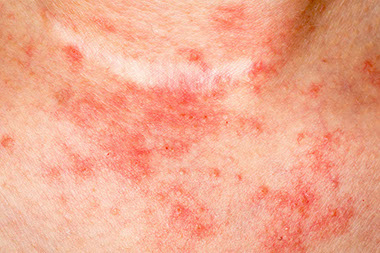
    Image of an eczema rash.

    Eczema (atopic dermatitis) is a chronic skin condition. It usually appears on the scalp, face, neck, or creases of the elbows, wrists, and knees. It usually improves as you get older, but can be a lifetime problem.

    Signs & Symptoms

    Patches of skin that are:

    *  Dry, red, and scaly

    *  Blistered and swollen

    *  Sometimes thick, discolored, or oozing and crusting

    Causes, Risk Factors & Care

    Eczema tends to run in families. It is also more common in persons who have allergies or asthma. Contact with cosmetics, dyes, deodorants, skin lotions, permanent press fabrics, and other allergens can aggravate eczema; so can wool fabrics, stress, exposure to extreme weather conditions, and eating foods, such as eggs, milk, seafood, or wheat products.

    Your doctor may prescribe antibiotics for skin infections and/or other medicines if self-care does not relieve symptoms.

    Self-Care

    *  Don’t scratch! This makes eczema worse. Your skin can get infected. Keep your fingernails cut short.

    *  Don’t take baths too often. Add bath oil to the water. Sponge bathe in between tub baths. Take quick showers.

    *  Use warm (not hot) water when you take a bath or shower.

    *  Use a mild soap or no soap at all on the areas of eczema.

    *  Don’t use wool clothes and blankets.

    *  Use a light, nongreasy and unscented lotion on your skin after you wash. Don’t use lotions that have alcohol. They can dry the skin.

    *  Try to keep from sweating. For example, don’t wear too many clothes for the weather.

    *  Wear rubber gloves when you do housework. Put talcum powder or cornstarch inside the gloves, or use latex gloves lined with cotton.

    *  Avoid foods, chemicals, cosmetics, and other things that make your eczema worse.

    When to Seek Medical Care

    Contact Doctor When:

    *  You have signs of an infection: Fever; and/or large amount of weeping or crusting skin areas.

    *  Your skin is red, you can’t stop scratching, and this keeps you from sleeping.

    *  You get no relief from self-care.

    Health at Home Lifetime book by the American Institute for Preventive Medicine. www.HealthyLife.com. All rights reserved.

    © American Institute for Preventive Medicine
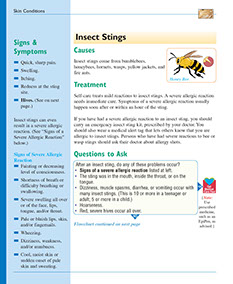
  • Insect Stings

    Skin Conditions

    Signs & Symptoms

    *  Quick, sharp pain.

    *  Swelling.

    *  Itching.

    *  Redness at the sting site.

    *  Hives.

    Insect stings can even result in a severe allergic reaction.

    Causes

    Insect stings come from bumblebees, honeybees, hornets, wasps, yellow jackets, and fire ants.

    Treatment

    Self-care treats mild reactions to insect stings. A severe allergic reaction needs immediate care. Symptoms of a severe allergic reaction usually happen soon after or within an hour of the sting.

    If you have had a severe allergic reaction to an insect sting, you should carry an emergency insect sting kit, prescribed by your doctor. You should also wear a medical alert tag that lets others know that you are allergic to insect stings. Persons who have had severe reactions to bee or wasp stings should ask their doctor about allergy shots.

    Questions to Ask

    Self-Care / Prevention

    To Avoid Insect Stings

    *  Keep food and drink containers tightly covered. (Bees love sweet things, like soft drinks.)

    *  Don’t wear perfume, colognes, or hair spray when you are outdoors.

    *  Don’t wear bright colors, like white or yellow. Choose neutral colors, like tan or khaki. Wear snug clothing that covers your arms and legs.

    *  Don’t go barefoot. If camping, look for insects in your shoes before you put them on.

    *  Wear an insect repellent, especially if you are sensitive to insect stings.

    *  Be careful when you work outdoors, pull weeds, mow tall grass, and work around shutters. Bees often build hives behind shutters.

    *  If an insect that stings gets in your car, stop the car. Put the windows down. Once the insect leaves, resume driving.

    *  Check for and repair openings in your window screens.

    To Treat an Insect Sting Without a Severe Allergic Reaction

    *  For a bee sting, gently scrape out the stinger as soon as possible. Use a blunt knife, credit card, or a fingernail. Yellow jackets, wasps, and hornets don’t lose their stingers.

    *  Don’t pull the stinger out with your fingers or tweezers. Don’t squeeze the stinger. It contains venom. You could re-sting yourself.

    *  Clean the sting area with soapy water.

    *  Remove jewelry from bitten fingers, wrists, etc. It may be difficult to remove jewelry once swelling occurs.

    *  Put a cold compress (ice in a cloth, etc.) on the sting. Don’t put ice directly on the skin. Hold the cold compress on the site for 10 to 15 minutes.

    *  Keep the sting area lower than heart level.

    *  Take an over-the-counter medicine for pain as directed on the label.

    *  For itching and swelling, apply a topical 1% hydrocortisone cream and/or take an over- the-counter antihistamine, such as Benadryl, if okay with your doctor. Follow directions on the labels.

    Signs of Severe Allergic Reaction

    *  Fainting or decreasing level of consciousness.

    *  Shortness of breath or difficulty breathing or swallowing.

    *  Severe swelling all over or of the face, lips, tongue, and/or throat.

    *  Pale or bluish lips, skin, and/or fingernails.

    *  Wheezing.

    *  Dizziness, weakness, and/or numbness.

    *  Cool, moist skin or sudden onset of pale skin and sweating.

    Healthier at Home book by the American Institute for Preventive Medicine. www.HealthyLife.com. All rights reserved.

    © American Institute for Preventive Medicine
  • Poison Ivy, Oak & Sumac

    Skin Conditions

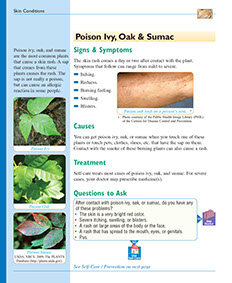
    Poison ivy, oak, and sumac are the most common plants that cause a skin rash. A sap that comes from these plants causes the rash. The sap is not really a poison, but can cause an allergic reaction in some people.

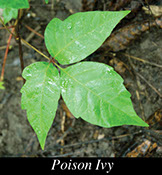
    Image of posion ivy leaf.
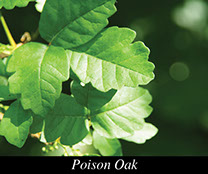
    Image of poison oak leaf.
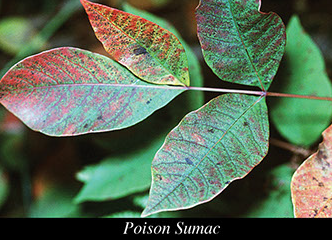
    Image of poison sumac.

    Signs & Symptoms

    The skin rash comes a day or two after contact with the plant. Symptoms that follow can range from mild to severe.

    *  Itching.

    *  Redness.

    *  Burning feeling.

    *  Swelling.

    *  Blisters.

    Causes

    You can get poison ivy, oak, or sumac when you touch one of these plants or touch pets, clothes, shoes, etc. that have the sap on them. Contact with the smoke of these burning plants can also cause a rash.

    Treatment

    Self-care treats most cases of poison ivy, oak, and sumac. For severe cases, your doctor may prescribe medicine(s).

    Questions to Ask

    Self-Care / Prevention

    To Prevent Getting a Rash

    *  Know what these plants look like and avoid them.

    – Poison ivy and poison oak both have 3 leaflets per stem. This is why you may have heard the saying, “Leaflets three, let them be.”

    – Each branch of poison sumac has 7 to 13 leaflets on a reddish stem. A single leaf is on the end of the stem. The others are paired along each side of the stem. Poison sumac grows in wetlands.

    *  Use an over-the-counter lotion (IvyBlock), which blocks skin contact with the sap. Use it as directed.

    *  Wear pants and long-sleeved shirts.

    *  Use an over-the-counter product (e.g., Tecnu) that removes poison ivy sap.

    *  Rinse the affected area with water.

    *  To help prevent an allergic reaction, do the things listed below. Do them within 6 hours of contact with one of the plants.

    – Remove all clothes and shoes that have touched the plant.

    – Wash the skin area well with soap and water.

    – Use an over-the-counter product (e.g., Tecnu) that removes poison ivy sap.

    To Treat Poison Ivy, Oak, or Sumac

    *  Take a cold shower, put the rash area in cold water, or pour cold water over it. Use soap when you shower.

    *  To relieve itching, take an over-the-counter antihistamine, such as Benadryl. Follow the label’s directions.

    *  For weeping blisters, mix 2 teaspoons of baking soda in 4 cups of water. Dip squares of gauze in this mixture. Cover the blisters with wet gauze for 10 minutes, 4 times a day. Do not apply this to the eyes.

    *  Wash all clothes and shoes with hot water and a strong soap. Bathe pets that have come in contact with the plant. The sap can stay on pets for many days. Clean items used to wash clothing and pets. Wear rubber gloves when you do all these things.

    *  Keep your hands away from your eyes, mouth, and face.

    *  Do not scratch or rub the rash.

    *  Take baths with lukewarm water. Add an over- the-counter product called Aveeno colloidal oatmeal.

    *  Apply any of these to the skin rash:

    – Calamine (not Caladryl) lotion.

    – Over-the-counter hydrocortisone cream. Follow the directions on the label.

    – A paste of 3 teaspoons of baking soda and 1 teaspoon of water.

    Healthier at Home book by the American Institute for Preventive Medicine. www.HealthyLife.com. All rights reserved.

    © American Institute for Preventive Medicine
  • Skin Rashes

    Skin Conditions

    This is caused by the varicella-zoster virus. This condition is contagious.

    Chickenpox

    Signs & Symptoms

    Flat, red spots that become raised and look like small pimples. These develop into small blisters that break and crust over. Fatigue and mild fever occur 24 hours before rash appears. Itching may be intense.

    What To Do

    See doctor or health care provider if it occurs in an adult; if self-care measures don’t bring relief in children; or if there are signs of infection (e.g., pus, increased redness, swelling, or pain). A vaccine is given to prevent this disease.

    Self-Care

    Keep from scratching affected areas. Apply cool, wet washcloths with baking soda or calamine lotion to affected areas. Take acetaminophen for fever. Take an OTC antihistamine as advised by your doctor if itching is intense. Chickenpox can be prevented with a chickenpox vaccine.

    Contact Dermatitis

    Causes are direct contact with poison ivy, oak, or sumac or contact with an irritant (cleaning product, cosmetic, jewelry, etc.).

    Signs & Symptoms

    Dry, red, itchy patches of skin. Blisters which may drain and then crust over.

    What To Do

    See doctor or health care provider if self- care measures don’t bring relief or if there are signs of infection (e.g., red streaks, fever, pus, increased redness, swelling, or pain).

    Self-Care

    Try to identify the irritant and avoid direct contact with it. Don’t scratch the rash. For itching, apply calamine lotion or OTC hydrocortisone cream to the affected area. Bathe in warm (not hot) water. Add an oatmeal product to the water. Pat (don’t rub) the skin dry. Take an OTC antihistamine as advised.

    Cradle Cap

    This is due to hormones that pass through the placenta before birth.

    Signs & Symptoms

    Scaly, crusty rash (in newborns) that starts behind the ears and spreads to the scalp.

    What To Do

    Use self-care.

    Self-Care

    Apply mineral oil to the scalp to soften the hard crusts, then use an antidandruff shampoo. Do this 2 to 3 times a week, massaging the scalp with a soft brush or washcloth for 5 minutes. Be sure to wash all of the oil out.

    Eczema (Atopic Dermatitis)

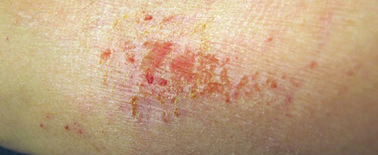
    Image of eczema rash.

    This tends to run in families. It is common in persons with asthma or allergies. Contact with irritants may worsen eczema.

    Signs & Symptoms

    Patches of skin that are dry, red, scaly, blistered, swollen, and sometimes thick, discolored, or oozing and crusting. Commonly occurs in the bend of the elbow or behind the knee.

    What To Do

    See doctor or health care provider if self- care measures don’t bring relief or if there are signs of infection (e.g., red streaks, fever, pus, increased redness, swelling, or pain).

    Self-Care

    Use an OTC hydrocortisone cream on the affected area. Don’t scratch. Don’t bathe too often. When you do, use warm (not hot) water and a mild soap (or no soap). Use a light, nongreasy, unscented lotion (without alcohol) after you wash. Avoid items that worsen the eczema.

    Heat Rash (Prickly Heat)

    Heat rash (prickly heat) or chafing. This occurs from too much sweating.

    Signs & Symptoms

    Rash with small red pimples, pink blotchy skin, and itching. Common sites are between skin folds (armpits, under the breasts, the groin).

    What To Do

    Use self-care.

    Self-Care

    Bathe in cool water without soap every couple of hours. Let your skin air dry. Put cornstarch in body creases or apply calamine lotion to very itchy spots. Don’t use ointments and creams that can block sweat gland pores. Stay in a cool, dry area.

    Fifth Disease

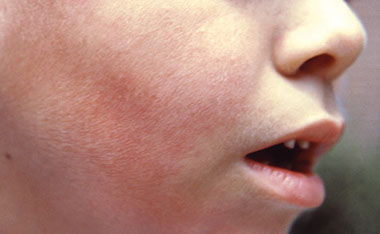
    Image of fifth disease rash.

    This is caused by the Human parvovirus B19. This condition is contagious.

    Signs & Symptoms

    Red rash of varying shades that fades to a flat, lacy pattern. Rash comes and goes. It usually starts on the facial cheeks and then on the arms and legs. This is a mild disease, usually with no other symptoms.

    What To Do

    Use self-care, but no special treatment is required.

    Self-Care

    Avoid hot or even warm baths or showers. Keep cool.

    Hives

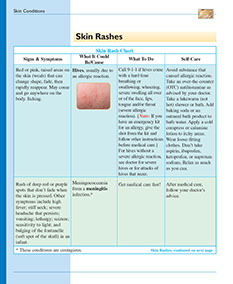
    Hives, usually due to an allergic reaction.

    Signs & Symptoms

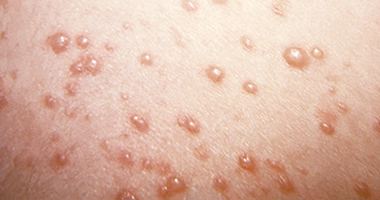
    Red or pink, raised areas on the skin (weals) that can change shape, fade, then rapidly reappear. May come and go anywhere on the body. Itching.

    What To Do

    Call 9-1-1 if hives come with a hard time breathing or swallowing, wheezing, severe swelling all over or of the face, lips, tongue and/or throat (severe allergic reaction). {Note: If you have an emergency kit for an allergy, give the shot from the kit and follow other instructions before medical care.} For hives without a severe allergic reaction, see doctor for severe hives or for attacks of hives that recur.

    Self-Care

    Avoid substance that caused allergic reaction. Take an over-the-counter (OTC) antihistamine as advised by your doctor. Take a lukewarm (not hot) shower or bath. Add baking soda or an oatmeal bath product to bath water. Apply a cold compress or calamine lotion to itchy areas. Wear loose-fitting clothes. Don’t take aspirin, ibuprofen, ketoprofen, or naproxen sodium. Relax as much as you can.

    Impetigo

    This is caused by a bacterial infection. This condition is contagious.

    Signs & Symptoms

    In infants, pus-filled blisters and red skin. In older children, golden crusts on red sores. Areas affected are the arms, legs, face, and around the nose first, then most of body. Sometimes fever. Occasional itching.

    What To Do

    See doctor or health care provider, especially if self-care measures don’t bring relief, if blisters are larger than 1 inch across, or if a red streak runs from the infection. An antibiotic may need to be prescribed.

    Self-Care

    Clean the area with an antibacterial soap several times a day. Apply an OTC antibiotic ointment 3 times a day after the scab falls off. Wash your hands after contact with the rash area. Don’t share towels, etc.

    Lyme Disease

    This is caused by a deer tick bite.

    Signs & Symptoms

    A fever and red rash 3 days to 2 weeks after a deer tick bite. The rash has raised edges with pale centers. It fades after a few days. Joint pain may develop later.

    What To Do

    See doctor or health care provider for diagnosis. Can be treated with an antibiotic.

    Self-Care

    Follow your doctor’s advice.

    Measles

    This is caused by a virus. This condition is contagious. MMR vaccines prevent measles.

    Signs & Symptoms

    Blotchy red rash that starts on the face and spreads to the rest of the body. Rash lasts about 7 days. These signs come before the rash: Fever; runny nose; sneezing; cough; eyes that look red and are sensitive to light; and blue-white spots in the mouth.

    What To Do

    Call doctor right away to be sure the problem is measles. If it is, follow the doctor’s advice. Let the child’s school and the local health department know.

    Self-Care

    Rest until fever and rash go away. Drink lots of liquids. For fever, take acetaminophen. Treat cough. Avoid lights, TV, reading, etc. while eyes are sensitive to light. Usually okay to return to school about 7 to 10 days after rash and fever are gone.

    Meningococcemia

    Meningococcemia from a meningitis infection. These conditions are contagious.

    Signs & Symptoms

    Rash of deep red or purple spots that don’t fade when the skin is pressed. Other symptoms include high fever; stiff neck; severe headache that persists; vomiting; lethargy; seizure; sensitivity to light; and bulging of the fontanelle (soft spot of the skull) in an infant.

    What To Do

    Get medical care fast!

    Self-Care

    After medical care, follow your doctor’s advice.

    Psoriasis

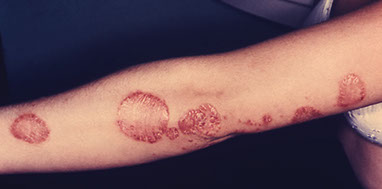
    Image of psoriasis.

    This is a chronic skin disease that tends to run in families. The exact cause is not known.

    Signs & Symptoms

    Itchy, red patches covered with silvery-white flaky skin. Common sites are the scalp, elbows, forearms, knees, and legs.

    What To Do

    See doctor or health care provider if psoriasis affects large areas of skin and/or if self-care measures don’t bring relief.

    Self-Care

    To prevent dryness, use a moisturizer. Use an OTC hydrocortisone or coal tar cream or ointment. If psoriasis affects your scalp, use an antidandruff shampoo. Take a bath with mineral salts or an oatmeal bath product.

    Ringworm

    This is caused by a fungal infection. This condition is contagious.

    Signs & Symptoms

    Redness, itchy, scaly patches on the skin or scalp that are round with distinct edges that grow outward as the infection spreads. Moistness in the folds of the skin (under the breasts or in the groin area). Bald spots may appear on the scalp.

    What To Do

    See doctor or health care provider for diagnosis and treatment, especially if you have not had this before or if ringworm occurs on the scalp or in several patches on the skin.

    Self-Care

    Follow your doctor’s advice.

    Rocky Mountain Spotted Fever

    Rocky mountain spotted fever, 1 to 14 days after a bite from an American dog tick or Rocky Mountain woodtick. These conditions are contagious.

    Signs & Symptoms

    Pink to red rash on the arms, legs, and palms of the hands. Often starts near the wrists and ankles, then spreads inward. Rash darkens in color, spreads, and can bleed. Sudden high fever with chills, severe headache, and delirium also occur.

    What To Do

    Contact doctor right away.

    Self-Care

    Follow your doctor’s advice.

    Rosacea (Adult Acne)

    The exact cause is not known. It may result from overuse of corticosteroid creams or alcohol use.

    Signs & Symptoms

    Red rash on the face. Red nose that looks swollen and puffy cheeks. May have pus-filled spots without blackheads or whiteheads.

    What To Do

    See doctor or health care provider if rosacea affects large areas of skin and/or if self-care measures don’t bring relief.

    Self-Care

    Avoid hot and/or spicy foods, alcohol, and caffeine. Don’t rub or massage the face. Avoid strong sunlight.

    Roseola

    This is caused by the Herpes type-6 virus.

    Signs & Symptoms

    Flat, rosy red rash on the chest and abdomen. A high fever occurs 2 to 4 days before the rash. The child feels only mildly ill when the fever is present.

    What To Do

    See doctor or health care provider if high fever causes febrile seizure.

    Self-Care

    Take acetaminophen for fever. Apply cool, wet washcloths or take baths with tepid (not cold) water.

    Scabies

    This is caused by skin parasites called itch mites. This condition is contagious.

    Signs & Symptoms

    Tiny red pimples that itch intensely, usually between the fingers, on the wrists and genitals; in the armpits; and along the belt line. Scabs and sores may form.

    What To Do

    See doctor or health care provider for diagnosis. Can be treated with a prescribed topical medicine.

    Self-Care

    Follow your doctor’s instructions. Wash clothing and bedding in hot water and detergent.

    Scarlet Fever

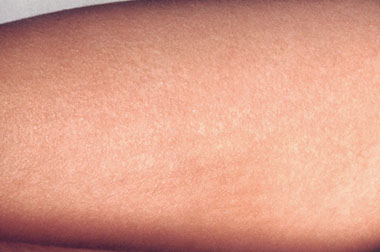
    Image of scarlet fever.

    This is caused by a bacterial infection. These conditions are contagious.

    Signs & Symptoms

    Rough, bright red rash (feels like sandpaper) on the face, neck, elbows, armpits, and groin. It spreads rapidly to entire body. A high fever and weakness occur before the rash. Other symptoms include sore throat, peeling of the skin, vomiting, and swollen tongue.

    What To Do

    See doctor or health care provider for diagnosis. Can be treated with an antibiotic.

    Self-Care

    Take acetaminophen for fever. Rest and drink plenty of fluids.

    Seborrhea

    This is a type of dermatitis. The glands in the skin make too much oil.

    Signs & Symptoms

    Scaly, oily rash with small, reddish-yellow patches. Areas affected are usually oily ones (the edge of the scalp, forehead, nose, and eyebrows) and the back and chest.

    What To Do

    See doctor or health care provider if self- care measures don’t bring relief or if there are signs of infection (e.g., red streaks, fever, pus, increased redness, swelling, or pain).

    Self-Care

    Use an OTC antidandruff shampoo with salicylic acid on the scalp area. Use OTC hydrocortisone cream on the affected skin areas. Handle the skin gently. Don’t scratch. Don’t use irritants like detergents.

    Shingles

    Image of the shingles.

    Shingles from the herpes zoster virus.* (Persons who have not had chicken pox or a vaccine for it can get chicken pox from exposure to shingles.) These conditions are contagious.

    Signs & Symptoms

    Rash of painful red blisters (most often on only one side and in only one area of the body). Pain, itching, burning, or tingling feeling before the rash appeared.

    What To Do

    See doctor or health care provider within 24 to 72 hours for an oral antiviral medicine. This can shorten the course of shingles and make symptoms less severe. {Note: All adults 60 years of age and older are advised to get a vaccine that can help prevent shingles and reduce the pain due to shingles.}

    Self-Care

    Take pain relievers as advised by your doctor. For itching, apply calamine lotion or a paste made of 3 teaspoons of baking soda mixed with 1 teaspoon of water to the affected area. Apply a cool, wet compress to blisters for 20 minutes at a time. Wash (don’t scrub) blisters until they crust over. Drink plenty of liquids.

    Syphilis

    This is a sexually transmitted disease caused by a specific bacterial infection. This condition is contagious.

    Signs & Symptoms

    Widespread red rash on the palms of the hands, soles of the feet, and sometimes around the mouth and nose. The small, red, scaly bumps do not itch. Other types of rashes, swollen lymph nodes, fever, and flu-like symptoms may also occur.

    What To Do

    See doctor or health care provider for diagnosis. Can be treated with an antibiotic.

    Self-Care

    Follow your doctor’s advice.

    West Nile Virus

    West Nile virus, 3 to 15 days after a bite from a mosquito infected with the virus.

    Signs & Symptoms

    Rash on the trunk of the body with fever, headache, bodyaches, and swollen lymph glands.

    What To Do

    See doctor right away.

    Self-Care

    Follow your doctor’s advice.

    Healthier at Home book by the American Institute for Preventive Medicine. www.HealthyLife.com. All rights reserved.

    © American Institute for Preventive Medicine
  • Don’T Let The Bed Bugs Bite

    SELF-CARE CORNER

    Image of women making bed.

    Bed bugs have become more common in the U.S. in recent years. Common pesticides used to kill bed bugs may not work as well as they once did. The bugs may be getting “resistant,” which means they can survive pesticides used on them. This resistance, along with increased travel by people and lack of knowledge about how to get rid of them, are likely to blame for the rise in these pests.

    Bed bugs feed on blood so they are attracted to people and animals. They also come out at night, so the bed is the best place for them to find their meal.

    Check for bed bugs

    If you want to keep bed bugs out, you’ll need to check your home, as well as hotels while traveling. Look for small, reddish brown bugs about the size of an apple seed. Use a flashlight to get a good look. Check:

    *  Under and all around the mattress, box spring and bed frame

    *  Seams and small crevices where they like to hide –  bed bugs can get into cracks as thin as a credit card

    *  Nightstands and other furniture near beds

    Do I have bed bugs?

    Even if you don’t see any bugs, watch for signs that they are hiding in your home and biting people. The most common signs of bed bugs include:

    *  Small, reddish spots on bed sheets or mattresses

    *  Small round, dark spots on the bed  (may look like ink spots)

    *  Tiny eggs, egg shells or light yellow skins

    How to prevent them

    Bed bugs have been found in clean homes that are well cared for. They can be hard to keep out. These tips can help you keep them away:

    *  Check for bed bugs when you travel and don’t put your suitcase on the bed.

    *  When you get home from a trip, immediately wash your travel clothes in hot water.

    *  Keep luggage outside when you get home and vacuum it thoroughly. Empty the vacuum contents into a plastic bag, seal it and throw it in the garbage outside.

    If you find a bug that might be a bed bug, tape it to a piece of paper so you can show it to a pest control expert. Call a pest control company right away. If you live in an apartment or rental home, contact your landlord about what to do.

    The Environmental Protection Agency has information about getting rid of them on their website. Visitwww.epa.gov/bedbugs.

    Sources: National Institutes of Health, Environmental Protection Agency

    © American Institute for Preventive Medicine
  • Why Do Mosquitoes Always Bite Me?

    MEDICAL NEWS

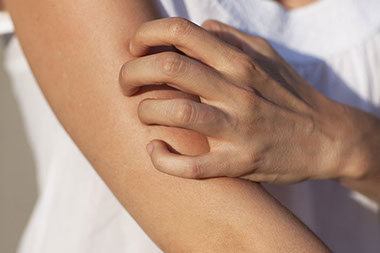
    Close up image of person itching arm.

    It has to do with how you smell, but scientists still don’t know why some breeds are attracted to different smells, said Jason Pitts, professor of biological sciences at Vanderbilt University.

    The source of the aromatic compounds that produce body odor are bacterial colonies that exist on human skin, particularly in dark, moist areas such as the armpits and between the toes. Pitts and his colleagues have discovered that mosquito antennae are filled with hundreds of tiny odor receptors, which are individually tuned to detect specific odors.

    Just as mosquitoes may love you, they may not love natural repellants such as clove oil, citronella, lemon grass, eucalyptus, castor oil, peppermint, lavender, and cedar oil. But almost all of these are less effective than the synthetic repellant DEET, and they need to be reapplied more frequently.

    Bet you didn’t know these pesky insects have a long-range system that allows them to track down potential prey from more than 100 yards away. The mosquitoes do so, in part, by sensing the carbon dioxide in human breath. When we exhale, our breath contains more carbon dioxide than the surrounding air, and mosquitoes can detect this difference-especially if you’ve had a beer or other alcoholic drink.

    To avoid mosquito bites, CDC gives the following advice:

    *  Use an insect repellant when you go outdoors. The FDA approves ones with DEET, picaridin. IR3535, and oil of lemon eucalyptus. Follow the product label’s directions.

    *  As much as possible, wear long sleeves, long pants, and socks. For extra protection, spray clothes, not your skin, with repellant that contains permethrin.

    *  Avoid outdoor activities from dusk to dawn or take extra care to use insect repellant and protective clothing during these times.

    *  Keep mosquitoes outside the house. Use screens on windows and doors or use air conditioning.

    *  On a regular basis, empty water that collects in outdoor buckets, flowerpots, pool covers and bird baths. Mosquitoes like stationary water.

    © American Institute for Preventive Medicine
  • Winter Itch

    SELF-CARE CORNER

    Image of a snowman.

    All winter flakes are not made of snow. Cold weather, with its low relative humidity, wreaks havoc on your skin, making it dry and flaky. Skin dries out if it’s deprived of moisture, and this dryness often aggravates itchiness, resulting in a condition commonly referred to as “winter itch.” During the winter the air is drier, and indoor heating further robs your skin of moisture. Fortunately, there are several ways that you can replenish the water content of your skin.

    Dr. Robyn Gmyrek, a dermatologist and director of the Skin and Laser Center at New York-Presbyterian Hospital/Columbia University Medical Center, suggests the following skin advice:

    *Moisturize daily.Petrolatum or cream-based moisturizers are far better than lotions for normal to dry skin. If you have sensitive skin, choose a moisturizer without fragrance or lanolin. After bathing, apply moisturizer directly to your wet skin to ensure that the moisturizer can help to trap surface moisture.

    *Limit the use of hot water and soap.If you have “winter itch,” take short lukewarm showers or baths with a non-irritating, non-detergent-based cleanser. Immediately afterward, apply a thick cream or a petroleum-jelly-type moisturizer. Gently pat skin dry.

    *Humidify.Dry air can pull the moisture from your skin. Room humidifiers can be very helpful. However, be sure to clean the unit and change the water according to the manufacturer’s instructions to reduce mold and fungi.

    *Protect yourself from the wind.Cover your face and use a petrolatum-based balm for your lips.

    *Protect your skin from the sun.Remember that winter sun can also be dangerous to the skin. Even in the winter months you should use a sunscreen with a sun-protection factor of 15 or greater if you will be outdoors for prolonged periods.

    *Avoid winter tanning.Tanning beds and artificial sunlamps are always damaging to your skin and increase your risk of skin cancer.

    *Take vitamin D supplements.During the summer months your natural vitamin D production increases due to daily sun exposure, but when winter rolls around that exposure decreases. Taking vitamin supplements can ensure that you are getting the recommended amounts of vitamin D all year.

    © American Institute for Preventive Medicine