Tag: itching

  • Lice

    Children’s Health

    Lice are small, wingless insects about the size of a sesame seed. Lice lay up to 3 to 5 eggs a day. The eggs are called “nits.” The nits hatch in 7 to 10 days. In another 7 to 10 days, a female louse matures and begins laying her own eggs.

    Head lice is a common problem in children in day- care centers and schools. Head lice only affect humans. They thrive on human blood and can survive longer than 30 days. In general, head lice can’t survive longer than 24 hours off their human host. Lice can also infest areas of the body other than the scalp. This is called body lice. Lice on the hair around the groin is called pubic lice.

    Signs & Symptoms

    For Head Lice

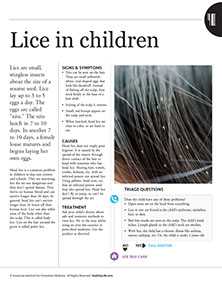
    *  Nits can be seen on the hair. They are small yellowish-white, oval-shaped eggs that look like dandruff. Instead of flaking off the scalp, they stick firmly to the base of a hair shaft.

    *  Itching of the scalp is intense.

    *  Small, red bumps appear on the scalp and neck.

    *  When hatched, head lice are clear in color, so are hard to see.

    Causes

    Head lice does not imply poor hygiene. It is caused by the spread of the insects through direct contact of the hair or head with someone who has head lice. Sharing hats, towels, combs, helmets, etc. with an infected person can spread lice. Using pillows, head rests, etc. that an infected person used may also spread lice. Head lice don’t fly or jump, so can’t be spread through the air.

    Treatment

    Ask your child’s doctor about safe and nontoxic methods to treat lice. He or she may advise using an over-the-counter or prescribed medicine. Use the product as directed.

    Questions to Ask

    Self-Care / Prevention

    Check everyone in your home for lice and nits. Treat only those who have lice. Lice-killing products won’t prevent lice.

    *  Use an over-the-counter shampoo, lotion, or cream made to get rid of lice and nits. Follow the directions on the package.

    *  Wear plastic or latex gloves. Don’t use too much shampoo. Doing this will make the child’s head too dry.

    Things to Tell Your Child

    *  Don’t share hats, brushes, or combs. If you must share helmets, wipe them with a damp towel and wear a baseball cap under the helmet.

    *  Don’t lie on a pillow that another child uses.

    *  Wash your hair and bathe often.

    To Remove the Nits

    *  Shine a flashlight on the hair roots. Nits are gray and hard to see, especially in blond hair.

    *  Start at one spot and go row by row or even strand by strand. Use the nit comb that comes in the package. Dip the comb in vinegar first. This will help loosen the nits.

    *  Comb the hair from the roots to the ends. Check the comb for nits after each pass, or, break the hair up into 4 or 5 sections with hair clips. Lift about an inch of hair up and out. Put the comb against your child’s head. Comb all the way to the tips of the hair. Keep going until you’ve done the whole head.

    *  Soak all combs, brushes, hair clips, and barrettes for 1 to 2 hours in the insecticidal shampoo. Or, soak them for 1 hour in soap and water, rubbing alcohol, or Lysol.

    *  Check for nits every 2 to 3 days for 2 to 3 weeks until all lice and nits are gone.

    *  A week to 9 days later, use the shampoo for lice again to kill any newly hatched nits. You don’t have to remove nits after treatment is finished except for cosmetic reasons.

    Other Things You Should Do

    *  Vacuum all mattresses, pillows, rugs, and furniture made of cloth, especially where children play. Use the long, thin attachment to suck the lice or nits out of car seats, toys, etc. Put the vacuum cleaner bags outside in the trash.

    *  Wash bedding and clothes right away in water 130ºF or hotter. Put them in the dryer on high for 30 minutes. Heat kills the lice and nits. Dry-clean clothes and hats that you can’t wash.

    *  Don’t use bug spray on lice, furniture, stuffed animals, etc.

    *  As soon as you know your child has lice, call your child’s school, child-care center, parents of your child’s friends, etc.

    *  Check your children for head lice and nits once a week. Check more often if your child scratches his or her head. Look for nits behind the ears and on the back of the neck. Spread hairs apart using a nit comb to look for the nits on the hair shafts.

    Resources

    National Pediculosis Association
    www.headlice.org

    Healthier at Home book by the American Institute for Preventive Medicine. www.HealthyLife.com. All rights reserved.

    © American Institute for Preventive Medicine
  • Rectal Problems

    Abdominal & Urinary Conditions

    The rectum is the lowest part of the large bowel (colon). The opening of the rectum is the anus. Stool are passed from the anus.

    Signs & Symptoms

    *  Rectal pain.

    *  Rectal bleeding.

    *  Anal itching.

    *  Redness, swelling, or a rash in the rectal area.

    Causes

    Often there is no clear cause. Persons with diabetes and liver disease are more prone to rectal itching.

    For Anal / Rectal Pain and/or Bleeding

    *  Constipation. Straining to pass stool. Hemorrhoids.

    *  Anal fissures. These are splits or tears in the skin around the anus.

    *  Polyps or small growths.

    *  Injury due to anal intercourse or the insertion of a foreign object.

    *  Blockage in the intestines.

    *  Colon or rectal cancer.

    For Anal / Rectal Itching

    *  Dry skin. Products that irritate or cause a skin allergy in the anal area. Examples are over-the-counter anesthetic ointments that end in “caine,” such as benzocaine.

    *  Hemorrhoids.

    *  Psoriasis. This is a chronic skin disease. With this, itchy, scaly red patches form on a part of the body.

    *  Pinworms. These are intestinal parasites. They usually affect children. The anal itching is at night and can be painful.

    *  A fungal infection.

    Treatment

    Treatment for rectal problems depends on the cause. Any sign of rectal bleeding should be evaluated by a doctor. This includes blood on toilet paper. Colon cancer should be checked for, despite the person’s age or family history of this disease.

    Questions to Ask

    Self-Care / Prevention

    For Anal / Rectal Bleeding

    *  Don’t lift heavy things.

    *  Stop taking anti-inflammatory medicines and/or aspirin (unless prescribed and monitored by your doctor).

    *  Don’t strain to pass stool.

    For Anal / Rectal Itching

    *  Practice good hygiene. Clean the rectal area daily.

    *  Use an over-the-counter ointment, such as one with zinc oxide or one for hemorrhoids, such as Preparation H. Follow package directions.

    *  Wear clothes and undergarments that fit loosely.

    *  Take a warm bath or sitz bath. A sitz bath is a shallow, warm water bath. You can get a sitz bath device from a medical supply company and some drug stores. Then dry the rectal area well. Use talcum powder, as needed.

    *  Take warm tub baths.

    *  Lose weight if you are overweight.

    *  If you are diabetic, keep blood sugar under control.

    *  For pinworms:

    – Check for pinworms in this way: In a dark room, a few hours after bedtime, shine a flashlight on the anus. Pinworms, if present, will go back into the anus when the flashlight is shined on them.

    – Wash the hands often.

    – Keep fingernails closely trimmed.

    – Try to get your child to not suck his thumb and not bite his nails.

    – Wash underwear and bed linen in hot soapy water.

    – If medication for pinworms is prescribed, use it as directed.

    For Rectal Pain

    *  Take warm baths.

    *  Use a warm water sitz bath for 15 minutes, 2 to 3 times a day.

    *  Put towels soaked in warm water on the anal area. Or, apply a cold compress to the painful area, if this helps with the pain. You can buy a sitz bath from a medical supply or drug store.

    *  Follow measures to prevent constipation.

    *  Don’t strain to pass stool.

    *  Keep the rectal area clean.

    *  Use soft, plain, unscented, two-ply toilet paper. Take your own toilet paper to work or other places that may use harsh paper. Use wet, not dry, toilet paper, if that helps.

    *  Use an over-the-counter wipe, such as Tucks, after using toilet paper.

    *  Don’t sit for long periods of time. When you do sit, raise your legs, as often as you can.

    *  If needed, take an over-the-counter medicine for pain as directed.

    Healthier at Home book by the American Institute for Preventive Medicine. www.HealthyLife.com. All rights reserved.

    © American Institute for Preventive Medicine
  • Vaginal Infections

    Women’s Health

    Vaginal infections are the most common reason American females see their doctors. Vaginal infections result in vaginitis (swelling of the vagina).

    Signs, Symptoms & Causes

    For Bacterial Vaginosis (BV)

    Nearly half of females with clinical signs of BV report no symptoms. When present, symptoms include:

    *  A thin, gray, or milky white vaginal discharge. This has a fishy odor, which is more noted after intercourse.

    *  Mild vaginal irritation or burning.

    Bacterial vaginosis results when certain bacteria outnumber normal and protective bacteria in the vagina. The exact cause is not known.

    Risk factors for BV include douching, using an IUD, and a change or an increase in sexual partners.

    For Vaginal Yeast Infections

    Vaginal yeast infections are also called Monilia, Candida, and fungal infections. Signs and symptoms range from mild to severe. They include:

    *  Thick, white vaginal discharge that looks like cottage cheese and may smell like yeast.

    *  Itching, irritation, and redness around the vagina.

    *  Burning and/or pain when urinating or with sex.

    Vaginal yeast infections result from the overgrowth of the fungus Candida. This is normally present in harmless amounts in the vagina, digestive tract, and mouth.

    Risk Factors for Vaginal Yeast Infections

    *  Hormonal changes that come with pregnancy or monthly periods. Taking hormones or birth control pills.

    *  Antibiotic use, especially “broad spectrum” ones. Corticosteroid medicine use.

    *  High blood sugar. This can occur when diabetes is not controlled.

    *  Sex that irritates the vagina a lot.

    *  Using douches. Using feminine hygiene sprays.

    *  Using hot tubs and jacuzzis a lot.

    Chronic vaginal yeast infections can be one of the first signs of diabetes, STIs, and HIV.

    Diagnosis

    Different vaginal infections have the same symptoms. This makes it hard to tell one from another. A doctor may need to diagnose the cause. A sample of vaginal fluid is taken and tested. Often, this takes less than 3 minutes.

    Treatment

    For Bacterial Vaginosis

    Prescribed antibiotic creams, gels, or pills are needed. Male sex partner(s) may also need treatment. Feminine hygiene sprays that mask vaginal odor should not be used. Nor should OTC medications, such as ones for vaginal yeast infections. These do not treat BV.

    For Vaginal Yeast Infections

    Prescribed and OTC vaginal creams or suppositories get rid of the Candida overgrowth. Oral medicines, such as Diflucan®, may be prescribed.

    Questions to Ask

    Self-Care / Prevention

    *  Take medications, as prescribed.

    *  For a repeat vaginal yeast infection, use an over-the-counter (OTC) antifungal vaginal medication, such as Monistat. Use it as directed. {Note: Stop using any OTC product for a vaginal yeast infection at least 24 hours before a vaginal exam.}

    *  Ask your pharmacist about an OTC cream for itching and burning to help with symptoms during treatment.

    *  Bathe or shower often. Clean the inside folds of the vulva. Dry the vaginal area well.

    *  Wipe from front to back after using the toilet.

    *  If your vagina is dry, use a water soluble lubricant, such as K-Y Liquid®, when you have sex.

    *  Wear all-cotton underwear. Don’t wear garments that are tight in the crotch. Change underwear and workout clothes as soon as possible after you sweat.

    *  Don’t use bath oils, bubble baths, feminine hygiene sprays, or perfumed or deodorant soaps.

    *  Don’t sit around in a wet bathing suit. Shower after you swim in a pool to remove the chlorine from your skin. Dry the vaginal area well.

    *  Eat well. Limit sugar and foods with sugar. Eat foods, such as yogurt, that contain live cultures of “lactobacillus acidophilus.” If you can’t tolerate yogurt, take an OTC product that has this.

    *  Let your doctor know if you are prone to getting yeast infections whenever you take an antibiotic. You may be told to also use a vaginal antifungal product.

    *  If you still menstruate, use unscented tampons or sanitary pads and change them often.

    Women's Self-Care book by the American Institute for Preventive Medicine. www.HealthyLife.com. All rights reserved.

    © American Institute for Preventive Medicine

  • Vaginal Problems

    Women’s Health

    A number of vaginal problems occur in women over age 50. Often, the problems are due to changes in the vagina that come with menopause. These include:

    *  Vaginal dryness

    *  Thinning of the walls of the vagina

    *  Loss of elasticity in the muscles in the vagina

    *  Shrinkage of the labia (external genitals that cover and protect the opening of the vagina)

    These changes can lead to common vaginal problems, such as:

    *  Pain during and after intercourse

    *  Vaginitis – vaginal swelling, irritation, and/or infections.

    Less common vaginal problems in women over 50 are:

    *  Sexually transmitted infections (STIs).

    *  Cancer of the vagina, which is rare.

    *  Abnormal vaginal bleeding (unless still menstruating or on hormone therapy (HT)

    It is common for menstrual periods to be irregular for several years before menopause. This is normal vaginal bleeding. For premenopausal women, the most common causes of abnormal vaginal bleeding, in this order, are: Not ovulating; malignancy; pregnancy; endometriosis; and benign tumors. The most common cause after menopause is malignancy.

    The chart below lists signs and symptoms of vaginal problems and what to do about them. {Note: All vaginal bleeding that occurs after menstruation has stopped should be evaluated by your doctor.}

    Hemorrhage

    Signs & Symptoms

    Vaginal bleeding with:

    *  A known bleeding disorder and you also have blood in your urine or stool

    *  Heavy vaginal bleeding after taking a clot dissolving drug for a heart attack or stroke

    What to Do

    Get immediate care.

    Internal Injury

    Signs & Symptoms

    Vaginal bleeding after trauma to the abdomen, pelvis, or vagina or vaginal bleeding with any of these problems:

    *  Dizziness and very heavy bleeding (you saturate more than 1 full sized pad in an hour’s time)

    *  Pale and moist skin and a decreased level of consciousness

    *  Extreme shortness of breath or a very hard time breathing

    *  Severe abdominal pain

    What to Do

    Get immediate care.

    Pelvic Inflammatory Disease (PID)

    This is an infection of the uterus, fallopian tubes, and/or ovaries.

    Signs & Symptoms

    Vaginal bleeding with 2 or more of these problems:

    *  Abdominal tenderness and/or bloating

    *  Pain in the pelvis or back

    *  Pain during intercourse

    *  Skin on your abdomen feels sensitive

    *  Vaginal discharge with abnormal color or odor

    *  Change in menstrual flow, if still menstruating

    *  Fever, chills

    What to Do

    Contact doctor.

    Infection of the cervix, uterus, or vagina

    Cervical, uterine, or vaginal cancer.

    Signs & Symptoms

    Vaginal bleeding after menopause, unless on estrogen therapy (ET).

    What to Do

    Contact doctor.

    Gonorrhea or similar sexually transmitted infection (STI)

    Signs & Symptoms

    Abnormal vaginal bleeding with:

    *  Mild itching and burning around the vagina

    *  Burning or pain when urinating or urinating more often

    *  A vaginal discharge with abnormal color

    *  Abdominal discomfort

    What to Do

    Contact doctor.

    Genital Herpes

    Signs & Symptoms

    Sores and/or painful blisters in the genital area and sometimes on the thighs or buttocks

    What to Do

    Contact doctor.

    Trichomoniasis

    Signs & Symptoms

    *  Vaginal itching, burning, and redness

    *  Greenish-yellow vaginal discharge

    *  Burning or pain when urinating

    What to Do

    Contact doctor.

    Bacterial Vaginosis

    This is an infection from one or more types of bacteria that may or may not be sexually transmitted.

    Signs & Symptoms

    *  Mild vaginal irritation or burning

    *  A thin, gray, or milky white vaginal discharge. This has a fishy odor, which is noticed more after sex. (About half of females have no symptoms.)

    What to Do

    Contact doctor.

    Atrophic Vaginitis

    This is caused by a decrease in estrogen.

    Signs & Symptoms

    Vaginal dryness, irritation, itching, and burning

    What to Do

    Contact doctor.

    Vaginal Yeast Infection

    Signs & Symptoms

    *  Itching, irritation, and redness around the vagina

    *  Thick, white vaginal discharge that looks like cottage cheese and may smell like yeast

    *  Burning and/or pain when urinating or with sex

    What to Do

    Use self-care.

    Vaginitis from Contact Dermatitis

    Signs & Symptoms

    Itching and redness in the outer genital area without other symptoms

    What to Do

    Use self-care.

    Care

    Medical treatment depends on the cause.

    For Atrophic Vaginitis:

    Use a prescribed estrogen cream or prescribed estrogen pills.

    For Bacterial Vaginosis:

    Use a prescribed antibiotic cream or gel or prescribed antibiotic pills.

    For a Vaginal Yeast Infection:

    It is important, though, to make sure that you have the right problem diagnosed. A burning sensation could be a symptom of a urinary tract infection caused by bacteria, which requires an antibiotic. Antibiotics will not help yeast infections. They make them worse. Trichomoniasis mimics yeast infections, too.

    Chronic vaginal infections can be one of the first signs of diabetes, sexually transmitted diseases, or HIV in women.

    Self-care measures treat most vaginal yeast infections. Your doctor can prescribe a vaginal cream or suppositories or an oral antifungal medicine, such as Diflucan.

    For a Severe Case of Contact Dermatitis in the Vaginal Area:

    Use an ointment prescribed by your doctor.

    Other medical treatments are treating the specific cause, such as STIs, cervical cancer, and uterine cancer.

    Self-Care / Prevention

    For a Vaginal Yeast Infection or Bacterial Vaginosis:

    *  Bathe or shower often. Clean the inside folds of the vulva. Dry the vaginal area well.

    *  Wipe from front to back after using the toilet.

    *  Wear all-cotton underwear.

    *  Don’t wear garments that are tight in the crotch.

    *  Change underwear and workout clothes right away after sweating.

    *  If you still menstruate, use unscented tampons or sanitary pads and change them often.

    *  Don’t use bath oils, bubble baths, feminine hygiene sprays, or perfumed or deodorant soaps.

    *  Don’t sit around in a wet bathing suit.

    *  Shower after you swim in a pool to remove the chlorine from your skin. Dry the vaginal area well.

    *  Eat well. Include foods that contain live cultures of “lactobacillus acidophilus,” such as yogurt. If you can’t tolerate yogurt, take an over- the-counter product that contains lactobacillus acidophilus.

    *  Let your doctor know if you tend to get yeast infections whenever you take an antibiotic. He or she may have you also take a vaginal antifungal agent.

    When You Have a Vaginal Yeast Infection:

    *  Use an over-the-counter product for vaginal yeast infections, such as Monistat, Gyne-Lotrimin, etc.

    *  Douche with a mild solution of 1 to 3 tablespoons of vinegar mixed in 1 quart of warm water. Repeat only once a day (up to 7 days) until the symptoms subside. Don’t do this if you are pregnant or if you have a sexually transmitted disease.

    *  Limit sugar and foods with sugar.

    For Vaginal Dryness and Painful Intercourse:

    *  Don’t use deodorant soaps or scented products in the vaginal area.

    *  Use a water soluble lubricant, such as K-Y Jelly, Replens, etc. Avoid oils or petroleum-based products.

    *  Use an estrogen cream for the vagina. Your doctor needs to prescribe this.

    *  Keep sexually active.

    *  Don’t use antihistamines unless truly needed.

    For Contact Dermatitis in the Vaginal Area:

    *  Avoid products that cause the problem (scented items, douches, etc.).

    *  Apply an over-the-counter hydrocortisone cream to the affected area. Use this infrequently, though. Hydrocortisone can, itself, lead to thinning of the vaginal tissue. Follow package directions.

    *  Put a cool compress on the affected area.

    *  Wash your underwear in a gentle detergent. Rinse it twice. Use only plain water for the second rinse. Don’t use a fabric softener.

    Health at Home Lifetime book by the American Institute for Preventive Medicine. www.HealthyLife.com. All rights reserved.

    © American Institute for Preventive Medicine