Tag: joint

  • Consider Low-Impact Or Nonimpact Aerobics

    Fitness

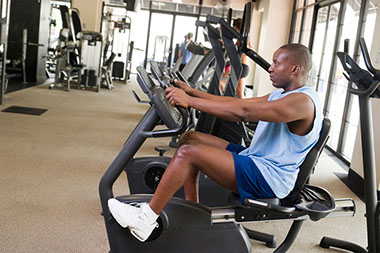
    Image of man exercising at the gym.

    Fitness activities that involve steady, rhythmic motions of major muscle groups and burn oxygen for more than a brief spurt are considered aerobic. They force your heart and lungs to work at anywhere from 60 to 85 percent of their capacity. Brisk walking and bicycling are examples of aerobic activities. So is aerobic dance-informally choreographed routines that combine calisthenics and dance.

    Aerobic dance classes became the rage in the early 1980s, but shock to bones and tendons caused by repeated jumping and bouncing produced a number of injuries. Low-impact and nonimpact aerobics are kinder to your skeleton.

    Low-impact aerobics are designed so that:

    *  Your feet stay close to the floor, and only one foot leaves the floor at a time.

    *  Only moderate jumping is involved.

    *  Jerky movements are kept to a minimum.

    Nonimpact aerobics are designed so that:

    *  No jumping is involved.

    *  They rely on large muscles of the thighs (as in lifts) rather than muscles in the feet and calves (as in jogging and skipping in place).

    *  They require more arm movement than high-intensity aerobics.

    Page image from A Year of Health Hints book by the American Institute for Preventive Medicine. www.HealthyLife.com. All rights reserved.

    © American Institute for Preventive Medicine
  • Put Your Tennis Elbow On Ice

    Bone & Muscle Problems

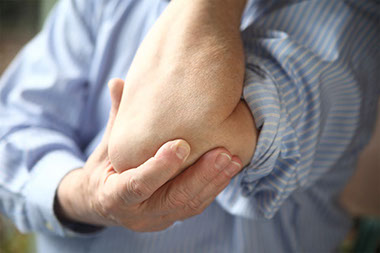
    Close up image of elbow.

    If you’re a tennis player with a hard, single-handed backhand shot, you can end up with a painful condition known as tennis elbow. Pain originates in the outer portion of the elbow and works its way down the forearm. Tennis players who are new to the game or use their forearms instead of the force of their whole bodies to swing the racket are most vulnerable.

    Other factors that contribute to the problem include:

    *  Using a racket that’s too heavy.

    *  Using a racket that’s too tightly strung.

    *  Using played out, deflated tennis balls or ones that are wet and heavy.

    *  Using an improper grip.

    *  Trying to put spin on the ball with improper wrist action.

    *  Using poor backhand technique.

    Continuing to use the arm aggravates the situation. Even several weeks of rest won’t prevent repeat episodes. The best game plan is to rest, then strengthen your forearm muscles and get coaching to improve your skill level.

    To relieve tennis elbow pain:

    *  Apply ice for the first two or three days.

    *  Take an over-the-counter medicine to reduce pain and inflammation. Examples are aspirin, ibuprofen, and naproxen sodium. Take as directed.

    If you still have pain after three weeks, see a doctor for proper diagnosis and treatment.

    To prevent repeat bouts of tennis elbow:

    *  Wait until the pain is gone and your grip strength is normal before resuming play.

    *  Wear an elastic bandage or counter-force brace around the forearm,  as directed.

    *  To strengthen your forearm muscles, lift small 1- to 2-pound weights by alternately flexing and extending your wrists with the palms facing down and your forearms resting on a flat surface. Start with 10 repetitions and work up to 40, three or four times a week.

    A Year of Health Hints book by the American Institute for Preventive Medicine. www.HealthyLife.com. All rights reserved.

    © American Institute for Preventive Medicine