Tag: loans

  • Refinancing Pros & Cons

    FINANCIAL HEALTH

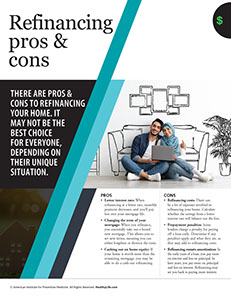
    Couple sitting on floor with laptop.

    There are pros & cons to refinancing your home. It may not be the best choice for everyone, depending on their unique situation.

    Pros

    *  Lower interest rate: When refinancing at a lower rate, monthly payment decreases, and you’ll pay less over your mortgage life.

    *  Changing the term of your mortgage: When you refinance, you essentially take out a brand new mortgage. This allows you to set new terms, meaning you can either lengthen or shorten the term.

    *  Cashing out on home equity: If your home is worth more than the remaining mortgage, you may be able to do a cash-out refinancing.

    Cons

    *  Refinancing costs: There can be a lot of expenses involved in refinancing your home. Calculate whether the savings from a lower interest rate will balance out the fees.

    *  Prepayment penalties: Some lenders charge a penalty for paying off a loan early. Determine if any penalties apply and what they are, as that may add to refinancing costs.

    *  Refinancing restarts amortization: In the early years of a loan, you pay more on interest and less on principal. In later years, you pay more on principal and less on interest. Refinancing may set you back to paying more interest.
    © American Institute for Preventive Medicine

  • Are Payday Loans Worth It?

    FINANCIAL HEALTH

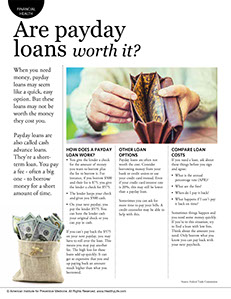
    Person holding open empty wallet.

    When you need money, payday loans may seem like a quick, easy option. But these loans may not be worth the money they cost you.

    Payday loans are also called cash advance loans. They’re a short-term loan. You pay a fee – often a big one – to borrow money for a short amount of time.

    How does a payday loan work?

    *  You give the lender a check for the amount of money you want to borrow plus the fee to borrow it. For instance, if you borrow $500 and their fee is $75, you give the lender a check for $575.

    *  The lender keeps your check and gives you $500 cash.

    *  On your next payday, you pay the lender $575. You can have the lender cash your original check or you can pay in cash.

    If you can’t pay back the $575 on your next payday, you may have to roll over the loan. This means you may pay another fee. The high fees for these loans add up quickly. It can get so expensive that you end up paying back an amount much higher than what you borrowed.

    Other loan options

    Payday loans are often not worth the cost. Consider borrowing money from your bank or credit union or use your credit card instead. Even if your credit card interest rate is 20%, this may still be lower than a payday loan.

    Sometimes you can ask for more time to pay your bills. A credit counselor may be able to help with this.

    Compare loan costs

    If you need a loan, ask about these things before you sign and agree:

    *  What is the annual percentage rate (APR)?

    *  What are the fees?

    *  When do I pay it back?

    *  What happens if I can’t pay it back on time?

    Sometimes things happen and you need some money quickly. If you’re in this situation, try to find a loan with low fees. Think about the amount you need. Only borrow what you know you can pay back with your next paycheck.

    Source: Federal Trade Commission

    © American Institute for Preventive Medicine