Tag: Manage Money

  • Mend Your Spending

    Financial Health

    Use your money wisely.

    You have probably asked or heard the question, “Do you really need that?” It is a good question to ask when you are thinking of making a purchase. Buying on impulse can be a big budget buster. Getting by with less is a budget saver.

    Use credit cards wisely:

    *  Keep cards to a minimum.

    *  Pay your bill on time to avoid a late payment fee and a higher “penalty” interest rate. Stay below your credit limit.

    *  Pay the balance in full. If you can’t, make more than the minimum payment.

    *  Try to avoid getting cash advances, which have very high interest rates.

    *  Ask for a lower interest rate on credit cards you currently have.

    Trim costs for tech services:

    *  Choose a cellphone plan that avoids hefty fees for extra minutes and texts. Consider dropping your landline phone or just using it for basic services.

    *  Shop around for best prices and services for Internet, phone, and cable. Bundle services if this saves money. Contact your current provider and ask if it will match a competitor’s lower price.

    *  Evaluate your use of cable, especially premium channels. Check out cheaper ways to get movies and programs, such as through your local library, Netflix for movies, and Hulu for TV.

    Other savings tips:

    *  Refinance your mortgage if you can lower the interest rate enough to make it worth your while. Use the extra money for other bills or to apply to the principal to pay your mortgage off sooner.

    *  Shop for items, even cars, online. Compare prices.

    *  Take advantage of employer sponsored programs and services. Examples are matching your 401(k) contributions and flexible spending accounts (FSAs), which allow you to use pre-tax dollars to pay for medical and child care expenses.

    *  Clip and download coupons for free, as well as reduced prices on groceries, restaurant meals, retail items, and home improvement services. Send in rebates that come with products you buy.

    *  Eat out less. Take your lunch to work.

    Action Step

    Have fun at little or no cost. Attend free community events, such as concerts and picnics. See movies at discount theaters or swap DVDs with family and friends. Go for hikes and bike rides as a family.
    Ways to Well-Being book by the American Institute for Preventive Medicine. www.HealthyLife.com. All rights reserved.

    © American Institute for Preventive Medicine

  • Filing For A Tax Extension

    FINANCIAL HEALTH

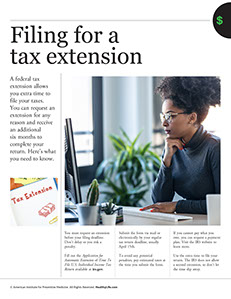
    Women on computer.

    A federal tax extension allows you extra time to file your taxes. You can request an extension for any reason and receive an additional six months to complete your return. Here’s what you need to know.

    *  You must request an extension before your filing deadline. Don’t delay or you risk a penalty.

    *  Submit the form via mail or electronically by your regular tax return deadline, usually April 15th.

    *  To avoid any potential penalties, pay estimated taxes at the time you submit the form.

    *  If you cannot pay what you owe, you can request a payment plan. Visit the IRS website to learn more.

    *  Use the extra time to file your return. The IRS does not allow a second extension, so don’t let the time slip away.

    *  Fill out the Application for Automatic Extension of Time To File U.S. Individual Income Tax Return available atirs.gov.

    © American Institute for Preventive Medicine
  • Save For More Than Just A Rainy Day

    Financial Health

    Invest in your future.

    Money doesn’t grow on trees, but it can grow when you save and invest it wisely. First, identify what you want to save for:

    *  Emergency funds? (Plan for three to six months of expenses.) Holiday expenses? Vacations? A house? College for your kids? Retirement?

    *  Rank order your goals.

    Invest, but do not put all your eggs in one basket.

    Diversify with stocks, bonds, mutual funds, IRAs, real estate, and commodities, such as gold and silver. Find out more about investing fromwww.mymoney.gov. Things you can do on your own:

    *  If your employer has a retirement plan, such as a 401(k), have as much deducted from your pay as possible, especially if your employer matches some or all of the amount you contribute.

    *  Get resources on planning for retirement and long-term care fromwww.csrees.usda.gov/fsll.

    *  Check out “529” prepaid tuition and savings plans for college fromwww.collegesavings.org. These offer tax-saving advantages.

    *  Get professional investment advice from employer sponsored programs or from your financial planner. Find a certified professional from the Association for Financial Counseling and Planning Education atwww.afcpe.org.

    Revisit your budget:

    *  Pay off credit card or high interest debts first. Then use some or all of the payment money for your savings plan.

    *  Put aside whatever you can in savings accounts, checking accounts, and certificates of deposit.

    *  Look for additional ways to save fromhttp://investor.gov/sites/default/files/Saving-and-Investing.pdf

    *  Decide the best ways you are likely to save money.

    – Have your paycheck automatically deposited in your bank and have some go directly into one or more savings accounts.

    – Save money you get from tax refunds, work bonuses, and extra income.

    Action Step

    Beware of investments that promise high returns with little or no risk. If it sounds too good to be true, it usually is.

    Ways to Well-Being. Published by the American Institute for Preventive Medicine.

    © American Institute for Preventive Medicine
  • Improve Your Home

    FINANCIAL HEALTH

    Couple looking at paint swatches.

    Owning a home is a big investment. Regular maintenance and improvement projects help protect your asset and keep it in top condition. These home projects are the best bang for your buck.

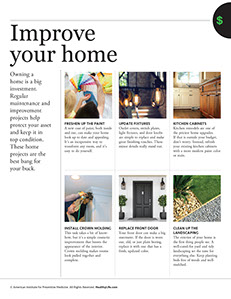
    Freshen up the paint

    A new coat of paint, both inside and out, can make your home look up to date and appealing. It’s an inexpensive way to transform any room, and it’s easy to do yourself.

    Update fixtures

    Outlet covers, switch plates, light fixtures, and door knobs are simple to replace and make great finishing touches. These minor details really stand out.

    Kitchen cabinets

    Kitchen remodels are one of the priciest home upgrades.  If that is outside your budget, don’t worry. Instead, refresh your existing kitchen cabinets with a more modern paint color or stain.

    Install crown molding

    This task takes a bit of know-how, but it’s a simple cosmetic improvement that boosts the appearance of the interior. Crown molding makes rooms look pulled together and complete.

    Replace front door

    Your front door can make a big statement. If the door is worn out, old, or just plain boring, replace it with one that has a fresh, updated color.

    Clean up the landscaping

    The exterior of your home is the first thing people see. A well-cared-for yard and tidy landscaping set the tone for everything else. Keep planting beds free of weeds and well-mulched.

    © American Institute for Preventive Medicine

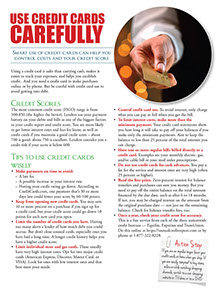
  • Use Credit Cards Carefully

    Financial Health

    Smart use of credit cards can help you control costs and your credit score.

    Using a credit card is safer than carrying cash, makes it easier to track your expenses, and helps you establish credit. And you need a credit card to make purchases online or by phone. But be careful with credit card use to avoid getting into debt.

    Tips to use credit cards wisely:

    *  Make payments on time to avoid: A late fee; a possible increase in your interest rate; having your credit rating go down. According toCreditCards.com, one payment that’s 30 or more days late could lower your score by 60-100 points.

    *  Keep from opening new credit cards. You may save 10 or more percent on a purchase if you sign up for a credit card, but your credit score could go down 10 points for each new card you open.

    *  Limit the number of credit cards you have. Having too many alerts a lender of how much debt you could accrue. But don’t close unused cards, especially ones you have had a long time. A longer credit history helps you have a higher credit score.

    *  Limit individual store and gas cards. These usually have very high interest rates. Opt for two major credit cards (American Express, Discover, Master Card, or VISA). Look for ones with low interest rates and that best meet your needs.

    *  Control credit card use. To avoid interest, only charge what you can pay in full when you get the bill.

    *  To limit interest costs, make more than the minimum payment. Your credit card statements show you how long it will take to pay off your balances if you make only the minimum payments. Aim to keep the balance to less than 25 percent of the total amount you can charge.

    *  Have one or more regular bills billed directly to a credit card. Examples are your monthly electric, gas, and/or cable bill or your mail order prescriptions.

    *  Do not use credit cards for cash advances. You pay a fee for the service and interest rates are very high (often 25 percent or higher).

    *  Read the fine print. Zero-percent interest for balance transfers and purchases can save you money. But you need to pay off the entire balance on the total amount financed by the due date, such as after 6 to 18 months. If not, you may be charged interest on the amount from the original purchase date – not just on the remaining balance. Check for balance transfer fees, too.

    *  Once a year, check your credit score for accuracy. This is a free service from each of the three nationwide credit bureaus – Equifax, Experian and TransUnion. Do this online athttps://annualcreditreport.comor by phone at 1-877-322-8228.

    Credit Scores

    The most common credit score (FICO) range is from 300-850 (the higher the better). Lenders use your payment history on your debts and bills as one of the biggest factors in your credit report and credit score. You are more likely to get lower interest rates and fees for loans, as well as credit cards if you maintain a good credit score – about 700 is good; above 750 is excellent. Lenders consider you a credit risk if your score is below 600.

    Action Step

    If you are an impulse buyer, leave your credit cards at home when you shop. If you are easily tempted to buy items online or while watching shopping channels, switch to a non-shopping website or  TV show, or to a DVD.

    Ways to Well-Being. Published by the American Institute for Preventive Medicine.

    © American Institute for Preventive Medicine
  • Medical Loans: The Good, Bad, And The Alternatives

    FINANCIAL HEALTH

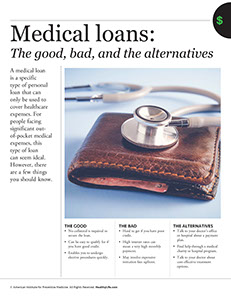
    Wallet with stethoscope.

    A medical loan is a specific type of personal loan that can only be used to cover healthcare expenses. For people facing significant out-of-pocket medical expenses, this type of loan can seem ideal. However, there are a few things you should know.

    The Good

    *  No collateral is required to secure the loan.

    *  Can be easy to qualify for if you have good credit.

    *  Enables you to undergo elective procedures quickly.

    The Bad

    *  Hard to get if you have poor credit.

    *  High interest rates can mean a very high monthly payment.

    *  May involve expensive initiation fees upfront.

    The Alternatives

    *  Talk to your doctor’s office or hospital about a payment plan.

    *  Find help through a medical charity or hospital program.

    *  Talk to your doctor about cost-effective treatment options.

    © American Institute for Preventive Medicine
  • Save At The Supermarket

    FINANCIAL HEALTH

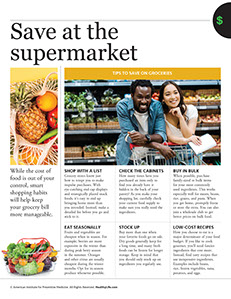
    Couple at the grocery store.

    While the cost of food is out of your control, smart shopping habits will help keep your grocery bill more manageable.

    Tips to save on groceries

    Shop with a list

    Grocery stores know just how to tempt you to make impulse purchases. With eye-catching end cap displays and strategically placed snack foods, it’s easy to end up bringing home more than you intended. Instead, make a detailed list before you go and stick to it.

    Check the cabinets

    How many times have you purchased an item only to find you already have it hidden in the back of your pantry? As you make your shopping list, carefully check your current food supply to make sure you really need the ingredients.

    Buy in bulk

    When possible, purchase family-sized or bulk items for your most commonly used ingredients. This works especially well for meats, beans, rice, grains, and pasta. When you get home, promptly freeze or store the extra. You can also join a wholesale club to get better prices on bulk food.

    Eat seasonally

    Fruits and vegetables are cheapest when in season. For example, berries are more expensive in the winter than during peak berry season in the summer. Oranges and other citrus are usually cheapest during the winter months. Opt for in-season produce whenever possible.

    Stock up

    Buy more than one when your favorite foods go on sale. Dry goods generally keep for a long time, and many fresh foods can be frozen for longer storage. Keep in mind that you should only stock up on ingredients you regularly use.

    Low-cost recipes

    How you choose to eat is a major determinant of your food budget. If you like to cook gourmet, you’ll need fancier ingredients that cost more. Instead, find tasty recipes that use inexpensive ingredients. Examples include beans, rice, frozen vegetables, tuna, potatoes, and eggs.

    © American Institute for Preventive Medicine

  • Save Now For Holiday Gift-Giving

    FINANCIAL HEALTH

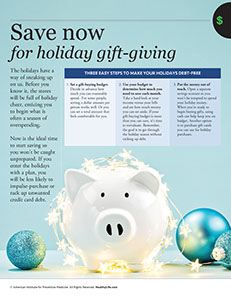
    Piggy bank with holiday lights and ornments.

    The holidays have a way of sneaking up on us. Before you know it, the stores will be full of holiday cheer, enticing you to begin what is often a season of overspending.

    Now is the ideal time to start saving so you won’t be caught unprepared. If you enter the holidays with a plan, you will be less likely to impulse-purchase or rack up unwanted credit card debt.

    Three easy steps to make your holidays debt-free

    1.Set a gift-buying budget.Decide in advance how much you can reasonably spend.  For some people, setting a dollar amount per person works well. Or you can set a total amount that feels comfortable for you.

    2.Use your budget to determine how much you need to save each month.Take a hard look at your income versus your bills and see how much money you can set aside. If your gift-buying budget is more than you can save, it’s time to reevaluate. Remember, the goal is to get through the holiday season without racking up debt.

    3.Put the money out of reach.Open a separate savings account so you won’t be tempted to spend your holiday money. When you’re ready to begin buying gifts, using cash can help keep you on budget. Another option is to purchase gift cards you can use for holiday purchases.

    © American Institute for Preventive Medicine
  • Should You Join A Mlm?

    FINANCIAL HEALTH

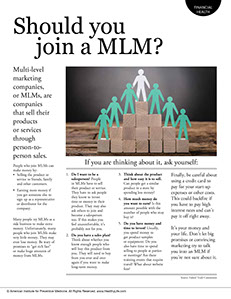
    Tier made of blocks with paper cut out of people.

    Multi-level marketing companies, or MLMs, are companies that sell their products or services through person-to-person sales.

    People who join MLMs can make money by:

    *  Selling the product or service to friends, family and other customers.

    *  Earning more money if you get someone else to sign up as a representative or distributor for the company.

    Many people try MLMs as a side business to make extra money. Unfortunately, many people who join MLMs make very little money. They may even lose money. Be wary of promises to “get rich fast” or make huge amounts of money from MLMs.

    If you are thinking about it, ask yourself:

    1.  Do I want to be a salesperson? People in MLMs have to sell their product or service. They have to ask people they know to invest time or money in their product. They may also ask others to join and become a salesperson too. If this makes you feel uncomfortable, it’s probably not for you.

    2.  Do you have a sales plan? Think about whether you know enough people who will buy this product from you. They will need to buy from you over and over again if you want to make long-term money.

    3.  Think about the product and how easy it is to sell. Can people get a similar product in a store by spending less money?

    4.  How much money do you want to earn? Is this amount possible with the number of people who may buy it?

    5.  Do you have money and time to invest? Usually, you spend money to get product samples or equipment. Do you also have time to spend selling to people at parties or meetings? Are there training events that require travel? What about website fees?

    Finally, be careful about using a credit card to pay for your start-up expenses or other costs. This could backfire if you have to pay high interest rates and can’t pay it off right away.

    It’s your money and your life. Don’t let big promises or convincing marketing try to talk you into an MLM if you’re not sure about it.

    Source: Federal Trade Commission

    © American Institute for Preventive Medicine

  • Tips For A Healthy Budget

    FINANCIAL HEALTH

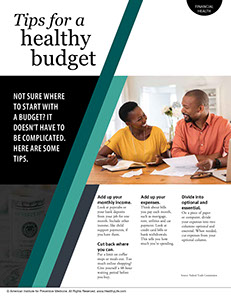
    Couple smiling going over budget.

    Not sure where to start with a budget? It doesn’t have to be complicated. Here are some tips.

    Add up your monthly income.

    Look at paystubs or your bank deposits from your job for one month. Include other income, like child support payments, if you have them.

    Cut back where you can.

    Put a limit on coffee stops or meals out. Too much online shopping? Give yourself a 48-hour waiting period before you buy.

    Add up your expenses.

    Think about bills you pay each month, such as mortgage, rent, utilities and car payment. Look at credit card bills or bank withdrawals. This tells you how much you’re spending.

    Divide into optional and essential.

    On a piece of paper or computer, divide your expenses into two columns: optional and essential. When needed, cut expenses from your optional column.

    Source: Federal Trade Commission

    © American Institute for Preventive Medicine