Tag: Manage Money

  • Teaching Kids To Manage Money

    FINANCIAL HEALTH

    Image of boy holding money in one hand and thumbs up with the other hand.

    Good money management habits start early. In fact, even preschool age children can begin to learn about money and how to use it responsibly. Parents and caregivers have the power to teach children about proper spending, saving and sharing from a young age.

    Preschool age

    *  Use play money to “buy” items.

    *  Teach children about work. Tell them how your job helps you pay for things like food and clothes.

    *  Take them to the grocery store and talk about what items cost.

    *  If children get money for a birthday or holiday, have them put it in their piggy bank instead of spending it right away.

    School age

    *  Discuss the prices of items while shopping. Show your kids your shopping receipts and explain how much items cost.

    *  Have kids help you clip coupons and talk about how much you can save.

    *  Open a savings account for your child.

    *  Consider giving an allowance for chores. Talk to them about saving their allowance to buy something later, rather than spending it all now.

    Teenagers

    *  Show your teen how to balance a checkbook.

    *  Discuss responsible credit card spending and avoiding credit card debt.

    *  If your teen has a job, talk about taxes and help them fill out their income tax form.

    *  Explain how automobile and health insurance works.

    Don’t feel pressured to give your child a complete course in finances. Children learn by watching others, so setting a positive example for spending and saving is a great way to teach.

    Source: University of Minnesota Extension

    © American Institute for Preventive Medicine

  • Using This Credit Card May Be Bad For Your Health

    WELL-BEING

    Image of young women cutting up a credit card.

    High levels of credit card debt and the stress of having debt may be bad for your health, a study in Social Science & Medicine suggests. People who reported higher levels of stress about their debt showed higher levels of physical impairment and reported worse health than those with lower levels of debt.

    In the study, researchers asked people to rate their own health on a scale of very poor to very good. They rated how much they worried about their total debt. Researchers also asked how difficult it was for survey participants to do everyday activities such as climbing stairs and carrying groceries. Participants also reported how many credit cards they have and whether they carry a balance from month to month.

    But it didn’t matter how many credit cards a person had, the big stress factor related to health was the ratio of credit card debt to their total family income-in other words, how much you owe compared with what you earn.

    “The stress of owing money, and knowledge that we’re paying high interest rates, may lead to increased stress resulting in worsening health,” said the director of Ohio State’s Center for Survey Research. Credit counseling is one way to reverse debt-stress.

    © American Institute for Preventive Medicine

  • Where Does The Money Go?

    FINANCIAL HEALTH

    Image of scale with bills on one side and a piggy bank on the other side.

    Regular expenses are a necessary part of life. In your household, you probably have a certain amount of money coming in and a different amount going out.

    Even if you have a rough idea of how much you spend, tracking your monthly expenses can help you find out a lot about your money. Small amounts here and there can quickly add up. For one month, write down everything you spend on bills, food, gas, clothes, and any other purchases – even your morning latte. Then, you can look for ways to cut back on unnecessary costs. Money you have left at the end of the month can be saved for an emergency fund or for future needs.

    © American Institute for Preventive Medicine

  • 4 Money Mistakes To Avoid

    FINANCIAL HEALTH

    Image of 3 friends.

    Little everyday choices can have a big impact on your finances. If you want to save more or spend less, think about whether you’re making any of these mistakes.

    Mistake #1: You put off saving money.

    Do you think that you can wait a few more months or even years before you need to save for retirement, your kids’ college or other future needs? Even if you can only put away a few dollars each week, start now. It can add up over time and the sooner you start, the more money you’ll have later.

    Mistake #2: You spend too much on “treats.”

    We all like to treat ourselves once in a while. But, if you’re spending money on treats often, such as going to the movies or buying yourself a new item, you could be creating money problems. Look for low-cost or free ways to reward yourself. Set aside some time with a friend, take a hot bath, watch a favorite movie at home or check out free museums and concerts.

    Mistake #3: You get lots of coupons in your mail and email.

    If you get catalogs in the mail and your inbox is filled with coupons and deals, this could be wrecking your money goals. After all, you may not need the items that are advertised. But, they look like such a good deal that you decide to buy them anyway. Do you really need another sweater or pair of jeans, or are you buying them because of the sale? Unsubscribe from email coupons and newsletters, and throw catalogs in the recycling bin. This can help lower the temptation to shop.

    Mistake #4: You don’t know how much money you really have.

    If you are struggling financially, it can be hard to look at your bank account balances. But, it’s better to know what you can afford than to go deeper into debt. Make a budget of what you have and what you can spend each month after bills are paid. Try to stick to your budget and find ways to cut out unnecessary items.

    © American Institute for Preventive Medicine

  • An Annual Financial Review

    FINANCIAL HEALTH

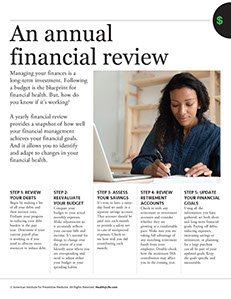
    Women writing on paper with laptop next to her.

    Managing your finances is a long-term investment. Following a budget is the blueprint for financial health. But, how do you know if it’s working?

    A yearly financial review provides a snapshot of how well your financial management achieves your financial goals. And it allows you to identify and adapt to changes in your financial health.

    Step 1: Review your debts

    Begin by making a list of all your debts and their interest rates. Evaluate your progress in reducing your debt burden in the past year. Determine if your current payoff plan is working or if you need to allocate more resources to reduce debt.

    Step 2: Reevaluate your budget

    Compare your budget to your actual monthly expenses. Make adjustments so it accurately reflects your current bills and income. It’s normal for things to change over the course of a year. Identify areas where you are overspending and need to adjust either your budget or your spending habits.

    Step 3: Assess your savings

    It’s wise to have a rainy-day fund set aside in a separate savings account. That account should be paid into each month to provide a safety net in case of unexpected expenses. Check to see how well you did contributing each month.

    Step 4: Review retirement accounts

    Check in with any retirement or investment accounts and consider whether they are growing at a comfortable pace. Make sure you are taking full advantage of any matching retirement funds from your employer. Double-check how the maximum IRA contribution may affect you in the coming year.

    Step 5: Update your financial goals

    Using all the information you have gathered, set both short and long-term financial goals. Paying off debts, reducing expenses, increasing savings or retirement, or planning for a large purchase can all be part of your updated goals. Keep the goals specific and measurable.

    © American Institute for Preventive Medicine

  • 4 Behaviors For A Healthy Wallet

    FINANCIAL HEALTH

    Concept image of growing leaf with stacked coins.

    1. Make a budget and stick to it.

    Many money experts will tell you that you need to know where your money is going each month. Creating a budget helps to see how much you spend on certain things and where you can cut back to save even more.

    2. Check your credit report each year.

    You are entitled to a free credit report once per year. This is an important step to help spot identity theft early. Your credit report can affect your mortgage rate and ability to get a loan.

    3. Shop around for a good APR on your next loan.

    The annual percentage rate (APR) on a loan is an important number. This is the total cost, including fees and interest, described as a yearly rate. The APR can vary widely between banks or lenders. It pays to take some extra time to find the best rate. Make sure you understand exactly what you will pay.

    4. Put money away for an emergency fund.

    Having an emergency fund offers peace of mind and protection from unexpected costs. Even a few dollars a week can add up, so save what you can.

    Paycheck checkup

    The Internal Revenue Service (IRS) says employees should look at their paycheck withholdings each year. Withholdings are taxes that are taken out of your paycheck.

    It’s especially important to check your withholdings in 2018, the IRS says. The Tax Cuts and Jobs Act, signed in December 2017, may change how much you want withheld.

    The IRS has a withholding calculator on their website at:apps.irs.gov/app/withholdingcalculator. This calculator can help you be sure that you aren’t having too much or too little tax withheld from your paychecks.

    © American Institute for Preventive Medicine

  • Are Payday Loans Worth It?

    FINANCIAL HEALTH

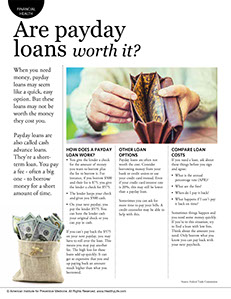
    Person holding open empty wallet.

    When you need money, payday loans may seem like a quick, easy option. But these loans may not be worth the money they cost you.

    Payday loans are also called cash advance loans. They’re a short-term loan. You pay a fee – often a big one – to borrow money for a short amount of time.

    How does a payday loan work?

    *  You give the lender a check for the amount of money you want to borrow plus the fee to borrow it. For instance, if you borrow $500 and their fee is $75, you give the lender a check for $575.

    *  The lender keeps your check and gives you $500 cash.

    *  On your next payday, you pay the lender $575. You can have the lender cash your original check or you can pay in cash.

    If you can’t pay back the $575 on your next payday, you may have to roll over the loan. This means you may pay another fee. The high fees for these loans add up quickly. It can get so expensive that you end up paying back an amount much higher than what you borrowed.

    Other loan options

    Payday loans are often not worth the cost. Consider borrowing money from your bank or credit union or use your credit card instead. Even if your credit card interest rate is 20%, this may still be lower than a payday loan.

    Sometimes you can ask for more time to pay your bills. A credit counselor may be able to help with this.

    Compare loan costs

    If you need a loan, ask about these things before you sign and agree:

    *  What is the annual percentage rate (APR)?

    *  What are the fees?

    *  When do I pay it back?

    *  What happens if I can’t pay it back on time?

    Sometimes things happen and you need some money quickly. If you’re in this situation, try to find a loan with low fees. Think about the amount you need. Only borrow what you know you can pay back with your next paycheck.

    Source: Federal Trade Commission

    © American Institute for Preventive Medicine

  • Are You Addicted To Shopping?

    WELL-BEING

    Image of couple holding shopping bags.

    Whether you like to look at clothing, housewares, tools, or electronics, shopping is a favorite pastime for many people. As the holidays approach, shopping becomes even more popular. Big sales, special deals, and promotions all seek to get more people to buy, buy, buy.

    But for some people, shopping is more than just fun around the holidays. It can actually be an addiction, according to the National Institute on Alcohol Abuse and Alcoholism.

    Signs of Shopping Addiction

    Many people think addiction is only for drugs and alcohol. But many behaviors including shopping can become an addiction. Access to online shopping can make the problem worse. You can buy whatever you want from the privacy of your home and just a few mouse clicks.

    It can be difficult to know if you just like to shop, or if it’s really a problem. If three or more of these statements apply to you, you may be addicted to shopping:

    *  You frequently buy things you don’t need.

    *  You have many unopened packages of items or clothing with the tags still on.

    *  You purchase things you can’t afford by using credit cards.

    *  You hide your purchases from your spouse or family.

    *  You feel a strong need to shop when you’re sad, angry, or anxious.

    *  You have secret credit cards or open new cards when others ones are maxed out.

    *  You think obsessively about shopping and money.

    *  You buy much more than planned, and feel guilty or ashamed afterward.

    *  Your relationships with family or friends have been affected by your shopping.

    © American Institute for Preventive Medicine

  • Avalanche Your Debt

    FINANCIAL HEALTH

    Four credit cards layed on top of eachother.

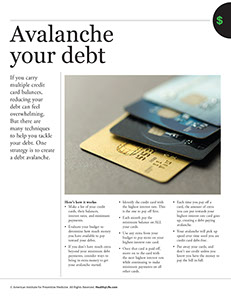
    If you carry multiple credit card balances, reducing your debt can feel overwhelming. But there are many techniques to help you tackle your debt. One strategy is to create a debt avalanche.

    Here’s how it works:

    *  Make a list of your credit cards, their balances, interest rates, and minimum payments.

    *  Evaluate your budget to determine how much money you have available to pay toward your debts.

    *  If you don’t have much extra beyond your minimum debt payments, consider ways to bring in extra money to get your avalanche started.

    *  Identify the credit card with the highest interest rate. This is the one to pay off first.

    *  Each month pay the minimum balance on ALL your cards.

    *  Use any extra from your budget to pay more on your highest interest rate card.

    *  Once that card is paid off, move on to the card with the next highest interest rate while continuing to make minimum payments on all other cards.

    *  Each time you pay off a card, the amount of extra you can put towards your highest interest rate card goes up, creating a debt-paying avalanche.

    *  Your avalanche will pick up speed over time until you are credit card debt-free.

    *  Put away your cards, and don’t use credit unless you know you have the money to pay the bill in full.

    © American Institute for Preventive Medicine
  • Eat Healthy & Save On Groceries

    FINANCIAL HEALTH

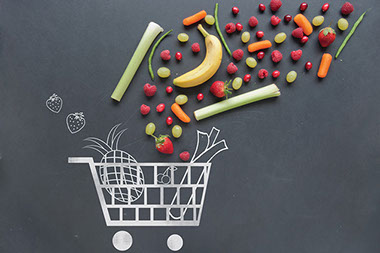
    Illustration of grocery cart with fruit and vegetables.

    Many people assume that healthy food, such as fresh fruit, costs more than processed and less nutritious foods like crackers and cookies. Although the best foods aren’t always the cheapest, healthy foods are worth the money spent. A healthy diet can help you feel better physically and mentally, which could mean fewer doctor visits and a better quality of life. If you’d like to eat healthier but are afraid it will hurt your budget, try these tips to get the most bang for your buck at the supermarket.

    *Plan your meals.Once or twice a week, sit down and write out the recipes you’d like to cook for the next few days. Write down the ingredients and shop for only those items. You’ll be less likely to resort to takeout because you have “nothing to eat” and you can avoid unneeded purchases.

    *Buy what’s in season.There’s a reason strawberries cost more in the winter months. They become harder to grow, and they must be shipped to your store from greater distances. Instead of trying to eat “summer” foods year-round, find out what’s freshest during each season. Citrus fruits and pears, for instance, are often best during the colder months.

    *Start a garden.You don’t need a huge yard to take advantage of growing your own food. Even a few small pots on a back deck or porch can allow you to grow some of your favorite fruits or vegetables. They’ll be fresh and delicious when you harvest them, and you won’t have to buy them.

    *Stock up.Canned goods, packaged cereals and other nonperishable items can be bought in larger quantities when on sale and stored. If you’re not a fan of clipping coupons, try buying them in bulk when possible.

    *Don’t overlook store brands.Buying canned and frozen items of the generic or store brand could save you a few dollars each time you visit the grocery store. Also, consider store brand bread, pasta, juice and other items. You probably won’t taste the difference.

    *Don’t shop while hungry.Some studies suggest that shopping while hungry could lead you to purchase more food than you need. Uneaten food, even the healthy kind, is money wasted.

    © American Institute for Preventive Medicine