Tag: Medical Self-Care

  • Health News: Sorting Fact From Fiction

    WELL-BEING

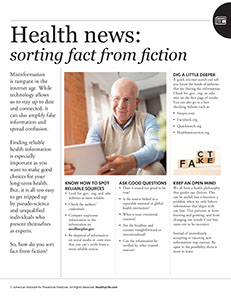
    Older man on reading on a tablet.

    Misinformation is rampant in the internet age. While technology allows us to stay up to date and connected, it can also amplify false information and spread confusion.

    Finding reliable health information is especially important as you want to make good choices for your long-term health. But, it is all too easy to get tripped up by pseudo-science and unqualified individuals who present themselves as experts.

    So, how do you sort fact from fiction?

    Know how to spot reliable sources

    *  Look for .gov, .org, and .edu websites as most reliable.

    *  Check the authors’ credentials.

    *  Compare suspicious information to the information onmedlineplus.gov.

    *  Be skeptical of information on social media or .com sites that you can’t verify from a more reliable source.

    Ask good questions

    *  Does it sound too good to be true?

    *  Is the source linked to a reputable national or global health institution?

    *  What is your emotional reaction?

    *  Are the headline and content straightforward or sensationalized?

    *  Can the information be verified by other trusted sources?

    Dig a little deeper

    A quick internet search can tell you know the kinds of websites that are sharing the information. Check for .gov, .org, or .edu sites on the first page of results. You can also go to a fact-checking website such as:

    *Snopes.com

    *Factcheck.org

    *Quackwatch.org

    *Healthnewsreview.org

    Keep an open mind

    We all have a health philosophy that guides our choices. This can be useful, but it becomes a problem when we only believe information that aligns with our bias. This prevents us from learning and growing, and from changing our minds if our bias turns out to be incorrect.

    Instead of immediately accepting or rejecting new information, stay curious. Be open to the possibility there is more to learn.
    © American Institute for Preventive Medicine
  • Home Medical Tests

    Medical Exams

    Home medical tests let you check for and monitor health conditions at home.

    Self-Testing Kits

    *  Diagnose when conditions are or are not present. These include kits that test for blood cholesterol level and blood in the stool.

    *  Monitor a chronic condition. These include kits that test for blood sugar levels and blood pressure readings.

    The U.S. Public Health Service and the Food and Drug Administration (FDA) give tips for safe and proper use of self-testing kits. (Each of these does not apply to all tests.)

    *  Don’t buy or use a test kit after the expiration date.

    *  Follow storage directions on the label.

    *  Note special precautions, such as not eating certain foods before testing.

    *  Study the package insert. First, read it through to get a general idea of how to perform the test. Then, go back and review the instructions and diagrams until you fully understand each step.

    *  Know what the test is meant to do and what it doesn’t do. Tests are not always 100% accurate.

    *  Some test results rely on comparing colors. If you’re colorblind, ask someone who is not colorblind to help you read the results.

    *  Follow instructions exactly. Don’t skip a step.

    *  When you collect a urine sample, use a sterile or clean container.

    *  Some steps need to be timed. Use a watch or clock with a second hand.

    *  Note what you should do if the results are positive, negative, or unclear.

    *  If something is not clear, don’t guess. Call the “800” number on the package or call a pharmacist for information.

    *  Keep test kits that have chemicals out of the reach of children. Discard away used test materials as directed.

    Page from the Healthier at Home book by the American Institute for Preventive Medicine. www.HealthyLife.com. All rights reserved.

    © American Institute for Preventive Medicine

  • Patient Safety

    Medical Care

    Doctor helping patient walk.

    Although estimates vary, as many as 251,000 people a year die in U.S. hospitals due to medical errors, also called Preventable Adverse Events (PAEs).

    Take an active role in every decision about your health care. If needed, have a family member or friend oversee your care.

    “Wrong-site” surgery includes operating on the wrong person, the wrong organ, or the wrong limb.

    Before you are taken into surgery, make sure the surgery is the one scheduled for you. Mark the body part to be operated on, too. Use the marker, etc. the doctor gives you to do this.

    Find out about patient safety from the Institute for Healthcare Improvement atihi.organd the Agency for Healthcare Research and Quality atahrq.gov.

    A Year of Health Hints book by the American Institute for Preventive Medicine. www.HealthyLife.com. All rights reserved.

    © American Institute for Preventive Medicine

  • Keep Track

    Healthylife® QuitWell™

    Part 3

    Man typing on his phone.

    Use a notebook, or a note in your phone. You can also find a sample scorecard at the end of this program.

    Each time that you use tobacco or nicotine, mark down the time. If you have space to write more, jot down the trigger or what you were doing right beforehand. At the end of each day, add up your total for the day.

    Do this for a few days to get an average. You many not use the same amount every day. Get your average for working days and days you have off. You will likely have different tobacco habits.

    © American Institute for Preventive Medicine