Tag: Men’s Health

  • Testicle Problems

    Men’s Health

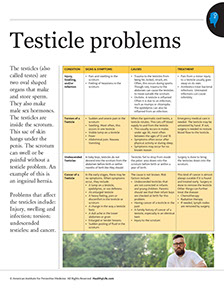
    The testicles (also called testes) are two oval shaped organs that make and store sperm. They also make male sex hormones. The testicles are inside the scrotum. This sac of skin hangs under the penis. The scrotum can swell or be painful without a testicle problem. An example of this is an inguinal hernia.

    Problems that affect the testicles include: Injury, swelling and infection; torsion; undescended testicles; and cancer.

    Signs & Symptoms

    For Injury, Swelling, and/or Infection

    *  Pain and swelling in the scrotum.

    *  Feeling of heaviness in the scrotum.

    For Torsion of a Testicle

    *  Sudden and severe pain in the scrotum.

    *  Swelling. Most often, this occurs in one testicle.

    *  Fever.

    *  Abdominal pain. Nausea. Vomiting.

    For Undescended Testicles

    *  In baby boys, testicles do not descend into the scrotum from the abdomen before birth or within months of birth like they should.

    For Cancer of a Testicle

    In the early stages, there may be no symptoms. When symptoms occur, they include:

    *  A lump on a testicle, epididymis, or vas deferens.

    *  An enlarged testicle.

    *  A heavy feeling, pain or discomfort in the testicle or scrotum.

    *  A change in the way a testicle feels.

    *  A dull ache in the lower abdomen or groin.

    *  Enlarged or tender breasts.

    *  Sudden pooling of fluid in the scrotum.

    Causes

    For Injury, Swelling, and Infection

    *  Trauma to the testicles from being hit, kicked, struck, etc. Often, this occurs during sports. Though rare, trauma to the abdomen can cause the testicles to move outside the scrotum.

    *  Orchitis. With this, a testicle is inflamed. Often it is due to an infection, such as mumps or chlamydia. The epididymis can also be inflamed from an infection.

    For Torsion of a Testicle

    When the spermatic cord twists, a testicle rotates. This cuts off blood supply to and from the testicle.

    *  This usually occurs in males under age 30, most often between the ages of 12 and 18.

    *  Symptoms often occur after physical activity or during sleep.

    *  Symptoms may occur for no known reason.

    For Undescended Testicles

    Testicles fail to drop from inside the pelvic area down into the scrotum before birth or within a year of birth.

    For Cancer of a Testicle

    The cause is not known. Risk factors include:

    *  Undescended testicles that are not corrected in infants and young children. Parents should see that their infant boys are checked at birth for this problem.

    *  Having cancer of a testicle in the past.

    *  A family history of cancer of a testicle, especially in an identical twin.

    *  Injury to the scrotum.

    Treatment

    For Injury, Swelling, and/or Infection

    *  Pain from a minor injury to a testicle usually goes away on its own.

    *  Antibiotics treat bacterial infections. Untreated infections can cause infertility.

    For Torsion of a Testicle

    Emergency medical care is needed. The testicle may be untwisted by hand. If not, surgery is needed to restore blood flow to the testicle.

    For Undescended Testicles

    Surgery is done to bring the testicles down into the scrotum.

    For Cancer of a Testicle

    This kind of cancer is almost always curable if it is found and treated early. Surgery is done to remove the testicle. Other things can further treat the disease:

    *  Chemotherapy.

    *  Radiation therapy.

    *  If needed, lymph nodes are removed by surgery.

    Questions to Ask

    Self-Care / Prevention

    To Avoid Injury to the Scrotum

    *  Wear protective gear and clothing during exercise and sports.

    *  Wear an athletic cup to protect the testicles.

    To Help Prevent Infections

    *  See that your children get vaccines for measles, mumps, and rubella (MMR) as advised by their doctor.

    *  To help prevent STDs, follow “Safer Sex” guidelines.

    To Treat Infections

    *  Take medication as prescribed.

    *  Take an over-the-counter medicine for pain and swelling, if needed. Follow directions.

    *  Rest.

    *  Apply cold compresses or an ice pack to painful, swollen area.

    Testicular Self-Exam

    Talk to your doctor about doing testicular self-exams (TSEs). If you choose to do TSEs, follow your doctor’s advice.

    The best time to do a TSE is after a warm bath or shower. This relaxes the scrotum, allows the testicles to drop down, and makes it easier to find anything unusual. Doing a TSE is easy and takes only a few minutes.

    1.  Stand in front of a mirror. Look for any swelling on the skin of the scrotum.

    2.  Examine each testicle with both hands. Place your index and middle fingers underneath the testicle and your thumbs on top. Gently roll one testicle then the other between your thumbs and fingers. One testicle may be larger. This is normal. Examine each testicle for any lumps. These are usually painless and about the size of a pea.

    3.  Find the epididymis. This is the comma-shaped cord behind the testicle. It may be tender to the touch. Check it for lumps.

    4.  Examine the vas deferens. This is the tubelike structure at the back of each testicle. Check it for lumps.

    Resources
    National Cancer Institute

    800.4.CANCER (422.6237)

    www.cancer.gov

    Healthier at Home book by the American Institute for Preventive Medicine. www.HealthyLife.com. All rights reserved.

    © American Institute for Preventive Medicine

  • Facts And Fallacies About Vasectomies

    Men’s Health

    Image of smiling male.

    Sterilization is the ultimate method of birth control. Vasectomies are safe and can be performed in about 30 minutes under local anesthesia. (The procedure involves surgical removal of part of the vas deferens or sperm duct.) You don’t even have to go to the hospital.

    Some common misconceptions make many men reluctant to consider a vasectomy. Having a vasectomy does not lower your sex drive, leave you impotent, or cause hardening of the arteries. And a vasectomy won’t reduce pleasurable sensations during sex.

    If you’re considering a vasectomy:

    *  Consult a urologist who specializes in genitourinary surgery.

    *  Make sure all your questions are answered satisfactorily.

    *  Think the matter over carefully before you take action.

    A Year of Health Hints book by the American Institute for Preventive Medicine. www.HealthyLife.com. All rights reserved.

    © American Institute for Preventive Medicine

  • Important Health Screenings For Men

    WELL-BEING

    Image of male doctor.

    Even if you feel fine, you should see your doctor for regular health screenings. Many health conditions cause no symptoms in their earliest stages. Screenings can help you get earlier treatment and a better outcome. The National Institutes of Health recommends the following tests for men:

    Abdominal aortic aneurysm:

    Adults ages 65 to 75 who have smoked may need this screening once. Others should consult with their doctor.

    Blood pressure:

    Every one to two years, depending on your risk factors or health conditions.

    Cholesterol:

    Beginning at age 35, every five years if levels are normal. Men with high blood pressure, other risk factors for heart disease or certain health conditions may need to get screened sooner or more often.

    Colon cancer:

    Screening may begin at age 50, or earlier, if you have a family history of the disease, certain risk factors or certain health conditions.

    Diabetes:

    Every three years beginning at age 45. Earlier and/or more frequent testing may be advised if you have certain risk factors.

    Eyes:

    Every one to two years, or more often if you have glaucoma, have certain eye conditions or if your doctor recommends it.

    Hearing:

    Adults over age 65 may need a hearing test if signs of hearing loss are present.

    Lung cancer:

    Annual screening may be recommended for adults aged 55 to 80 years who have a 30 pack-year (smoke one pack per day for 30 years) smoking history AND currently smoke or have quit within the past 15 years.

    Osteoporosis:

    Discuss screening with your doctor if you are over age 50.

    Physical exam:

    Height, weight and Body Mass Index (BMI) should be measured at well visits.

    Prostate cancer:

    Discuss screening with your doctor. Men with certain risk factors may need screenings beginning at age 45.

    Sexually transmitted infections:

    Depending on age, lifestyle and medical history, you may need to discuss with your doctor about getting tested for chlamydia, syphilis, HIV and other infections.

    Men of all ages and health statuses need regular health screenings. Call your doctor to schedule your well visit!

    © American Institute for Preventive Medicine

  • Men’S Health 2

    MEDICAL NEWS

    Image of oler man at the doctor's office.

    Increasing awareness of health problems that can be prevented among men and encourage men and boys to get early detection and treatment of disease and injury.

    6 health tests men need

    Here are 6 essential screening tests all men should receive during their lifetime, according to pathologist and men’s health expert Dr. Thomas Wheeler, Baylor College of Medicine.

    1.Prostate cancer:The prostate specific antigen (PSA) test was developed to help detect prostate cancer in men, but experts now disagree about treating the cancer if detected. Men, starting at age 50, should speak with their docs about the pros and cons of screening. For those in high-risk categories, this conversation should begin at age 45 or earlier.

    2.Blood pressure:It’s a simple and painless test for the “silent killer.” Why? Because high blood pressure has no symptoms. Often, simple diet changes and regular exercise can lower blood pressure. If not, the medications to control blood pressure are well tolerated and do not cost a lot.

    3.Cholesterol:A cholesterol test also is a simple screening test and is advised for men at least every 5 years, or yearly if abnormal.

    4.Colon cancer:This is the third most common cancer in Americans. Beginning at age 50, men should be screened for precancerous polyps and colon cancer. Screening tests include the fecal occult blood test, flexible sigmoidoscopy and colonoscopy.

    5.Skin cancer:Limiting sun exposure and receiving regular check-ups can help men avoid this common cancer including melanoma – a potentially deadly form.

    6.Diabetes:Men 45 years and older should be tested for type 2 diabetes every 3 years. Common screening blood tests are fasting glucose and hemoglobin A1c. Diabetes can be detected early before complications of more advanced disease set in.

    © American Institute for Preventive Medicine