Tag: milestones

  • Reward Yourself For Weight Loss

    Weight Control

    When a behavior is followed by a reward, the behavior is more likely to be repeated. So the more you are rewarded for your weight-loss efforts, the more likely you’ll continue to succeed.

    But you don’t have to wait until you lose weight to reward yourself Rewards should begin the very first day of your diet. (Of course, food should not be a reward.)

    Here are just a few examples of the kinds of rewards that can help you to adhere to your weight-control plan.

    *  Buy yourself a bouquet of flowers.

    *  Call a friend long-distance.

    *  Give yourself some special “me” time.

    *  Try a new cologne.

    *  Get your car washed.

    *  Have a low-calorie picnic. (The picnic is the reward, not the food.)

    *  Treat yourself to a movie.

    *  Keep a diary of all the improvements you notice while dieting (more stamina, feeling attractive, fitting into smaller-size clothing).

    Page from A Year of Health Hints book by the American Institute for Preventive Medicine. www.HealthyLife.com. All rights reserved.

    © American Institute for Preventive Medicine

  • Step-By-Step

    Weight Control

    Walk off extra weight and improve health problems.

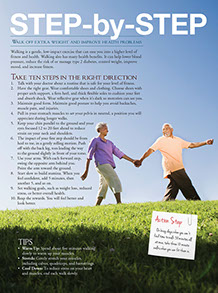
    Walking is a gentle, low-impact exercise that can ease you into a higher level of fitness and health. Walking also has many health benefits. It can help lower blood pressure, reduce the risk of or manage type 2 diabetes, control weight, improve mood, and increase fitness.

    Take ten steps in the right direction:

    1.  Talk with your doctor about a routine that is safe for your level of fitness.

    2.  Have the right gear. Wear comfortable shoes and clothing. Choose shoes with proper arch support, a firm heel, and thick flexible soles to cushion your feet and absorb shock. Wear reflective gear when it’s dark so motorists can see you.

    3.  Maintain good form. Maintain good posture to help you avoid backaches, muscle pain, and injuries.

    4.  Pull in your stomach muscles to set your pelvis in neutral, a position you will appreciate during longer walks.

    5.  Keep your chin parallel to the ground and your eyes focused 12 to 20 feet ahead to reduce strain on your neck and shoulders.

    6.  The impact of your first step should be from heel to toe, in a gently rolling motion. Push off with the back leg, toes leading the way to the ground slightly in front of your torso.

    7.  Use your arms. With each forward step, swing the opposite arm behind you. Point the arm toward the ground.

    8.  Start slow to build stamina. When you feel confident, add 5 minutes, then another 5, and so on.

    9.  Set walking goals, such as weight loss, reduced stress, or better overall health.

    10. Reap the rewards. You will feel better and look better.

    Tips

    *  Warm Up: Spend about five minutes walking slowly to warm up your muscles.

    *  Stretch: Gently stretch your muscles, including calves, quadriceps, and hamstrings.

    *  Cool Down: To reduce stress on your heart and muscles, end each walk slowly.

    Action Step

    On busy days when you can’t find time to walk 30 minutes all at once, take three 10-minute walks when you can fit them in.
    Page from Ways to Well-Being book by the American Institute for Preventive Medicine. www.HealthyLife.com. All rights reserved.

    © American Institute for Preventive Medicine

  • Set Fitness Goals

    Healthylife® Weigh

    Part 5

    Active women with armband to hold smartphone.

    Set your own fitness goals. Other people may have suggestions, but choose a goal that you want to go after. Other people’s fitness goals should not interfere with one you set for yourself.

    *  Write down your goals. This gives them more importance.

    *  Your goals should be within reach, but challenging. Make sure your goals are S.M.A.R.T. Does your goal meet the criteria?

    *  Know why you are setting each goal. For example, you may be doing this exercise for stress relief or to try something new. Or, you are meeting a friend and want to help them stick to their goal.

    *  Review and adjust your goals as needed. It takes practice to know how to set reasonable but challenging goals for yourself.

    *  Track your progress and reward yourself for successes.

    © American Institute for Preventive Medicine