Tag: mindset

  • Help! I Just Ate Half A Cake!

    Healthylife® Weigh

    Part 6

    Cheesecake dessert with chocolate and coffee.

    Recover from Overeating

    1. Be kind to yourself. Practice self-care right away, both in what you say to yourself and what you do.

    Say something kind to yourself now. Write it down here:

    2. Drink water and get enough sleep. This supports your kidneys and liver, two organs in your body that help keep digestion going smoothly and filter out toxins.

    3. Get up and move. Perhaps go for a slow walk today. Then, get your heart pumping more tomorrow with a faster walk or an exercise class.

    4. Start the next day with a healthy breakfast. Get your metabolism revved and running early. This will help you use the extra energy you consumed the day before. Choose a food high in fiber for breakfast. This will help your body clear your digestive system of waste, especially from a large meal high in fatty and salty foods. Choose plant-based sources of protein to give your body extra fiber.

    5. Continue to follow your healthy eating plan. Avoid the “I blew it” approach that can cause one “off” meal or snack to spiral out of control.

    6. Plan for the future. Without a plan, this is likely to happen again.

    – Am I eating enough? Do I feel like I’m starving all the time?

    – Am I getting enough from each food group? Your body may need a nutrient that it isn’t getting.

    – Am I being too tough on myself? Making a lot of changes at once can be hard to stick with. Create a realistic plan for you to make changes gradually. Allow yourself some treats.

    – Learn healthy ways to cope with emotions in this section.
    © American Institute for Preventive Medicine
  • Look Beyond Your Weight Goal

    Healthylife® Weigh

    Part 7

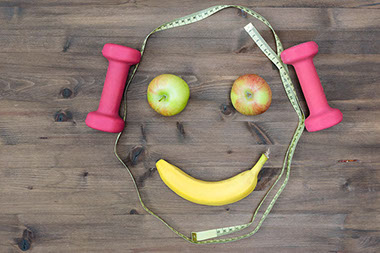
    Apples, measuring tape, dumbbells and banana assembled into a smiling face.

    A healthy lifestyle is not just about the number on the scale. Reflect on what got you motivated to lose weight and got you over hurdles. Strengthen your values by connecting more to the world around you.

    Share your story.Share your struggles, your ideas, and your motivation. Share through your words and actions. You may have inspired someone already. Post to social media or comment on another post. Start a blog about your journey as you continue to learn and manage new challenges.

    Say thank youto those who have helped you along the way and who continue to help you. This may be your healthcare professionals, health coach, coworkers, friends, family, or the stranger who makes your coffee every day. Let people know how much they mean to you. It could be the boost that person needs today.

    Address hunger in your community.Millions of people worldwide struggle with food insecurity. Someone who is food insecure doesn’t know where their next meal is coming from. Many are children. It may be you. Food banks, soup kitchens, homeless shelters, and other community organizations appreciate volunteers or donations. Volunteer to teach a cooking class or lead a grocery store tour. Share your strengths.

    Care for the environment.The global food system depends on a healthy planet. It is also one of the biggest contributors of greenhouse gases and global warming. Choose local, sustainably produced food when possible. In general, the negative environmental impact increases with how far the food traveled, how long it was stored, and how many chemicals were sprayed on it. Buy enough, but not too much, to reduce waste. Use reusable containers for eating and transporting meals and snacks.

    © American Institute for Preventive Medicine
  • Mental Health

    Healthylife® Weigh

    Part 5

    Group of people with thumbs up in yoga studio.

    Emotional Health

    Exercise releases endorphins and increases levels of serotonin and dopamine in the brain. These brain chemicals help create feelings of happiness and euphoria. You may start to feel these benefits after just a few minutes of moderate exercise. This leads to a quick happiness buzz and an overall mood boost!

    Stress Management

    Norepinephrine is a chemical that can moderate the brain’s response to stress. Exercise helps to increase that chemical. Exercise can decrease worry and tension. It also enhances the mind’s ability to deal with daily stressors. Managing stress can reduce emotional eating and cravings for sweets and high-fat foods. The calming effect of exercise can last at least four hours after the exercise is over.

    View physical activity as a break from your day. Use this time to focus on the present, instead of past or future problems and worries.

    Connect to My Values:

    Example: Having good emotional health will help me enjoy what I am doing in the moment. Enjoying life’s pleasures, such as the beauty of fall colors, is important to me.

    © American Institute for Preventive Medicine

  • Power Of Perception

    Healthylife® Weigh

    Part 2

    Cauliflower pizza with spinach, zucchini and asparagus.

    Which words/phrases do you associate with vegetables?

    *  Green

    *  Filling

    *  Necessary evil

    *  Fiber

    *  Broccoli

    *  Minerals

    *  Boring

    *  Variety

    *  Hydrating

    *  Vitamins

    *  Colorful

    *  Fresh

    *  Salad

    *  Do I have to?

    *  Exciting

    *  Nourishing

    *  Canned

    *  Soggy

    *  Crisp

    *  French fries

    Having a positive attitude toward a food may help you be more willing to try it and include it in your diet.

    *  Look back at the words listed above. How do you think your current attitude toward vegetables influences your food choices?

    *  After learning about vegetables, how do you feel your attitude toward vegetables has changed?

    *  What is one new way you want to eat a vegetable this week?

    © American Institute for Preventive Medicine
  • Set Yourself Up For Success

    Healthylife® Weigh

    Part 5

    Man running along hiking trail.

    Create a consistent routine for yourself. Reduce the number of excuses you can make. Tips for creating an exercise habit:

    *Seize your moment.Be aware of when your motivation to exercise is high. You may prefer mornings over evenings. Or, the opposite. Plan to exercise when you are more likely to be physically and mentally on board with it.

    *Get ready ahead of time.Pack a bag with clothes, shoes, deodorant, hair ties, a water bottle, a small towel, and other supplies you’ll need. When exercise comes up on your calendar, all you have to do is grab the bag.

    *Get ready for round 2 ahead of time.Have several days’ worth of workout clothes clean and ready to go. Store workout clothes together so it is easy to re-fill your gym bag. Make it easier to repeat your habit.

    *Commit to repeating your routine.Join a recreational sports team, sign up for a class, or pay for a personal training package. Even if you are not feeling up to it one day, having it on the schedule may get you there.

    *Be accountable to someone.Commit to meeting a friend for exercise at a certain time. Get a workout buddy and swap shoes. If you don’t show up, they won’t be able to work out either! Or, commit to logging your workout on social media or with a friend.

    *Be patient.It may take time to find an activity you like. It may take even longer to feel like it is a normal part of your day to exercise. Keep going. You’ll get there!

    © American Institute for Preventive Medicine

  • 4 Behaviors For A Healthy Wallet

    FINANCIAL HEALTH

    Concept image of growing leaf with stacked coins.

    1. Make a budget and stick to it.

    Many money experts will tell you that you need to know where your money is going each month. Creating a budget helps to see how much you spend on certain things and where you can cut back to save even more.

    2. Check your credit report each year.

    You are entitled to a free credit report once per year. This is an important step to help spot identity theft early. Your credit report can affect your mortgage rate and ability to get a loan.

    3. Shop around for a good APR on your next loan.

    The annual percentage rate (APR) on a loan is an important number. This is the total cost, including fees and interest, described as a yearly rate. The APR can vary widely between banks or lenders. It pays to take some extra time to find the best rate. Make sure you understand exactly what you will pay.

    4. Put money away for an emergency fund.

    Having an emergency fund offers peace of mind and protection from unexpected costs. Even a few dollars a week can add up, so save what you can.

    Paycheck checkup

    The Internal Revenue Service (IRS) says employees should look at their paycheck withholdings each year. Withholdings are taxes that are taken out of your paycheck.

    It’s especially important to check your withholdings in 2018, the IRS says. The Tax Cuts and Jobs Act, signed in December 2017, may change how much you want withheld.

    The IRS has a withholding calculator on their website at:apps.irs.gov/app/withholdingcalculator. This calculator can help you be sure that you aren’t having too much or too little tax withheld from your paychecks.

    © American Institute for Preventive Medicine
  • Commit To Be Fit

    BE FIT

    Image of middle-aged women with dumb bells.

    How are those resolutions going about now? You can make a renewed commitment to yourself and your health anytime. Here’s advice from Life Time Fitness to move forward:

    *Create a vision statement.Make your resolution a commitment and create a vision statement that projects clear personal investment and connects directly to your happiness and health. Once you’ve created your personal vision, you can identify what goals will get you there.

    *Don’t assume you know how to exercise.Many people who exercise think they know what to do when they walk into a gym, but it is common to use poor form, train at an inappropriate intensity, or choose the wrong exercises for your needs. A well-planned program using proper exercise technique will prove much more successful. Sit down with a well-qualified and certified personal trainer to talk about your exercise program to start on the right track.

    *Test your readiness.Ask yourself how ready you are to make an actual change. If your vision is health-based and you’ve made the goal of working out every morning of the week, ask yourself (on a scale of 1 to 10 with 10 being absolutely positive) how likely you’ll be able to commit and achieve that task and identify barriers that might get in the way. If your readiness is 7 or above, you’re ready to embark on your vision. If it’s below 7, change or revise your goal until you’re confident enough to know you’ll succeed. Small steps to succeed are better than big steps to fail.

    *Junk the junk.Don’t think you can stick to your diet while keeping junk food in the house. Make a commitment to get rid of all the foods that don’t promote health. Instead, fill your kitchen with good choices.

    *Put it on the fridge.Laminate it, frame it or post it on your mirror. The goal is to have your resolution statement somewhere where you will see it often as a reminder of what you are working toward. If you’re a social person, share it.

    © American Institute for Preventive Medicine

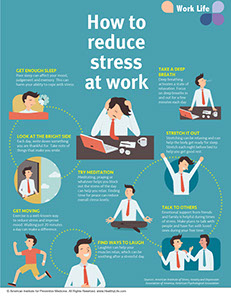
  • How To Reduce Stress At Work

    WORK LIFE

    Image of smiling employee.

    Get enough sleep:Poor sleep can affect your mood, judgement and memory. This can harm your ability to cope with stress.

    Look at the bright side:Each day, write down something you are thankful for. Take note of things that make you smile.

    Get moving:Exercise is a well-known way to reduce stress and improve mood. Walking just 20 minutes a day can make a difference.

    Try meditation:Meditating, praying or whatever helps you block out the stress of the day can help you relax. Finding time for peace can reduce overall stress levels.

    Find ways to laugh:Laughter can help your muscles relax, which can be soothing after a stressful day.

    Take a deep breath:Deep breathing activates a state of relaxation. Focus on deep breaths in and out for a few minutes each day.

    Stretch it out:Stretching can be relaxing and can help the body get ready for sleep. Stretch each night before bed to help you get good rest.

    Talk to others:Emotional support from friends and family is helpful during times of stress. Make plans to talk with people and have fun with loved ones during your free time.

    Sources: American Institute of Stress, Anxiety and Depression Association of America, American Psychological Association

    © American Institute for Preventive Medicine