Tag: monitoring

  • High Blood Pressure

    Heart & Circulation Problems

    The medical name for high blood pressure is hypertension (hy-puhr-TEHN-shun). High blood pressure (HBP) is when blood moves through the arteries at a higher pressure than normal. The heart strains to pump blood through the arteries.

    Signs & Symptoms

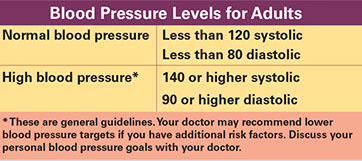
    High blood pressure (HBP) is a “silent disease.” Often there are no signs or symptoms. A lot of adults with HBP do not know they have it. So, get your blood pressure checked at each doctor’s office visit, at least every 2 years, or as often as your doctor advises. When blood pressure is 180 or higher (top number) or 120 or higher (bottom number), these signs of a hypertensive crisis may occur:

    *  Severe chest pain

    *  Severe headache with confusion and blurred vision

    *  Severe anxiety

    *  Shortness of breath

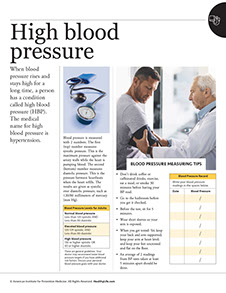
    Blood pressure is measured with 2 numbers. The first (top) number measures systolic pressure. This is the maximum pressure against the artery walls while the heart is pumping blood. The second (bottom) number measures diastolic pressure. This is the pressure between heartbeats when the heart refills. The results are given as systolic over diastolic pressure, such as 120/80 millimeters of mercury (mm Hg).

    Tips When You Have Your BP Measured

    *  Don’t drink coffee or smoke 30 minutes before having your BP read. (Don’t smoke at all!)

    *  Go to the bathroom before you get it checked.

    *  Before the test, sit for 5 minutes.

    *  Wear short sleeves so your arm is exposed.

    *  When you get tested: Sit; keep your back and arm supported; and keep your arm at heart level.

    *  An average of 2 readings from BP tests taken at least 5 minutes apart should be done.
    Causes, Risk Factors & Care

    The exact cause is not known.

    Risk factors include:

    *  Family history of HBP

    *  Aging. More than half of older adults have HBP.

    *  Smoking cigarettes

    *  Race. African Americans are more likely to have HBP than Caucasians.

    *  Gender. Men are more likely to have HBP than women (until women reach menopause).

    *  Being inactive. Obesity. Sleep apnea.

    *  Drinking too much alcohol

    *  Too much sodium intake in some persons

    *  Emotional distress

    High blood pressure could be caused by another medical problem or be a side effect of some medicines. This is called secondary hypertension. This can usually be reversed when the problem is treated.

    Diagnosis

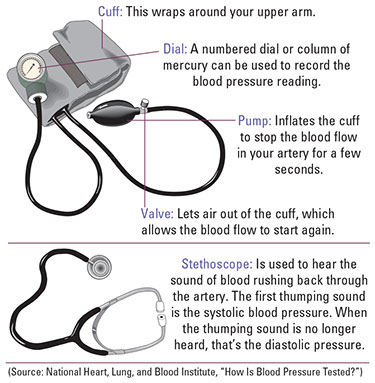
    Blood pressure readings tell if your blood pressure is high. A health care professional measures blood pressure during an office visit with a manual or automated device called a sphygmomanometer (sfig’-mo-ma-nom-e-ter). The numbers on the gauge measure your blood pressure in millimeters of mercury (mm Hg).

    You should get 2 or more readings at different times. To confirm a diagnosis of HBP, your doctor may have you wear a device that records your blood pressure every 20-30 minutes over a period of 24 to 48 hours. This is called ambulatory blood pressure monitoring (ABPM).

    Note: Sometimes just being at the doctor’s office is enough to raise some people’s blood pressure. This is called “white-coat hypertension.” If you think this affects you, tell your doctor. You may be advised to check your blood pressure with a home testing device. Your doctor may have you wear a device that records your blood pressure for 24 hours. This will give accurate readings of your blood pressure.

    Health Problems Related to HBP

    High blood pressure plays a major role in these health problems:

    *  Stroke. Dementia. Brain damage.

    *  Heart disease. A person with HBP is 5 times more likely to have a heart attack than a person without HBP. It can also cause the heart to enlarge. This could cause (congestive) heart failure.

    *  Chronic kidney disease

    *  Kidney failure

    *  Vision loss. This includes blindness.
    Why is ambulatory blood pressure monitoring (ABPM) done?

    During an office visit, a short-term rise in blood pressure can be due to:

    *  Emotions or stress

    *  Pain or physical activity

    *  Caffeine or nicotine

    *  “White-coat hypertension.” With this, just being at a doctor’s office or in the presence of medical staff is enough to raise blood pressure.

    Getting blood pressure readings over 1-2 days during normal activity and sleep gives a more accurate measurement of your blood pressure.

    Self-Care / Prevention

    For blood pressure control, follow a healthy lifestyle.

    *  Get your blood pressure checked at each office visit, at least every 2 years, or as often as your doctor advises.

    *  Get to and/or stay at a healthy weight. Aim for a body mass index (BMI) between 18.5 and 24.9. Find your BMI using the table below or from:www.nhlbisupport.com/bmi.

    *  Don’t smoke. If you smoke, quit.

    *  Limit alcohol to 2 drinks or less a day if you are male and 1 drink or less a day if you are female or age 65 or older.

    *  Limit caffeine.

    *  Exercise. Try to do at least 60 minutes a day.

    *  Learn to handle stress. Take classes. Learn relaxation techniques, etc.

    *  Take medicine as prescribed. Tell your doctor if you have any side effects, such as dizziness, faintness, or a dry cough without having a cold. Don’t stop taking your prescribed medicine or change the dose(s) unless your doctor tells you to.

    *  Talk to your doctor or pharmacist before you take antihistamines and decongestants. Discuss all prescribed and over-the-counter medicines with your doctor and pharmacist before you take them to avoid harmful drug interactions. Find out about drug and food interactions, too. Ask if grapefruit juice can cause harmful effects with the medicine(s) you take.

    *  Keep track of your blood pressure using a home testing device. Do this if advised by your doctor.

    Medical Care

    High blood pressure usually lasts a lifetime, but can be treated and controlled. If you are diagnosed with high blood pressure, follow your doctor’s advice. Medical treatment includes:

    *  A physical exam and lab tests. These check for damage to your heart, kidneys, and other organs. They also identify risk factors you have for heart, kidney, and other diseases. Your treatment plan is based on your needs.

    *  Follow-up blood pressure checks and other tests as needed.

    *  Healthy lifestyle changes.

    *  Medications. Most persons need more than 1 medicine to treat high blood pressure.

    Your doctor will decide if and what medication(s) you need. This is based on your blood pressure level, age, race, other conditions you have, heart disease risk factors, etc. Common medicines used to treat HBP are:

    *  Diuretics (water pills)

    *  Calcium channel blockers

    *  ACE inhibitors

    *  Angiotensin II receptor blockers

    *  Beta-blockers

    *  Alpha blockers. Alpha-beta blockers.

    *  Nervous system inhibitors

    *  Vasodilators

    Reasons to Get Medical Care

    *  You have signs or symptoms of a hypertensive crisis. Get medical care right away.

    *  You need to schedule office visit appointments to get your blood pressure checked. Do this as often as your doctor advises.

    *  You have adverse side effects from taking medicine(s) to lower blood pressure. Examples are:

    – You feel lightheaded or dizzy.

    – You feel weak, sleepy, and/or drowsy.

    – Your heart races.

    – You get a skin rash.

    Resources

    American Heart Association

    800.242.8721

    www.heart.org

    National Heart, Lung, and Blood Institute
    www.nhlbi.nih.gov

    High Blood Pressure brochure by the American Institute for Preventive Medicine. www.HealthyLife.com. All rights reserved.

    © American Institute for Preventive Medicine
  • High Blood Pressure 2

    Pregnancy & Prenatal Care

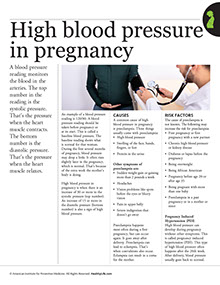
    A blood pressure reading concerns the blood in the arteries. The top number in the reading is the systolic pressure. That’s the pressure when the heart muscle contracts. The bottom number is the diastolic pressure. That’s the pressure when the heart muscle relaxes.

    An example of a blood pressure reading is 120/80. This is measured in millimeters of mercury (mm Hg). A blood pressure reading should be taken before pregnancy or at its start. This is called a baseline blood pressure. The baseline reading shows what is normal for that woman. During the first several months of pregnancy, blood pressure may drop a little. It often rises slightly later in the pregnancy. That’s because of the extra work the mother’s body is doing. A slight rise is normal then. High blood pressure in pregnancy is when there is an increase of 30 or more in the systolic pressure (top number). An increase of 15 or more in the diastolic pressure (bottom number) is also a sign of high blood pressure.

    Causes

    Preeclampsia

    A common cause of high blood pressure in pregnancy is preeclampsia. This used to be called toxemia. Three things usually come with preeclampsia:

    *  High blood pressure

    *  Swelling of the face, hands, fingers, or feet

    *  Protein in the urine

    Other symptoms of preeclampsia are:

    *  Sudden weight gain or gaining more than 2 pounds a week

    *  Headaches

    *  Vision problems like spots before the eyes or blurry vision

    *  Pain in upper belly

    *  Severe indigestion that doesn’t go away

    Preeclampsia affects about 7 out of 100 pregnant women. It happens most often during a first pregnancy, but can occur again, especially with a new partner. And, it only happens during pregnancy. It goes away after delivery. Preeclampsia can lead to eclampsia. That’s when convulsions also occur. Eclampsia can result in a coma for the mother.

    Risk Factors

    The cause of preeclampsia is not known. High blood pressure does not have to be present before pregnancy. The things listed below may increase the risk for preeclampsia:

    *  First pregnancy or first pregnancy with a new partner

    *  Chronic high blood pressure or kidney disease

    *  Diabetes or lupus before the pregnancy

    *  Being overweight

    *  Being African American

    *  Pregnancy before age 20 or after age 35

    *  Being pregnant with more than one baby

    *  Preeclampsia in a past pregnancy or in a mother or sister

    Pregnancy Induced Hypertension (PIH)

    High blood pressure can develop during pregnancy without other symptoms. This is called pregnancy induced hypertension (PIH). This type of high blood pressure often happens after the 20th week. After delivery, blood pressure usually goes back to normal.

    Treatment

    High blood pressure and preeclampsia can range from mild to severe. They can be treated with medical help and home care. But if serious symptoms are present, medicine and/or hospital care may be needed. The health care provider may induce labor (bring on labor). Or a Cesarean section (C-section) may be done.

    When blood pressure remains high, not enough blood reaches the placenta. The fetus doesn’t get enough oxygen and nutrients. That can cause:

    *  Growth problems for the fetus

    *  Placenta abruptio.

    *  A baby that is born preterm, that has mental problems, is underweight, or stillborn

    Questions to Ask

    Self-Care

    *  Get a lot of rest. Sleep 8 to 12 hours at night. Take 2 naps during the day, if you can. When you sleep or rest, lie on your left side, as much as you can. This helps blood flow to the placenta. When you tire of lying on your left side, lie on your right side.

    *  Take medicine for high blood pressure as prescribed. If told to do so, take regular blood pressure readings at home. Ask your health care provider how to get a home test kit.

    *  Follow your health care provider’s advice about exercise.

    *  Do things to relax. Examples: listen to soft music, put your feet up, take a nap. Watch a TV show that makes you laugh. Put your hand on your belly to feel your baby move.

    *  Don’t take any medicine without your health care provider’s okay. That includes cold or sinus medicines and antacids.

    Prenatal Self-Care book by the American Institute for Preventive Medicine. www.HealthyLife.com. All rights reserved.

    © American Institute for Preventive Medicine

  • Safe Pregnancy After Age Thirty-Five

    Pregnancy & Prenatal Care

    Image of pregnant older women reading.

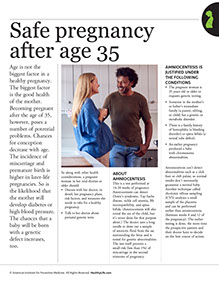
    Age is not the biggest factor in a healthy pregnancy. The biggest factor is the good health of the mother.

    Becoming pregnant after the age of 35, however, poses a number of potential problems. Chances for conception decrease with age. The incidence of miscarriage and premature birth is slightly higher in later-life pregnancies. So is the likelihood that the mother will develop diabetes or high blood pressure. The chances that a baby will be born with a genetic defect increases, too. So along with other health considerations, a pregnant woman in her mid-thirties or older should:

    *  Discuss with her doctor, in detail, her pregnancy plans, risk factors, and measures she needs to take for a healthy pregnancy.

    *  Talk to her doctor about prenatal genetic tests.

    About Amniocentesis

    Usually performed at about 16 weeks into the pregnancy, amniocentesis can detect Down’s syndrome, Tay-Sachs disease, sickle cell anemia, Rh incompatibility, and spina bifida. (Amniocentesis will also reveal the sex of the child, but it’s never done for that purpose alone.) The doctor uses a long needle to draw out a sample of amniotic fluid, which is tested for genetic abnormalities. The test itself presents some risk-there is about 1 chance in 100 to 1 chance in 200 that a miscarriage may occur.

    Amniocentesis is justified under the following conditions.

    *  The pregnant woman is 35 years old or older or requests genetic testing.

    *  Someone in the mother’s or father’s immediate family (a parent, sibling, or child) has a genetic or metabolic disorder.

    *  There is a family history of hemophilia (a bleeding disorder) or spina bifida (a neural tube defect).

    *  An earlier pregnancy produced a baby with chromosome abnormalities.

    Amniocentesis can’t detect abnormalities such as a club foot or cleft palate, so normal results don’t necessarily guarantee a normal baby. Another technique called chorionic villous sampling (CVS) analyzes a small sample of the placenta and can be performed earlier than amniocentesis, (between weeks 8 and 12 of the pregnancy). The earlier testing is done, the more time the prospective parents and their doctor have to decide on the best course of action.

    A Year of Health Hints book by the American Institute for Preventive Medicine. www.HealthyLife.com. All rights reserved.

    © American Institute for Preventive Medicine
  • Take Control Of Your Blood Pressure

    General Health Conditions

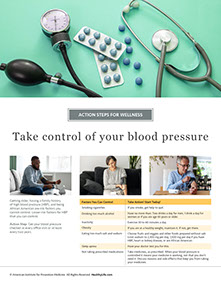
    Part of a blood pressure cuff and medications.

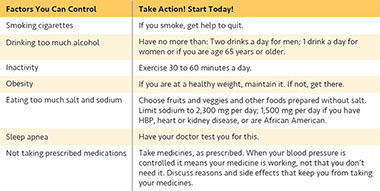
    Getting older, having a family history of high blood pressure (HBP), and being African American are risk factors you cannot control. Lower risk factors for HBP that you can control.

    Action Step:Get your blood pressure checked at every office visit or at least every two years.

    Health at Home Lifetime book by the American Institute for Preventive Medicine. www.HealthyLife.com. All rights reserved.

    © American Institute for Preventive Medicine

  • Exercise Addiction: Are You At Risk?

    BE FIT

    Image of female in fitness attire.

    Many women think that with achieving a fabulous figure like fashion models comes happiness, wealth, and the ideal mate. They will often exercise to a dangerous point in pursuit of “their dream body,” say Dr. Julia Samton, a neuropsychiatrist, and Certified Personal Trainer Franci Cohen who speak out about the dangers of pushing yourself past your limit.

    “For some girls, this desire for that picture-perfect life can lead to exercise addiction-the beginning of this quest for perfection,” says Dr. Samton.

    Typical symptoms of someone who is letting exercise take over her (or his) life:

    *Intention effects.The amount of exercise or length of exercise sessions is longer than originally intended.

    *Time.Large amounts of time are spent exercising and conflict with other areas of life.

    *Continuance.The person will continue to exercise even with persistent physical or psychological issues that are made worse from exercising, such as a recurring injury.

    “The biggest red flag,” according to Dr. Samton, “would be when exercise starts to interfere with one’s occupational, social, and overall functioning. It’s at this point that treatment is recommended.”

    “Cognitive behavioral therapy can be helpful, but seeking a therapist with experience in exercise addiction is crucial. For extreme cases, there are inpatient treatment facilities,” says Dr. Samton.

    © American Institute for Preventive Medicine
  • How Does Your Heart ‘Rate’?

    BE FIT

    Image of female checking heart rate.

    When it comes to getting a good workout, no two people are alike. Age, health status, fitness level, and many other factors can play a role in how hard you can – or should – exercise.

    Your target heart rate can tell you if you’re exercising hard enough to burn calories, but not too hard. Your target heart rate is how fast you want your heart to beat during exercise.

    You can find your target heart rate by following these steps:

    1. Get a stopwatch or use a watch or clock that has a second hand.

    2. Periodically during exercise, put two fingers on a pulse point. This can be the inside of your wrist on the thumb side, the inside of your elbow, or the side of your neck.

    3. Count how many times your heart beats in 60 seconds.

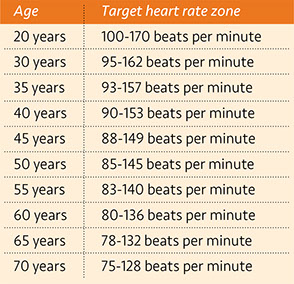
    Next, find your age in the chart and see if your heart rate is within the target heart rate zone listed. If it’s higher than the zone, take your workout down to an easier level. If it’s below, you may be able to exercise a little harder.

    Chart of Target Heart Rate Zone.

    If you’re just starting out with exercise, aim for the lower end of the range. After a few weeks, you can gradually work up to a higher heart rate within the zone.

    People who have heart conditions or other health problems should discuss any exercise or fitness activities with their doctor before starting. Certain medications that treat heart and blood pressure disease can cause a lower heart rate. Discuss your medications with your physician before trying to reach your maximum heart rate.

    Heart rate and blood pressure explained

    Heart rate and blood pressure are not the same thing. Blood pressure is the force of blood moving through your body. Heart rate or pulse is simply the number of times your heart beats per minute.

    A faster heart rate does not necessarily mean your blood pressure is rising. When the heart rate speeds up, blood vessels get bigger, allowing more blood to move through. This means many people can safely raise their heart rate during exercise without affecting their blood pressure.

    Talk to your doctor about blood pressure and get it checked yearly. Most people with high blood pressure can and should exercise with their doctor’s approval.

    Source: American Heart Association

    © American Institute for Preventive Medicine