Healthy Travel
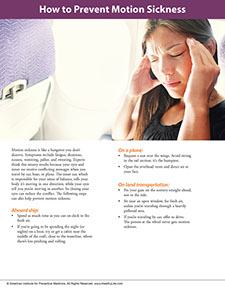
Motion sickness is like a hangover you don’t deserve. Symptoms include fatigue, dizziness, nausea, vomiting, pallor, and sweating. Experts think this misery results because your eyes and inner ear receive conflicting messages when you travel by car, boat, or plane. The inner ear, which is responsible for your sense of balance, tells your body it’s moving in one direction, while your eyes tell you you’re moving in another. So closing your eyes can reduce the conflict. The following steps can also help prevent motion sickness.
Aboard ship:
* Spend as much time as you can on deck in the fresh air.
* If you’re going to be spending the night (or nights) on a boat, try to get a cabin near the middle of the craft, close to the waterline, where there’s less pitching and rolling.
On a plane:
* Request a seat over the wings. Avoid sitting in the tail section; it’s the bumpiest.
* Open the overhead vents and direct air at your face.
On land transportation:
* Fix your gaze on the scenery straight ahead, not to the side.
* Sit near an open window, for fresh air, unless you’re traveling through a heavily polluted area.
* If you’re traveling by car, offer to drive. The person at the wheel never gets motion sickness.
In addition, the following steps are helpful no matter what your means of transportation.
* Get plenty of rest before setting out. Fatigue makes you more vulnerable to motion sickness.
* Avoid drinking alcohol before or during travel, and don’t overindulge the night before.
* Take an over-the-counter motion sickness medication (such as Dramamine) approximately 30 minutes before travel begins. Read the package for cautions and other important information.
* If over-the-counter medications don’t bring relief, ask your doctor about a prescription medication containing scopolamine, available as a patch that’s usually worn behind your ear.
* Don’t read while traveling and don’t try to focus on any other stationary object. Aboard a ship, lie down on your back and close your eyes.
* If any of your traveling companions get sick, move as far away from them as possible; otherwise, you may get sick, too.
Some people report that taking tablets of powdered gingerroot relieves their motion sickness. Others find relief by pressing on an acupressure point about midway on the inside of the wrist, where the hand and forearm meet.
If preventive measures fail and you feel sick anyway, you can try the following:
* Breathe slowly and deeply.
* Remove yourself from smoke and food odors, and get some fresh air.
* To reduce tension and anxiety, concentrate on relaxing all your muscles, as though you’re a limp rag doll, and visualize a peaceful scene.
* To settle a queasy stomach, eat dry crackers.
© American Institute for Preventive Medicine