Tag: mouth

  • Talking About Oral Cancer

    MEDICAL NEWS

    Image of dentist with illustration of a tooth.

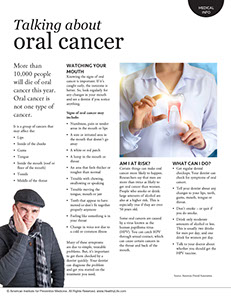
    More than 10,000 people will die of oral cancer this year. Oral cancer is not one type of cancer.

    It is a group of cancers that may affect the:

    *  Lips

    *  Inside of the cheeks

    *  Gums

    *  Tongue

    *  Inside the mouth (roof or floor of the mouth)

    *  Tonsils

    *  Middle of the throat

    Watching your mouth

    Knowing the signs of oral cancer is important. If it’s caught early, the outcome is better. So, look regularly for any changes in your mouth and see a dentist if you notice anything.

    Signs of oral cancer may include:

    *  Numbness, pain or tender areas in the mouth or lips

    *  A sore or irritated area in the mouth that doesn’t go away

    *  A white or red patch

    *  A lump in the mouth or throat

    *  An area that feels thicker or rougher than normal

    *  Trouble with chewing, swallowing or speaking

    *  Trouble moving the tongue, mouth or jaw

    *  Teeth that appear to have moved or don’t fit together properly anymore

    *  Feeling like something is in your throat

    *  Change in voice not due to a cold or common illness

    Many of these symptoms are due to simple, treatable problems. But, it’s important to get them checked by a dentist quickly. Your dentist can diagnose the problem and get you started on the treatment you need.

    Am I at risk?

    Certain things can make oral cancer more likely to happen. Researchers say that men are more than twice as likely to get oral cancer than women. People who smoke or drink large amounts of alcohol are also at a higher risk. This is especially true if they are over 50 years old.

    Some oral cancers are caused by a virus known as the human papilloma virus (HPV). You can catch HPV through sexual contact, which can cause certain cancers in the throat and back of the mouth.

    What can I do?

    *  Get regular dental checkups. Your dentist can check for symptoms of oral cancer.

    *  Tell your dentist about any changes to your lips, teeth, gums, mouth, tongue or throat.

    *  Don’t smoke – or quit if you do smoke.

    *  Drink only moderate amounts of alcohol or less. This is usually two drinks for men per day, and one drink for women per day.

    *  Talk to your doctor about whether you should get the HPV vaccine.

    Source: American Dental Association
    © American Institute for Preventive Medicine
  • Canker Sores

    Dental & Mouth Concerns

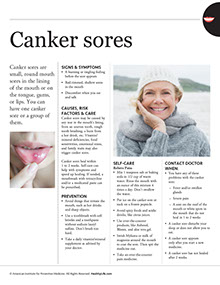
    Canker sores are small, round mouth sores in the lining of the mouth or on the tongue, gums, or lips. You can have one canker sore or a group of them.

    Signs & Symptoms

    *  A burning or tingling feeling before the sore appears

    *  Red-rimmed, shallow sores in the mouth

    *  Discomfort when you eat and talk

    Causes, Risk Factors & Care

    Canker sores may be caused by any tear in the mouth’s lining, from an uneven tooth, rough tooth brushing, a burn from a hot drink, etc. Vitamin/mineral deficiencies, emotional stress, and family traits may also trigger canker sores.

    Canker sores heal within 1 to 2 weeks. Self-care can help with symptoms and speed up healing. If needed, a mouthwash with tetracycline and/or an oral paste (amelxanox) can be prescribed.

    Self-Care / Prevention

    To Relieve Pain:

    *  Mix 1/2 cup salt in 1 cup of warm water. Rinse the mouth with an ounce of this mixture 4 times a day. Don’t swallow the water.

    *  Put ice on the canker sore or suck on a frozen popsicle.

    *  Avoid spicy foods and acidic drinks, like citrus juices.

    *  Use over-the-counter products, like Anbesol, Blistex, and aloe vera gel.

    *  Swish Mylanta or milk of magnesia around the mouth to coat the sore. Then spit the medicine out.

    *  Put the gel from a vitamin E capsule on the sore several times a day.

    *  Take an over-the-counter pain medicine.

    Prevention

    *  Avoid things that irritate the mouth, such as hot drinks and sharp objects.

    *  Use a toothbrush with soft bristles and a toothpaste without sodium lauryl sulfate. Don’t brush too hard.

    *  Take a daily vitamin/mineral supplement as advised by your doctor.

    Medical Care

    Contact Doctor When:

    *  You have any of these problems with the canker sore:

    – Fever and/or swollen glands

    – Severe pain

    – A sore on the roof of the mouth or white spots in the mouth that do not heal in 1 to 2 weeks

    *  A canker sore disturbs your sleep or does not allow you to eat.

    *  A canker sore appears only after you start a new medicine.

    *  A canker sore has not healed after 3 weeks.

    Healthier at Home book by the American Institute for Preventive Medicine. www.HealthyLife.com. All rights reserved.

    © American Institute for Preventive Medicine

  • Mouth To Hand

    SELF-CARE CORNER

    Image of person holding their wrist.

    Tingling, numbness and pain in your fingers and wrists? Is it just tired hands or something more severe? While, these can all be signs of tired, overused hands, these symptoms can also indicate something serious, such as a repetitive stress injury, tendonitis, aggravation of arthritis or sprains, and even carpal tunnel syndrome.

    With over 152.7 billion text messages sent per month in the U.S. alone, according to CTIA-The Wireless Association, it is becoming clear that our society is shifting its primary method of communication from our mouths and voices to our hands and fingers. With this shift, there has also been an increase in the number of injuries related to these repetitive motions.

    “It is important that patients don’t dismiss symptoms of sore fingers, occasional numbness and tingling,” says George Kardashian, MD, an orthopedic surgeon and hand specialist at The Center for Bone and Joint Disease. “These symptoms are all the body’s way of saying it needs a break or a more serious injury will occur.”

    Since it is almost impossible to stop using mobile devices or computers completely, it is important to know how to prevent these symptoms from turning from sore, tired fingers into something more severe.

    *  Take frequent breaks from typing and texting.

    *  Stretch your hands and fingers.

    *  Use ice packs to reduce swelling.

    *  See your doctor if you have continuing symptoms.

    © American Institute for Preventive Medicine

  • Open Wide

    SELF-CARE CORNER

    Image of dentist.

    Your dentist and dental hygienist inspect your mouth for oral cancers when you show up for your regular dental cleanings. But between visits, take note of these early warning signs, and see your dental professional if they do not improve or disappear after 2 to 3 weeks:

    *  A sore, or soreness or irritation that doesn’t go away

    *  Red or white patches, or pain, tenderness, or numbness in your mouth or lips

    *  Lumps, thickening tissues, rough spots, crusty or eroded areas

    *  Difficulty chewing, swallowing, or moving your jaw or tongue

    *  A change in the way your teeth fit together when you close your mouth

    Always call your dental professional right away if you have any immediate concerns. Those at high risk of developing oral cancer have traditionally been heavy alcohol drinkers and smokers over age 50. But today, cancer is occurring in younger, nonsmokers. The sexually transmitted HPV is related to some cancers in younger people.

    © American Institute for Preventive Medicine