Tag: Movement & Mobility

  • Move Your Way

    Fitness

    Man wearing apron and cleaning gloves, using a broom stick as a guitar.

    The key to moving more is finding and doing activities you really enjoy. Dancing, walking, gardening…if it moves you and makes you happy, it works! When you do move, work toward 20 minutes a day of moderate to vigorous levels of movement. Regular physical activity helps with weight management and improving cardiovascular health. Add some weighted hand gloves for increased resistance and to build muscle while you move.

    Be More Earth-Friendly

    Want to help the earth while exercising? Plogging – or picking up trash while you jog or walk – is one way you can do your part to keep your community, and the environment, clean.

    Page from HealthyLife Weigh book by the American Institute for Preventive Medicine. www.HealthyLife.com. All rights reserved.

    © American Institute for Preventive Medicine

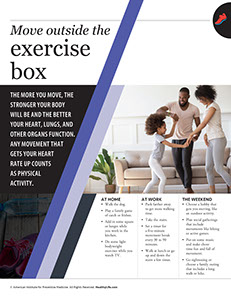
  • Move Outside The Exercise Box

    BE FIT

    Family dancing around.

    The more you move, the stronger your body will be and the better your heart, lungs, and other organs function. Any movement that gets your heart rate up counts as physical activity.

    At home

    *  Walk the dog.

    *  Play a family game of catch or frisbee.

    *  Add in some squats or lunges while you work in the kitchen.

    *  Do some light bodyweight exercises while you watch TV.

    At work

    *  Park farther away to get more walking time.

    *  Take the stairs.

    *  Set a timer for a five-minute movement break every 30 to 90 minutes.

    *  Walk at lunch or go up and down the stairs a few times.

    The weekend

    *  Choose a hobby that gets you moving, like an outdoor activity.

    *  Plan social gatherings that include movements like hiking or active games.

    *  Put on some music and make chore time fun and full of movement.

    *  Go sightseeing or choose a family outing that includes a long walk or hike.
    © American Institute for Preventive Medicine

  • Ready, Set, Goal

    Fitness

    Set short-term & long-term fitness goals.

    If you haven’t exercised for years, the odds that you will run a marathon soon are against you. Not that you can’t do it, if you start training now. However, a better motivator might be to set short-term goals that allow you to build up strength and endurance to get what you ultimately want.

    Ready

    Just saying you want to exercise more isn’t enough. Be specific about how much exercise you want to do, how much time you plan to spend on it, and how you will measure your results.

    Set

    Set a specific long-term goal. For example, “Within six months, I want to compete in a 15-mile walk,” or “In three months, I will be able to walk for 60 minutes a day, six times a week.”

    Next, set the short-term goals that will get you there. For example, walk 15 minutes a day, three times a week, for two weeks. Then increase your walking times and the number of days you walk until you reach your goal.

    Goal

    Before you know it, you’ll feel proud that you reached your short-term goal. And you’ll feel better and have more energy!

    Use SMART tips for setting goals

    *  Specific – Know what, why, and how you are going to accomplish your goals.

    *  Measurable – What tools will you use to measure your successes? Inches lost? Better stamina?

    *  Attainable – Choose goals within your reach. Setting sights too high can become discouraging.

    *  Realistic – Do you have the skills, the ability and an OK from your doctor to reach these goals?

    *  Timely – Set a timeframe for each goal. Some you can achieve in two days. Others will take two weeks or two months.

    Action Step

    As you meet your short-term goals, reward yourself with anything that promotes your progress, such as a new pair of shoes.

    Page image from the Ways to Well-Being book by the American Institute for Preventive Medicine. www.HealthyLife.com. All rights reserved.

    © American Institute for Preventive Medicine
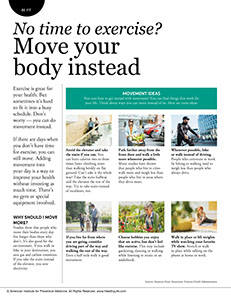
  • No Time To Exercise? Move Your Body Instead

    BE FIT

    Father and son walking the dog.

    Exercise is great for your health. But sometimes it’s hard to fit it into a busy schedule. Don’t worry – you can do movement instead.

    If there are days when you don’t have time for exercise, you can still move. Adding movement into your day is a way to improve your health without investing as much time. There’s no gym or special equipment involved.

    Why should I move more?

    Studies show that people who move their bodies every day live longer than those who don’t. It’s also good for the environment. If you walk or bike to your destination, you save gas and carbon emissions. If you take the stairs instead of the elevator, you save electricity.

    Movement ideas

    Not sure how to get started with movement? You can find things that work for your life. Think about ways you can move instead of sit. Here are some ideas:

    *Avoid the elevator and take the stairs if you can.You can burn calories two to three times faster climbing stairs than walking briskly on flat ground. Can’t take it the whole way? Take the stairs halfway and the elevator the rest of the way. Try to take stairs instead of escalators, too.

    *Park farther away from the front door and walk a little more whenever possible.Many studies have shown that people who live in cities walk more and weigh less than people who live in areas where they drive more.

    *Whenever possible, bike or walk instead of driving.People who commute to work by biking or walking tend to weigh less than people who always drive.

    *If you live far from where you are going, consider driving part of the way and walking the rest of the way.Even a half-mile walk is good movement.

    *Choose hobbies you enjoy that are active, but don’t feel like exercise.This may include gardening, dancing or walking while listening to music or an audiobook.

    *Walk in place or lift weights while watching your favorite TV show.Stretch or walk in place while talking on the phone at home or work.

    Sources: American Heart Association, Veterans Health Administration

    © American Institute for Preventive Medicine

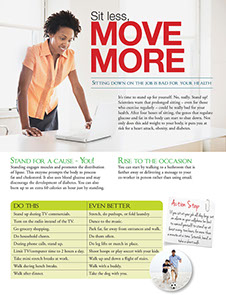
  • Sit Less, Move More

    Fitness

    Image of generational famiy running and walking at the park.

    Sitting down on the job is bad for your health.

    It’s time to stand up for yourself. No, really. Stand up! Scientists warn that prolonged sitting – even for those who exercise regularly – could be really bad for your health. After four hours of sitting, the genes that regulate glucose and fat in the body can start to shut down. Not only does this add weight to your body, it puts you at risk for a heart attack, obesity, and diabetes.

    Stand for a cause – You!

    Standing engages muscles and promotes the distribution of lipase. This enzyme prompts the body to process fat and cholesterol. It also uses blood glucose and may discourage the development of diabetes. You can also burn up to an extra 60 calories an hour just by standing.

    Rise to the occasion.

    You can start by walking to a bathroom that is farther away or delivering a message to your co-worker in person rather than using email.

    Do This

    Stand up during TV commercials.

    Turn on the radio instead of the TV.

    Go grocery shopping.

    Do household chores.

    During phone calls, stand up.

    Limit TV/computer time to 2 hours a day.

    Take mini stretch breaks at work.

    Walk during lunch breaks.

    Walk after dinner.

    Even Better

    Stretch, do pushups, or fold laundry.

    Dance to the music.

    Park far, far away from entrances and walk.

    Do them often.

    Do leg lifts or march in place.

    Shoot hoops or play soccer with your kids.

    Walk up and down a flight of stairs.

    Walk with a buddy.

    Take the dog with you.

    Action Step

    If you sit at your job all day long, set an alarm on your cellphone (on low) to remind yourself to stand up at least every two hours for more than a minute at a time. Stretch, bend, or take a short walk.

    Page image from the Ways to Well-Being book by the American Institute for Preventive Medicine. www.HealthyLife.com. All rights reserved.

    © American Institute for Preventive Medicine
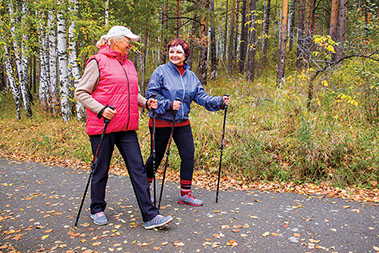
  • See Your Fitness Progress

    BE FIT

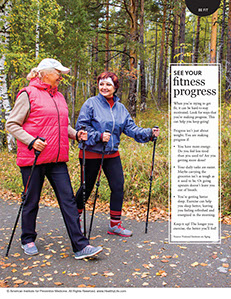
    Two women walking with walking sticks.

    When you’re trying to get fit, it can be hard to stay motivated. Look for ways that you’re making progress. This can help you keep going!

    Progress isn’t just about weight. You are making progress if:

    *  You have more energy. Do you feel less tired than you used to? Are you getting more done?

    *  Your daily tasks are easier. Maybe carrying the groceries isn’t as tough as it used to be. Or going upstairs doesn’t leave you out of breath.

    *  You’re getting better sleep. Exercise can help you sleep better, leaving you feeling refreshed and energized in the morning.

    Keep it up! The longer you exercise, the better you’ll feel!

    Source: National Institute on Aging

    © American Institute for Preventive Medicine
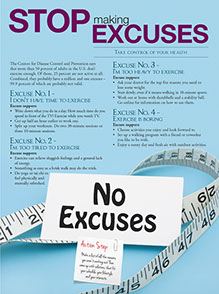
  • Stop Making Excuses

    Fitness

    Take control of your health.

    The Centers for Disease Control and Prevention says that more than 50 percent of adults in the U.S. don’t exercise enough. Of those, 25 percent are not active at all. Combined, they probably have a million and one excuses – 99.9 percent of which are probably not valid.

    Excuse No. 1 – I don’t have time to exercise.

    Excuse zappers:

    *  Write down what you do in a day. How much time do you spend in front of the TV? Exercise while you watch TV.

    *  Get up half an hour earlier to work out.

    *  Split up your workouts. Do two 30-minute sessions or three 10-minute sessions.

    Excuse No. 2 – I’m too tired to exercise.

    Excuse zappers:

    *  Exercise can relieve sluggish feelings and a general lack of energy.

    *  Something as easy as a brisk walk may do the trick.

    *  Do yoga or tai chi to feel physically and mentally refreshed.

    Excuse No. 3 – I’m too heavy to exercise.

    Excuse zappers:

    *  Ask your doctor for the top five reasons you need to lose some weight.

    *  Start slowly, even if it means walking in 10-minute spurts.

    *  Work out at home with dumbbells and a stability ball. Go online for information on how to use them.

    Excuse No. 4 – Exercise is boring.

    Excuse zappers:

    *  Choose activities you enjoy and look forward to.

    *  Set up a walking program with a friend or coworker you like to be with.

    *  Enjoy a sunny day and fresh air with outdoor activities.

    Action Step

    Make a list of all the reasons you aren’t working out. Then come up with solutions that fit your schedule, your lifestyle, and your interests.

    Page image from the Ways to Well-Being book by the American Institute for Preventive Medicine. www.HealthyLife.com. All rights reserved.

    © American Institute for Preventive Medicine
  • Get Back Into The Exercise Habit

    BE FIT

    Image of 2 females jogging.

    Stressful and busy times in our lives often get in the way of exercise. Whether you’ve been busy with your job, family, or other commitments, it is possible to get back into a fitness habit. If you haven’t exercised for months or even years, here are some safe ways to start fresh and enjoy all the healthy benefits of exercise again.

    1.Go easy at first.Understand that your body will need to work back up to its prior fitness level. Go for a shorter and lighter workout and see how you feel the next day. Gradually make it longer and more difficult each time. This will help you avoid injury and soreness.

    2.Don’t be frustrated.Perhaps you can’t run as fast or lift as many pounds as you did before. That’s to be expected. You can, however, keep working at your fitness goals to be your healthiest self. Each day you exercise, you get closer to that goal.

    3.Recovery is important.You may notice more soreness at first, as your body adjusts to exercise again. Be sure you cool down at the end of your workout and stretch your muscles.

    4.Set realistic goals.Fitness goals can help move you forward. But goals that are too difficult to reach may cause you to throw in the towel. Be proud of any progress you make and each day you choose to be active.

    5.Ask a friend to join you.Having a workout buddy can help you stay motivated and make it fun. Perhaps your friend can join you at the gym or for walks around the neighborhood a few times a week.

    6.Consider a coach or trainer.Professional fitness experts can help you avoid injury and get you on a good fitness plan. Some gyms offer free or low-cost training sessions to new members.

    Source: Office of Disease Prevention and Health Promotion

    © American Institute for Preventive Medicine
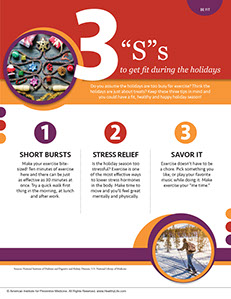
  • 3 “S”S To Get Fit During The Holidays

    BE FIT

    Jump roap shaped into a christmas tree with ornaments and fitness gear.

    Do you assume the holidays are too busy for exercise? Think the holidays are just about treats? Keep these three tips in mind and you could have a fit, healthy and happy holiday season!

    1.  Short bursts: Make your exercise bite-sized! Ten minutes of exercise here and there can be just as effective as 30 minutes at once. Try a quick walk first thing in the morning, at lunch and after work.

    2.  Stress relief: Is the holiday season too stressful? Exercise is one of the most effective ways to lower stress hormones in the body. Make time to move and you’ll feel great mentally and physically.

    3.  Savor it: Exercise doesn’t have to be a chore. Pick something you like, or play your favorite music while doing it. Make exercise your “me time.”

    Sources: National Institute of Diabetes and Digestive and Kidney Diseases, U.S. National Library of Medicine

    © American Institute for Preventive Medicine
  • Getting Motivated To Exercise

    BE FIT

    Image of couple running.

    We know exercise is healthy. But, without motivation, it’s hard to get started. Try these tips to get excited about working out, to get going and to stay with it.

    *Set goals you can achieve.Try 20 minutes of exercise, 3 days per week. Once you’ve mastered that habit, move it up to 30. Then, increase the number of days, and so on.

    *Make exercise “me time.”Exercise class, a walk or your favorite sport is time that helps your body and mind get healthier. Think of it as a treat to yourself.

    *Write down something you’ve achieved with exercise.Whether you met your goal for two weeks or perhaps noticed your mood was better, take note of it. Go back and look at the good things you’ve accomplished over time. This can give you positive encouragement.

    *Don’t dwell on setbacks.Everyone has a day where they miss a workout. Just move forward and figure out how you can get back into your routine tomorrow.

    *Find support when you need it.Sometimes, it helps to have a friend cheer you on. Or, maybe a family member is willing to babysit your kids while you exercise. Maybe you can ask a friend to exercise with you. Together, you can motivate each other.

    *Skip the stuff you don’t like.If you really dislike a certain class or activity, don’t do it. Instead, find an exercise you can look forward to. Do what gets you active and feels fun and invigorating.

    *Try something new.Whether it’s a new class, a new video or a new piece of equipment at the gym, variety can be fun. Doing the same exercise every day for weeks or months can kill motivation.

    If you have any health conditions, or haven’t exercised in a long time, ask your doctor which types of exercise would work best for you.

    Source: American Academy of Family Physicians

    © American Institute for Preventive Medicine