Tag: Movement & Physical Fitness

  • Start Running

    BE FIT

    Middle aged women jogging on beach.

    Running is a great form of exercise. It gets your heart rate up, builds endurance, and releases stress. But, running is also high-impact and should be approached with caution. Here’s how to get started safely:

    1. Check with your doctor to make sure running is right for you.

    2. Invest in comfortable footwear that provides cushion and support.

    3. Stretch and strengthen your feet to prepare them for impact.

    4. Begin with a walk-run program that gradually builds endurance.

    5. Take it slow! If you haven’t run in a while, assume your body needs time to adapt.

    6. Don’t push through pain. A little twinge may become an injury if you run through it.

    7. Cross-train with exercises that build strength and flexibility like weight training, yoga, and stretching.

    8. Hydrate and fuel well before, during, and after you run.

    9. Give your body plenty of rest between runs to avoid overtraining.

    10. Listen to music or find a running partner to make your runs more enjoyable.

    © American Institute for Preventive Medicine

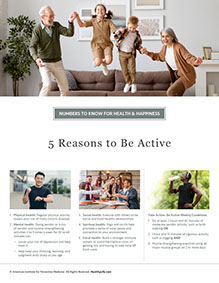
  • 5 Reasons To Be Active

    Fitness

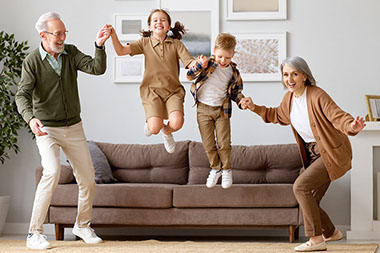
    Grandparents playing with their grandchildren.

    1.  Physical health: Regular physical activity lowers your risk of many chronic diseases.

    2.  Mental health: Doing aerobic or a mix of aerobic and muscle-strengthening activities 3 to 5 times a week for 30 to 60 minutes can:

    –  Lower your risk of depression and help treat it

    –  Help keep your thinking, learning, and judgment skills sharp as you age

    3.  Social health: Exercise with others to be social and build healthy relationships.

    4.  Spiritual health: Yoga and tai chi help promote a sense of inner peace and connection to your environment.

    5.  Fiscal health: Build a stronger immune system to avoid the medical costs of getting sick and having to take time off from work.

    Take Action: Be Active Weekly Guidelines

    1.  Do at least 2 hours and 30 minutes of moderate aerobic activity, such as brisk walkingOR

    2.  1 hour and 15 minutes of vigorous activity, such as joggingAND

    3.  Muscle strengthening exercises using all major muscle groups on 2 or more days.
    Page from HealthyLife Weigh book by the American Institute for Preventive Medicine. www.HealthyLife.com. All rights reserved.

    © American Institute for Preventive Medicine
  • How To Buy Sports Shoes That Fit

    Fitness

    Image of person lacing tennis shoe.

    A carpenter needs a saw, a painter needs a brush, and an accountant needs a calculator. And anyone who’s serious about fitness needs a good pair of shoes (or several, if you’re active in more than one activity besides swimming). The right shoes can make the difference between comfort and discomfort, between safety and injury, between performing well and not performing well.

    Consider these factors before you buy activewear shoes.

    *  Are the shoes suitable for the sport or activity for which you intend to wear them? Walking, hiking, racquetball, tennis, aerobics, and so forth require differently designed footwear. But you may want to consider cross-training shoes, suitable for several different activities.

    *  Can you wiggle your toes in the shoes while sitting and standing? (You should be able to.)

    *  Does the widest area of your foot correspond to the widest area of the shoe? (To find out, try this: Stand on a piece of paper, bend down, and trace a line around each shoe with a pencil. Then slip off your shoes, stand in the same place, and trace a line around each foot with a different colored pencil. If at any point the outline of your feet is larger than the outline of your shoes, you’re squeezing some or all of the bones, ligaments and muscles in each foot.)

    *  Do the inner seams rub against your foot? (They shouldn’t.)

    *  Does the shoe have a firm heel cradle and arch support?

    *  Does the shoe provide adequate shock absorption?

    *  Are the shoes comfortable when you move from side to side or when you walk or jump? Test these movements before you buy.

    Good shoes don’t need to be “broken in.” The shoes you buy should be comfortable from the start.

    Page image from A Year of Health Hints book by the American Institute for Preventive Medicine. www.HealthyLife.com. All rights reserved.

    © American Institute for Preventive Medicine

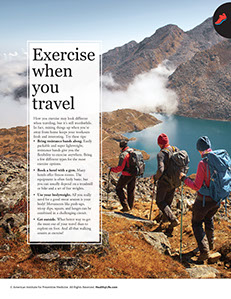
  • Exercise When You Travel

    BE FIT

    Group of people hiking.

    How you exercise may look different when traveling, but it’s still worthwhile. In fact, mixing things up when you’re away from home keeps your workouts fresh and interesting. Try these tips:

    *Bring resistance bands along.Easily packable and super lightweight, resistance bands give you the flexibility to exercise anywhere. Bring a few different types for the most exercise options.

    *Book a hotel with a gym.Many hotels offer fitness rooms. The equipment is often fairly basic, but you can usually depend on a treadmill or bike and a set of free weights.

    *Use your bodyweight.All you really need for a good sweat session is your body! Movements like push-ups, tricep dips, squats, and lunges can be combined in a challenging circuit.

    *Get outside.What better way to get the most out of your travel than to explore on foot. And all that walking counts as exercise!

    © American Institute for Preventive Medicine
  • Stay Fit For Life By Getting Flexible

    BE FIT

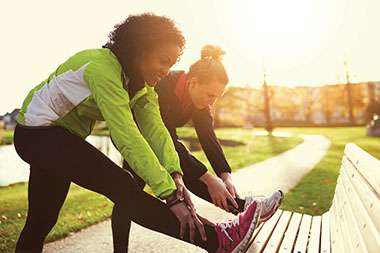
    Two women stretching legs on bench.

    Flexibility is your range of motion throughout the joints of your body. A rigid joint may not function well and can limit your ability to move with ease.

    A healthy range of motion allows you to bend down to tie your shoes or reach up high to get something out of a cabinet. If you want to move well, you need to be flexible!

    Tips to improve flexibility

    *  Stretch your muscles daily.

    *  Take regular stretch breaks, especially after long periods of inactivity.

    *  Make time to stretch after you exercise when your muscles are warm.

    *  Hold each stretch for about 90 seconds.

    *  Only stretch to the point of “comfortable discomfort,” never pain.

    *  Breathe deeply and relax while stretching.

    © American Institute for Preventive Medicine
  • Benefits Of Walking

    Fitness

    Couple hiking through trees with walking sticks.

    Walking doesn’t make just your feet happy. It is good for your whole body!

    *  Great way to keep fit without risk of injury.

    *  Special equipment not needed.

    *  Burns calories. Builds stamina.

    *  Enhances muscle tone. Makes the heart stronger.

    *  Helps relieve stress and lifts your mood.

    *  Aids digestion and regularity.

    *  Enhances feelings of well-being.

    *  Lowers the risk of, and helps manage, diabetes, heart disease, high blood pressure, and osteoporosis.

    Page from HealthyLife Weigh book by the American Institute for Preventive Medicine. www.HealthyLife.com. All rights reserved.

    © American Institute for Preventive Medicine
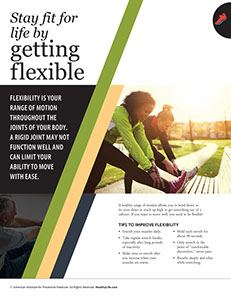
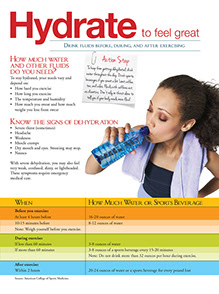
  • Hydrate To Feel Great

    Fitness

    Drink fluids before, during, and after exercising.

    How much water and other fluids do you need?

    To stay hydrated, your needs vary and depend on:

    *  How hard you exercise

    *  How long you exercise

    *  The temperature and humidity

    *  How much you sweat and how much weight you lose from sweat

    Know the signs of dehydration:

    *  Severe thirst (sometimes)

    *  Headache

    *  Weakness

    *  Muscle cramps

    *  Dry mouth and eyes. Sweating may stop.

    *  Nausea

    With severe dehydration, you may also feel very weak, confused, dizzy, or lightheaded. These symptoms require emergency medical care.

    Action Step

    To keep from getting dehydrated, drink water throughout the day. Drink sports beverages if you sweat a lot. Limit coffee, tea, and colas. Don’t rely on thirst alone to tell you if your body needs more fluid.

    Page image from the Ways to Well-Being book by the American Institute for Preventive Medicine. www.HealthyLife.com. All rights reserved.

    © American Institute for Preventive Medicine

  • Exercise Your Feet

    BE FIT

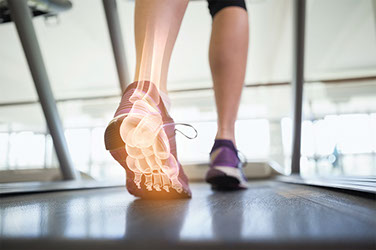
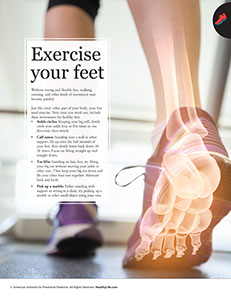
    Close up of feet walking on treadmill, with an overlapping illustration of a foot skeleton.

    Without strong and flexible feet, walking, running, and other kinds of movement may become painful.

    Just like every other part of your body, your feet need exercise. Next time you work out, include these movements for healthy feet:

    *Ankle circles:Keeping your leg still, slowly circle your ankle four or five times in one direction, then switch.

    *Calf raises:Standing near a wall or other support, lift up onto the ball mounds of your feet, then slowly lower back down 10-20 times. Focus on lifting straight up and straight down.

    *Toe lifts:Standing on bare feet, try lifting your big toe without moving your ankle or other toes. Then keep your big toe down and lift your other four toes together. Alternate back and forth.

    *Pick up a marble:Either standing with support or sitting in a chair, try picking up a marble or other small object using your toes.

    © American Institute for Preventive Medicine
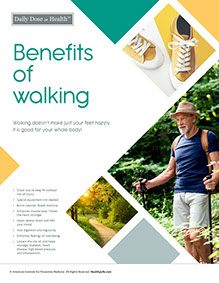
  • Step Up To A Longer Life

    WELL-BEING

    Elderly couple walking.

    Could something as simple as walking help you live longer? Some recent research says it’s possible. Here’s what to know:

    1.  Researchers had 17,000 older women wear a device each day to count their steps.

    2.  They tracked the women for four years.

    3.  Those who took between 4,400 and 7,500 steps each day were less likely to die during those four years.

    4.  Walking more than 7,500 steps is also good for your health!

    Researchers said this is helpful for people who may think that 10,000 steps is overwhelming. Try to walk 4,400 steps or more each day, and you could see some important health benefits.

    Sources: Journal of the American Medical Association, National Institutes of Health

    © American Institute for Preventive Medicine
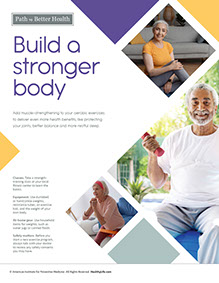
  • Build A Stronger Body

    Fitness

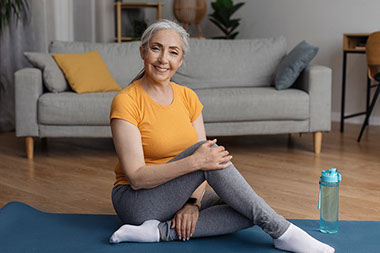
    Smiling women sitting on a yoga mat.

    Add muscle-strengthening to your aerobic exercises to deliver even more health benefits, like protecting your joints, better balance and more restful sleep.

    Classes:Take a strength-training class at your local fitness center to learn the basics.

    Equipment:Use dumbbell or hand/ankle weights, resistance tubes, an exercise ball, and the weight of your own body.

    At-home gear:Use household items for weights, such as water jugs or canned foods.

    Safety matters:Before you start a new exercise program, always talk with your doctor to review any safety concerns you may have.

    Page from HealthyLife Weigh book by the American Institute for Preventive Medicine. www.HealthyLife.com. All rights reserved.

    © American Institute for Preventive Medicine