
Tag: myth

  • Digging Into Detox Diets

    HEALTHY EATING

    Image of different berries.

    The word “detox” is a popular term in diets today. Many detox diets and plans promise to help your body flush out toxins and get you healthier.

    Some detox diets follow extreme guidelines like:

    *  Fasting (not eating) for long periods

    *  Drinking only special detox drinks or juices

    *  Using supplements or products that claim to detox your body

    *  Using laxatives, enemas or other products to empty the colon

    Safety concerns

    Many detox plans haven’t been proven to be safe. Supplements and extreme diets can cause health problems. The Food and Drug Administration (FDA) has taken action against detox products that are dangerous or contain illegal ingredients.

    Don’t assume that a “natural” detox plan is safe. It may be risky because:

    *  Drinking large quantities of juice can be dangerous for people with kidney disease.

    *  Drinking juices that are “raw” or unpasteurized can cause serious illnesses from bacteria.

    *  People with diabetes often need to eat a healthy diet and need to eat at regular times. Fasting or drinking juice instead of meals can cause dangerous blood sugar levels.

    *  Using too many laxatives can cause dehydration, severe diarrhea and an imbalance in minerals and vitamins.

    *  Fasting for long periods can cause headaches, dehydration and fainting.

    Your body’s own detox

    The human body is already designed to get rid of toxins. Most of this is done by the liver, which processes and removes chemicals, toxins and other unwanted things.

    Supporting your liver is a healthy and safe way to “detox” without extreme or dangerous diets. You can support your liver by:

    *  Eating a healthy diet rich in fruits, vegetables, lean protein and whole grains

    *  Working toward a healthy weight if you’re overweight

    *  Avoiding or limiting processed foods

    *  Drinking plenty of water

    *  Avoiding or limiting alcoholic drinks

    *  Getting exercise regularly

    *  Following directions on medicines and take medicines as your doctor prescribes

    *  Getting vaccines for hepatitis A and B, which are diseases that affect the liver

    Not all diets are safe. Before you start any detox or diet plan, ask your doctor.

    Sources: American Liver Foundation, National Center for Complementary and Integrative Health

    © American Institute for Preventive Medicine

  • Do Cell Phones Cause Cancer?

    WELL-BEING

    Women holding cell phone with head phones on.

    Many people have their phones in pockets or purses all the time.

    Is this safe?

    Cell phones and RF waves

    When they are turned on, cell phones give off radiofrequency (RF) waves. When a person holds a cell phone up to their ear, they are exposed to the RF waves from the phone.

    At very high levels, RF waves can cause heat. This is how microwave ovens heat food. But the energy given off by a cell phone isn’t enough to cause a person’s body to heat up.

    Most stuides say “NO”

    Studies on rats have found that exposing their entire bodies to RF waves for long periods of time may increase the risk of a certain type of tumor. The levels used in this study were much higher than what a person would experience from normal everyday cell phone use.

    Most studies on humans have found that people who have brain tumors do not use cell phones more than people who don’t have tumors. Other human studies have found that brain tumors don’t happen more on the side of the head where people hold their cell phones. Both results seem to suggest that cell phones do not cause brain tumors.

    But a few studies have found an increased tumor risk on the side of the head where a person usually holds their cell phone.

    Researchers believe we need more studies to find out for sure whether cell phones could be linked to cancer.

    What should I do?

    The American Cancer Society says RF waves are not as strong as different types of radiation like x-rays and UV light. X-rays and UV light can damage DNA. RF waves from cell phones are much weaker and don’t cause DNA damage. This means they would not make changes that could cause a tumor to form.

    But, if you want to avoid exposure to RF waves, you can:

    *  Keep your phone away from your body. Don’t keep it in your pocket when it’s turned on.

    *  Use the speaker function or an earpiece when talking on the phone.

    Source: American Cancer Society

    © American Institute for Preventive Medicine

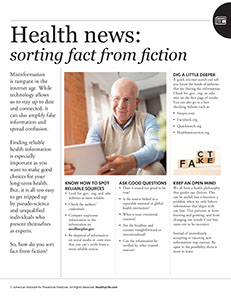
  • Health News: Sorting Fact From Fiction

    WELL-BEING

    Older man on reading on a tablet.

    Misinformation is rampant in the internet age. While technology allows us to stay up to date and connected, it can also amplify false information and spread confusion.

    Finding reliable health information is especially important as you want to make good choices for your long-term health. But, it is all too easy to get tripped up by pseudo-science and unqualified individuals who present themselves as experts.

    So, how do you sort fact from fiction?

    Know how to spot reliable sources

    *  Look for .gov, .org, and .edu websites as most reliable.

    *  Check the authors’ credentials.

    *  Compare suspicious information to the information onmedlineplus.gov.

    *  Be skeptical of information on social media or .com sites that you can’t verify from a more reliable source.

    Ask good questions

    *  Does it sound too good to be true?

    *  Is the source linked to a reputable national or global health institution?

    *  What is your emotional reaction?

    *  Are the headline and content straightforward or sensationalized?

    *  Can the information be verified by other trusted sources?

    Dig a little deeper

    A quick internet search can tell you know the kinds of websites that are sharing the information. Check for .gov, .org, or .edu sites on the first page of results. You can also go to a fact-checking website such as:

    *Snopes.com

    *Factcheck.org

    *Quackwatch.org

    *Healthnewsreview.org

    Keep an open mind

    We all have a health philosophy that guides our choices. This can be useful, but it becomes a problem when we only believe information that aligns with our bias. This prevents us from learning and growing, and from changing our minds if our bias turns out to be incorrect.

    Instead of immediately accepting or rejecting new information, stay curious. Be open to the possibility there is more to learn.

    © American Institute for Preventive Medicine
  • Wine Confusion: Healthy Or Not?

    MEDICAL NEWS

    Image of a wine bottle with 2 glasses of wine and grapes.

    Wine has been making the headlines in recent months as a “healthy” choice. Some studies suggest the compounds and antioxidants in wine can reduce your risk of heart disease, cancer, and more.

    This can be confusing if you’ve been told that alcohol isn’t good for you. Should you drink wine to get healthier, or skip it?

    There is no perfect answer for everyone. It’s important to note that these studies are promising, but they’re not enough to say that wine is a healthy choice. Many of these studies were done in labs, on mice, or were done with supplements instead of real wine. And for some, the possible benefits of wine wouldn’t be worth the risk. Wine is also high in calories and sugar. This can add to obesity and affect blood sugar, especially in diabetics. In addition, wine and alcohol can interact with certain medicines.

    Many people can enjoy alcohol in  small amounts without problems. But if you have a history of alcoholism or your doctor has told you not to drink, you should not drink wine or any alcoholic beverage.

    The Centers for Disease Control and Prevention (CDC) says that drinking too much alcohol, even wine, can harm your health. So if you decide to drink, be sure you do it in moderation.

    So what is “moderation”? According to the Dietary Guidelines for Americans, moderation is up to one drink per day for women and up to two drinks per day for men-and only by adults of legal drinking age.

    The bottom line:

    If you already have a drink once in a while, switching to red wine may be healthier than other choices such as beer or spirits. But the health benefits of red wine are not fully understood. So, experts do not recommend it as a daily drink for everyone.

    © American Institute for Preventive Medicine