Tag: nausea

  • Is It Food Poisoning Or A Virus?

    SELF-CARE CORNER

    Man holding a glass of water with one hand and holding stomach in pain with the other hand.

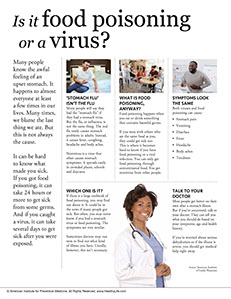
    Many people know the awful feeling of an upset stomach. It happens to almost everyone at least a few times in our lives. Many times, we blame the last thing we ate. But this is not always the cause.

    It can be hard to know what made you sick. If you got food poisoning, it can take 24 hours or more to get sick from some germs. And if you caught a virus, it can take several days to get sick after you were exposed.

    ‘Stomach flu’ isn’t the flu

    Many people will say they had the “stomach flu” if they had a stomach virus. But the flu, or influenza, is not the same thing. The real flu rarely causes stomach problems in adults. Instead, it causes fever, coughing, headache and body aches.

    Norovirus is a virus that often causes stomach symptoms. It spreads easily in crowded places, schools and daycares.

    What is food poisoning, anyway?

    Food poisoning happens when you eat or drink something that contains harmful germs.

    If you were with others who ate the same food as you, they could get sick too. This is where it becomes hard to know if you have food poisoning or a viral infection. You can only get food poisoning through contaminated food. You get norovirus from other people.

    Symptoms look the same

    Both viruses and food poisoning can cause:

    *  Stomach pain

    *  Vomiting

    *  Diarrhea

    *  Fever

    *  Headache

    *  Body aches

    *  Tiredness

    Which one is it?

    If there is a large outbreak of food poisoning, you may find out about it. It could be in the news if many people got sick. But often, you may never know if you had a stomach virus or food poisoning. The symptoms are very similar.

    Sometimes doctors may run tests to find out what kind of illness you have. Usually, however, this isn’t necessary.

    Talk to your doctor

    Most people get better on their own after a stomach illness. But if you’re concerned, talk to your doctor. They can tell you what you should do based on your symptoms, age and health history.

    If you’re worried about serious dehydration or if the illness is severe, you should get medical help right away.

    Source: American Academy of Family Physicians

    © American Institute for Preventive Medicine

  • How To Prevent Motion Sickness

    Healthy Travel

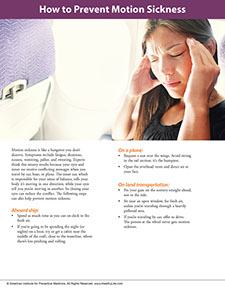
    Motion sickness is like a hangover you don’t deserve. Symptoms include fatigue, dizziness, nausea, vomiting, pallor, and sweating. Experts think this misery results because your eyes and inner ear receive conflicting messages when you travel by car, boat, or plane. The inner ear, which is responsible for your sense of balance, tells your body it’s moving in one direction, while your eyes tell you you’re moving in another. So closing your eyes can reduce the conflict. The following steps can also help prevent motion sickness.

    Aboard ship:

    *  Spend as much time as you can on deck in the fresh air.

    *  If you’re going to be spending the night (or nights) on a boat, try to get a cabin near the middle of the craft, close to the waterline, where there’s less pitching and rolling.

    On a plane:

    *  Request a seat over the wings. Avoid sitting in the tail section; it’s the bumpiest.

    *  Open the overhead vents and direct air at your face.

    On land transportation:

    *  Fix your gaze on the scenery straight ahead, not to the side.

    *  Sit near an open window, for fresh air, unless you’re traveling through a heavily polluted area.

    *  If you’re traveling by car, offer to drive. The person at the wheel never gets motion sickness.

    In addition, the following steps are helpful no matter what your means of transportation.

    *  Get plenty of rest before setting out. Fatigue makes you more vulnerable to motion sickness.

    *  Avoid drinking alcohol before or during travel, and don’t overindulge the night before.

    *  Take an over-the-counter motion sickness medication (such as Dramamine) approximately 30 minutes before travel begins. Read the package for cautions and other important information.

    *  If over-the-counter medications don’t bring relief, ask your doctor about a prescription medication containing scopolamine, available as a patch that’s usually worn behind your ear.

    *  Don’t read while traveling and don’t try to focus on any other stationary object. Aboard a ship, lie down on your back and close your eyes.

    *  If any of your traveling companions get sick, move as far away from them as possible; otherwise, you may get sick, too.

    Some people report that taking tablets of powdered gingerroot relieves their motion sickness. Others find relief by pressing on an acupressure point about midway on the inside of the wrist, where the hand and forearm meet.

    If preventive measures fail and you feel sick anyway, you can try the following:

    *  Breathe slowly and deeply.

    *  Remove yourself from smoke and food odors, and get some fresh air.

    *  To reduce tension and anxiety, concentrate on relaxing all your muscles, as though you’re a limp rag doll, and visualize a peaceful scene.

    *  To settle a queasy stomach, eat dry crackers.

    Page image from A Year of Health Hints book by the American Institute for Preventive Medicine. www.HealthyLife.com. All rights reserved.

    © American Institute for Preventive Medicine

  • Dizziness & Vertigo

    Brain & Nervous System

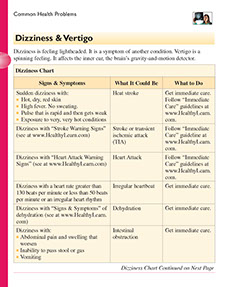
    Dizziness is feeling lightheaded. It is a symptom of another condition. Vertigo is a spinning feeling. It affects the inner ear, the brain’s gravity-and-motion detector.

    Dizziness Conditions

    Heat Stroke

    Signs & Symptoms

    Sudden dizziness with:

    *  Hot, dry, red skin

    *  High fever. No sweating.

    *  Pulse that is rapid and then gets weak

    *  Exposure to very, very hot conditions

    What to Do

    Get immediate care.

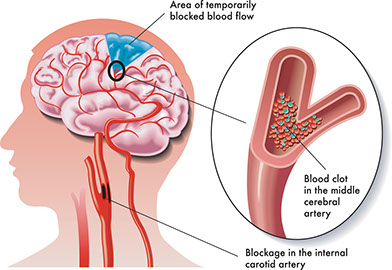
    Stroke or Transient Ischemic Attack

    Illustration on how a stroke is caused.

    Signs & Symptoms

    Dizziness with “Stroke Warning Signs

    What to Do

    Follow “Immediate Care” guideline.

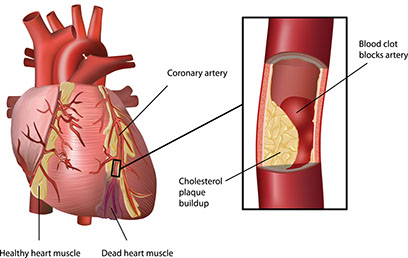
    Heart Attack

    Illustration of how a heart attack is caused.

    Signs & Symptoms

    Dizziness with “Heart Attack Warning Signs

    What to Do

    Follow “Immediate Care” guidelines

    Irregular Heartbeat

    Signs & Symptoms

    Dizziness with a heart rate greater than 130 beats per minute or less than 50 beats per minute or an irregular heart rhythm

    What to Do

    Get immediate care.

    Dehydration

    Signs & Symptoms

    Dizziness with “Signs & Symptoms” of dehydration

    What to Do

    Get immediate care.

    Intestinal Obstruction

    Signs & Symptoms

    Dizziness with:

    *  Abdominal pain and swelling that worsen

    *  Inability to pass stool or gas

    *  Vomiting

    What to Do

    Get immediate care.

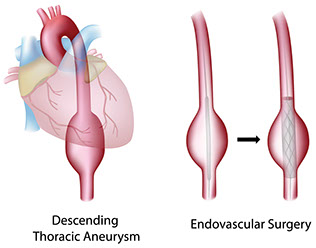
    Dissecting Aortic Aneurysm

    Illstration of a descending thoracic aneurysm.

    This is a tear in the main artery from the heart.

    Signs & Symptoms

    Dizziness and fainting. Severe chest pain with extreme pain felt across the upper back (not just on one side) that came on within 15 minutes for no apparent reason, such as an injury or back strain. The pain can spread to the abdomen.

    What to Do

    Get immediate care. (Do not take aspirin.)

    Ear Infection

    Signs & Symptoms

    Dizziness with ear pain, ringing in the ear, pus or other ear discharge, fever

    What to Do

    Contact doctor.

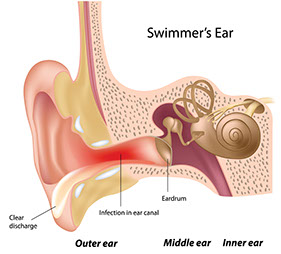
    Illustration of swimmer's ear.

    Labyrnthitis

    This is an inflammation in the ear that usually results from an upper respiratory infection.

    Signs & Symptoms

    Dizziness with:

    *  True spinning sensation

    *  Loss of balance

    *  Nausea and vomiting

    *  Ringing in the ears

    *  Jerky movements of the eye

    What to Do

    Contact doctor.

    Low Blood Sugar

    This can occur in persons taking insulin or oral pills for diabetes and/or after not eating for 4 or more hours.

    Signs & Symptoms

    Dizziness with hunger, sweating, trembling, anxiety, and confusion

    What to Do

    Use self-care.

    Temporary Drop in Blood Pressure (Orthostatic Hypotension)

    This could be a side effect of taking medicines, such as ones for high blood pressure and depression.

    Signs & Symptoms

    Dizziness when getting up too quickly from a seated or lying position

    What to Do

    Use self-care.

    Other Causes of Dizziness:

    *  Alcohol

    *  New medications, antibiotics, or high doses of aspirin

    *  A change in altitude or motion sickness

    *  Sudden movement, such as with turning the head quickly

    *  Seeing fast moving objects Treatment for dizziness depends on the cause.

    Vertigo

    Signs & Symptoms

    *  Wooziness

    *  Sense that the room is spinning

    *  Nausea

    *  Blurred vision

    *  Floating, rocking, and/or rolling feeling

    *  Sense of walking on an uneven surface

    *  Loss of balance

    Causes, Risk Factors & Care

    Vertigo is caused by a problem with the inner ear. Causes of vertigo are:

    *  Benign Positional Vertigo (BPV). This is the most common type. It may happen when you turn over in bed, get up, sit down, bend over, or just tilt your head. The sensations start within seconds of changing positions and last less than a minute. As bothersome as BPV is, it rarely signals more serious disease. Risk factors for BPV are aging, viral infections, and a prior head injury.

    *  Ménière’s disease. This condition may be due to spasms of blood vessels in the inner ear, fluid retention in the inner ear, or allergic reactions. Ménière’s disease is linked with a decrease in hearing and tinnitus. It sometimes leads to permanent hearing loss.

    *  Multiple sclerosis. With this, the covering that protects nerves (myelin) is destroyed. Over time, scar tissue (sclerosis) forms where the myelin used to be in the brain and spinal cord. Scar tissue or inflammation in the brain may cause vertigo symptoms.

    After proper diagnosis, most cases of vertigo are easily treated in the doctor’s office or at home with self-care.

    While attacks of Ménière’s disease can continue for many years, some symptoms can be controlled with medication.

    Self-Care

    For Orthostatic Hypotension:

    *  Don’t jump out of bed. Go from a lying position to a sitting position slowly. Sit on the edge of the bed a few minutes. Stand up slowly.

    *  From a sitting position, stand up slowly. Hold onto the arms of the chair or the head of the bed for support.

    *  If you feel lightheaded, sit back down for a few minutes. Take a few deep breaths. Get up again, slowly.

    For Benign Positional Vertigo (BPV):

    *  Sit on the side of the bed and lean to your right, resting the right ear on the bed. This might make you dizzy and nauseous at first.

    *  Wait 20 seconds until the dizziness stops and sit up straight.

    *  Wait another 20 seconds and repeat steps 1 and 2 on your left side.

    *  Do this exercise 10 to 15 times, 3 times a day.

    For Ménière’s Disease:

    *  Lie still in bed until the dizziness and nausea are gone.

    *  Walk with assistance.

    *  Don’t change positions too fast.

    *  Do not drive, climb ladders, or work around dangerous machinery.

    *  Decrease the amount of salt and fluids in your diet.

    *  Avoid bright lights. Do not read when you have a spinning feeling.

    *  Resume your normal activities when symptoms go away.

    *  Avoid alcohol, caffeine, and tobacco.

    Health at Home Lifetime book by the American Institute for Preventive Medicine. www.HealthyLife.com. All rights reserved.

    © American Institute for Preventive Medicine

  • Food Poisoning

    Abdominal & Urinary Conditions

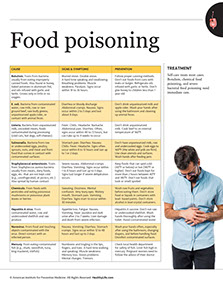
    Self-care treats most cases. Botulism, chemical food poisoning, and severe bacterial food poisoning need immediate care.

    Botulism

    Cause

    Toxin from bacteria usually from eating improperly canned foods. Also found in honey and oils infused with garlic. Grows only in little or no oxygen.

    Signs & Symptoms

    Blurred vision. Double vision. A hard time speaking and swallowing. Breathing problems. Muscle weakness. Paralysis. Signs occur within 4 to 36 hours.

    Prevention

    Follow proper canning methods. Boil home-canned food for 10 or more minutes. Don’t eat foods from cans with leaks or bulges. Refrigerate oils infused with garlic or herbs. Don’t give honey to children less than 1 year old.

    E. coli

    Cause

    Bacteria from contaminated water, raw milk, raw or rare ground beef, unpasteurized apple juice or cider, or contact with contaminated animal feces.

    Signs & Symptoms

    Diarrhea or bloody discharge. Abdominal cramps. Nausea. Signs occur within 2 to 5 days and last about 8 days.

    Prevention

    Don’t drink unpasteurized milk and apple cider. Wash your hands after using the bathroom and cleaning up animal feces.

    Listeria

    Cause

    Bacteria from unpasteurized milk, uncooked meats, foods contaminated during processing (cold cuts, hot dogs, soft cheeses).

    Signs & Symptoms

    Fever. Chills. Headache. Backache. Abdominal pain. Diarrhea. Often, signs occur within 48 to 72 hours, but can take up to 3 weeks to occur.

    Prevention

    Don’t drink unpasteurized milk. Cook beef to an internal temperature of 160ºF.

    Salmonella

    Cause

    Bacteria from raw or undercooked eggs, poultry, and meat and from food that comes in contact with contaminated surfaces.

    Signs & Symptoms

    Stomach pain. Diarrhea. Nausea. Chills. Fever. Headache. Signs occur within 8 to 12 hours and last up to 1 or 2 days.

    Prevention

    Don’t have unpasteurized milk, raw and undercooked eggs. Cook eggs to 160ºF (the white and yolk are firm). Use clean utensils and surfaces.

    Staphylococcal enterotoxin

    Cause

    Toxin from bacteria usually from meats, dairy foods, eggs, etc. that are not kept cold (e.g., unrefrigerated, at picnics, etc.) Also spread by human contact.

    Signs & Symptoms

    Severe nausea. Abdominal cramps. Diarrhea. Vomiting. Signs occur within 1 to 6 hours and last up to 3 days. Signs last longer if severe dehydration occurs.

    Prevention

    Keep foods that can spoil cold (40ºF or below) or hot (140ºF or higher). Don’t eat foods kept for more than 2 hours between 40ºF and 140ºF. Don’t eat foods that look or smell spoiled. Wash your hands often. Use clean utensils and surfaces.

    Chemicals

    Cause

    From foods with pesticides and eating poisonous mushrooms or poisonous plant leaves or berries.

    Signs & Symptoms

    Sweating. Dizziness. Mental confusion. Very teary eyes. Watery mouth. Stomach pain. Vomiting. Diarrhea. Signs start to occur within 30 minutes.

    Prevention

    Wash raw fruits and vegetables before eating them. Don’t store food or liquids in containers with lead- based paints. Don’t store alcohol in lead crystal containers.

    Hepatitis A virus

    Cause

    From contaminated water, raw and undercooked shellfish, oysters, clams, mussels, scallops, etc.

    Signs & Symptoms

    Appetite loss. Nausea. Vomiting. Fever. Jaundice and dark urine after 3 to 10 days. Liver damage and death from severe infection.

    Prevention

    Hepatitis A vaccine. Don’t eat raw or undercooked shellfish, oysters, etc.

    Norwalk-like viruses

    Cause

    From food and touching objects contaminated with the virus. Direct contact with an infected person.

    Signs & Symptoms

    Nausea. Vomiting. Diarrhea. Stomach cramps. Signs occur within 12 to 48 hours and last up to 2 days.

    Prevention

    Wash your hands often, especially after using the bathroom, changing diapers, and before handling food. Disinfect contaminated surfaces.

    Mercury

    Cause

    From eating contaminated fish (e.g., shark, swordfish, tuna, king mackerel, tilefish).

    Signs & Symptoms

    Numbness and tingling in the lips, fingers, and toes. A hard time walking and speaking. Muscle weakness. Memory loss. Mental changes. Tremors.

    Prevention

    Check local health department for safety of fish. Limit fish high in mercury. Pregnant women need to follow the advice of their doctor.

    Questions to Ask

    Self-Care / Prevention

    *  For chemical food poisoning, call the Poison Control Center (800.222.1222).

    *  Heed warnings for food products that could be harmful. News reports list these items. So does the FDA atwww.fda.gov.

    Healthier at Home book by the American Institute for Preventive Medicine. www.HealthyLife.com. All rights reserved.

    © American Institute for Preventive Medicine

  • Poisoning

    First Aid

    Concept image of smoke forming a skull.

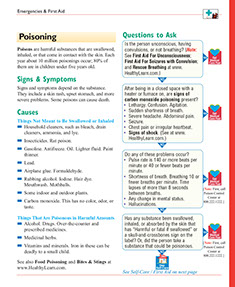
    Poisons are harmful substances that are swallowed, inhaled, or that come in contact with the skin. Each year about 10 million poisonings occur; 80% of them are in children under five years old.

    Signs & Symptoms

    Signs and symptoms depend on the substance. They include a skin rash, upset stomach, and more severe problems. Some poisons can cause death.

    Causes

    Things Not Meant to Be Swallowed or Inhaled

    *  Household cleaners, such as bleach, drain cleaners, ammonia, and lye.

    *  Insecticides. Rat poison.

    *  Gasoline. Antifreeze. Oil. Lighter fluid. Paint thinner.

    *  Lead.

    *  Airplane glue. Formaldehyde.

    *  Rubbing alcohol. Iodine. Hair dye. Mouthwash. Mothballs.

    *  Some indoor and outdoor plants.

    *  Carbon monoxide. This has no color, odor, or taste.

    Things That Are Poisonous in Harmful Amounts

    *  Alcohol. Drugs. Over-the-counter and prescribed medicines.

    *  Medicinal herbs.

    *  Vitamins and minerals. Iron in these can be deadly to a small child.

    Treatment

    Treatment depends on the poison and its effects. Information to give the Poison Control Center, emergency department, etc.:

    *  The name of the substance taken.

    *  The amount and when it was taken.

    *  A list of ingredients on the label.

    *  Age, gender, and weight of the person who took the poison. How the person is feeling and reacting. Any medical problems the person has.

    Prevention

    *  Buy household products, vitamins, and medicines in child-resistant packaging. Keep these and all poisons out of children’s reach.

    *  Put child-resistant latches on cabinet doors. Follow instructions for use and storage of pesticides, household cleaners, and other poisons.

    *  Keep products in original containers. Don’t transfer them to soft drink bottles, plastic jugs, etc.

    *  Teach children not to take medicine and vitamins unless an adult gives it to them. Don’t call these “candy” in front of a child.

    *  Wear protective clothing, masks, etc., when using chemicals that could cause harm if inhaled or absorbed by the skin.

    *  Install carbon monoxide detectors in your home and garage.

    Questions to Ask

    Self-Care / First Aid

    For Swallowed Poisons

    1.  If the person is unconscious, shout for help. Call 9-1-1!

    2.  For a conscious person, call the Poison Control Center (800.222.1222). Follow instructions. Do not give Syrup of Ipecac to induce vomiting unless the Poison Control Center tells you to. {Note: The American Academy of Pediatrics recommends that parents don’t give Syrup of Ipecac to children.}

    3.  Lay the person on his or her left side to keep the windpipe clear, especially if the person vomited. Keep a sample of the vomit and the poison container.

    For Inhaled Poisons

    1.  Protect yourself. Move the person to fresh air (outdoors if you can). Try not to breathe the fumes yourself.

    2.  Follow steps 1 and 2 above for Swallowed Poisons. Get medical care.

    For Chemical Poisons on Skin

    1.  Protect yourself. Flood the skin with water for 5 or more minutes. Remove clothing that was in contact with the person.

    2.  Gently wash the skin with soap and water. Rinse well. Get medical care.

    Healthier at Home book by the American Institute for Preventive Medicine. www.HealthyLife.com. All rights reserved.

    © American Institute for Preventive Medicine

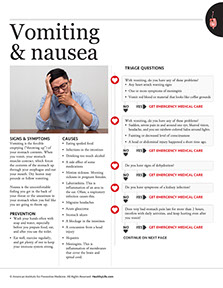
  • Vomiting & Nausea

    Abdominal & Urinary Conditions

    Signs & Symptoms

    *  Vomiting is throwing up the stomach’s contents. Dry heaves may precede or follow vomiting.

    *  Nausea is when you feel like you’re going to throw up.

    Causes

    *  Viruses in the intestines. Eating spoiled food or eating or drinking too much.

    *  A side effect of some medications, such as certain antibiotics.

    *  Motion sickness. Morning sickness in pregnant females.

    *  Labyrinthitis. This is inflammation of an area in the ear. Often, a respiratory infection causes this.

    *  Migraine headaches.

    *  Acute glaucoma.

    *  Stomach ulcers.

    *  A blockage in the small or large intestine (bowel).

    *  A concussion from a head injury.

    *  Hepatitis.

    *  Meningitis. This is inflammation of membranes that cover the brain and spinal cord.

    Questions to Ask

    Self-Care / Prevention

    For Vomiting

    *  Don’t smoke, drink alcohol, or take aspirin.

    *  Don’t eat solid foods. Don’t drink milk.

    *  Drink clear liquids at room temperature (not too hot or cold). Good examples are water; sport drinks, such as Gatorade; diluted fruit juices; ginger ale, etc. Take small sips. Drink only 1 to 2 ounces at a time. Stir carbonated beverages to get all the bubbles out before you sip them. Suck on ice chips if nothing else will stay down. {Note: For children, contact your child’s doctor about using over- the-counter (OTC) mixtures, such as Pedialyte.}

    *  Gradually return to a regular diet, but wait about 8 hours from the last time you vomited. Start with foods like dry toast, crackers, rice, and other foods that are easy to digest. Or, eat foods as tolerated. Avoid greasy or fatty foods.

    For Nausea Without Vomiting

    *  Drink clear liquids. Eat small amounts of dry foods, such as soda crackers, if they help.

    *  Avoid things that irritate the stomach, such as alcohol and aspirin.

    *  For motion sickness, use an over-the-counter medicine, such as Dramamine. You could also try Sea-Bands, a wrist band product that uses acupressure on a certain point on the wrist to control motion sickness. Sporting goods stores and drugstores sell Sea-Bands.

    Resources

    Foodsafety.gov

    www.foodsafety.gov

    Healthier at Home book by the American Institute for Preventive Medicine. www.HealthyLife.com. All rights reserved.

    © American Institute for Preventive Medicine