
Tag: noise

  • How Your Surroundings Affect Your Health

    WELL-BEING

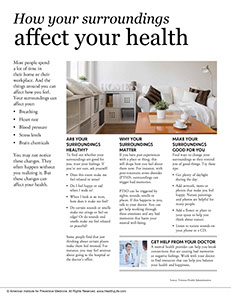
    Clean organzied room.

    Most people spend a lot of time in their home or their workplace. And the things around you can affect how you feel. Your surroundings can affect your:

    *  Breathing

    *  Heart rate

    *  Blood pressure

    *  Stress levels

    *  Brain chemicals

    You may not notice these changes. They often happen without you realizing it. But these changes can affect your health.

    Are your surroundings healthy?

    To find out whether your surroundings are good for you, trust your feelings. If you’re not sure, ask yourself:

    *  Does this room make me feel relaxed or tense?

    *  Do I feel happy or sad when I walk in?

    *  When I look at an item, how does it make me feel?

    *  Do certain sounds or smells make me cringe or feel on edge? Or do sounds and smells make me feel relaxed or peaceful?

    Some people find that just thinking about certain places make them feel stressed. For instance, you may feel anxious about going to the hospital or the doctor’s office.

    Why your surroundings matter

    If you have past experiences with a place or thing, this will shape how you feel about them now. For instance, with post-traumatic stress disorder (PTSD), surroundings can trigger bad memories.

    PTSD can be triggered by sights, sounds, smells or places. If this happens to you, talk to your doctor. You can get help working through these emotions and any bad memories that harm your mental well-being.

    Make your surroundings good for you

    Find ways to change your surroundings so they remind you of good things. Try these tips:

    *  Get plenty of daylight during the day.

    *  Add artwork, items or photos that make you feel happy. Nature paintings and photos are helpful for many people.

    *  Add a flower or plant to your space to help you think about nature.

    *  Listen to nature sounds on your phone or a CD.

    Get help from your doctor

    A mental health provider can help you break connections that are causing bad memories or negative feelings. Work with your doctor to find resources that can help you balance your health and happiness.

    Source: Veterans Health Administration
    © American Institute for Preventive Medicine
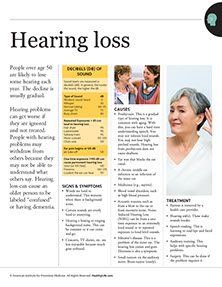
  • Hearing Loss

    Ear, Nose & Throat Conditions

    People over age 50 are likely to lose some hearing each year. The decline is usually gradual. About 30% of adults age 65 through 74 and about 50% of those age 85 and older have hearing problems.

    Hearing problems can get worse if they are ignored and not treated. People with hearing problems may withdraw from others because they may not be able to understand what others say. Hearing loss can cause an older person to be labeled “confused” or “senile.”

    Signs & Symptoms

    *  Words are hard to understand. This worsens when there is background noise.

    *  Certain sounds are overly loud or annoying.

    *  Hearing a hissing or ringing background noise. This can be constant or it can come and go.

    *  Concerts, TV shows, etc. are less enjoyable because much goes unheard.

    Causes

    Presbycusis (prez-bee-KU-sis). This is a gradual type of hearing loss. It is common with aging. With this, you can have a hard time understanding speech. You may not tolerate loud sounds. You may not hear high pitched sounds. Hearing loss from presbycusis does not cause deafness.

    *  Ear wax that blocks the ear canal.

    *  A chronic middle ear infection or an infection of the inner ear.

    *  Medicines (e.g., aspirin).

    *  Blood vessel disorders, such as high blood pressure.

    *  Acoustic trauma, such as from a blow to the ear or from excessive noise. Noise-Induced Hearing Loss (NIHL) can be from a one-time exposure to an extremely loud sound or to repeated exposure to loud level sounds.

    *  Ménière’s disease. This is a problem of the inner ear. The hearing loss comes and goes. Dizziness is also a symptom.

    *  Small tumors on the auditory nerve. Brain tumor (rarely).

    Treatment

    *  Earwax is removed by a health care provider.

    *  Hearing aid(s). These make sounds louder.

    *  Speech reading. This is learning to read lips and facial expressions.

    *  Auditory training. This helps with specific hearing problems.

    *  Surgery. This can be done if the problem requires it.

    Questions to Ask

    Self-Care / Prevention

    For Gradual, Age-Related Hearing Loss

    *  Ask people to speak clearly, distinctly, and in a normal tone.

    *  Look at people when they are talking to you. Watch their expressions.

    *  Try to limit background noise when speaking with someone.

    *  In a church or theater, sit in the 3rd or 4th row with people sitting around you.

    *  Install a flasher or amplifier on your phone, door chime, and alarm clock.

    To Hear Sounds Better

    *  Use a hearing aid. There are many kinds. Examples are ones worn:

    – In-the-Ear (ITE).

    – Behind-the-Ear (BTE).

    – In-the-Canal (ITC).

    *  To find the hearing aid that works best for you, see an audiologist. Ask him or her about a trial period with different hearing aids to find one you are comfortable with.

    *  Use devices and listening systems that help you hear better when you use your telephone, mobile phone, TV, stereo, etc.

    To Clear Earwax

    Use only if the eardrum is not ruptured. Check with your doctor if you are not sure.

    *  Lie on your side. Using a syringe or medicine dropper, carefully squeeze a few drops of lukewarm water into your ear (or have someone else do this). Let the water remain there for 10 to 15 minutes and then shake it out. Now, squeeze a few drops of hydrogen peroxide, mineral oil, or an over-the-counter cleaner, such as Debrox, into the ear. Let the excess fluid flow out of the ear.

    *  After several minutes, put warm water in the ear again. Let it stay there for 10 to 15 minutes. Tilt the head to allow it to drain out of the ear.

    Repeat this entire procedure again in 3 hours if the earwax has not cleared.

    Resources

    American Speech-Language Hearing Association

    800.638.8255

    www.asha.org

    Better Hearing Institute

    800.EAR.WELL (327.9355)

    www.betterhearing.org

    Healthier at Home book by the American Institute for Preventive Medicine. www.HealthyLife.com. All rights reserved.

    © American Institute for Preventive Medicine

  • Avoiding Distractions At Work

    WORK LIFE

    Close up image of laptop with hands and phone.

    We all have days that are more productive than others. But you can be your best each day if you learn how to avoid the biggest distractions at your workplace.

    Put the phone away

    Is your phone frequently dinging with texts or people calling you “just to chat?” Do you find yourself checking social media or playing with apps when you should be working?

    Smart phones are a major cause of work-related distractions. Some employers have policies that prohibit cell phone use on the job. If that’s the case, you’ll need to follow those rules. But if your employer allows cell phones, turn off notifications and put the phone in a place that’s harder to reach. Some phones have an option that filters all calls except those from important or emergency numbers. This is a great way to allow people to reach you when it’s necessary, but to avoid non-essential calls and notifications.

    Use white noise

    If other people’s conversations or office noises are bothering you, consider ways you can soften or filter some of the sound. A white noise machine, fan or even headphones that play white noise or quiet non-distracting music may be helpful.

    Ways to get your focus back

    Everyone needs a mental break once in a while. Instead of checking your phone or social media, try these healthy tips that can energize you and help you get back to your work:

    *  Take a short walk around the building.

    *  Eat a healthy snack, such as fruits, vegetables, or lean protein.

    *  Drink a glass of water. Add a lemon or cucumber slice for more flavor.

    *  Get up from your chair and stretch for 3 minutes.

    *  Clean or organize your workspace. Clutter in your space can make your brain feel cluttered, too.

    © American Institute for Preventive Medicine

  • Like It Loud? Your Ears Don’T

    WELL-BEING

    Image of man listening to music with headphones.

    What do a lawn mower, a motorcycle, and a music player have in common? They can all cause permanent hearing loss.

    Many people assume that only extremely loud sounds, such as gunshots, can damage the ears. But any loud noise, such as power tools, headphones turned up too loud, lawn equipment, or a concert, can lead to hearing loss. This is known as noise-induced hearing loss.

    Noise-induced hearing loss often happens gradually, so you don’t realize the damage that’s being done over time. For instance, being around loud machinery every day or listening to loud music in earphones regularly can cause hearing damage that adds up. The National Institutes of Health states that 26 million Americans between the ages of 20 and 69 have hearing loss caused by excessive noise.

    The Centers for Disease Control and Prevention (CDC) says anything over 85 decibels can damage hearing. The louder it is, the faster it can cause hearing loss if used regularly and/or for long periods. Normal conversation is 60 decibels, and a hair dryer is around 90.

    Save your hearing

    The best way to prevent noise-induced hearing loss is to avoid loud noises whenever you can. But, this may not be possible if your job requires you to be around certain equipment. If you can’t avoid it, always wear proper hearing protection. This includes earplugs and/or ear muffs that have a noise reduction rating (NRR) listed.

    If you notice you have trouble hearing, talk to your doctor.

    © American Institute for Preventive Medicine

  • Too Loud

    SELF-CARE CORNER

    Image of workers wearing proper safety glasses and headphones while working on machinery.

    Noise-induced hearing loss is the only type of hearing loss you can prevent. If you understand the hazards of noise and how to practice good hearing health, you can protect your hearing for life. Here’s how:

    *  Know which noises can cause damage (those at or above 85 decibels, such as a motorcycle).

    *  If you can’t reduce the noise or protect yourself from it, move away from the source.

    *  Wear earplugs or other protective devices when involved in a loud activity, even Zumba class (activity-specific earplugs and earmuffs are available at hardware and sporting goods stores).

    *  Be alert to hazardous noises in the environment.

    *  Protect the ears of children who are too young to protect their own.

    *  Have your hearing tested if you think you might have hearing loss.

    About sound

    Sound is measured in units called decibels. Sounds of less than 75 decibels, even after long exposure, are unlikely to cause hearing loss. But long or repeated exposure to sounds at or above 85 decibels can cause hearing loss. The louder the sound, the shorter the amount of time it takes for hearing loss to happen.

    © American Institute for Preventive Medicine