Tag: nutrition

  • Eat Soup To Satisfy

    HEALTHY EATING

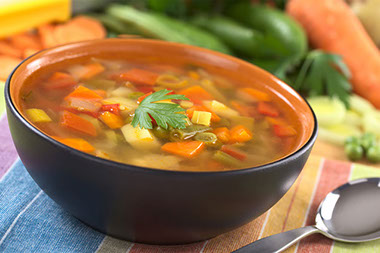
    A bowl of soup.

    Healthy foods like vegetables and fruits have lots of nutrients and fewer calories. Eating a diet with plenty of vegetables and fruit can help you lose weight.

    Soup is a comforting way to enjoy vegetables (and sometimes fruit) of the season. It’s warm, easy to eat and may help you fill up. In fact, some evidence suggests that eating soup before a meal can help you eat less.

    You’ll need to make sure your soup is lower in calories if you want to lose weight. It helps to use lots of vegetables and some fruits, and avoid high-calorie ingredients like cream and sugar.

    © American Institute for Preventive Medicine

  • Go Nuts For A Healthy Heart

    HEALTHY EATING

    Variety of nuts shaped into a heart.

    Nuts often get a reputation as being unhealthy. We add them to cookies and ice cream. People eat them by the handful at parties. But do nuts deserve a bad rap?

    Concerns about calories

    For years, many people avoided nuts because they are high in calories and fat. However, newer research finds that nuts can be an important part of a healthy diet. They contain many nutrients needed for body functions.

    The key is to eat nuts in moderation. This means you may need to eat smaller portions. Then, you can avoid eating too many calories from nuts.

    Look at the serving size on a package of nuts to get an idea of how much to eat. One serving may be quite small (2-4 tablespoons).

    Some Fats are Healthy

    Yes, most nuts are high in total fat. But these fats found in nuts actually promote good health! Most are high in healthy monounsaturated or polyunsaturated fats.

    Monounsaturated and polyunsaturated fats can help lower bad cholesterol, which can lower the risk of heart disease and stroke. The American Heart Association recommends people eat more of these fats from healthy sources like nuts and seeds.

    Protein packed

    Nuts are a good source of plant-based protein. Protein is an essential nutrient that the body needs for building muscle, repairing tissues and making hormones.

    It takes longer for the body to digest proteins than carbohydrates. That’s why eating some protein could help you feel less hungry than if you ate only carbohydrates, like crackers or bread.

    The Dietary Guidelines for Americans recommend that people eat healthy sources of protein, like those that come from nuts and seeds, and plant foods.

    Which types to eat

    Of course, there are many different kinds of nuts. Each type tastes different and may contain a variety of nutrients. As long as you’re not coating nuts with sugar and salt, any type can be healthy.

    Take a look at your favorite nut’s nutrition facts and go from there. For instance, macadamia nuts are one of the highest in calories and fat per ounce. But take those calories into account, and eat them instead of chips or cookies.

    Replace unhealthy, processed foods with nuts. You’ll get more nutrients and might even feel more full.

    Sources: Academy of Nutrition and Dietetics, National Institutes of Health, U.S. Department of Agriculture

    © American Institute for Preventive Medicine

  • Nuts & Allergies

    HEALTHY EATING

    Image of hands holding sign that says "Nut Free".

    Food allergies affect millions of people. With a food allergy, the immune system reacts to the food like it’s an invader. It may cause swelling, trouble breathing, hives and itching.

    Nut allergy dangers

    Nut allergies can be life-threatening.

    A person who is allergic to nuts could have a reaction from being near someone eating nuts. Even a tiny crumb of nuts left on a table could be life-threatening. This is why many schools do not allow nuts in classrooms or lunchrooms.

    If you or your family member has a nut allergy, you can still enjoy some nut alternatives. They can be just as delicious – and nutritious – as nuts.

    Nut alternatives

    Nuts contain plant-based protein, healthy fats and some vitamins and minerals. If you can’t eat nuts, don’t worry. There are other foods with these benefits!

    *Legumes:Soybeans, peas, lentils and chickpeas are legumes. They can be roasted as a snack or in salads. Some people are allergic to some types of legumes, however. Be sure to ask about legume allergies before using them for passing dishes or at school.

    *Seeds:There are so many kinds to choose from, like sunflower, pumpkin, chia, flax and hemp. They go well with salads, in smoothies or as a snack.

    *Avocadoes:Although not a significant source of protein, avocadoes are rich in healthy fats, B vitamins, potassium and magnesium. Avocadoes can go on many foods, from toast to salads to  stir-frys.

    Nut-Free butter Options

    Many nut-free butters make a great sandwich or spread for fruit. They taste a lot like peanut butter but without the peanuts.

    Today’s nut-free butters may contain soybeans, sunflower seeds, chickpeas or peas. These can all be healthy alternatives to nuts. Most contain some healthy fats and protein. Check the label for added salt or sugar.

    The Bottom Line

    Nuts are a healthy choice – and there are allergy-free options available. If you have an allergy to nuts, read all food labels. Look at allergen information and ingredients to stay safe.

    © American Institute for Preventive Medicine

  • The Mighty Cruciferous

    HEALTHY EATING

    Different colored cauliflower in bowl, surrounded by bok choy, cabbage, kale.

    Cruciferous vegetables are among the most well-studied, cancer-fighting foods. This incredible group of vegetables is packed with nutrients that support good health and may prevent cancer growth.

    Cruciferous vegetables

    The name “cruciferous” comes from the cross-like shape (crucifer) of the four-petaled flowers these plants produce. They include:

    *  Broccoli

    *  Cauliflower

    *  Cabbage

    *  Brussel sprouts

    *  Kale

    *  Collard greens

    *  Bok choy

    Key nutrients

    Cruciferous vegetables are nutrient-dense, meaning they provide lots of nutrition in a low amount of calories. Some of their most important nutrients include:

    *  Vitamins C, E, and K

    *  Folate

    *  Carotenoids

    *  Fiber

    *  Potassium

    *  Selenium

    *  Glucosinolates, which are sulfur-containing compounds that are central to their cancer-fighting benefits.

    Cancer-fighting benefits

    While more research is needed, cruciferous vegetables may provide these benefits:

    *  Protect cellular DNA from damage

    *  Neutralize carcinogens

    *  Have anti-inflammatory effects

    *  Inhibit tumor blood vessel formation and metastasis

    *  Induce tumor cell death

    © American Institute for Preventive Medicine

  • Bone Up On Calcium & Vitamin D

    Nutrition

    Build and maintain healthy bones and teeth.

    Calcium and Vitamin D are two vital nutrients for bone health. They may also reduce the risk for cancer, heart disease, stroke, diabetes, and autoimmune diseases. Calcium is the most abundant mineral in the body. It is needed to support the structure of the teeth and bones. It is also important for the heart, muscles, and nerves to function properly and for blood to clot. Vitamin D is needed for calcium to be absorbed. Without enough Vitamin D and calcium, the body pulls calcium from the bones. This causes them to soften or become fragile.

    Sources for vitamin D:

    1.  Exposure to the sun’s ultraviolet B rays. Ten to 15 minutes of midday sunshine (without sunscreen) may meet daily needs.

    2.  Fish, such as salmon, tuna, and mackerel

    3.  Fortified foods, such as milk, cereals, orange juices, yogurts, and margarine

    Sources of calcium:

    The best sources of calcium are milk, yogurt, and cheese. Non dairy sources include vegetables, such as broccoli, Chinese cabbage, and kale. Some foods are fortified with calcium. These include cereals, many fruit juices, and tofu.

    Daily Needs for Calcium*

    Ages

    1-3 years

    4-8 years

    9-18 years

    19-50 years

    51-70 years (males)

    51+ years (females)

    >70 years (males)

    Pregnant and breast-feeding women:

    14-18 years

    19+ years

    Milligrams (mg)

    700

    1,000

    1,300

    1,000

    1,000

    1,200

    1,300

    1,000

    * Source: Institute of Medicine (IOM).

    * Follow your doctor’s advice for calcium.

    Daily Needs for Vitamin D*

    Ages

    1-70 years

    >70 years

    International Units (IUs)

    600

    800

    * Source: Institute of Medicine (IOM). The National Osteoporosis Foundation advises 400-800 IUs for adults under age 50 years; 800-1,000 IUs for adults age 50 years and older.

    * Follow your doctor’s advice for vitamin D.

    Action Step

    Have at least two servings of nonfat or low-fat milk, yogurt or cheese a day. Eat green leafy vegetables and foods fortified with Vitamin D.

    Page from Ways to Well-Being book by the American Institute for Preventive Medicine. www.HealthyLife.com. All rights reserved.

    © American Institute for Preventive Medicine

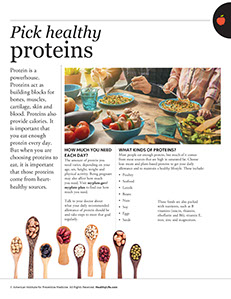
  • Healthy Eating 4

    Nutrition

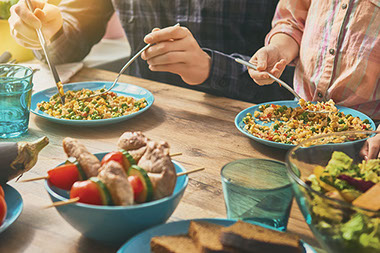
    Family sitting around table eating.

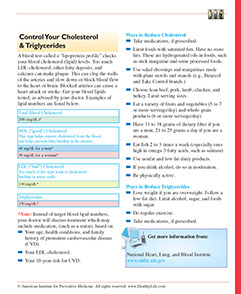
    Choose foods that help lower LDL (bad) cholesterol and raise HDL (good) cholesterol. Medicines have a big impact on improving blood cholesterol (lipid) levels.  Follow your doctor’s advice for taking medications.

    Action Step:Take a walk at least 30 minutes a day, five days a week. Lose weight. Weight loss and moderate physical activity raise HDL (good) cholesterol.

    Page from HealthyLife Weigh book by the American Institute for Preventive Medicine. www.HealthyLife.com. All rights reserved.

    © American Institute for Preventive Medicine

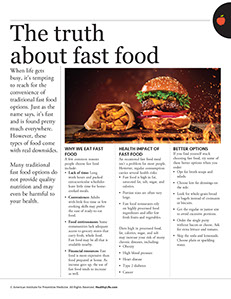
  • To Market, To Market, Shop Smart

    Nutrition

    Choose healthy and low-calorie foods.

    Look at buying healthy, low-calorie foods. When you buy them, the more likely you are to eat them. And when you do not buy foods high in sugar, fat, and empty calories, they are not there to tempt you.

    Start with planning.

    Plan for meals that will be eaten at home, lunches that need to be packed, and for healthy snacks. Make a shopping list before you go to the store. And shop after you have eaten. If you are hungry, you will be more tempted to buy foods high in fat and/or sugar, such as cakes, cookies, cheese puffs, and other packaged snacks.

    Location! location!

    For nutrient-dense foods that are lower in calories, shop the perimeter of the store. To fill half your plate with fruits and veggies, start at the produce section. Then choose whole-grain cereals and packaged and canned products low in sodium from middle aisles. Try to avoid the cookie, candy, and chips aisles. Then choose fresh fish, lean meats, and dairy products low in fat. Finish in the freezer section for more fruits, veggies, and fish. Choose items without added sugars, fats, and sauces.

    Items to include on a healthy shopping list:

    *  Skim or 1% milk

    *  Low or reduced-fat cheeses

    *  Eggs or egg substitute

    *  Unprocessed meats, fish, poultry

    *  Low-sodium or no-salt added canned soups & vegetables

    *  Whole grain breads and cereals

    *  Rice crackers

    *  Low-sodium or unsalted crackers

    *  Frozen vegetables without added sauces

    *  Fresh fruits and vegetables

    *  Unsweetened tea

    *  Fat-free and reduced-fat salad dressings

    *  Unsalted nuts and seeds

    *  Canola and olive oils

    Action Step

    Remember to compare food labels for calories, fat, sugars, and vitamins and minerals per serving. Use coupons wisely.

    Page from Ways to Well-Being book by the American Institute for Preventive Medicine. www.HealthyLife.com. All rights reserved.

    © American Institute for Preventive Medicine

  • Brussels Sprouts: A Winter Veggie Powerhouse

    HEALTHY EATING

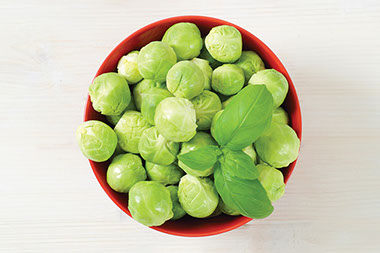
    Brussels spouts in red bowl.

    Brussels sprouts may have a reputation for being the vegetable your mother made you eat. But there’s plenty of reasons that adults and kids alike should eat their Brussels sprouts. Their peak season is fall to winter, so now is a good time to try them.

    Why eat Brussels sprouts?

    Brussels sprouts belong to the cruciferous vegetable family. Other cruciferous vegetables include broccoli, cauliflower, kale and cabbage.

    Like other veggies, brussels sprouts are low in calories and packed with nutrients. They also have plenty of fiber to help with digestion. Fiber may also help you feel fuller, longer.

    Brussels sprouts also have some special health benefits. They may play a role in reducing the risk of developing cancer.

    How to cook brussels sprouts

    Brussels sprouts are versatile and can be roasted, used in casseroles, salads and even on pizza. Many people can find a way to cook them that agrees with their tastes.

    A popular way to roast them is to toss them with honey, lemon juice or dried fruit for a sweet side dish. But brussels sprouts also work well with savory flavors like parmesan cheese or garlic.

    Nutrition

    One half cup of cooked Brussels sprouts contains just 28 calories. It also contains 2 grams of fiber and very little fat and carbohydrates. Brussels sprouts are a good source of many important nutrients, including vitamins A and C. These vitamins are antioxidants, which help fight inflammation and some diseases.

    In addition, Brussels sprouts are packed with vitamin K, which is important for blood clotting and healthy bones. Brussels sprouts contain important minerals like iron, magnesium and phosphorus. And finally, they contain heart-healthy omega-3 fats.

    If you haven’t eaten Brussels sprouts in a while, give them a try. They make a nutritious and delicious addition to any diet.

    Sources: Academy of Nutrition and Dietetics, National Institutes of Health, US Department of Agriculture

    © American Institute for Preventive Medicine

  • Eat Your Greens

    HEALTHY EATING

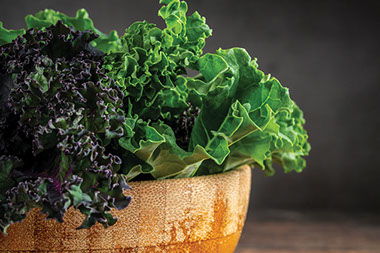
    Variety of greens.

    Spring is fresh greens season. Lettuce, kale, arugula, swiss chard, and spinach are among the first fruits of the garden due to their cold tolerance and rapid growth.

    While they are easy to grow, their delicate leaves and short shelf life mean they won’t last long in your fridge. How you clean and store them will determine whether you get a crisp salad or a bitter bite.

    When properly handled and prepared, spring greens are a healthy source of vitamins A and K, plus calcium, potassium, and a wealth of phytochemicals.

    Here is what you need to know to get the most out of your spring greens:

    Plan to eat the greens within a day or two:

    *  Separate the leaves and soak them in an ice-water bath once you get them home. The ice-cold water will keep them crisp and help prevent nutrient loss.

    *  Pat the leaves dry or spin in a salad spinner to remove excess moisture.

    *  Store clean, dry greens in a sealed container or bag.

    *  Eat within a few days.

    Plan to hold the greens for several days before eating:

    *  Wait to wash them until you are ready to eat them.

    *  Rinse with water, or soak in an ice water bath to refresh the leaves.

    *  Pat dry or spin in a salad spinner to remove excess moisture.

    *  Gently tear leaves into bite-sized pieces and use immediately.

    © American Institute for Preventive Medicine

  • Healthy Eating 2

    HEALTHY EATING

    © American Institute for Preventive Medicine