Tag: options

  • Infertility: When To See A Doctor

    MEDICAL NEWS

    Young couple talking to doctor.

    It is not uncommon for some couples to have trouble conceiving. If a couple has been trying for one year without success, they are said to be dealing with infertility.

    While infertility may be common, it is not hopeless. Many effective treatments are available. Knowing when to talk to your doctor about fertility can help you get closer to your goal of getting pregnant.

    What causes infertility?

    Infertility is not just a woman’s issue. It can affect one or both partners.

    Men require healthy sperm to be fertile. Anything that impacts the number, shape, and movement of sperm may cause infertility. These may include:

    *  Unhealthy habits

    *  Trauma to the testes

    *  Certain medications or supplements

    *  Cancer treatment

    *  Medical conditions

    Women need functioning ovaries, fallopian tubes, and a uterus to get pregnant. A condition that affects any one of these organs can cause infertility issues. These may include:

    *  Polycystic ovary syndrome (PCOS)

    *  Diminished ovarian reserve

    *  Blocked fallopian tubes

    *  Menopause

    *  Abnormal uterine shape

    When to see a doctor

    Every couple should talk to their doctor to let them know they are trying to get pregnant. Your doctor may have specific recommendations and screenings that would be of benefit.

    Some couples may be at a higher risk of infertility. If you have any of the following risk factors, you should talk to your doctor right away when trying to conceive:

    *  Irregular or no menstrual periods

    *  Painful periods

    *  Endometriosis

    *  Pelvic inflammatory disease

    *  History of miscarriage

    *  Any suspected male factors, such as cancer treatment, history of teste trauma, etc.

    Women over the age of 30 may experience age-related declines in fertility. Once a woman is over 35, infertility becomes more common. While this doesn’t mean someone at that age will not be able to conceive, it does mean you should talk to your doctor sooner if you do not become pregnant.

    Any couple who has been trying to conceive for one year without success should talk to their doctor. Couples over the age of 35 should talk to their doctor after six months of trying.

    Your doctor may refer you to a reproductive endocrinologist who specializes in infertility. Never hesitate to talk with your doctor if you have any questions or concerns about yourself or your partner’s fertility.

    © American Institute for Preventive Medicine

  • Choose Benefit Options With Both Cost And Care In Mind

    Medical Care

    Wooden blocks with medical icons.

    *  Signing up for the same plan as the one you have is easy, but spending time to find out about all options could be worth it. Ask your employer for written materials for your options or how to access the information online.

    *  Estimate what your costs for the coming year will be using each option. Your company’s or insurance company’s website may have tools to help you do this.

    *  Consider a flexible spending account (FSA) to help pay for health care expenses. It also offers tax advantages. To determine how much to put into an FSA, add up out-of-pocket costs you expect to pay for the coming year. These include co-pays, deductibles, cost for eyeglasses, contact lenses, etc.

    *  The best deal may not be the cheapest plan, but the one that gives the best price for the benefits you are most likely to use.

    *  Find out if you can lower your health care premium costs by taking part in certain wellness and disease management programs offered through work.

    A Year of Health Hints book by the American Institute for Preventive Medicine. www.HealthyLife.com. All rights reserved.

    © American Institute for Preventive Medicine

  • Making Medical Decisions

    Medical Care

    Describe the Problem

    Be Able to Answer These Questions About Your Current Problem and Complaints

    *  What do you think the problem is?

    *  Are you in pain? If yes:

    – What does the pain feel like? Is it a sharp, dull, and/or throbbing pain?

    – Where is the pain?

    *  When did the problem(s) start? Has it changed since then?

    *  What makes it go away?

    *  Have you felt like this before? Is so, when? What made it go away then?

    *  Have you had any other symptoms or signs lately? Examples are:

    – Fever.

    – Blood in the urine.

    – Shortness of breath.

    – Anxiety.

    – Insomnia.

    Be Able to Give This Information About Your Health

    *  Your medical history and your family’s medical history.

    *  Allergies you have.

    *  Medications you take.

    *  Your daily habits.

    *  Your work.

    *  Pressures you are under.

    Ask for a Diagnosis

    Your Doctor or Health Care Provider Makes a Diagnosis From

    *  Symptoms (things you feel, such as pain).

    *  Signs (things that can be seen or measured, such as swelling).

    *  Exams and tests.

    When Your Doctor or Health Care Provider Gives You A Diagnosis

    *  Ask him or her to explain the diagnosis in detail.

    *  Ask questions if you don’t understand. If you need to, bring a trusted family member or friend with you to help ask questions.

    *  Find out if your condition is chronic or acute. A chronic one lasts a long time. An acute one comes on suddenly and doesn’t last long. If your condition is chronic, find out how it will affect your life.

    *  Ask if the diagnosis increases your risk for any other problems. If so, find out what they are and what you can do to prevent them.

    Other Things to Ask

    *  Is my condition contagious? If so, how do I not spread it?

    *  Is my condition genetic? If so, what does this mean for others in my family?

    *  How certain are you about this diagnosis? Are there are other symptoms to look for that would help confirm or disprove the diagnosis?

    *  What books, pamphlets, and computer Web sites can I use to find out more about my condition? What organizations can I contact? Is there a support group in my area for this condition?

    Find Out About Treatment

    Ask your doctor or health care provider to state clearly and simply what the proposed treatment is. If medication is prescribed, ask these questions:

    *  What is the name of the medicine? Write down the name and dose.

    *  What will the medicine do?

    *  Is there a less expensive, generic form?

    *  When, how often, and for how long, should I take the medicine?

    *  Do I take this medicine until I feel better or until it is used up?

    *  When will the medicine start to work?

    *  Could there be side effects? What should I do if they occur? What side effects should I let you know about?

    *  Is this medicine okay to use with other medications I take?

    *  Is there anything else I should or should not do while taking the medicine?

    – Should I take this medicine with or without food?

    – Is there anything I should not eat or drink when I take this medicine? Can I take this medicine with grapefruit juice?

    – Can I have alcohol?

    – Do I need to stay out of the sun?

    *  What should I do if I miss a dose?

    If Surgery is Prescribed

    *  Find out about the alternatives to surgery.

    *  Consider getting a second opinion. Your health insurance may require this.

    *  Find out if your health insurance plan will pay for the surgery.

    *  Ask what types of surgery there are for your condition.

    *  Ask for a step-by-step account of the procedure. Find out what you need to do before surgery. Find out what is done during and after surgery. This includes anesthesia and recovery.

    Questions to Ask if A Test is Prescribed

    *  What is the test called? How will it help tell what is wrong?

    *  Will it give specific or general information?

    *  If the answer is general, where do we go from here?

    *  How accurate and reliable is the test?

    *  Is the test invasive or noninvasive? Invasive means something, such as a catheter, chemical dye, etc., is inserted into the body. Nothing is inserted into the body with an noninvasive test. Examples are blood pressure readings and simple chest x-rays.

    *  What will I have to do to prepare for the test?

    *  Where do I go for the test?

    *  How and when will I get the test’s results?

    *  Will more tests be needed?

    Ask About Benefits

    Medical treatments change over time as researchers learn more and technology improves. Make certain that you and your health care provider have access to the latest and best information.

    *  Find out how the proposed treatment will improve your condition.

    – Will it cure the problem?

    – Will it help with symptoms?

    – Can it lead to other problems?

    *  Discuss with your health care provider what you expect the proposed treatment will do. Make sure you are being realistic about what you expect.

    *  Find out what will happen if you don’t have the treatment.

    A good rule of thumb is to make sure one strong reason can stand alone to justify going ahead with the treatment. In many cases, two or more not-so-strong reasons may not be enough. Discuss your concerns with your health care provider and loved ones.

    Ask About Risks

    If surgery is prescribed, ask about the risks for these things, during and after surgery:

    *  Pain.

    *  Anesthesia.

    *  Infection.

    *  Accidental injury.

    *  Heavy bleeding (hemorrhage).

    *  Another unplanned operation.

    *  Death.

    *  Weigh the risks versus the benefits before you decide to proceed with treatment. Discuss your concerns with your health care provider and others close to you.

    *  With your health care provider, chart the risks and benefits. On a sheet of paper, draw a line down the center. List the risks on one side. List the benefits on the other. Weigh each item on a scale from 1 to 5 (1 = not so important; 5 = very important). Add up the columns to see which one has a higher score.

    *  Ask about risks before you get any test or X-ray, no matter how minor it may be. If you are not asked about allergies, state them ahead of time. If you are female, tell your health care provider if you are or may be pregnant. If so, you should not get X-rays unless they are absolutely necessary.

    Find Out Costs

    *  What is the cost of the proposed treatment?

    *  Does this include the cost for follow-up? If so, how much is covered?

    *  Check with your insurance plan to see what it will pay and how much you will have to pay.

    *  Ask what you need to do to get maximum benefits. An example is pre-authorization for surgery. Find out if your health care provider and hospital accept your insurance.

    *  What related costs do I need to consider? Look into costs of medication, costs for time off work and child care and transportation costs.

    Find Out Success Rates

    The success rate is how often a treatment works compared to how many times it is done. For example, if a certain surgery has been done 100 times and was successful 80 times, it has a success rate of 80%.

    If surgery is prescribed, ask your health care provider and the medical facility where you will have the surgery these questions:

    *  What is the national success rate?

    *  What is the success rate at the hospital/medical facility where my treatment is planned?

    *  What is the surgeon’s success rate and experience with the surgery?

    *  How many procedures are the above success rates based on?

    *  Are there any personal factors that will affect my odds either way?

    *  How long will the results of my surgery/treatment last?

    According to several studies, you are less likely to die or suffer complications from surgery or other procedures if you go to an accredited hospital that performs a large number of that procedure each year. Some experts advise at least 200 surgeries. If you are given a success rate percentage, find out how many procedures the percentage is based on. A success rate of 80% doesn’t mean much if it is based on only 5 surgeries. For more information on hospital surgical success rates, read the book Best Medicine by Bob Arnot, M.D.

    Ask About Other Options

    Discuss other options that can diagnose and/or treat your condition. There is usually more than one option. Sometimes, the best choice at the time may be no choice. This is called “wait and see.” If this doesn’t work for you, make a list of other options. Ask your doctor or health care provider these questions:

    *  What might happen if I decide to do nothing?

    *  What are my other options?

    – Ask about options that don’t need surgery, such as lifestyle changes (diet, exercise, stopping smoking, etc.).

    – If surgery is proposed, ask about outpatient surgery, laser treatment, laporascopic surgery, and the newest ways to treat your condition.

    *  If you are not satisfied with your options, discuss this with your provider. If you are still not satisfied, consider consulting another health care provider.

    *  Look into every option in depth.

    Ask When Treatment Should Begin

    When you decide to go ahead with a treatment plan, ask these questions:

    *  When is the best time to get started with the plan?

    *  Do I have to undergo treatment right away? If not, how long can I safely wait? Don’t assume that it has to be done as soon as possible. You may be able to delay the treatment until a time that best fits your schedule.

    *  Decide the best time for you to begin the treatment.

    Make a Decision

    After you get the answers from steps 1 to 9, decide what to do.

    *  You can also decide to refuse treatment, but you should ask your health care provider what can happen if you do this.

    *  If you feel rushed or uncomfortable when you discuss your decision with your doctor or health care provider, tell him or her how you feel.

    *  Read about “Informed Consent” and “Advanced Directives” on the last 2 panels. If you have not already done so, consider writing a living will or signing a durable power of attorney for health care.

    Informed Consent

    Informed consent is a legal issue in medicine. It means that you agree to treatment only after it has been explained to you and that you understand it. You should know:

    *  The nature of the treatment.

    *  Its benefits and risks.

    *  The likelihood of the treatment’s success.

    *  If your treatment is experimental in nature.

    The physician should review any options you can get instead of surgery or other procedures. There are no guaranteed outcomes in medicine, but informed consent enables YOU to make a rational and educated decision about your treatment. It also promotes greater understanding and joint decision making between you and your health care provider. With informed consent:

    *  You cannot demand services that go beyond what are considered “acceptable” practices of medicine or that violate professional ethics.

    *  You must recognize that you may be faced with some uncertainties or unpleasantness.

    *  You should, if competent, be responsible for your choices. Don’t have others make decisions for you.

    *  You should also know about “Advance Directives.”

    Advance Directives

    Advance directives are a legal way for you to state your wishes to choose or refuse medical treatment. There are two types of advance directives:

    *  Durable Power of Attorney for Health Care – This document names a person(s) who would make treatment decisions for you if you are not able to make them yourself. This person would state your wishes. Your condition does not have to be terminal or irreversible to have someone speak on your behalf.

    *  Living Will – This written document states what medical treatment you would want or not want. A living will applies only when you can’t express your wishes on your own and you suffer from a terminal illness or condition and aren’t expected to survive.

    In writing, you may choose or refuse:

    *  Measures to Support Life, such as a respirator (a machine to breathe for you).

    *  Measures to Sustain Life, such as tube feedings and kidney dialysis (a machine that does the work of your kidneys).

    *  Measures to Enhance Life. These keep you comfortable, but don’t prolong life. Examples are pain medications and hospice care.

    Each state has its own laws on advance directives. Get forms for them from your lawyer, local hospital or library, or from your state’s Web site. You can also get forms and information from these Web sites:www.putitinwriting.organdwww.uslivingwillregistry.com.

    After you complete advance directives, discuss them with your family and close friends. Give your doctor a copy, too.


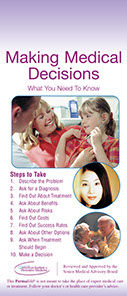
    Cover image to the Making Medical Decision brochure by the American Institute for Preventive Medicine. www.HealthyLife.com. All rights reserved.

    © American Institute for Preventive Medicine

  • When To Refuse Tests Or Surgery

    Medical Care

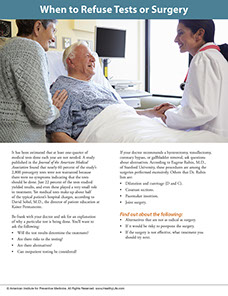
    Image of doctor talking to hospital patient and spouse.

    It has been estimated that at least one-quarter of medical tests done each year are not needed. A study published in the Journal of the American Medical Association found that nearly 60 percent of the study’s 2,800 pre-surgery tests were not warranted because there were no symptoms indicating that the tests should be done. Just 22 percent of the tests studied yielded results, and even these played a very small role in treatment. Yet medical tests make up about half of the typical patient’s hospital charges, according to David Sobel, M.D., the director of patient education at Kaiser Permanente.

    Be frank with your doctor and ask for an explanation of why a particular test is being done. You’ll want to ask the following:

    *  Will the test results determine the treatment?

    *  Are there risks to the testing?

    *  Are there alternatives?

    *  Can outpatient testing be considered?

    If your doctor recommends a hysterectomy, tonsillectomy, coronary bypass, or gallbladder removal, ask questions about alternatives. According to Eugene Rubin, M.D., of Stanford University, these procedures are among the surgeries performed excessively. Others that Dr. Rubin lists are:

    *  Dilatation and curettage (D and C).

    *  Cesarean sections.

    *  Pacemaker insertion.

    *  Joint surgery.

    Find out about the following:

    *  Alternatives that are not as radical as surgery.

    *  If it would be risky to postpone the surgery.

    *  If the surgery is not effective, what treatment you should try next.

    Page from A Year of Health Hints book by the American Institute for Preventive Medicine. www.HealthyLife.com. All rights reserved.

    © American Institute for Preventive Medicine

  • Air Travel

    Healthylife® Weigh

    Part 3

    Snacks for the airplane.

    Air travel can be time consuming because of the time it takes to get to the airport, get through security, wait for a flight, fly, and get to your final destination. Avoid going more than 3 to 4 hours without having something to eat. Plan to have a meal, a snack, or both!

    *  Bring one or more travel snacks with you.

    *  Look for these healthy snack options from to-go vendors. Read the Nutrition Facts on food labels, when available.

    – Fresh fruit

    – Low-sodium soup

    – Wraps and small sandwiches

    – Yogurt with cut-up fruit

    – Cottage cheese with fruit

    *  If you have time, choose a restaurant with healthy options on the menu. Sit and eat slowly to help digestion.

    *  Drink water. Bring an empty water bottle to the airport and re-fill it at a drinking fountain after going through security. Or, buy a water bottle once inside the airport terminal. Water is usually offered on the plane. Altitude and dry air can cause dehydration.

    *  Move around, both at the airport and while on the plane, if you can. Go for walks at the airport if you have a lot of waiting time. Stretch in your seat on the plane or walk to the restroom.

    If you won’t be traveling for a while, come back to this page for tips when it applies in the future. Or, share these tips with a spouse or friend who is traveling soon!

    © American Institute for Preventive Medicine

  • Choose Fresh, Frozen, Canned, Or Dried

    Healthylife® Weigh

    Part 2

    Frozen strawberries.

    All forms of fruits and vegetables can be healthy options. You may like the taste of one form over another. If you have only tried a vegetable in one form (for example, canned green beans), try it fresh or frozen. You may be surprised how different it tastes. Frozen and canned produce is picked at the peak of ripeness. This means the nutrients were able to fully develop before the plant was picked. This makes these choices very healthy, especially outside of the growing/harvest season.

    Fresh

    *  Choose a variety of fresh produce. Include ready-to-eat snacks like apples and baby carrots.

    *  Buy produce that’s in season to help the environment and provide natural variety in your diet.

    *  Grow your own, when possible.

    Frozen

    *  Choose frozen veggies without added sauces or salt. Add your own seasonings that have little or no salt or sodium.

    *  Choose fruits without added sugar. Fruit has plenty of natural sugar.

    Canned

    *  Choose low-sodium added varieties.

    *  Wipe off the top of the can before opening it.

    *  Rinse the vegetables in a colander to reduce the sodium content further.

    *  With canned fruit, look for options packed in water or 100% fruit juice. Avoid canned fruits that are packed in syrup.

    Dried

    *  Avoid choices with added sugar.

    *  Drink a glass of water to replace the water that has been removed.

    © American Institute for Preventive Medicine

  • Meal And Snack Ideas

    Healthylife® Weigh

    Part 3

    Family eating dinner together at home.

    Below are ideas for basic meals and snacks. Use these ideas to start building your meal plan.

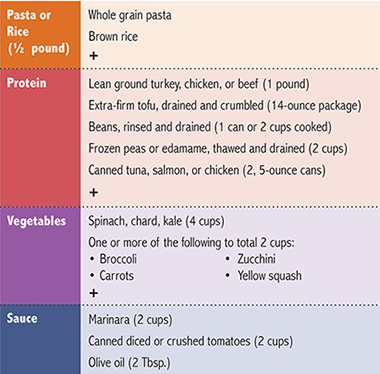
    Meal Idea: Pasta or Rice Dinner

    Choose ingredients from the chart below. This recipe makes four servings.

    Chart of meal ideas, pasta or rice dinner.

    Directions:

    1. Cook pasta or rice according to package directions and drain.

    2. Cook protein choice as needed.

    3. Cook veggies by steaming, grilling, roasting, sautéing, or adding to boiling pasta water in the last few minutes of cooking.

    4. In a large pot, heat sauce over medium heat. If using spices, add them now. Add protein and veggies to heat through. Toss with hot cooked pasta or rice and serve.

    For a casserole, follow the directions above. Then, pour into a 9 x 13-inch baking pan and bake for 40-60 minutes until the top is golden brown.

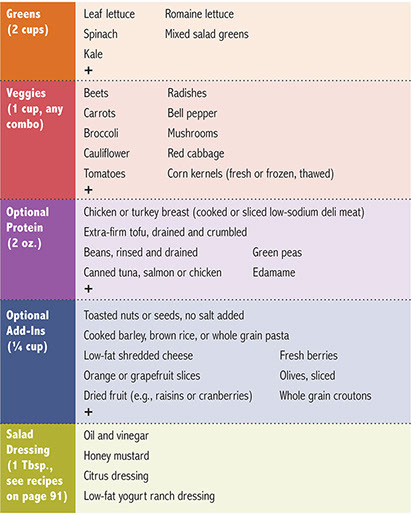
    Meal Idea: Salad

    Choose ingredients from the chart below. This salad recipe serves one person.

    Chart of meal ideas, salad.

    Directions:

    Toss ingredients together when ready to eat. Or, prepare a salad ahead of time in a container, keeping very moist ingredients (like tomatoes and dressing) separate. When you are ready to eat, toss and empty onto a plate or in a large bowl.

    Salad Dressing

    Salad dressing can be a healthy choice for your salad. Use healthy, unsaturated fats in salad dressing to:

    *  Help you feel full and more satisfied.

    *  Help your body get the benefits of other vitamins in your salad, like fat-soluble vitamins A, D, E, and K.

    *  Add flavor. Dressings are a great place for herbs, spices, and other powerful flavors to make your salad POP!

    *  Help you eat vegetables that you don’t like plain.

    Tips for Selecting a Dressing at a Restaurant:

    *  Ask for oil-based dressings, such as olive oil and balsamic vinegar.

    *  Ask for dressing on the side. Toss your salad with half the dressing provided and put the rest to the side. Most restaurants offer much more dressing than you need for your salad.

    *  If you are worried you may use too much dressing, ask for a half-size salad or order another vegetable as a side dish.

    *  On bottled dressings, look for ones made without added sugars.

    Make Your Own Salad Dressing

    Use 1-2 Tbsp. of the dressing on your salad. Store leftovers in a sealed jar.

    *  Oil and vinegar dressing: 3 Tbsp. olive oil, 2 Tbsp. red wine vinegar,  1/8 tsp. salt (a dash), ¼ tsp. black pepper. Serving size: 1 Tbsp.

    *  Honey mustard dressing: 6 Tbsp. mustard, ½ Tbsp. fresh lemon juice or cider vinegar, 1½ Tbsp. honey, 1 tsp. olive or canola oil, 1/8 tsp. salt  (a dash), ¼ tsp. black pepper. Serving size: 2 Tbsp.

    *  Citrus dressing: 2 Tbsp. lime, lemon, or orange juice; 3-4 Tbsp. canola or olive oil, 1/8 tsp. salt (a dash), ¼ tsp. black pepper. Serving size: 1 Tbsp.

    *  Creamy low-fat ranch dressing: 1 (6-ounce) container plain nonfat or  low-fat yogurt, 1/3 cup low-fat mayonnaise, 2 Tbsp. white vinegar, 1 Tbsp. dried dill, ¼ tsp. garlic powder, 1/8 tsp. salt (a dash). Serving size: 2 Tbsp.

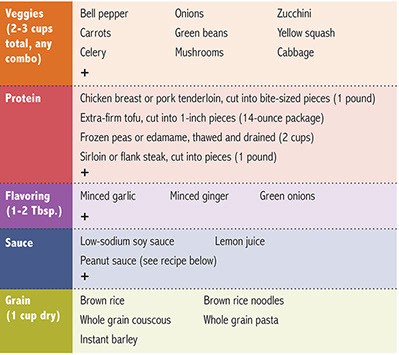
    Meal Ideas: Stir-Fry

    Choose ingredients from the chart below. This recipe makes four servings.

    Chart of meal ideas, stir-fry.

    Peanut Sauce:In a small bowl, stir together ¼ cup peanut butter, 1/3 cup water, ¼ cup low-sodium soy sauce, 2 Tbsp. cider vinegar, and 4 tsp. sugar.

    Directions

    1. Cook grains. Follow package directions and set aside.

    2. If using meat: In a large skillet over medium heat, cook meat or poultry in 1 tablespoon canola or olive oil. Set aside.

    3. Add veggies to skillet, starting with harder veggies (these take longer to cook). Cook to desired softness. Add flavoring (garlic, ginger, or green onions). If adding tofu, peas, or edamame, add that now.

    4. Add sauce and cook for 1-2 more minutes. Stir in cooked meat.

    5. Serve over cooked grains.

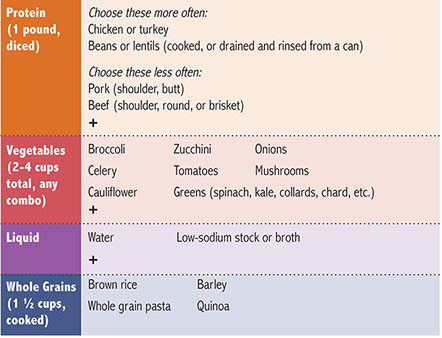
    Meal Ideas: Soup

    Choose ingredients from the chart below. This recipe makes four servings.

    Chart of meal ideas, soup.

    Directions

    1. If using meat: Heat 1 Tbsp. of canola or olive oil in a soup pot. Add meat and cook for 5 minutes. If not using meat, skip this step.

    2. Add chosen vegetables and sauté for 5 minutes. If using frozen vegetables, thaw in the microwave first.

    3. Add liquid and beans or lentils (if using) and bring to a boil. Once boiling, reduce heat and simmer for 25-30 minutes. Stir occasionally.

    4. Add grains and seasonings. Cook for an additional 5 minutes.

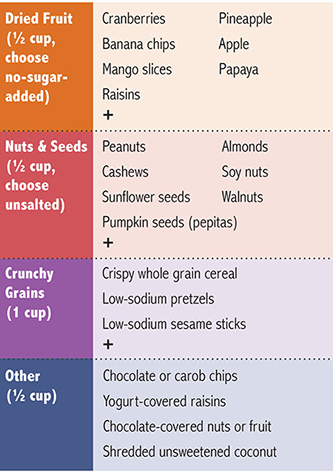
    Snack Ideas: Trail Mix

    Choose ingredients from the chart below. This recipe makes four servings.

    Chart of snack ideas, trail mix.

    © American Institute for Preventive Medicine

  • How To Choose A Quality Hospice

    FAMILY LIFE

    Image of male nurse and elderly man on a laptop.

    When a loved one is diagnosed with a serious or life-limiting illness, the questions facing an individual or a family can be overwhelming. The National Hospice and Palliative Care Organization recommends that people learn more about hospice as an important option before they are faced with a medical crisis.

    Hospice is not a place but a kind of care for people who have a life-limiting illness and are making the choice to focus on quality and comfort if more conventional treatments have become burdensome.

    Hospices provide high-quality care that is tailored to your loved one’s needs and that supports family caregivers.

    Your doctor and other health care providers or your company’s EAP may recommend hospice providers in your area. You can also get a list of hospice providers and more information about hospice from the National Hospice and Palliative Care Organization atwww.nhpco.org.

    Important questions in choosing a quality hospice include:

    *  Is the hospice Medicare certified?

    *  What services should I expect from the hospice?

    *  How are services provided after hours?

    *  How and where does hospice provide short-term inpatient care?

    *  What services do volunteers offer?

    *  How long does it typically take the hospice to enroll someone once the request for services is made?

    When should hospice care begin?

    Every patient and family must decide that based upon their unique needs. Professionals encourage people to learn about care options long before they think they may need them.

    © American Institute for Preventive Medicine