Tag: outpatient

  • The Ins And Outs Of Ambulatory Surgery

    Medical Care

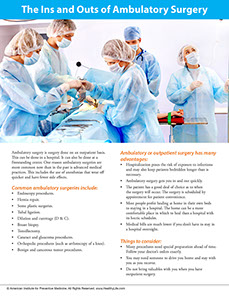
    Ambulatory surgery is surgery done on an outpatient basis. This can be done in a hospital. It can also be done at a freestanding center. One reason ambulatory surgeries are more common now than in the past is advanced medical practices. This includes the use of anesthesias that wear off quicker and have fewer side effects. Common ambulatory surgeries include:

    *  Endoscopy procedures.

    *  Hernia repair.

    *  Some plastic surgeries.

    *  Tubal ligation.

    *  Dilation and curettage (D & C).

    *  Breast biopsy.

    *  Tonsillectomy.

    *  Cataract and glaucoma procedures.

    *  Orthopedic procedures (such as arthroscopy of a knee).

    *  Benign and cancerous tumor procedures.

    Ambulatory or outpatient surgery has many advantages:

    *  Hospitalization poses the risk of exposure to infections and may also keep patients bedridden longer than is necessary.

    *  Ambulatory surgery gets you in and out quickly.

    *  The patient has a good deal of choice as to when the surgery will occur. The surgery is scheduled by appointment for patient convenience.

    *  Most people prefer healing at home in their own beds to staying in a hospital. The home can be a more comfortable place in which to heal than a hospital with its hectic schedules.

    *  Medical bills are much lower if you don’t have to stay in a hospital overnight.

    Things to consider:

    *  Many procedures need special preparation ahead of time. Follow your doctor’s orders exactly.

    *  You may need someone to drive you home and stay with you as you recover.

    *  Do not bring valuables with you when you have outpatient surgery.
    Page from A Year of Health Hints book by the American Institute for Preventive Medicine. www.HealthyLife.com. All rights reserved.

    © American Institute for Preventive Medicine

  • Save On Hospital Services

    Medical Care

    Image of nurse helping a women walk.

    Hunt for hospital quality.

    Choose a hospital that has a good success record with the kind of surgery you need. You are less likely to die or have serious problems if the hospital does the surgery a lot. What is “a lot”? Some experts say the hospital should do a surgery at least 200 times a year. If the surgery you need is rare, that may not be possible. Ask about the hospital’s experience with surgeries like yours. Talk to your doctor, the hospital administrator, or the hospital’s chief of staff.

    Avoid hospital germs.

    Five to 10% of all hospital patients will get an infection they did not have before they were in the hospital. To protect yourself:

    *  Be well-rested and well fed before you go to the hospital.

    *  Check that persons who give you care wash or sanitize their hands.

    *  If a roommate gets pneumonia, ask to have your room changed.

    Control consults.

    You could get a hospital bill for a doctor visit that you didn’t even know about. To avoid this, try to make sure your doctor knows that you or someone acting for you must approve a consult with another doctor. If you can, ask your insurance company if the cost of the consult is covered in part or in full.

    Keep track of hospital services.

    Keep a list of services you get. Compare the list to your hospital bill. Have a friend or relative make the list if you can’t. Also, ask for an itemized bill and check it. Some common things to note are:

    *  Doctor visits. X-rays. Tests.

    *  Medicines (pills, shots, IVs).

    *  Giving blood samples.

    *  Consults and services with specialists.

    *  Anesthesia. Surgery. Receiving blood.

    *  Room charges. Telephone and TV charges.

    You stay, you pay.

    Find out when hospital check out time is and make plans to follow it. If not, you may be charged for an extra day.

    Cover image to the Healthy Savings book by the American Institute for Preventive Medicine. www.HealthyLife.com. All rights reserved.

    © American Institute for Preventive Medicine

  • Types Of Surgery

    Medical Care

    Image of doctors performing surgery.

    It’s funny. People think of surgery as “major” when it happens to them and “minor” when it’s being done to someone else! In reality, surgery is thought to be major when it involves any vital organs and/or requires a long time period to perform. The following words classify various surgeries:

    Curative

    A procedure that rids the body of a problem or corrects a condition.

    Diagnostic

    A procedure that helps in making a diagnosis about a suspected problem.

    Elective

    A procedure that may or may not be done, depending upon the patient’s wishes.

    Emergency

    An immediate operation to save a life or maintain the use of a body part.

    Exploratory

    A surgery that explores a body organ or body area for a suspected disorder.

    Palliative

    A surgery that eases bodily pain but doesn’t cure the problem.

    Planned

    A surgery set up well in advance of the actual operation date.

    Urgent

    An operation that must be done within a matter of hours.

    Page from Health at Home book by the American Institute for Preventive Medicine. www.HealthyLife.com. All rights reserved.

    © American Institute for Preventive Medicine