Tag: patience

  • Dealing With Difficult Personalities

    WORK LIFE

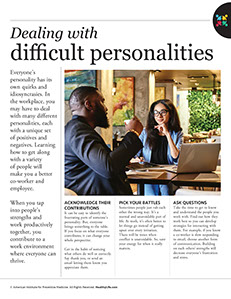
    Two coworkers sitting with laptop, talking and drinking coffee.

    Everyone’s personality has its own quirks and idiosyncrasies. In the workplace, you may have to deal with many different personalities, each with a unique set of positives and negatives. Learning how to get along with a variety of people will make you a better co-worker and employee.

    When you tap into people’s strengths and work productively together, you contribute to a work environment where everyone can thrive.

    Acknowledge their contributions

    It can be easy to identify the frustrating parts of someone’s personality. But, everyone brings something to the table. If you focus on what everyone contributes, it can change your whole perspective.

    Get in the habit of noticing what others do well or correctly. Say thank you, or send an email letting them know you appreciate them.

    Pick your battles

    Sometimes people just rub each other the wrong way. It’s a normal and unavoidable part of life. At work, it’s often better to let things go instead of getting upset over every irritation. There will be times when conflict is unavoidable. So, save your energy for when it really matters.

    Ask questions

    Take the time to get to know and understand the people you work with. Find out how they work best so you can develop strategies for interacting with them. For example, if you know a co-worker is slow responding to email, choose another form of communication. Building on each others’ strengths will decrease everyone’s frustration and stress.
    © American Institute for Preventive Medicine

  • Feeding The Picky Eater

    FAMILY LIFE

    Image of young girl excited to eat.

    Pre-dinner tips

    *  Get your child involved. Many kids can help with shopping and cooking. Being involved in the process may make them more likely to try new foods. Have them choose a favorite fruit or vegetable from the store. Younger children can help pour ingredients or cut soft foods, like bananas, with a butter knife. Older children can help with measurements.

    *  Get some exercise. Kids who have been actively playing may be hungrier when dinner comes. The hungrier they are, the more likely they may try new things.

    *  Turn off devices. Make family mealtimes relaxing and unplugged. Ban cell phones, television or other devices from the table.

    Size matters

    Don’t force your child to eat foods they don’t like. Rather, put a “sample size” on their plate. It can be just one bite of food. This may be less overwhelming than serving a large portion to them.

    Sanity-saving steps

    *  Make healthier snacks to fill the gaps. Serve fresh fruit or vegetables as a snack to get in extra nutrients. Skip the processed crackers and chips.

    *  Don’t have a battle. Forcing your child to eat could make them dislike their food even more.

    *  Don’t use bribes or rewards for eating. Rewards teach your child to expect something every time he/she tries a new food.

    *  Make one healthy meal for everyone. Don’t feel pressured to make “special meals” for picky eaters.

    *  Talk about your child’s eating habits with their doctor. Most picky eaters are getting enough of the foods they need. But, ask their pediatrician just in case. Some children need supplements to help get extra nutrients that they’re missing.

    Source: American Academy of Pediatrics

    © American Institute for Preventive Medicine

  • How To Survive A Dieting Setback

    Weight Control

    Image of women in front of a cupcake and apple on a scale.

    Everyone experiences occasional setbacks, especially people on diets. The trick is to prevent a minor slip from becoming a major disaster that thwarts your long-term weight-loss goals.

    The most determined dieter cheats once in a while-it’s only human. Don’t chastise yourself or give up because you’ve had a slip-up in your eating plans. Remember, a temporary setback does not equal a permanent failure!

    Here’s what to remember when you go astray.

    *  Setbacks are a natural part of learning self-control.

    *  Acknowledge your mistake and plan how you’ll respond to a similar situation the next time. Make it work to your advantage.

    *  Remember, long-term success is still quite possible.

    *  Give yourself positive feedback. If you eat half of a candy bar, for instance, praise yourself for not eating the whole thing.

    Page from A Year of Health Hints book by the American Institute for Preventive Medicine. www.HealthyLife.com. All rights reserved.

    © American Institute for Preventive Medicine

  • Appreciate The Journey

    Healthylife® Weigh

    Part 5

    Two women enjoying a run together.

    Know why you are being physically active. This will help get you motivated to start and to keep going.

    1.Connect with your interests.If you enjoy hiking, find a new trail to explore. If you are in a new place, plan a day with lots of walking to learn about your new neighborhood. You may find you can be active for much longer when you have distracting, interesting scenery around you.

    2.Be reflective.Take time to reflect as part of your workout or your cool-down. Appreciate your abilities and strengths. Express gratitude for those who encourage and guide you.

    3.Have fun.Find an organized fun run or “Couch to 5k” program in your community. Fun runs often have a theme, like color runs, glow-in-the-dark runs, and obstacle courses. Many can be done as a team. Having a goal that is bigger than the physical activity itself can motivate you, keep you accountable, and keep you moving longer than you may have otherwise!

    4.Connect with others.Make memories with your friends and family that revolve around being active. Have tough conversations while on a long walk or hike. You may be more likely to find a solution or think more clearly while being active.

    5.Listen to music.Music can be inspiring and distract you from a tough workout. It can also help you keep up your pace.

    © American Institute for Preventive Medicine

  • Be Patient With Exercise Results

    BE FIT

    Image of women using treadmill at a gym.

    Getting started with an exercise plan is a big step toward a healthier life. But, sticking with that exercise program can be tough when you’re not seeing results as quickly as you want. When many exercise plans promise fast, dramatic results, being patient can be frustrating.

    Some people may find that they work hard but aren’t seeing weight loss or feel like they aren’t getting as fit as they want. This can lead to exercise burnout and quitting. Don’t give up! Find ways to push through the tough times. If you keep it up, the benefits of exercise are worth the effort.

    Tip #1: Step off the scale.

    Although you may be losing some weight with exercise, it’s not always obvious right away. This can happen when someone gains muscle, which weighs more than fat. Instead of worrying about a number, look at how your clothes are fitting or how you are feeling overall. Weigh yourself once a week to check in, but don’t let it be the only way you are measuring your progress.

    Tip #2: Don’t compare.

    People gain and lose weight in different ways and at different rates. A friend may drop pounds or get fit faster than you. That can be upsetting if you’re working hard. Try not to worry about how much progress someone else has made. Focus on yourself and what you have accomplished each day.

    Tip #3: Track progress.

    Use a notebook or an app on your phone to record your positive changes, no matter how small. Perhaps you did two more pushups, or walked for 10 extra minutes. Maybe you felt more energy than usual today. Whatever it is, record it so you can go back and see all of the ways exercise is boosting your health.

    Tip #4: Be mindful of your diet.

    Exercise can increase your hunger. It can be easy to overeat after a workout and consume more calories than you burned. Prepare a healthy snack before you work out, such as a banana with peanut butter or yogurt and fresh fruit. Having something ready can reduce the chances of grabbing something quick but unhealthy.

    You may not see “instant” results from exercise. But, believe that you are doing something great for your body. With time, you will improve your health and well-being.

    © American Institute for Preventive Medicine

  • Parenting A Teen

    FAMILY LIFE

    Image of mother and daughter talking.

    It’s not easy parenting a teen. Your teen’s brain is still developing until about age 25, according to the National Institutes of Health. These are areas that control judgment, decision making, and impulse control. What’s a frustrated parent to do? NIH News in Health suggests these actions:

    *  Respect your teen’s opinions. Nonjudgmental communication shows your love.

    *  Be honest and direct with your teen when talking about sensitive subjects such as drugs, drinking, smoking, and sex.

    *  Respect your teen’s privacy.

    *  Have meals together.

    *  Help your teen make healthy choices and plan ahead for difficult situations.

    *  Meet and get to know your teen’s friends.

    *  Compliment your teen and celebrate your child’s efforts and accomplishments.

    *  Limit time your teen uses video games, texting, and instant messaging.

    © American Institute for Preventive Medicine

  • Stepping Into The Stepparent Role

    FAMILY LIFE

    Image of husband and wife and two children.

    Stepfamilies face unique challenges and situations, especially when the family is newly blended. If you’re just getting to know your new stepfamily, it may take some time for everyone to feel comfortable with the new situation, says the National Stepfamily Resource Center. The organization offers this advice for new stepparents:

    *Understand that bonding takes time.Children of any age may need to get used to their new family. Try not to get discouraged if things don’t go smoothly right away.

    *Communication is key.All families need good communication. This means listening to each other and addressing problems and arguments calmly and directly.

    *Show interest in your stepchildren.Attend their activities, listen to their opinions, and ask them specific questions about their day. Try new family activities together such as walks in the park, bike rides, or something everyone will enjoy.

    *Use compromise to solve problems.Don’t use a “my way or the highway” approach, or the stepchild may become distant or show difficult behavior.

    *See a family counselor or therapistif you need extra help.

    © American Institute for Preventive Medicine