
Tag: personalities

  • Dealing With Difficult Personalities

    WORK LIFE

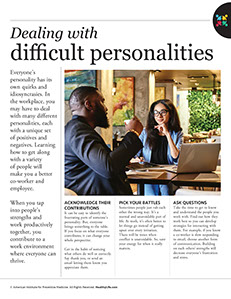
    Two coworkers sitting with laptop, talking and drinking coffee.

    Everyone’s personality has its own quirks and idiosyncrasies. In the workplace, you may have to deal with many different personalities, each with a unique set of positives and negatives. Learning how to get along with a variety of people will make you a better co-worker and employee.

    When you tap into people’s strengths and work productively together, you contribute to a work environment where everyone can thrive.

    Acknowledge their contributions

    It can be easy to identify the frustrating parts of someone’s personality. But, everyone brings something to the table. If you focus on what everyone contributes, it can change your whole perspective.

    Get in the habit of noticing what others do well or correctly. Say thank you, or send an email letting them know you appreciate them.

    Pick your battles

    Sometimes people just rub each other the wrong way. It’s a normal and unavoidable part of life. At work, it’s often better to let things go instead of getting upset over every irritation. There will be times when conflict is unavoidable. So, save your energy for when it really matters.

    Ask questions

    Take the time to get to know and understand the people you work with. Find out how they work best so you can develop strategies for interacting with them. For example, if you know a co-worker is slow responding to email, choose another form of communication. Building on each others’ strengths will decrease everyone’s frustration and stress.
    © American Institute for Preventive Medicine

  • Difficult People In The Workplace

    WORK LIFE

    Image of a business man looking off the distance.

    A manager rushes into his employee’s office at 4:30 p.m., drops a pile of papers on her desk, and barks, “I need these read, edited, and finalized by 8:30 a.m.”

    A woman calls in sick. She is shivering, coughing, and has a fever.  Her supervisor screams, “I don’t care what illness you have. If you’re not in the office today, I’ll take it as your resignation!”

    These are real examples of workplace bullying that cause stress, depression, and anxiety. The National Mental Health Association estimates that each year more than one billion sick days can be due to mental health disorders caused by work stress. That’s $193 billion a year in lost earnings.

    Psychology Professor Katerina Bezrukova studies the psychological effect of workplace injustices and intergroup relations at Santa Clara University.

    She says there are 4 kinds of co-workers and supervisors to look out for:

    1.Narcissistic.These types have fragile self-esteem. They may become outraged when someone challenges them. Bezrukova says avoid criticizing them. Document your own work, too, so you have a record of everything you do.

    2.Aggressive.To them, everyone is a predator or prey. That’s why they like to intimidate others and even bully them. They also tend to act frantic when a project comes in or a deadline is fast approaching. Bezrukova advises victims to stay out of the way. If they can, show them how management-by-hysteria can be inefficient.

    3.Rigid.These types won’t try anything new. They manage with viewpoint of “It’s my way or the highway.” This stems from fears of being pushed around. Bezrukova says let them feel like they are a part of the decision.

    4.Impaired.These people have ADD, anxiety, depression, burnout, or substance abuse issues. They need professional help. Employee Assistance Programs or other kinds of intervention are best.

    “People, who suffer from a workplace injustice of some sort, develop anger, frustration, anxiety, insomnia, headaches. These relationships, coupled with the connection between long-term, chronic psychological distress and increased risk of physical health problems such as cardiovascular disease, make this a crucial dollars and cents issue for business,” says Bezrukova.

    © American Institute for Preventive Medicine