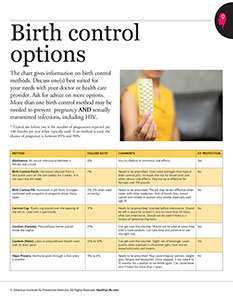
This page gives information on birth control methods. Discuss one(s) best suited for your needs with your doctor or health care provider. Ask for advice on more options. More than one birth control method may be needed to prevent pregnancy AND sexually transmitted infections, including HIV.
* Typical use failure rate is the number of pregnancies expected per 100 females per year when typically used. If no method is used, the chance of pregnancy is between 85% and 90%.
Abstinence
No sexual intercourse between a female and a male.
Has no medical or hormonal side effects.
Failure Rate*
0%
HIV / STI Protection
Yes
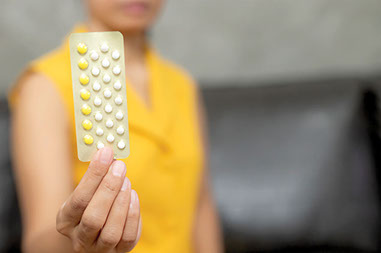
Birth Control Patch
Hormones released from a skin patch worn on the skin weekly for 3 weeks. It is not worn the 4th week.
Needs to be prescribed. Gives more estrogen than typical birth control pills. Increases the risk for blood clots and other serious side effects. May not be as effective for females over 198 pounds.
Failure Rate*
7%
HIV / STI Protection
No
Birth Control Pill
Hormones in pill form. Estrogen combined with progestin or progestin alone. Many types.
Needs to be prescribed. The pill may be less effective when taken with other medicines. Risk of blood clots, breast cancer and strokes in women who smoke, especially over age 35.
Failure Rate*
3% (1% when used correctly)
HIV / STI Protection
No
Cervical Cap
Plastic cap placed over the opening of the cervix. Used with a spermicide.
Needs to be prescribed. Inserted before intercourse. Should be left in place for at least 8, but no more than 48 hours after last intercourse. Should not be used if there is a history of abnormal Pap tests.
Failure Rate*
17%
HIV / STI Protection
No
Condom (Female)
Polyurethane barrier placed inside the vagina.
Can get over-the-counter. Should not be used at same time with a male condom. Can take time and patience to use the right way.
Failure Rate*
21%
HIV / STI Protection
Yes
Condom (Male)
Latex or polyurethane sheath worn over an erect penis.
Can get over-the-counter. Slight risk of breakage. Loses quality when exposed to ultraviolet light, heat, and oil-based lubricants and creams.
Failure Rate*
13% to 18%
HIV / STI Protection
Yes
Depo-Provera
Hormone given through a shot every 3 months.
Needs to be prescribed. May cause irregular periods, weight gain, fatigue and headaches. Once stopped, it can take 4 to 18 months for a woman to be fertile again. Can cause bone loss if taken for more than 2 years.
Failure Rate*
4% to 6%
HIV / STI Protection
No
Diaphragm
Reusable, thin, soft, cap (plastic or silicon) that covers the cervix. Used with a spermicide.
Needs to be prescribed. Should be checked for leaks. Size may need to be changed with weight changes. May dislodge during intercourse. Should be left in place at least 6, but no more than 24 hours, after last intercourse.
Failure Rate*
6% to 16%
HIV / STI Protection
No
Emergency Contraception Pills
High-dose birth control pills that need to be taken up to 5 days after unprotected intercourse. Called “morning after pill.”
Progestin-only pills are available over-the-counter without age restrictions. Other types, such as ella®, are available by prescription only for all ages. Most require a single dose but some are taken as 2 doses, 12 hours apart. Can cause nausea, vomitting, breast tenderness and changes in menstrual periods.
Failure Rate*
11% to 25% (the sooner used, the more effective)
HIV / STI Protection
No
Emergency IUD Insertion
Needs to be done within 5 days of unprotected intercourse.
Needs to be done by a health care professional. Used as an emergency contraception method.
Failure Rate*
Less than 1%
HIV / STI Protection
No
FemCap®
Silicone rubber device. Fits snugly over the cervix.
Needs to be prescribed. Should be left in place for at least 6, but no more than 48 hours, after last intercourse.
Failure Rate*
17% to 23%; less effective if gave birth
HIV / STI Protection
No
Nexplannon®
Thin plastic implant about the size of a match stick. Releases a low dose of the hormone progestin for up to 3 years.
Needs to be inserted and removed by a health care professional. Can cause irregular menstrual bleeding, mostly fewer and lighter periods, or no periods.
Failure Rate*
Less than 1%
HIV / STI Protection
No
Intrauterine Device (IUD)
ParaGard. Small copper device inserted into uterus. {Note: An IUD does not prevent an ectopic pregnancy. With this, an embryo starts to grow outside the uterus.}
Needs to be inserted and removed by health care professional. Can be left in place for up to 10 years. May become dislodged. Risk of infection and piercing of the uterus. Need to check that the 2 strings hang from the bottom so the IUD is in the correct position.
Failure Rate*
Less than 1%
HIV / STI Protection
No
Intrauterine System (IUS)
Mirena®. T-shaped device placed in uterus. Releases low dose of hormones every day for 5 years.
Needs to be inserted and removed by a health care professional. May lessen menstrual cramps. Needs to be replaced every 5 years.
Failure Rate*
Less than 1%
HIV / STI Protection
No
Lea’s Shield®
Silicone cup with an air valve and a loop (aids in removal) that fits snugly over the cervix. Used with a spermicide.
Needs to be prescribed. Should be left in place at least 8, but no more than 48 hours, after last intercourse.
Failure Rate*
15%
HIV / STI Protection
No
Natural Family Planning
Ovulation signs need to be checked for and tracked.
Sexual intercourse must be limited to “safe” days. Takes training, time and record keeping to work right. Method for planning a pregnancy, too.
Failure Rate*
2% to 23%
HIV / STI Protection
No
NuvaRing®
A soft, flexible ring that a female inserts deep into the vagina. Contains hormones.
Needs to be prescribed. A new Ring is inserted once and kept in place for 3 weeks. It is removed the week of menstrual period. May cause increased risk for vaginal problems.
Failure Rate*
7% to 9%
HIV / STI Protection
No
Spermicides (Foams, Jellies, Creams)
Chemicals inserted into the vagina kill sperm before it enters the uterus.
Can get over-the-counter. More reliable when used with condoms, diaphragms, etc. Inserted between 5 and 90 minutes before intercourse. Need to reapply for repeated acts of intercourse.
Failure Rate*
21% to 28%
HIV / STI Protection
No
Today’s Sponge®
Polyurethane barrier that contains spermicide.
Can get over-the-counter. Must be left in place for 6 hours after last intercourse, but should not be worn for more than 24 hours after sex.
Failure Rate*
12% to 24%
HIV / STI Protection
Some
Sterilization (Female)
Tubal ligation (having the tubes tied). This surgery burns, cuts, blocks or ties off the fallopian tubes. Another type, tubal implants (Essure®), is not surgery. A device is inserted through the vagina and uterus into each fallopian tube. This causes scar tissue to grow and plug the tubes.
Permanent form of birth control. Should be used only when no more children are desired. Surgery usually needs general anesthesia. Essure® is no longer sold in the U.S. but women who are using it to prevent pregnancy can continue to use it. Women who suspect they may be having symptoms related to the device, such as pain, should talk to their doctor about what steps may be appropriate for them to take.
Failure Rate*
Less than 1%
HIV / STI Protection
No
Sterilization (Male)
Vasectomy. The tubes through which sperm travels from the testes are cut.
Permanent form of birth control. Done in an outpatient setting with local anesthesia. Not effective right away. Sperm can still be present for 20 ejaculations.
Failure Rate*
Less than 1%
HIV / STI Protection
No
Withdrawal
The penis is removed before ejaculation.
Have to control ejaculation. Sperm can leak before this occurs.
Failure Rate*
Up to 27%
HIV / STI Protection
No