Tag: plan

  • Save Now For Holiday Gift-Giving

    FINANCIAL HEALTH

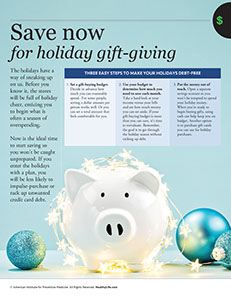
    Piggy bank with holiday lights and ornments.

    The holidays have a way of sneaking up on us. Before you know it, the stores will be full of holiday cheer, enticing you to begin what is often a season of overspending.

    Now is the ideal time to start saving so you won’t be caught unprepared. If you enter the holidays with a plan, you will be less likely to impulse-purchase or rack up unwanted credit card debt.

    Three easy steps to make your holidays debt-free

    1.Set a gift-buying budget.Decide in advance how much you can reasonably spend.  For some people, setting a dollar amount per person works well. Or you can set a total amount that feels comfortable for you.

    2.Use your budget to determine how much you need to save each month.Take a hard look at your income versus your bills and see how much money you can set aside. If your gift-buying budget is more than you can save, it’s time to reevaluate. Remember, the goal is to get through the holiday season without racking up debt.

    3.Put the money out of reach.Open a separate savings account so you won’t be tempted to spend your holiday money. When you’re ready to begin buying gifts, using cash can help keep you on budget. Another option is to purchase gift cards you can use for holiday purchases.

    © American Institute for Preventive Medicine

  • Being Ready For A Disaster

    Home Safety

    By acting on the items below, you and your family can be prepared for many types of disasters that may occur in the future.

    General Tips to Stay Safe

    *  Be alert and aware of what’s around you (e.g., a strange car parked in the same spot for a long time or an odd package). Report these and threats of violence to local police. Since the attack inside Columbine High School in 1999, plans for violence in other schools have been prevented because people have found and told police about notes with plans, materials to make bombs, etc. Stay calm and patient.

    *  Listen for sirens that alert you about a possible disaster.

    *  Tune into the TV or radio for news as well as what to do. The Emergency Alert System (EAS) decides what actions should be taken. For more information, contactwww.fcc.gov/eb/eas.

    *  Check for injuries and give first aid, if needed.

    Plans to Make Before a Disaster

    *  Write down, ahead of time, the steps to take for different disasters (e.g., house, fires, floods, etc.). Go through drills for each plan with the whole family. Make sure the car always has gas. This is in case you have to leave an area.

    *  Know your place of work’s emergency plans. Find out about them from your supervisor, Employee Assistance Program (EAP), etc.

    *  Take a course in first aid from the Red Cross, your police or fire department.

    *  Give each family member a prepaid phone card with about a ten dollar value. Instruct children how to use the card and a pay phone. Some cell phone services may be overwhelmed in an emergency.

    *  Set up a “check-in” plan. Choose someone for family members to call or e-mail to check on each other. Pick someone far enough away who would not likely be part of the same event. Of course, call each other on cell, regular, or pay phones.

    *  Choose two places to meet. One is at home or near your home. Choose another place farther away in case you can’t get home. Make plans for the safety of your children.

    *  If you have children in school, find out the school’s crisis plan. Know the school’s policy for sending children home. Make sure the school has current phone numbers for you and other caregivers in case you can’t be reached. Find out what the school needs to have to release your child to designated caregivers.

    *  If you have a pet, plan for its safety. For more information, contact the Red Cross orwww.disasterrelief.org/library/prepare/pets.html.

    *  When you enter a building, find emergency exits and stairways. Plan ahead how to get out quickly from buildings, vehicles, crowded public places, etc.

    *  Make an emergency supply kit. Put these things in backpacks or containers that one or more family members can easily carry:

    – Three days’ supply of bottled water (one gallon a day per person if possible. Put these next to, not in your containers.)

    – Food that won’t spoil. A hand can opener.

    – Flashlight and extra batteries

    – A battery powered radio or TV and extra batteries

    – First aid kits for the home and the car

    – Sleeping bags or blankets

    – A change of clothing for each person

    – Items for family members with special needs (e.g., baby supplies, medicines, etc.)

    – Duct tape and dry towels that you can make wet to make a room airtight

    – Bleach

    – Important documents, cash, and credit cards

    For more information on being ready for disasters, contactwww.redcross.orgor call your local Red Cross. Ask about their “Preparing for the Unexpected” class. This one and a half-hour class teaches families and employees safety steps to take for many kinds of disasters.

    Types of Disasters

    Weather Disasters

    *  Find out and be prepared for disasters that are likely to occur in your area (e.g., floods, earthquakes, tornados, etc.).

    *  Tune in, daily, to weather forecasts. The Emergency Broadcast System (EBS) uses radio and TV stations to issue a WATCH (for an expected emergency) or a WARNING (for an emergency in progress or one that is about to occur).

    *  Heed the warnings given. Emergency sirens may also sound. Know when your community does a practice drill for sirens (e.g., the first Saturday of the month at 1:00 p.m). Then you won’t confuse this with an actual emergency.

    *  Watch for fallen power lines. Avoid them.

    For more information on weather updates, contact The National Weather Service atwww.nws.noaa.gov.

    Biological Terrorism

    Biological terrorism includes anthrax, smallpox, and other biological agents. If a biological attack occurs, the public will be informed and told what to do. Stay calm and listen for instructions on the radio or television.

    For up-to-date information on biological agents, contact the Centers for Disease Control and Prevention. Call 888.246.2675 (English), 888.246.2857 (Spanish) or visitwww.bt.cdc.gov.

    Bomb Threats

    *  Don’t touch strange packages.

    *  Be suspicious if packages have a ticking sound or have wires or aluminum foil sticking out from them.

    *  Leave the building as fast as you can.

    *  Call local police and the building manager.

    *  When leaving a building, try not to walk by windows.

    For more information, contactwww.disasterrelief.org.

    Anthrax

    Anthrax has already led to illness and death for a limited number of Americans. How concerned should you be about this now? Again, knowledge is power. Don’t panic!

    Know these simple facts:

    *  Anthrax is caused by a specific bacteria. If caught early enough, it can be treated with antibiotics. It does not spread from person to person.

    *  Know what anthrax looks like. It can be brownish and grainy. This is a crude form. It can also be a very fine, white powder.

    *  Know the symptoms of anthrax infections. Symptoms depend on the way anthrax causes the infection. The most common way to get infected is anthrax exposure through a cut or abrasion in the skin. When treated early, this is curable. Inhaled anthrax is more harmful, but is also treatable if found very early.

    Signs and Symptoms of Inhaled Anthrax

    *  Fever

    *  Cough (dry, not with phlegm)

    *  Muscle aches

    *  A hard time breathing

    *  Chest discomfort

    *  A runny nose is not a symptom.

    Signs and Symptoms of Skin Anthrax

    *  A raised, itchy bump that looks like a bug bite

    *  Within two days, this changes into a fluid-filled sac.

    *  A painless ulcer with a dark or black area in the center

    What Else Can You Do?

    *  Get a flu shot at the start of flu season. This lessens the chance of getting the flu. Then you won’t confuse flu symptoms with those of anthrax.

    *  Seek medical care for anthrax symptoms. This is most important for persons who could have been exposed to anthrax where they work or live.

    *  Take antibiotics only if they are prescribed. Don’t take them “just in case” to prevent getting anthrax. Taking antibiotics when they are not needed could lead to resistant bacteria. This means the medicine will no longer work against the germ.

    *  When you open mail keep it away from your face.

    *  Don’t blow or sniff the contents.

    *  WASH YOUR HANDS WELL AFTER YOU HANDLE MAIL!

    *  For more information on anthrax, contactwww.bt.cdc.gov.

    Smallpox

    Smallpox is caused by a specific virus. It was wiped out as a disease in 1977, but may exist in labs in some foreign countries. This makes it possible for use in germ warfare. Smallpox is very contagious.

    What Can You Do?

    *  Listen to the news on a regular basis. If a confirmed case of smallpox occurs, the public will be informed and told what to do.

    *  Know the symptoms of smallpox.

    *  For people exposed to smallpox, a vaccine (from an emergency supply) can be given to lessen the severity of or even prevent the illness. The vaccine needs to be given within 4 days after exposure, though.

    {Note: Besides anthrax and smallpox, there are other biological agents that terrorists could use. The government will provide information if this is an issue to be concerned about.}

    Signs and Symptoms of Smallpox

    These occur about 12 days after exposure.

    *  High fever

    *  Fatigue

    *  Headache

    *  Backache

    *  Skin rash, mostly on the face and then on the arms and legs a few days later

    *  The rash starts out flat and red and then becomes pus-filled.

    *  Crusts form early in the second week.

    *  Scabs form and

    Explosions and Fires

    *  Follow fire prevention measures. Install and maintain smoke alarms. Plan escape routes from both your home and your place of work. For a more complete list of fire prevention tips, contact: National Fire Protection Association atwww.nfpa.orgor contactwww.firesafetytips.com.

    *  Know the building’s emergency plan.

    *  Know where fire exits are.

    *  Keep fire extinguishers working. Know where they are and how to use them.

    *  Learn first aid.

    *  Keep a battery-operated radio, flashlights and extra batteries, a first-aid kit, and bright tape to mark off unsafe areas on each floor.

    *  Stay calm and exit the building quickly.

    *  If things are falling, get under a strong table or chair.

    For more information on fire safety, contactwww.disasterrelief.org.

    When Inside a Building Where a Fire Occurs

    *  Get out! Stay low (crawl) and exit the burning building as fast as you can.

    *  Feel the top, middle, and bottom of a closed door for heat. If the door is not warm, brace yourself against the door and open it slowly. If the door is warm, find another way out.

    *  Always stay below the smoke.

    *  After you are out, call 911!

    When Trapped in a Collapsed Building

    *  Use a flashlight, if you have one.

    *  Don’t move more than necessary so you won’t kick up dust. Cover your mouth with clothing.

    *  To help someone find you, tap a pipe or wall or whistle. Don’t yell. Doing so can cause you to breathe in dangerous amounts of dust. Shout only as a last resort.

    *  Wait for emergency workers. (Untrained people should not try to go inside a collapsed building for any reason.)

    Harmful Chemical Exposures

    Once in awhile, you hear about chemical leaks from industrial sites. The threat of chemical warfare is also on the minds of Americans. Of utmost concern is to keep your home safe.

    What Can You Do?

    *  Install a carbon monoxide detector in your home and garage. Follow the manufacturer’s instructions.

    *  If the alarm sounds, open windows and doors. Leave the building right away. Call 911 if persons are dizzy, weak, short of breath, confused, etc. If not, turn off all appliances that use fuel and have a qualified person inspect your home.

    *  Don’t run cars and lawn mowers in the garage. Don’t use gas ranges for heat.

    *  Have your home furnace, chimney, and flue checked by a qualified person every year. If you think there is a gas leak, call the local gas company and follow their advice.

    *  Use common sense. Buying biohazard suits and expensive gas masks are a waste of money.

    *  If you work at a company where a harmful chemical leak or exposure could occur, follow your workplace safety guidelines. Use Material Safety Data Sheets (MSDS’s), which tell you how to use chemicals safely. Know where this data is. Use the information given.

    *  In the event of a chemical leak or exposure, follow the advice of local officials. You may be told to “evacuate” or “shelter in place.”

    Evacuate

    *  If officials tell you to leave the area, do so right away.

    *  Take your disaster supply kit, if available.

    *  Wear pants, long-sleeved shirts, and sturdy shoes for protection.

    *  Lock your home.

    *  Travel routes approved by local officials. Shortcuts could be dangerous or closed.

    *  Take pets.

    *  Watch for fallen power lines and avoid them.

    Shelter in Place

    If local officials recommend to “shelter in place,” stay in your home or workplace.

    *  Close and lock windows and outside doors.

    *  Turn off heating and cooling units and fans.

    *  Close the fireplace flue.

    *  Get your disaster supply kit, if available.

    *  Turn on the radio and listen for what to do.

    *  If you can, go to an inside room with no windows above ground level.

    *  Seal vents and cracks around doors with duct tape and wet towels. Tape all the faucets and drains, too.

    Contact with chemicals can kill. For this reason, do not leave the shelter to help victims. Persons trained to deal with harmful chemicals should treat victims.


    Take Charge, Coping with a Crisis book by the American Institute for Preventive Medicine. www.HealthyLife.com. All rights reserved.

    © American Institute for Preventive Medicine

  • Build A Budget

    Financial Health

    Make a plan to live within your means.

    No matter what your income, having a budget helps you plan and manage your money. It also helps you get a grip on your spending. You can use a budget-making tool, such as a free one from the websitewww.mint.com. You can write one on your own with a pencil and paper.

    Track your expenses:

    First, list your fixed monthly must-haves − mortgage or rent, phone, cable, Internet access, car payment, or public transit costs. Include other regular set monthly expenses, such as loan payments, tuition and/or student loans, insurance premiums, church donations, and gym and other monthly membership fees. Next, identify your variable expenses. These include what you spend weekly, monthly, two or four times a year, and yearly for:

    *  Groceries

    *  Restaurant meals, snacks, coffee and other drinks

    *  Gas and upkeep for your car

    *  Electric, gas, and water bills

    *  Property taxes

    *  Credit card payments

    *  Entertainment – Movies, DVDs, concerts, golf, toys, and social events

    *  Clothes and shoes

    *  Haircuts, cosmetics, and toiletries

    *  Gifts for birthdays, holidays, weddings, etc.

    *  Household items and home improvements

    *  Vacation

    You can get amounts for many of these from monthly statements for your credit cards, debit cards, and checking and saving accounts. Otherwise, get and keep receipts for everything you pay for. You may be surprised by how much you spend on coffee drinks, food, liquor, and tips when eating out.

    Put some of your income into a savings account. Do this yourself from your take-home pay or have a pre-set amount automatically deposited into a savings account.

    Start by listing your total monthly income:

    Include your take-home pay, alimony, child support, unemployment, social security, and public aid. If you work on commission or freelance, your income can vary from month to month. Just estimate a monthly amount.

    Action Step

    If you are spending more than you earn, cut back on variable expenses. If you still have money left over after paying your bills and putting money into savings, carry over the extra for future expenses.

    Ways to Well-Being book by the American Institute for Preventive Medicine. www.HealthyLife.com. All rights reserved.

    © American Institute for Preventive Medicine

  • How To Save Your Life In A House Fire

    Home Safety

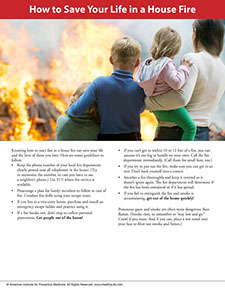
    Image of mother and children in front of a house fire.

    Knowing how to react fast in a house fire can save your life and the lives of those you love. Here are some guidelines to follow.

    *  Keep the phone number of your local fire department clearly posted near all telephones in the house. (Try to memorize the number, in case you have to use a neighbor’s phone.) Use 911! where the service is available.

    *  Prearrange a plan for family members to follow in case of fire. Conduct fire drills using your escape route.

    *  If you live in a two-story house, purchase and install an emergency escape ladder and practice using it.

    *  If a fire breaks out, don’t stop to collect personal possessions. Get people out of the house!

    *  If you can’t get to within 10 to 12 feet of a fire, you can assume it’s too big to handle on your own. Call the fire department immediately. (Call them for small fires, too.)

    *  If you try to put out the fire, make sure you can get to an exit. Don’t back yourself into a corner.

    *  Smother a fire thoroughly and keep it covered so it doesn’t ignite again. The fire department will determine if the fire has been contained or if it has spread.

    *  If you fail to extinguish the fire and smoke is accumulating, get out of the house quickly!

    Poisonous gases and smoke are often more dangerous than flames. (Smoke rises, so remember to “stay low and go.” Crawl if you must. And if you can, place a wet towel over your face to filter out smoke and fumes.)

    A Year of Health Hints book by the American Institute for Preventive Medicine. www.HealthyLife.com. All rights reserved.

    © American Institute for Preventive Medicine

  • Plan Problem-Solving 2

    Healthylife® QuitWell™

    Part 2

    Image of smiling women at desk.

    Your worries and concerns take up time in your day. Many issues cannot simply be ignored or brushed aside. To avoid letting these thoughts trigger smoking or chewing habits, plan time to address them.

    Steps to Address Your Worries

    1. Write a worry at the top of a piece of paper. It may seem old-fashioned to write this down on paper, when so much is done on the computer or a smartphone. However, writing things down can be powerful.

    2. Divide the paper into three columns:

    a. What I can’t do. Recognize what is out of your control.

    b. What I can do. List possible actions that are within your control. Write things you know how to do and that are realistic actions for you to take.

    c. What I will do and when. Decide which action you are ready to take first. This action may not solve every part of the problem, but it is a small step toward a solution. Write when you will do this.

    3. After you have taken an action towards a solution, repeat this process the next day or when you are ready to take another step.

    © American Institute for Preventive Medicine

  • Set Goals 2

    SleepWell® Program

    Week 2

    Image of wood blocks with letters spelling "smart."

    View sleep improvement as a long-term project, especially if you have had poor sleep for a long time. First, define small steps you want to take. Continue to reflect on your efforts.

    Small Steps

    Think of the actions you take on a daily basis as small steps towards your bigger goal. This guide has already given you many ideas for small steps. Examples are limiting caffeine and dimming the lights one hour before bedtime. Identify your next change and use the following guidelines to improve your goal. All goals should be:

    Chart on S.M.A.R.T.

    Stay motivated with the small successes you achieve along the way. Use your SleepWell® Tracker every day for feedback on the effect your actions have on your sleep.

    Reminder:If your sleep issues are chronic (last longer than three weeks), your primary goal should be to schedule an appointment with your doctor or a sleep specialist.

    Practice Goal-Setting

    Strengthen your goal using the S.M.A.R.T. tool. Start with a simple statement about what you want to accomplish. Next, write how your goal will be specific, measurable, attainable, relevant, and timely.

    Barriers to Change

    As you think more about your goal, roadblocks may appear. You may need tools or skills to achieve your goal. Identify what is making it difficult for you to change. Barriers do not mean you can’t make the change. Identify challenges that must be overcome to succeed.

    © American Institute for Preventive Medicine

  • An Annual Financial Review

    FINANCIAL HEALTH

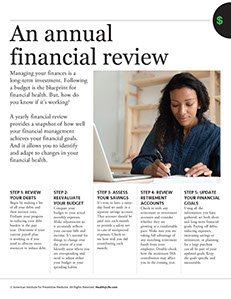
    Women writing on paper with laptop next to her.

    Managing your finances is a long-term investment. Following a budget is the blueprint for financial health. But, how do you know if it’s working?

    A yearly financial review provides a snapshot of how well your financial management achieves your financial goals. And it allows you to identify and adapt to changes in your financial health.

    Step 1: Review your debts

    Begin by making a list of all your debts and their interest rates. Evaluate your progress in reducing your debt burden in the past year. Determine if your current payoff plan is working or if you need to allocate more resources to reduce debt.

    Step 2: Reevaluate your budget

    Compare your budget to your actual monthly expenses. Make adjustments so it accurately reflects your current bills and income. It’s normal for things to change over the course of a year. Identify areas where you are overspending and need to adjust either your budget or your spending habits.

    Step 3: Assess your savings

    It’s wise to have a rainy-day fund set aside in a separate savings account. That account should be paid into each month to provide a safety net in case of unexpected expenses. Check to see how well you did contributing each month.

    Step 4: Review retirement accounts

    Check in with any retirement or investment accounts and consider whether they are growing at a comfortable pace. Make sure you are taking full advantage of any matching retirement funds from your employer. Double-check how the maximum IRA contribution may affect you in the coming year.

    Step 5: Update your financial goals

    Using all the information you have gathered, set both short and long-term financial goals. Paying off debts, reducing expenses, increasing savings or retirement, or planning for a large purchase can all be part of your updated goals. Keep the goals specific and measurable.

    © American Institute for Preventive Medicine

  • Being Ready For Medical Emergencies

    First Aid

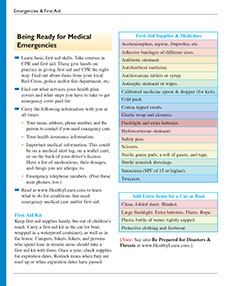
    *  Learn basic first-aid skills. Take courses in CPR and first aid. These give hands-on practice in giving first aid and CPR the right way. Find out about them from your local Red Cross, police and/or fire department, etc.

    *  Find out what services your health plan covers and what steps you have to take to get emergency costs paid for.

    *  Carry the following information with you at all times:

    – Your name, address, phone number, and the person to contact if you need emergency care.

    – Your health insurance information.

    – Important medical information. This could be on a medical alert tag, on a wallet card, or on the back of your driver’s license. Have a list of medications, their dosages, and things you are allergic to.

    – Emergency telephone numbers. (Post these near phones, too.)

    First-Aid Kit

    Keep first-aid supplies handy, but out of children’s reach. Carry a first-aid kit in the car (or boat, wrapped in a waterproof container), as well as in the house. Campers, bikers, hikers, and persons who spend time in remote areas should take a first-aid kit with them. Once a year, check supplies for expiration dates. Restock items when they are used up or when expiration dates have passed.

    First-Aid Supplies & Medicines

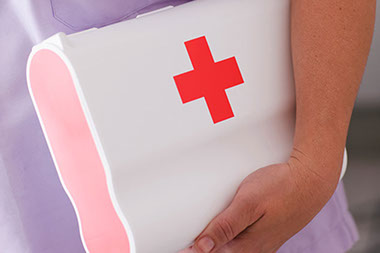
    Image of person holding first aid kit.

    *  Acetaminophen, aspirin, ibuprofen, etc.

    *  Adhesive bandages of different sizes.

    *  Antibiotic ointment.

    *  Antidiarrheal medicine.

    *  Antihistamine tablets or syrup.

    *  Antiseptic ointment or wipes.

    *  Calibrated medicine spoon & dropper (for kids).

    *  Cold pack.

    *  Cotton-tipped swabs.

    *  Elastic wrap and closures.

    *  Flashlight and extra batteries.

    *  Hydrocortisone ointment.

    *  Safety pins.

    *  Scissors.

    *  Sterile gauze pads, a roll of gauze, and tape.

    *  Sterile nonstick dressings.

    *  Sunscreen (SPF of 15 or higher).

    *  Tweezers.

    Add Extra Items for a Car or Boat

    *  Clean, folded sheet. Blanket.

    *  Large flashlight. Extra batteries. Flares. Rope.

    *  Plastic bottle of water, tightly capped.

    *  Protective clothing and footwear.

    Healthier at Home book by the American Institute for Preventive Medicine. www.HealthyLife.com. All rights reserved.

    © American Institute for Preventive Medicine

  • Face Unsupportive Situations

    Healthylife® Weigh

    Part 4

    Couple using laptop computer at home on sofa.

    Apply the suggestions in the table below to your challenges. Not all strategies will be right for all scenarios. You can turn a negative situation into a positive one for everyone.

    *  Let others know what your goals are and why you are working to achieve them.

    *  Model trying new foods and being open to new tastes.

    *  Reduce the amount of time spent with negative people, if possible.

    *  Describe your efforts as a lifestyle change rather than a diet.

    *  Share how you are doing things differently this time if you have struggled in the past.

    *  Let supportive people know how much their support means to you. Send a sincere thank you card, email, or share a kind word in person. They will likely help you again.

    *  Enjoy treats every now and then. Plan to have a small amount. Don’t let guilt rob you of enjoying the treat!

    © American Institute for Preventive Medicine