Tag: prenatal

  • Safe Travel For Pregnant Women

    Healthy Travel

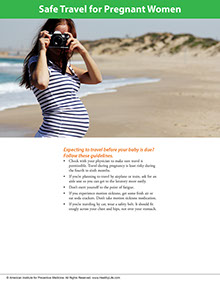
    Image of pregnant women on vacation.

    Expecting to travel before your baby is due? Follow these guidelines.

    *  Check with your physician to make sure travel is permissible. Travel during pregnancy is least risky during the fourth to sixth months.

    *  If you’re planning to travel by airplane or train, ask for an aisle seat so you can get to the lavatory more easily.

    *  Don’t exert yourself to the point of fatigue.

    *  If you experience motion sickness, get some fresh air or eat soda crackers. Don’t take motion sickness medication.

    *  If you’re traveling by car, wear a safety belt. It should fit snugly across your chest and hips, not over your stomach.

    Page image from A Year of Health Hints book by the American Institute for Preventive Medicine. www.HealthyLife.com. All rights reserved.

    © American Institute for Preventive Medicine

  • Smart Ways To Exercise During Pregnancy

    Pregnancy & Prenatal Care

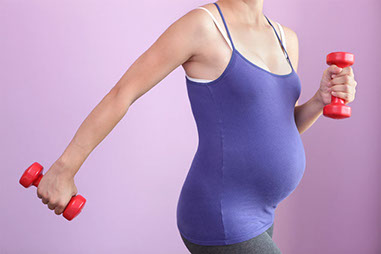
    Image of pregnant women exercising with dumb bells.

    Exercise can help ease muscular aches and pains and other discomforts women sometimes experience during their pregnancies. Yoga, walking, swimming, and other forms of low-impact or stretching exercises are best.

    Follow your health care provider’s advice for exercising during your pregnancy. General guidelines for exercising during pregnancy follow:

    *  You can usually do the same forms of exercise you did before your pregnancy, but don’t go to extremes.

    *  Check your pulse when you exercise. In general, your heart rate should stay below 140 beats a minute.

    *  Avoid any sport or activity with the risk of a hard fall, such as horseback riding and water skiing.

    *  Don’t do exercises that involve jumping, twisting, or bouncy motions.

    *  Don’t become overheated. Drink water before, during, and after you exercise. Make sure you get an extra 4 to 8 ounces of water for every 15 minutes of active exercise. Drink more fluids in warm weather or if you sweat a lot.

    *  After the 20th week of pregnancy, avoid exercises in which you lie flat on your back.

    A Year of Health Hints book by the American Institute for Preventive Medicine. www.HealthyLife.com. All rights reserved.

    © American Institute for Preventive Medicine

  • Safe Pregnancy After Age Thirty-Five

    Pregnancy & Prenatal Care

    Image of pregnant older women reading.

    Age is not the biggest factor in a healthy pregnancy. The biggest factor is the good health of the mother.

    Becoming pregnant after the age of 35, however, poses a number of potential problems. Chances for conception decrease with age. The incidence of miscarriage and premature birth is slightly higher in later-life pregnancies. So is the likelihood that the mother will develop diabetes or high blood pressure. The chances that a baby will be born with a genetic defect increases, too. So along with other health considerations, a pregnant woman in her mid-thirties or older should:

    *  Discuss with her doctor, in detail, her pregnancy plans, risk factors, and measures she needs to take for a healthy pregnancy.

    *  Talk to her doctor about prenatal genetic tests.

    About Amniocentesis

    Usually performed at about 16 weeks into the pregnancy, amniocentesis can detect Down’s syndrome, Tay-Sachs disease, sickle cell anemia, Rh incompatibility, and spina bifida. (Amniocentesis will also reveal the sex of the child, but it’s never done for that purpose alone.) The doctor uses a long needle to draw out a sample of amniotic fluid, which is tested for genetic abnormalities. The test itself presents some risk-there is about 1 chance in 100 to 1 chance in 200 that a miscarriage may occur.

    Amniocentesis is justified under the following conditions.

    *  The pregnant woman is 35 years old or older or requests genetic testing.

    *  Someone in the mother’s or father’s immediate family (a parent, sibling, or child) has a genetic or metabolic disorder.

    *  There is a family history of hemophilia (a bleeding disorder) or spina bifida (a neural tube defect).

    *  An earlier pregnancy produced a baby with chromosome abnormalities.

    Amniocentesis can’t detect abnormalities such as a club foot or cleft palate, so normal results don’t necessarily guarantee a normal baby. Another technique called chorionic villous sampling (CVS) analyzes a small sample of the placenta and can be performed earlier than amniocentesis, (between weeks 8 and 12 of the pregnancy). The earlier testing is done, the more time the prospective parents and their doctor have to decide on the best course of action.

    A Year of Health Hints book by the American Institute for Preventive Medicine. www.HealthyLife.com. All rights reserved.

    © American Institute for Preventive Medicine

  • Tips For A Healthier, Easier Pregnancy

    Pregnancy & Prenatal Care

    Close up image of 4 pregnant bellies.

    Healthy moms tend to have healthy babies. If you plan to become pregnant, take the following steps to help your baby get off to a good start.

    *  Have a complete medical exam, including a gynecological exam. A number of medical conditions, including obesity, high blood pressure, diabetes, smoking, alcohol use, nutritional deficiencies, and Rh negative blood factor (after the first pregnancy) can jeopardize the health of mother and child.

    *  Check with your doctor about the effects of any prescription or over-the-counter medication you take.

    *  If you have a chronic medical condition, ask your doctor how it may affect your pregnancy and whether or not you should change or adjust your medication.

    *  If you use an IUD or take birth control pills, use an alternative form of birth control for 1 to 2 months before trying to become pregnant.

    *  If you’re markedly overweight, plan to lose excess pounds before becoming pregnant.

    *  Exercise regularly.

    *  Consider genetic tests or counseling if you or your husband has a family history of genetic disorders, if you are 35 or older, or if your husband is 50 or older.

    You and your baby will do best if you follow these guidelines.

    *  Ask your doctor or a dietitian to outline a meal plan that meets the special nutritional needs created by pregnancy.

    *  Avoid caffeine, alcohol, nicotine, and illicit drugs, as they can harm you and your unborn baby.

    *  Consult your doctor before taking any medication.

    *  Ask your doctor what prenatal vitamin/mineral supplement you should take.

    *  Follow your health care provider’s advice about weight gain. The amount of weight you gain should depend on your pre-pregnancy weight and health status, as well as your ethnic background. If you are very overweight, plan to lose excess pounds before you get pregnant.

    *  Continue to exercise in moderation.

    *  Practice relaxation and other stress management techniques. (Doctors think emotional stress may constrict the blood supply to the uterus and placenta, the baby’s only source of oxygen and nutrients.)

    *  Enroll in childbirth preparation classes.

    *  If you own a cat, arrange for someone else to empty the litter box. Cat excrement can transmit a disease called toxoplasmosis. If you’re infected while pregnant, your baby may be stillborn, born prematurely, or suffer serious damage to the brain, eyes, or other parts of the body.

    A Year of Health Hints book by the American Institute for Preventive Medicine. www.HealthyLife.com. All rights reserved.

    © American Institute for Preventive Medicine

  • Want To Have A Baby? Try This

    Pregnancy & Prenatal Care

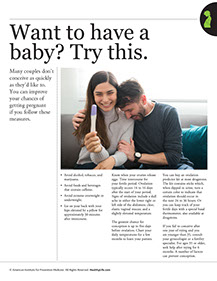
    Image of happy couple looking at positive pregnancy test, while male is making a phone call.

    Many couples don’t conceive as quickly as they’d like to. You can improve your chances of getting pregnant if you follow these measures.

    *  Avoid alcohol, tobacco, and marijuana.

    *  Avoid foods and beverages that contain caffeine.

    *  Avoid extreme overweight or underweight.

    *  Lie on your back with your hips elevated by a pillow for approximately 30 minutes after intercourse.

    *  Know when your ovaries release eggs. Time intercourse for your fertile period. Ovulation normally occurs 14 to 16 days after the start of your period. Signs of ovulation include a dull ache in either the lower right or left side of the abdomen; clear, elastic vaginal mucus; and a slightly elevated temperature.

    You can buy an ovulation predictor kit at most drugstores. The kit contains sticks which, when dipped in urine, turn blue if you’re ovulating.

    Or you can keep track of your fertile days with a special basal thermometer, also available at drugstores. Having intercourse when your temperature drops approximately 0.4ºF increases your chances of conception.

    If you fail to conceive after one year of trying, consult your gynecologist or a fertility specialist. A number of factors can prevent conception.

    A Year of Health Hints book by the American Institute for Preventive Medicine. www.HealthyLife.com. All rights reserved.

    © American Institute for Preventive Medicine

  • Thinking About Getting Pregnant?

    WELL-BEING

    Image of couple looking at the results of a pregnancy test.

    A healthy pregnancy starts with these steps, according to the CDC:

    *  Take a vitamin with 400 micrograms (mcg) folic acid every day. Read the label.

    *  Avoid alcohol, tobacco, and street drugs.

    *  Keep hands clean by washing them often with soap and water to prevent infections.

    *  See a health care professional regularly. Talk about any medical problems (such as obesity, diabetes, seizures) and medicine use (both prescription and over-the-counter).

    *  Ask about avoiding any substances at work or at home that might be harmful to a developing baby.

    *  Eat a healthy, balanced diet.

    *  Avoid unpasteurized (raw) milk and foods made from it.

    *  Avoid eating raw or undercooked meat.

    *  While pregnant, get early prenatal care and go to every appointment.

    © American Institute for Preventive Medicine