
Tag: priorities

  • Getting Fit In Less Time

    BE FIT

    Women on treadmill looking at watch.

    Have you heard of interval training for exercise? You may have assumed this type of exercise is only for athletes. However, people of almost all fitness levels can use it.

    Interval training means you add short bursts of more intense activities into your regular exercise routine. How fast and how long you do your intervals is completely up to you. This can be as simple as 10 seconds of running and then 4 minutes of walking. If that’s not possible, alternate brisk walking with slower walking.

    Intervals don’t have to be more than a few seconds. One of the biggest advantages is that you don’t need any special equipment to get started!

    Why should I do it?

    The American College of Sports Medicine (ACSM) says interval training has several benefits, including:

    *  Burn more calories: Even if you can only do short intervals, you’re still burning more calories than if you hadn’t done the intervals at all.

    *  Most of your time: Many people can’t find time for longer workouts. Instead, use the time you have to work harder with intervals.

    *  Boost mood: Exercise releases endorphins. These are feel-good chemicals in the brain. More vigorous exercise may release more endorphins than only doing light exercise.

    *  Fight boredom: Doing the same exercises all the time can lead to boredom. But, mixing it up with intervals can help keep you interested.

    *  More aerobic fitness: Higher intensity will improve your cardio fitness. With time and practice, you’ll be able to exercise harder and longer.

    For beginners

    *  Choose a distance if you don’t want to count or use a stopwatch. For instance, jog or walk briskly to the next tree or driveway.

    *  If using equipment like an elliptical machine or bike, alternate faster bouts of that exercise with your usual pace.

    Interval training can be done at your fitness level. But, don’t be too aggressive at first because you could get an injury. While you want to get your heart pumping, you don’t want to make it so hard that you can’t stick with it.

    Studies suggest that interval training can be safe and helpful to most people. Ask your doctor before starting a new exercise plan to be sure it’s right for you.

    Source: American College of Sports Medicine

    © American Institute for Preventive Medicine
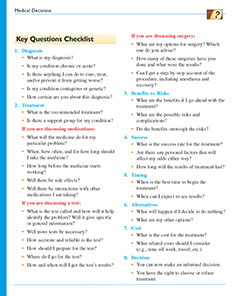
  • Key Questions Checklist

    Medical Care

    Diagnosis

    *  What is my diagnosis?

    *  Is my condition chronic or acute?

    *  Is there anything I can do to cure, treat, and/or prevent it from getting worse?

    *  Is my condition contagious or genetic?

    *  How certain are you about this diagnosis?

    Treatment

    *  What is the recommended treatment?

    *  Is there a support group for my condition?

    If you are discussing medications:

    *  What will the medicine do for my particular problem?

    *  When, how often, and for how long should I take the medicine?

    *  How long before the medicine starts working?

    *  Will there be side effects?

    *  Will there be interactions with other medications I am taking?

    If you are discussing a test:

    *  What is the test called and how will it help identify the problem? Will it give specific or general information?

    *  Will more tests be necessary?

    *  How accurate and reliable is the test?

    *  How should I prepare for the test?

    *  Where do I go for the test?

    *  How and when will I get the test’s results?

    If you are discussing surgery:

    *  What are my options for surgery? Which one do you advise?

    *  How many of these surgeries have you done and what were the results?

    *  Can I get a step-by-step account of the procedure, including anesthesia and recovery?

    Benefits vs. Risks

    *  What are the benefits if I go ahead with the treatment?

    *  What are the possible risks and complications?

    *  Do the benefits outweigh the risks?

    Success

    *  What is the success rate for the treatment?

    *  Are there any personal factors that will affect my odds either way?

    *  How long will the results of treatment last?

    Timing

    *  When is the best time to begin the treatment?

    *  When can I expect to see results?

    Alternatives

    *  What will happen if I decide to do nothing?

    *  What are my other options?

    Cost

    *  What is the cost for the treatment?

    *  What related costs should I consider (e.g., time off work, travel, etc.).

    Decision

    *  You can now make an informed decision.

    *  You have the right to choose or refuse treatment.

    Page from the Healthier at Home book by the American Institute for Preventive Medicine. www.HealthyLife.com. All rights reserved.

    © American Institute for Preventive Medicine

  • Beat Procrastination At Work

    WORK LIFE

    Illustration of man with head down on messy desk.

    Do you put off doing tasks and find yourself scrambling at the last minute? You could be procrastinating. Try the tips below to break the habit.

    Break large tasks down into smaller pieces.

    Rather than trying to do the entire project, start with one piece. This can make a large project less overwhelming and more realistic.

    Get motivated.

    Think about how pleased you’ll be when it’s done. Focus on the positive aspects of your job, and why you do what you do. This may help you get the energy to tackle difficult tasks.

    Try rewards.

    Commit to getting the project done a few days early. When you do, treat yourself after work. Examples of positive rewards may be your favorite meal or a fun activity you enjoy.

    Source: American Psychological Association

    © American Institute for Preventive Medicine