Tag: prioritize

  • Keeping Cool When Work Heats Up

    WORK LIFE

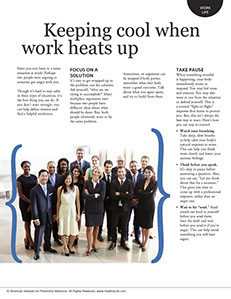
    Image of a great of employees.

    Have you ever been in a tense situation at work? Perhaps two people were arguing or someone got angry with you.

    Though it’s hard to stay calm in these types of situations, it’s the best thing you can do. If you don’t react strongly, you can help defuse tension and find a helpful resolution.

    Focus on a solution

    It’s easy to get wrapped up in the problem, not the solution. Ask yourself, “what are we trying to accomplish?” Many workplace arguments start because two people have different ideas about what should be done. But, both people ultimately want to fix the same problem.

    Sometimes, an argument can be stopped if both parties remember what they both want: a good outcome. Talk about what you agree upon, and try to build from there.

    Take pause

    When something stressful is happening, your body immediately wants to respond. You may feel tense and anxious. You may also want to run from the situation or defend yourself. This is a normal “fight-or-flight” response that wants to protect you. But, this isn’t always the best way to react. Here’s how you can stay in control:

    *  Watch your breathing. Take deep, slow breaths to help calm your body’s natural response to stress. This can help you think more clearly and lower your anxious feelings.

    *  Think before you speak. It’s okay to pause before answering a question. Also, you can say, “Let me think about that for a moment.” This gives you time to come up with a professional response, rather than an angry one.

    *  Wait to hit “send.” Read emails out loud to yourself before you send them. Save the draft and wait before you send it if you’re angry. This can help avoid something you will later regret.
    © American Institute for Preventive Medicine
  • Manage Your Time

    Healthylife® Weigh

    Part 5

    Couple on a walk.

    Incorporate more movement into your daily activities. Take the stairs, park farther away from the building, and get up to stretch every hour. Also, plan at least 30 minutes each day, most days of the week, to engage in moderate-to-intense exercise. Add exercise to your daily schedule.

    Decrease Time Wasters

    If you feel time is a barrier for you, look at how you spend your time now. Keep a time log for a full day. Block off chunks of time when you sleep and are at work or school. Write down how much time you spend getting ready to go places, preparing food, relaxing, doing household chores, watching TV, or browsing social media.

    *  Decrease time spent watching TV or browsing social media. Set limits for yourself. Record shows so you can skip through commercials.

    *  Prepare meals ahead of time. Make more than one meal at once.

    *  Get help from others, especially with household chores and meal preparation.

    It may not be practical to make changes in all areas or plan physical activity every day. Start by taking small steps, such as being active on a weekend day or getting up a little earlier one morning to walk around the neighborhood.

    © American Institute for Preventive Medicine

  • Overwhelmed At Work? How To Handle It

    WORK LIFE

    Image of stressed women at work.

    No matter what your job, you’re bound to feel overwhelmed sometimes. Whether you have new responsibilities, are worried about a certain project, or just have too much on your plate, it’s normal to feel the pressure occasionally. Though you may not be able to change what’s causing these feelings, you can find ways to deal with these situations in a healthy way.

    Jot it down.

    If your mind is swimming with a list of to-dos, put it on paper. Sometimes seeing the list can help you come up with a plan to get it done. You can figure out what needs to be done first, and then you have a starting point.

    Take a break from work when you’re off-duty.

    If your life revolves around the buzzing of your phone with emails and work demands, try to take some time each day to turn it off. You may find you feel more relaxed and ready to focus when you return to work.

    Start with just one step.

    If a huge project feels too difficult to start, then just think about the first thing you need to do. It can be something minor, such as sending an email or writing down a task list. Every big project begins with one step. Consider what needs to be done right now, and do that first. Once you get started, it may be easier to keep going.

    Talk to your supervisor.

    If possible, bring up your main concerns to your boss. Be specific about your problem, and focus on what you can do to help solve it. For instance, if you have too many tasks, tell them what you are able to do in the time you have, and suggest alternate ways to get the rest done. Perhaps you can ask for more time to get a project done. Or, see if you can delegate the task to a co-worker.

    An organized desk gives you control

    If you’re feeling buried at work, look in front of you. A messy desk can create more stress and anxiety. Clean up your space by:

    *  Going through papers as you get them, rather than letting them pile up

    *  Creating a “pending” or “in progress” folder for things you need to do

    *  Clean up your space before you leave each day

    *  Put things back as soon as you’re done using them

    A tidy desk can brighten your outlook and boost your productivity.

    Source: American Psychological Association

    © American Institute for Preventive Medicine
  • Tips To Survive The Workweek

    WORK LIFE

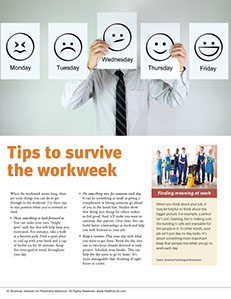
    Image of the days of the week on paper with emotion faces.

    When the workweek seems long, there are some things you can do to get through to the weekend. Try these tips to stay positive when you’re stressed or tired:

    *  Have something to look forward to. You can make your own “bright spot” each day that will help keep you motivated. For instance, take a walk at a favorite park. Find a quiet place to curl up with your book and a cup of herbal tea for 30 minutes. Keep this mini-goal in mind throughout your day.

    *  Do something nice for someone each day. It can be something as small as giving a compliment or letting someone go ahead of you in the lunch line. Studies show that doing nice things for others makes us feel good. And, it’ll make you want to continue that pattern. Over time, this can build better relationships at work and help you look forward to your job.

    *  Keep a routine. Plan your day with what you want to get done. Break the day into one or two-hour chunks devoted to each project. Schedule your breaks. This can help the day seem to go by faster. It’s more manageable than thinking of eight hours at a time.

    Finding meaning at work

    When you think about your job, it may be helpful to think about the bigger picture. For example, a janitor isn’t just cleaning; but is making sure the building is safe and enjoyable for the people in it. In other words, your job isn’t just day-to-day tasks. It’s about something more important. Keep that perspective when you go to work each day.

    Source: American Psychological Association

    © American Institute for Preventive Medicine

  • 6 Ways To Boost Productivity

    WORK LIFE

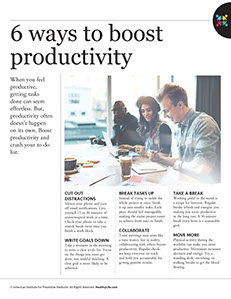
    Three co-workers sitting at table working.

    When you feel productive, getting tasks done can seem effortless. But, productivity often doesn’t happen on its own. Boost productivity and crush your to-do list.

    Cut out distractions

    Silence your phone and turn off email notifications. Give yourself 15 to 30 minutes of uninterrupted work at a time. Check your phone or take a stretch break every time you finish a work block.

    Write goals down

    Take a moment in the morning to write a clear to-do list. Focus on the things you must get done, not wishful thinking. A clear goal is more likely to be achieved.

    Break tasks up

    Instead of trying to tackle the whole project at once, break it up into smaller tasks. Each piece should feel manageable, making the entire project easier to achieve from start to finish.

    Collaborate

    Team meetings may seem like a time-waster, but in reality, collaborating with others boosts productivity. Regular check-ins keep everyone on track and hold you accountable for getting positive results.

    Take a break

    Working pedal to the metal is a recipe for burnout. Regular breaks refresh and energize you making you more productive in the long run. A 10-minute break every hour is a reasonable goal.

    Move more

    Physical activity during the workday can make you more productive. Movement increases alertness and energy. Try a standing desk, stretching, or walking breaks to get the blood flowing.

    © American Institute for Preventive Medicine