Tag: privacy

  • A Dozen Rights Every Patient Should Expect

    Medical Care

    Image of doctor talking to patient.

    What rights and privileges can you expect from a hospital when you become a patient? According to the American Hospital Association (AHA), there are specific standards of care that all patients are entitled to. The AHA has developed a voluntary code-the Patient’s Bill of Rights-that presents guidelines for both staff and patients.

    1.  You have the right to considerate and respectful care.

    2.  You have the right to obtain from your physician complete, current information concerning your diagnosis, treatment, and prognosis in terms you can reasonably be expected to understand.

    3.  You have the right to receive from your physician information necessary to give informed consent prior to the start of any procedure and/or treatment.

    4.  You have the right to refuse treatment to the extent permitted by law, and to be informed of the medical consequences of your action.

    5.  You have the right to privacy concerning your own medical care program.

    6.  You have the right to expect that all communications and records pertaining to your care should be treated as confidential.

    7.  You have the right to expect that, within its capacity, a hospital must make a reasonable response to your request for services.

    8.  You have the right to obtain information about any relationship of your hospital to other health care and educational institutions insofar as your care is concerned.

    9.  You have the right to be advised if the hospital proposes to engage in or perform human experimentation affecting your care or treatment.

    10. You have the right to expect reasonable continuity of care.

    11. You have the right to examine and receive an explanation of your bill regardless of the source of payment.

    12. You have the right to know what hospital rules and regulations apply to your conduct as a patient.

    Page from A Year of Health Hints book by the American Institute for Preventive Medicine. www.HealthyLife.com. All rights reserved.

    © American Institute for Preventive Medicine

  • Patient Rights

    Medical Care

    Image of male patient.

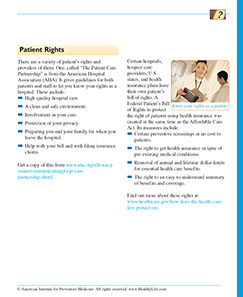
    There are a variety of patient’s rights and providers of them. One, called “The Patient Care Partnership” is from the American Hospital Association (AHA). It gives guidelines for both patients and staff to let you know your rights in a hospital. These include:

    *  High-quality hospital care.

    *  A clean and safe environment.

    *  Involvement in your care.

    *  Protection of your privacy.

    *  Preparing you and your family for when you leave the hospital.

    *  Help with your bill and with filing insurance claims.

    Get a copy of this fromwww.aha.org/advocacy-issues/communicatingpts/pt-care-partnership.shtml.

    Certain hospitals, hospice care providers, U.S. states, and health insurance plans have their own patient’s bill of rights. A Federal Patient’s Bill of Rights to protect the right of patients using health insurance was created at the same time as the Affordable Care Act. Its measures include:

    *  Certain preventive screenings at no cost to patients.

    *  The right to get health insurance in spite of pre-existing medical conditions.

    *  Removal of annual and lifetime dollar limits for essential health care benefits.

    *  The right to an easy-to-understand summary of benefits and coverage.

    Find out more about these rights atwww.healthcare.gov/how-does-the-health-care-law-protect-me.

    Page from the Healthier at Home book by the American Institute for Preventive Medicine. www.HealthyLife.com. All rights reserved.

    © American Institute for Preventive Medicine

  • Protect Your Personal Information

    FINANCIAL HEALTH

    Image of laptop with shield and lock key.

    Identity theft is a serious crime. It happens when someone steals your personal information such as your social security number or credit card numbers and uses it without your permission. You may see mistakes or mystery charges on your bank, credit card, or other account statements. You may receive bills for products or services you never received. Protect your personal information, urges the Federal Trade Commission. Get detailed information online atwww.ftc.gov/idtheft.

    *Keep your important papers secure.Limit what you carry in your wallet or purse. Pick up new checks at the bank instead of having them mailed to your home. Take outgoing mail to a collection box or the post office. Don’t leave it in your mailbox. Shred sensitive documents, receipts, credit card offers, insurance forms, checks, bank statements, and similar documents.

    *Secure your social security number.Only give it out when necessary (and ask if you can use a different kind of identification).

    *Protect your computer and mobile devices.Use anti-virus software. Don’t open files or click on links sent by strangers. Remove the memory cards from mobile devices before recycling them.

    *Protect your data online.Keep your passwords private. Don’t over share on social networking sites. If you post too much information about yourself, an identity thief can use that information to answer challenging questions on your accounts (birthdays, mother’s name, pet names, high school).

    © American Institute for Preventive Medicine

  • Protect Yourself From Medical Identity Fraud

    MEDICAL NEWS

    Image of money and a stethoscope.

    It’s America’s fastest growing identity crime. DHHS says health care data hacking has affected more than 34 million Americans. Stolen records provide information for tax and insurance fraud.

    “When someone steals your medical identity, they corrupt your individual health record, so the next time you receive care your doctor can be working off a file riddled with bad information,” say ID Experts, a medical software provider.

    Use these wise fraud protection tips.

    *  Protect your health insurance card as carefully as you would your Social Security or credit cards. Theft of these cards allows someone to assume your identity to receive care. Treat their loss as seriously as a missing credit card; notify your insurance company and include it on any police report you file.

    *  Never share your insurance with a friend or family member. When someone pretends to be you to receive health care, your lifetime medical records become compromised. This can lead to a future misdiagnosis, a prescription mistake, or other inappropriate treatment.

    *  Use strong passwords on patient portals and change them often.

    *  Be observant in medical offices. Don’t just fill out the HIPAA policy form and then assume your provider is being careful. Raise concerns, like medical records sitting open on desks or unattended and unlocked computer terminals.

    *  Do NOT provide your medical information to someone who calls or emails you about your “possible involvement in a recent breach.”

    © American Institute for Preventive Medicine