Tag: pulse

  • Quick Healthy Heart Habits

    WELL-BEING

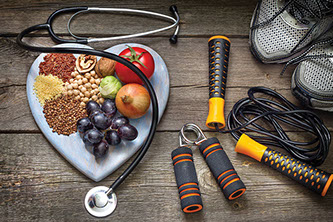
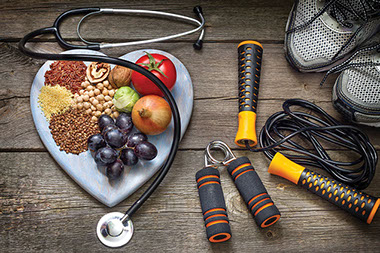
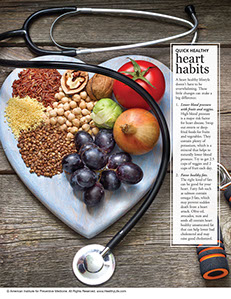
    Image of heart plate with heart healthy foods and fitness gear.

    A heart healthy lifestyle doesn’t have to be overwhelming. These little changes can make a big difference:

    1.  Lower blood pressure with fruits and veggies. High blood pressure is a major risk factor for heart disease. Swap out sweets or deep-fried foods for fruits and vegetables. They contain plenty of potassium, which is a mineral that helps to naturally lower blood pressure. Try to get 2.5 cups of veggies and 2 cups of fruit each day.

    2.  Favor healthy fats. The right kind of fats can be good for your heart. Fatty fish such as salmon contain omega-3 fats, which may prevent sudden death from a heart attack. Olive oil, avocados, nuts and seeds all contain heart healthy unsaturated fat that can help lower bad cholesterol and may raise good cholesterol.

    © American Institute for Preventive Medicine

  • Figure Out Your Target Heart Rate

    Fitness

    Image of man checking heart rate.

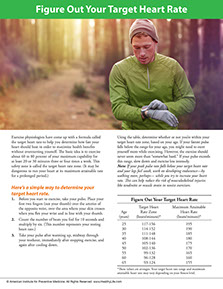
    Exercise physiologists have come up with a formula called the target heart rate to help you determine how fast your heart should beat in order to maximize health benefits without overexerting yourself. The basic idea is to exercise about 60 to 80 percent of your maximum capability for at least 20 or 30 minutes three or four times a week. This safety zone is called the target heart rate zone. (It may be dangerous to run your heart at its maximum attainable rate for a prolonged period.)

    Here’s a simple way to determine your target heart rate.

    1.  Before you start to exercise, take your pulse. Place your first two fingers (not your thumb) over the arteries of the opposite wrist, over the area where your skin creases when you flex your wrist and in line with your thumb.

    2.  Count the number of beats you feel for 10 seconds and multiply by six. (This number represents your resting heart rate.)

    3.  Take your pulse after warming up, midway through your workout, immediately after stopping exercise, and again after cooling down.

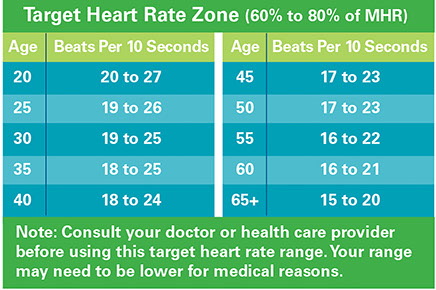
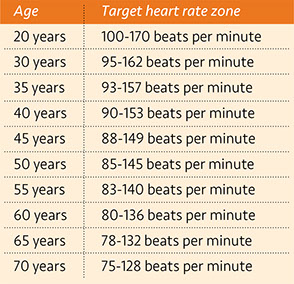
    Using the table below, determine whether or not you’re within your target heart rate zone, based on your age. If your fastest pulse falls below the range for your age, you might need to exert yourself more while exercising. However, the exercise should never seem more than “somewhat hard.” If your pulse exceeds this range, slow down and exercise less intensely.

    Note: If your peak pulse rate falls below your target heart rate and your legs feel weak, work on developing endurance-by walking more, perhaps-while you try to increase your heart rate. This can help reduce the risk of musculoskeletal injuries like tendinitis or muscle strain in novice exercisers.

    Chart showing Target Heart Rate Zones.
    Page image from A Year of Health Hints book by the American Institute for Preventive Medicine. www.HealthyLife.com. All rights reserved.

    © American Institute for Preventive Medicine

  • Fainting & Unconsciousness

    First Aid

    Signs & Symptoms

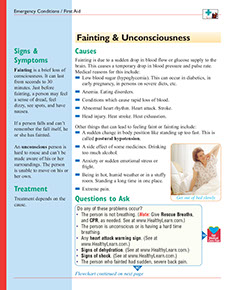
    Fainting is a brief loss of consciousness. It can last from seconds to 30 minutes. Just before fainting, a person may feel a sense of dread, feel dizzy, see spots, and have nausea.

    If a person falls and can’t remember the fall itself, he or she has fainted.

    An unconscious person is hard to rouse and can’t be made aware of his or her surroundings. The person is unable to move on his or her own.

    Causes

    Fainting is due to a sudden drop in blood flow or glucose supply to the brain. This causes a temporary drop in blood pressure and pulse rate. Medical reasons for this include:

    *  Low blood sugar (hypoglycemia). This can occur in diabetics, in early pregnancy, in persons on severe diets, etc.

    *  Anemia. Eating disorders.

    *  Conditions which cause rapid loss of blood.

    *  Abnormal heart rhythm. Heart attack. Stroke.

    *  Head injury. Heat stroke. Heat exhaustion.

    Other things that can lead to feeling faint or fainting include:

    *  A sudden change in body position like standing up too fast. This is called postural hypotension.

    *  A side effect of some medicines. Drinking too much alcohol.

    *  Anxiety or sudden emotional stress or fright.

    *  Being in hot, humid weather or in a stuffy room. Standing a long time in one place.

    *  Extreme pain.

    Treatment

    Treatment depends on the cause.

    Questions to Ask

    Self-Care / Prevention

    For Unconsciousness

    *  Check for a response. Call 9-1-1! Give Rescue Breaths and CPR, or treat for Shock, as needed.

    *  Check for a medical alert tag or information. Call the emergency number if there is one. Follow instructions given.

    *  Don’t give the person anything to eat or drink, not even water.

    For Fainting

    *  Catch the person before he or she falls.

    *  Lie the person down with the head below heart level. Raise the legs 8 to 12 inches to promote blood flow to the brain. If the person can’t lie down, have him or her sit down, bend forward, and put the head between the knees.

    *  Loosen any tight clothing.

    *  Don’t slap or shake a person. Don’t give anything to eat or drink.

    *  Check for a medical alert tag. Respond as needed.

    To Reduce the Risk of Fainting

    *  Follow your doctor’s advice to treat any medical problem which may lead to fainting. Take medicines as prescribed. Let the doctor know about any side effects.

    *  Get up slowly from bed or from a chair.

    *  Avoid turning your head suddenly.

    *  Wear loose-fitting clothing around the neck.

    *  Don’t exercise too much when it is hot and humid. Drink a lot of fluids when you exercise.

    *  Avoid stuffy rooms and hot, humid places. When you can’t do this, use a fan.

    *  If you drink alcohol, do so in moderation.

    For a Low Blood Sugar Reaction

    *  Have a sugar source, such as: One half cup of fruit juice or regular (not diet) soda; 6 to 7 regular (not sugar free) hard candies; 3 glucose tablets; or 6 to 8 ounces of milk.

    *  If you don’t feel better after 15 minutes, take the same amount of sugar source again. If you don’t feel better after the second dose, call your doctor.
    Healthier at Home book by the American Institute for Preventive Medicine. www.HealthyLife.com. All rights reserved.

    © American Institute for Preventive Medicine

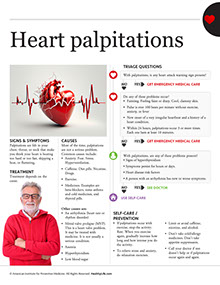
  • Heart Palpitations

    Heart & Circulation Problems

    Signs & Symptoms

    Palpitations can be felt in the chest, throat, or neck. With them, it feels like the heart is pounding, racing, and/or fluttering. It can feel like the heart has skipped a beat.

    Causes

    Most of the time, palpitations are not a serious problem. Common causes include:

    *  Anxiety. Fear. Stress. Hyperventilation.

    *  Caffeine. Diet pills. Nicotine. Drugs.

    *  Exercise.

    *  Medicines. Examples are beta-blockers, some asthma and cold medicines, and thyroid pills.

    Other causes are:

    *  An arrhythmia (heart rate or rhythm disorder).

    *  Mitral valve prolapse (MVP). This is a heart valve problem. It may be treated with medicine. It is not usually a serious condition.

    *  Anemia.

    *  Hyperthyroidism.

    *  Low blood sugar.

    Treatment

    Treatment depends on the cause.

    Questions to Ask

    Self-Care / Prevention

    *  If palpitations occur with exercise, stop the activity. Rest. When you exercise again, gradually increase how long and how intense you do the activity.

    *  To relieve stress and anxiety, do relaxation exercises.

    *  Limit or avoid caffeine, nicotine, and alcohol.

    *  Don’t take cold/allergy medicines. Don’t take appetite suppressants.

    *  Call your doctor if rest doesn’t help or if palpitations occur again and again.

    Resources

    The American Heart Association

    800.AHA.USA1 (242.8721)

    www.heart.org/HEARTORG

    National Heart, Lung, and Blood Institute (NHLBI)

    www.nhlbi.nih.gov

    Healthier at Home book by the American Institute for Preventive Medicine. www.HealthyLife.com. All rights reserved.

    © American Institute for Preventive Medicine

  • How Does Your Heart ‘Rate’?

    BE FIT

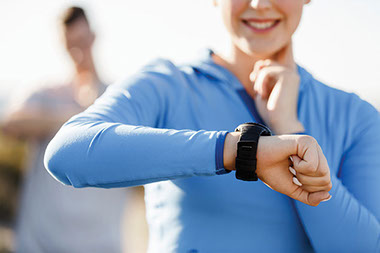
    Image of female checking heart rate.

    When it comes to getting a good workout, no two people are alike. Age, health status, fitness level, and many other factors can play a role in how hard you can – or should – exercise.

    Your target heart rate can tell you if you’re exercising hard enough to burn calories, but not too hard. Your target heart rate is how fast you want your heart to beat during exercise.

    You can find your target heart rate by following these steps:

    1. Get a stopwatch or use a watch or clock that has a second hand.

    2. Periodically during exercise, put two fingers on a pulse point. This can be the inside of your wrist on the thumb side, the inside of your elbow, or the side of your neck.

    3. Count how many times your heart beats in 60 seconds.

    Next, find your age in the chart and see if your heart rate is within the target heart rate zone listed. If it’s higher than the zone, take your workout down to an easier level. If it’s below, you may be able to exercise a little harder.

    Chart of Target Heart Rate Zone.

    If you’re just starting out with exercise, aim for the lower end of the range. After a few weeks, you can gradually work up to a higher heart rate within the zone.

    People who have heart conditions or other health problems should discuss any exercise or fitness activities with their doctor before starting. Certain medications that treat heart and blood pressure disease can cause a lower heart rate. Discuss your medications with your physician before trying to reach your maximum heart rate.

    Heart rate and blood pressure explained

    Heart rate and blood pressure are not the same thing. Blood pressure is the force of blood moving through your body. Heart rate or pulse is simply the number of times your heart beats per minute.

    A faster heart rate does not necessarily mean your blood pressure is rising. When the heart rate speeds up, blood vessels get bigger, allowing more blood to move through. This means many people can safely raise their heart rate during exercise without affecting their blood pressure.

    Talk to your doctor about blood pressure and get it checked yearly. Most people with high blood pressure can and should exercise with their doctor’s approval.

    Source: American Heart Association

    © American Institute for Preventive Medicine