Tag: rash

  • Say Goodbye To Winter Rash

    SELF-CARE CORNER

    Female using face cream on cheeks.

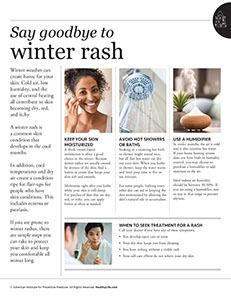
    Winter weather can create havoc for your skin. Cold air, low humidity, and the use of central heating all contribute to skin becoming dry, red, and itchy. A winter rash is a common skin condition that develops in the cool months.

    In addition, cool temperatures and dry air create a condition ripe for flair-ups for people who have skin conditions. This includes eczema or psoriasis.

    If you are prone to winter rashes, there are simple steps you can take to protect your skin and keep you comfortable all winter long.

    Keep your skin moisturized

    A thick, cream-based moisturizer is often a good choice in the winter. Because winter rashes are usually caused by dryness of the skin, find a lotion or cream that keeps your skin soft and smooth.

    Moisturize right after you bathe while your skin is still damp. For patches of skin that are dry, red, or itchy, you can apply lotion as often as needed.

    Avoid hot showers or baths

    Soaking in a steaming hot bath or shower might sound nice, but all that hot water can dry out your skin. When you bathe or shower, keep the water warm and limit your time to five or ten minutes.

    For some people, bathing every other day can aid in keeping the skin moisturized by allowing the skin’s natural oils to accumulate.

    Use a humidifier

    In cooler months, the air is cold and it also contains less water. If your home heating system does not have built-in humidity control, you may choose to purchase a humidifier to add moisture to the air.

    Ideal indoor air humidity should be between 30-50%. If you are using a humidifier, aim to stay in that range to prevent dryness.

    When to seek treatment for a rash

    Call your doctor if you have any of these symptoms:

    *  You develop open cuts or sores

    *  Your dry skin keeps you from sleeping

    *  You have itching without a visible rash

    *  Your self-care efforts do not relieve your dry skin

    © American Institute for Preventive Medicine

  • Work-Related Skin Problems

    WORK LIFE

    Electrician wearing gloves while working.

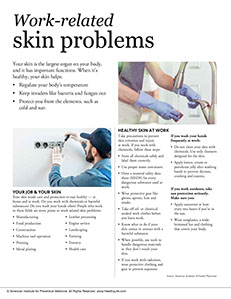
    Your skin is the largest organ on your body, and it has important functions. When it’s healthy, your skin helps:

    *  Regulate your body’s temperature

    *  Keep invaders like bacteria and fungus out

    *  Protect you from the elements, such as cold and sun

    Your job & your skin

    Your skin needs care and protection to stay healthy – at home and at work. Do you work with chemicals or harmful substances? Do you wash your hands often? People who work in these fields are more prone to work-related skin problems:

    *  Manufacturing

    *  Food production

    *  Construction

    *  Machine tool operation

    *  Printing

    *  Metal plating

    *  Leather processing

    *  Engine service

    *  Landscaping

    *  Farming

    *  Forestry

    *  Health care

    Healthy skin at work

    Take precautions to prevent skin irritation and injury at work. If you work with chemicals, follow these steps:

    *  Store all chemicals safely and label them correctly.

    *  Use proper waste containers.

    *  Have a material safety data sheet (MSDS) for every dangerous substance used at work.

    *  Wear protective gear like gloves, aprons, hats and masks.

    *  Take off oil- or chemical-soaked work clothes before you leave work.

    *  Know what to do if your skin comes in contact with a harmful substance.

    *  When possible, use tools to handle dangerous materials so they don’t touch your skin.

    *  If you work with radiation, wear protective clothing and gear to prevent exposure.

    If you wash your hands frequently at work:

    *  Do not clean your skin with chemicals. Use only cleansers designed for the skin.

    *  Apply lotion, cream or petroleum jelly after washing hands to prevent dryness, cracking and eczema.

    If you work outdoors, take sun protection seriously. Make sure you:

    *  Apply sunscreen at least every two hours if you’re in the sun.

    *  Wear sunglasses, a wide-brimmed hat and clothing that covers your body.

    Source: American Academy of Family Physicians

    © American Institute for Preventive Medicine

  • Ten Ways To Get Rid Of Winter Itch

    Skin Conditions

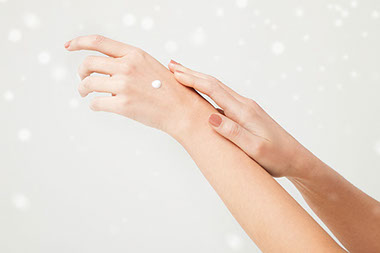
    Image of lotion on hand.

    Oh, that winter itch! Your skin feels as rough and dry as sandpaper. If your skin is chapped, cracked, and inflamed during the coldest months of the year, take heart. Relief is a simple matter of water conservation.

    The basic problem is lack of moisture. Anything that steals moisture from the skin will result in dryness and chapping. The drier the air, the more rapidly moisture evaporates. (In winter, heated indoor air tends to be dry.) Also, soap and excessive bathing or showering strips the skin of its natural oils making the problem worse. Add it up and the dehydrated cells begin to shrink and separate like caked mud in a dry lake bed and a network of painful cracks appear on your skin.

    Dry skin affects everyone, but older people have it worse because oil production gradually declines with age.

    Since you can’t change the weather or your age, try these suggestions if you want to prevent winter itch.

    *  Drink 8 or more glasses of water a day.

    *  Don’t scratch or rub your skin. Do apply moisturizer to your skin daily. Use an oil-based lotion.

    *  Don’t overexpose your skin to water, such as with washing dishes. Wear rubber gloves when you wash dishes.

    *  Right after washing your hands, put hand cream on to seal in moisture.

    *  Use petroleum jelly on very dry skin areas.

    *  Take a shower instead of a bath. Use warm (not hot) water. Pat your skin dry, but not all the way. Apply a moisturizing cream while your skin is damp. Use products with lanolin. If you prefer to bathe, bathe for only 15 to 20 minutes in lukewarm water. Pat yourself dry. Do not rub. Use a bath oil on your skin after bathing. Try sponge baths. Use a washcloth instead of soaping the skin directly. Use a mild liquid cleanser like Cetaphil brand, or use a fatted soap. Avoid deodorant, medicated, or alkaline soaps.

    *  Don’t use moisturizers with fragrances, preservatives, or alcohol.

    *  Use a night cream for the face. Stay out of the strong sun. Do not use tanning salons. Use a sunblock with a sun protection factor (SPF) of at least 15.

    *  Lower the setting on your heating thermostat so you’re comfortable, not toasty.

    *  Use a humidifier to add moisture to the air in a room or have a humidifier connected to your furnace. Also, don’t sit too close to fireplace heat – it’s drying.

    A Year of Health Hints book by the American Institute for Preventive Medicine. www.HealthyLife.com. All rights reserved.

    © American Institute for Preventive Medicine

  • Allergies

    General Health Conditions

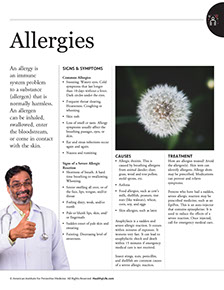
    An allergy is an immune system problem to a substance (allergen) that is normally harmless. An allergen can be inhaled, swallowed, or come in contact with the skin.

    Signs & Symptoms

    For Common Allergies

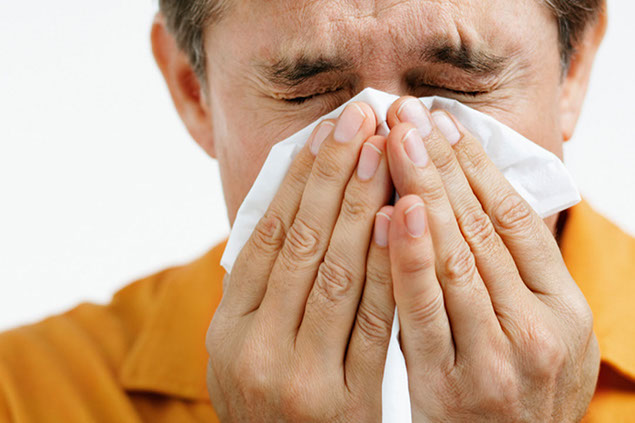
    *  Sneezing. Watery eyes. Cold symptoms that last longer than 10 days without a fever. Dark circles under the eyes.

    *  Frequent throat clearing. Hoarseness. Coughing or wheezing.

    *  Skin rash.

    *  Loss of smell or taste.

    *  Ear and sinus infections occur again and again.

    Signs of a Severe Allergic Reaction

    *  Shortness of breath. A hard time breathing or swallowing. Wheezing.

    *  Severe swelling all over, or of the face, lips, tongue, and/or throat.

    *  Feeling dizzy, weak, and/or numb.

    *  Pale or bluish lips, skin, and/or fingernails.

    *  Cool, moist skin or sudden onset of pale skin and sweating.

    *  Fainting. Decreasing level of awareness.

    Causes

    *  Allergic rhinitis. This is caused by breathing allergens from animal dander; dust; grass, weed and tree pollen; mold spores, etc.

    *  Asthma.

    *  Food allergies. Common ones are milk, fish, nuts, wheat, corn, and eggs.

    *  Skin allergies.

    Anaphylaxis is a sudden and severe allergic reaction. It occurs within minutes of exposure. It worsens very fast. It can lead to anaphylactic shock and death within 15 minutes if emergency medical care is not received.

    Insect stings, nuts, penicillin, and shellfish are common causes of a severe allergic reaction.

    Treatment

    How are allergies treated? Avoid the allergen(s). Skin tests can identify allergens. Allergy shots may be prescribed. Medications can prevent and relieve symptoms. Persons who have had a sudden, severe allergic reaction may be prescribed medicine, such as an EpiPen. This is used for a severe reaction before getting emergency medical care.

    Questions to Ask

    Self-Care / Prevention

    For a Severe Allergic Reaction

    *  Take prescribed medicine, such as an EpiPen, as advised. Then get emergency care!

    *  Wear a medical ID alert tag for things that cause a severe allergic reaction.

    *  Avoid things you are allergic to.

    For Other Allergic Reactions

    *  If mild symptoms occur after you take a medicine, call your doctor for advice.

    *  For hives and itching, take an OTC antihistamine, such as Benadryl. Take it as prescribed by your doctor or as directed on the label.

    *  Don’t use hot water for baths, showers, or to wash rash areas. Heat worsens most rashes and makes them itch more.

    *  For itching, use an oatmeal bath or calamine (not Caladryl) lotion. You can also use a paste made with 3 teaspoons of baking soda and 1 teaspoon of water.

    *  Avoid things you are allergic to.

    *  Read food labels. Don’t eat foods that have things you are allergic to. When you eat out, find out if menu items have things you are allergic to before you order them.

    Resources

    Asthma and Allergy Foundation of America 800.7.ASTHMA (727.8462)

    www.aafa.org

    Healthier at Home book by the American Institute for Preventive Medicine. www.HealthyLife.com. All rights reserved.

    © American Institute for Preventive Medicine

  • Eczema

    Skin Conditions

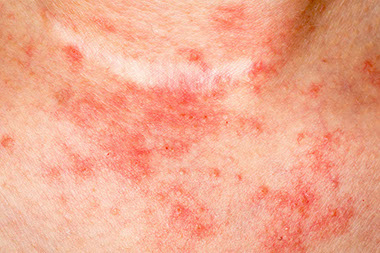
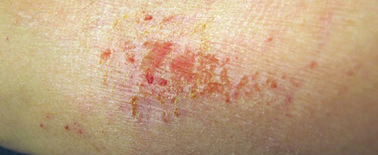
    Image of an eczema rash.

    Eczema (atopic dermatitis) is a chronic skin condition. It usually appears on the scalp, face, neck, or creases of the elbows, wrists, and knees. It usually improves as you get older, but can be a lifetime problem.

    Signs & Symptoms

    Patches of skin that are:

    *  Dry, red, and scaly

    *  Blistered and swollen

    *  Sometimes thick, discolored, or oozing and crusting

    Causes, Risk Factors & Care

    Eczema tends to run in families. It is also more common in persons who have allergies or asthma. Contact with cosmetics, dyes, deodorants, skin lotions, permanent press fabrics, and other allergens can aggravate eczema; so can wool fabrics, stress, exposure to extreme weather conditions, and eating foods, such as eggs, milk, seafood, or wheat products.

    Your doctor may prescribe antibiotics for skin infections and/or other medicines if self-care does not relieve symptoms.

    Self-Care

    *  Don’t scratch! This makes eczema worse. Your skin can get infected. Keep your fingernails cut short.

    *  Don’t take baths too often. Add bath oil to the water. Sponge bathe in between tub baths. Take quick showers.

    *  Use warm (not hot) water when you take a bath or shower.

    *  Use a mild soap or no soap at all on the areas of eczema.

    *  Don’t use wool clothes and blankets.

    *  Use a light, nongreasy and unscented lotion on your skin after you wash. Don’t use lotions that have alcohol. They can dry the skin.

    *  Try to keep from sweating. For example, don’t wear too many clothes for the weather.

    *  Wear rubber gloves when you do housework. Put talcum powder or cornstarch inside the gloves, or use latex gloves lined with cotton.

    *  Avoid foods, chemicals, cosmetics, and other things that make your eczema worse.

    When to Seek Medical Care

    Contact Doctor When:

    *  You have signs of an infection: Fever; and/or large amount of weeping or crusting skin areas.

    *  Your skin is red, you can’t stop scratching, and this keeps you from sleeping.

    *  You get no relief from self-care.

    Health at Home Lifetime book by the American Institute for Preventive Medicine. www.HealthyLife.com. All rights reserved.

    © American Institute for Preventive Medicine

  • Poison Ivy, Oak & Sumac

    Skin Conditions

    Poison ivy, oak, and sumac are the most common plants that cause a skin rash. A sap that comes from these plants causes the rash. The sap is not really a poison, but can cause an allergic reaction in some people.

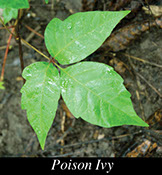
    Image of posion ivy leaf.
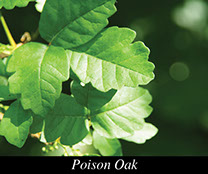
    Image of poison oak leaf.
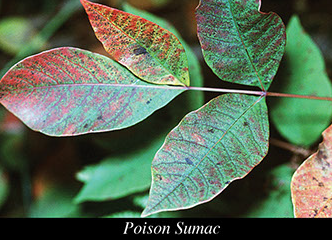
    Image of poison sumac.

    Signs & Symptoms

    The skin rash comes a day or two after contact with the plant. Symptoms that follow can range from mild to severe.

    *  Itching.

    *  Redness.

    *  Burning feeling.

    *  Swelling.

    *  Blisters.

    Causes

    You can get poison ivy, oak, or sumac when you touch one of these plants or touch pets, clothes, shoes, etc. that have the sap on them. Contact with the smoke of these burning plants can also cause a rash.

    Treatment

    Self-care treats most cases of poison ivy, oak, and sumac. For severe cases, your doctor may prescribe medicine(s).

    Questions to Ask

    Self-Care / Prevention

    To Prevent Getting a Rash

    *  Know what these plants look like and avoid them.

    – Poison ivy and poison oak both have 3 leaflets per stem. This is why you may have heard the saying, “Leaflets three, let them be.”

    – Each branch of poison sumac has 7 to 13 leaflets on a reddish stem. A single leaf is on the end of the stem. The others are paired along each side of the stem. Poison sumac grows in wetlands.

    *  Use an over-the-counter lotion (IvyBlock), which blocks skin contact with the sap. Use it as directed.

    *  Wear pants and long-sleeved shirts.

    *  Use an over-the-counter product (e.g., Tecnu) that removes poison ivy sap.

    *  Rinse the affected area with water.

    *  To help prevent an allergic reaction, do the things listed below. Do them within 6 hours of contact with one of the plants.

    – Remove all clothes and shoes that have touched the plant.

    – Wash the skin area well with soap and water.

    – Use an over-the-counter product (e.g., Tecnu) that removes poison ivy sap.

    To Treat Poison Ivy, Oak, or Sumac

    *  Take a cold shower, put the rash area in cold water, or pour cold water over it. Use soap when you shower.

    *  To relieve itching, take an over-the-counter antihistamine, such as Benadryl. Follow the label’s directions.

    *  For weeping blisters, mix 2 teaspoons of baking soda in 4 cups of water. Dip squares of gauze in this mixture. Cover the blisters with wet gauze for 10 minutes, 4 times a day. Do not apply this to the eyes.

    *  Wash all clothes and shoes with hot water and a strong soap. Bathe pets that have come in contact with the plant. The sap can stay on pets for many days. Clean items used to wash clothing and pets. Wear rubber gloves when you do all these things.

    *  Keep your hands away from your eyes, mouth, and face.

    *  Do not scratch or rub the rash.

    *  Take baths with lukewarm water. Add an over- the-counter product called Aveeno colloidal oatmeal.

    *  Apply any of these to the skin rash:

    – Calamine (not Caladryl) lotion.

    – Over-the-counter hydrocortisone cream. Follow the directions on the label.

    – A paste of 3 teaspoons of baking soda and 1 teaspoon of water.

    Healthier at Home book by the American Institute for Preventive Medicine. www.HealthyLife.com. All rights reserved.

    © American Institute for Preventive Medicine

  • A Simple Remedy For Prickly Heat

    Skin Conditions

    Image of women sitting in grass field on sunny summer day.

    Feeling hot and sticky is bad enough. A visible sign of discomfort only makes it worse. Such is the case with prickly heat (also known as heat rash), identified by clusters of small blisters that itch and appear where you perspire the heaviest – the armpits, neck, back, or creases in the elbows (but not the face).

    Hot, humid weather, sensitive skin, and excess weight all aggravate prickly heat. Here are some simple ways to find relief:

    *  Wear loose, lightweight clothing.

    *  Dust the affected area with cornstarch.

    *  Take cool baths to reduce itching.

    *  Avoid hot, humid environments and stay in air-conditioned places, if possible.

    The key to managing prickly heat is to avoid sweating by staying in a cool environment. The rash will disappear in a couple of days.

    A Year of Health Hints book by the American Institute for Preventive Medicine. www.HealthyLife.com. All rights reserved.

    © American Institute for Preventive Medicine

  • Shingles

    Skin Conditions

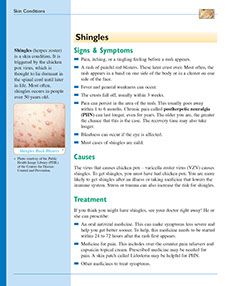
    Shingles (herpes zoster) is a skin condition. It is triggered by the chicken pox virus, which is thought to lie dormant in the spinal cord until later in life. Most often, shingles occurs in people over 50 years old.

    Signs & Symptoms

    *  Pain, itching, or a tingling feeling before a rash appears.

    *  A rash of painful red blisters. These later crust over. Most often, the rash appears in a band on one side of the body or in a cluster on one side of the face.

    *  Fever and general weakness can occur.

    *  The crusts fall off, usually within 3 weeks.

    *  Pain can persist in the area of the rash. This usually goes away within 1 to 6 months. Chronic pain called postherpetic neuralgia (PHN) can last longer, even for years. The older you are, the greater the chance that this is the case. The recovery time may also take longer.

    *  Blindness can occur if the eye is affected.

    *  Most cases of shingles are mild.

    Image of the shingles.

    Causes

    The virus that causes chicken pox – varicella zoster virus (VZV) causes shingles. To get shingles, you must have had chicken pox. You are more likely to get shingles after an illness or taking medicine that lowers the immune system. Stress or trauma can also increase the risk for shingles.

    Treatment

    If you think you might have shingles, see your doctor right away! He or she can prescribe:

    *  An oral antiviral medicine. This can make symptoms less severe and help you get better sooner. To help, this medicine needs to be started within 24 to 72 hours after the rash first appears.

    *  Medicine for pain. This includes over-the-counter pain relievers and capsaicin topical cream. Prescribed medicine may be needed for pain. A skin patch called Lidoderm may be helpful for PHN.

    *  Other medicines to treat symptoms.

    Questions to Ask

    Self-Care / Prevention

    *  A Zoster vaccine may help prevent getting shingles. It can also reduce the pain due to shingles. The vaccine is advised for persons age 60 and older.

    *  Unless your doctor has prescribed pain medicine, take an over-the-counter one as directed.

    *  Don’t wear clothing that irritates the skin area where sores are present.

    *  Keep sores open to the air. Until the blisters are completely crusted over, do not go near children or adults who have not yet had chicken pox. Do not go near persons who have a condition which weakens their immune system. Examples are cancer, HIV/AIDS, and chronic illnesses. They could get chicken pox from exposure to shingles.

    *  Wash blisters. Don’t scrub them.

    *  To relieve itching, apply calamine lotion to the affected area. You can also use a paste made of 3 teaspoons of baking soda mixed with 1 teaspoon of water.

    *  Avoid drafty areas.

    *  Put a cool compress, such as a cold cloth dipped in ice water, on the blisters. Do this for 20 minutes at a time.

    *  Drink lots of liquids.

    Resources

    National Institute of Allergy and Infectious Diseases (NIAID)

    www.niaid.nih.gov

    National Shingles Foundation

    212.222.3390

    www.vzvfoundation.org

    Healthier at Home book by the American Institute for Preventive Medicine. www.HealthyLife.com. All rights reserved.

    © American Institute for Preventive Medicine

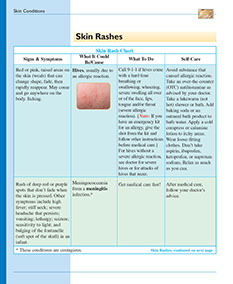
  • Skin Rashes

    Skin Conditions

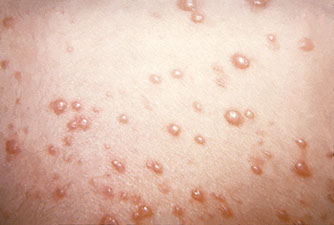
    This is caused by the varicella-zoster virus. This condition is contagious.

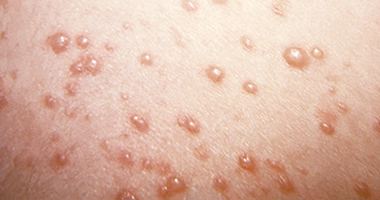
    Chickenpox

    Signs & Symptoms

    Flat, red spots that become raised and look like small pimples. These develop into small blisters that break and crust over. Fatigue and mild fever occur 24 hours before rash appears. Itching may be intense.

    What To Do

    See doctor or health care provider if it occurs in an adult; if self-care measures don’t bring relief in children; or if there are signs of infection (e.g., pus, increased redness, swelling, or pain). A vaccine is given to prevent this disease.

    Self-Care

    Keep from scratching affected areas. Apply cool, wet washcloths with baking soda or calamine lotion to affected areas. Take acetaminophen for fever. Take an OTC antihistamine as advised by your doctor if itching is intense. Chickenpox can be prevented with a chickenpox vaccine.

    Contact Dermatitis

    Causes are direct contact with poison ivy, oak, or sumac or contact with an irritant (cleaning product, cosmetic, jewelry, etc.).

    Signs & Symptoms

    Dry, red, itchy patches of skin. Blisters which may drain and then crust over.

    What To Do

    See doctor or health care provider if self- care measures don’t bring relief or if there are signs of infection (e.g., red streaks, fever, pus, increased redness, swelling, or pain).

    Self-Care

    Try to identify the irritant and avoid direct contact with it. Don’t scratch the rash. For itching, apply calamine lotion or OTC hydrocortisone cream to the affected area. Bathe in warm (not hot) water. Add an oatmeal product to the water. Pat (don’t rub) the skin dry. Take an OTC antihistamine as advised.

    Cradle Cap

    This is due to hormones that pass through the placenta before birth.

    Signs & Symptoms

    Scaly, crusty rash (in newborns) that starts behind the ears and spreads to the scalp.

    What To Do

    Use self-care.

    Self-Care

    Apply mineral oil to the scalp to soften the hard crusts, then use an antidandruff shampoo. Do this 2 to 3 times a week, massaging the scalp with a soft brush or washcloth for 5 minutes. Be sure to wash all of the oil out.

    Eczema (Atopic Dermatitis)

    Image of eczema rash.

    This tends to run in families. It is common in persons with asthma or allergies. Contact with irritants may worsen eczema.

    Signs & Symptoms

    Patches of skin that are dry, red, scaly, blistered, swollen, and sometimes thick, discolored, or oozing and crusting. Commonly occurs in the bend of the elbow or behind the knee.

    What To Do

    See doctor or health care provider if self- care measures don’t bring relief or if there are signs of infection (e.g., red streaks, fever, pus, increased redness, swelling, or pain).

    Self-Care

    Use an OTC hydrocortisone cream on the affected area. Don’t scratch. Don’t bathe too often. When you do, use warm (not hot) water and a mild soap (or no soap). Use a light, nongreasy, unscented lotion (without alcohol) after you wash. Avoid items that worsen the eczema.

    Heat Rash (Prickly Heat)

    Heat rash (prickly heat) or chafing. This occurs from too much sweating.

    Signs & Symptoms

    Rash with small red pimples, pink blotchy skin, and itching. Common sites are between skin folds (armpits, under the breasts, the groin).

    What To Do

    Use self-care.

    Self-Care

    Bathe in cool water without soap every couple of hours. Let your skin air dry. Put cornstarch in body creases or apply calamine lotion to very itchy spots. Don’t use ointments and creams that can block sweat gland pores. Stay in a cool, dry area.

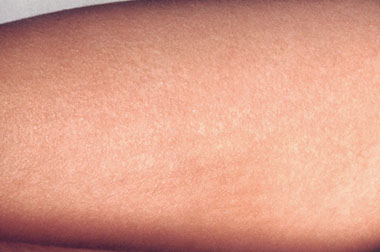
    Fifth Disease

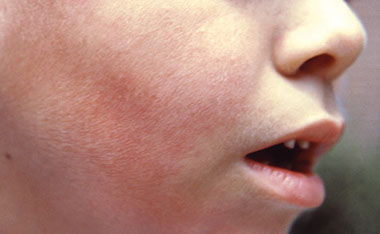
    Image of fifth disease rash.

    This is caused by the Human parvovirus B19. This condition is contagious.

    Signs & Symptoms

    Red rash of varying shades that fades to a flat, lacy pattern. Rash comes and goes. It usually starts on the facial cheeks and then on the arms and legs. This is a mild disease, usually with no other symptoms.

    What To Do

    Use self-care, but no special treatment is required.

    Self-Care

    Avoid hot or even warm baths or showers. Keep cool.

    Hives

    Hives, usually due to an allergic reaction.

    Signs & Symptoms

    Red or pink, raised areas on the skin (weals) that can change shape, fade, then rapidly reappear. May come and go anywhere on the body. Itching.

    What To Do

    Call 9-1-1 if hives come with a hard time breathing or swallowing, wheezing, severe swelling all over or of the face, lips, tongue and/or throat (severe allergic reaction). {Note: If you have an emergency kit for an allergy, give the shot from the kit and follow other instructions before medical care.} For hives without a severe allergic reaction, see doctor for severe hives or for attacks of hives that recur.

    Self-Care

    Avoid substance that caused allergic reaction. Take an over-the-counter (OTC) antihistamine as advised by your doctor. Take a lukewarm (not hot) shower or bath. Add baking soda or an oatmeal bath product to bath water. Apply a cold compress or calamine lotion to itchy areas. Wear loose-fitting clothes. Don’t take aspirin, ibuprofen, ketoprofen, or naproxen sodium. Relax as much as you can.

    Impetigo

    This is caused by a bacterial infection. This condition is contagious.

    Signs & Symptoms

    In infants, pus-filled blisters and red skin. In older children, golden crusts on red sores. Areas affected are the arms, legs, face, and around the nose first, then most of body. Sometimes fever. Occasional itching.

    What To Do

    See doctor or health care provider, especially if self-care measures don’t bring relief, if blisters are larger than 1 inch across, or if a red streak runs from the infection. An antibiotic may need to be prescribed.

    Self-Care

    Clean the area with an antibacterial soap several times a day. Apply an OTC antibiotic ointment 3 times a day after the scab falls off. Wash your hands after contact with the rash area. Don’t share towels, etc.

    Lyme Disease

    This is caused by a deer tick bite.

    Signs & Symptoms

    A fever and red rash 3 days to 2 weeks after a deer tick bite. The rash has raised edges with pale centers. It fades after a few days. Joint pain may develop later.

    What To Do

    See doctor or health care provider for diagnosis. Can be treated with an antibiotic.

    Self-Care

    Follow your doctor’s advice.

    Measles

    This is caused by a virus. This condition is contagious. MMR vaccines prevent measles.

    Signs & Symptoms

    Blotchy red rash that starts on the face and spreads to the rest of the body. Rash lasts about 7 days. These signs come before the rash: Fever; runny nose; sneezing; cough; eyes that look red and are sensitive to light; and blue-white spots in the mouth.

    What To Do

    Call doctor right away to be sure the problem is measles. If it is, follow the doctor’s advice. Let the child’s school and the local health department know.

    Self-Care

    Rest until fever and rash go away. Drink lots of liquids. For fever, take acetaminophen. Treat cough. Avoid lights, TV, reading, etc. while eyes are sensitive to light. Usually okay to return to school about 7 to 10 days after rash and fever are gone.

    Meningococcemia

    Meningococcemia from a meningitis infection. These conditions are contagious.

    Signs & Symptoms

    Rash of deep red or purple spots that don’t fade when the skin is pressed. Other symptoms include high fever; stiff neck; severe headache that persists; vomiting; lethargy; seizure; sensitivity to light; and bulging of the fontanelle (soft spot of the skull) in an infant.

    What To Do

    Get medical care fast!

    Self-Care

    After medical care, follow your doctor’s advice.

    Psoriasis

    Image of psoriasis.

    This is a chronic skin disease that tends to run in families. The exact cause is not known.

    Signs & Symptoms

    Itchy, red patches covered with silvery-white flaky skin. Common sites are the scalp, elbows, forearms, knees, and legs.

    What To Do

    See doctor or health care provider if psoriasis affects large areas of skin and/or if self-care measures don’t bring relief.

    Self-Care

    To prevent dryness, use a moisturizer. Use an OTC hydrocortisone or coal tar cream or ointment. If psoriasis affects your scalp, use an antidandruff shampoo. Take a bath with mineral salts or an oatmeal bath product.

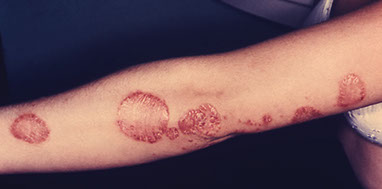
    Ringworm

    This is caused by a fungal infection. This condition is contagious.

    Signs & Symptoms

    Redness, itchy, scaly patches on the skin or scalp that are round with distinct edges that grow outward as the infection spreads. Moistness in the folds of the skin (under the breasts or in the groin area). Bald spots may appear on the scalp.

    What To Do

    See doctor or health care provider for diagnosis and treatment, especially if you have not had this before or if ringworm occurs on the scalp or in several patches on the skin.

    Self-Care

    Follow your doctor’s advice.

    Rocky Mountain Spotted Fever

    Rocky mountain spotted fever, 1 to 14 days after a bite from an American dog tick or Rocky Mountain woodtick. These conditions are contagious.

    Signs & Symptoms

    Pink to red rash on the arms, legs, and palms of the hands. Often starts near the wrists and ankles, then spreads inward. Rash darkens in color, spreads, and can bleed. Sudden high fever with chills, severe headache, and delirium also occur.

    What To Do

    Contact doctor right away.

    Self-Care

    Follow your doctor’s advice.

    Rosacea (Adult Acne)

    The exact cause is not known. It may result from overuse of corticosteroid creams or alcohol use.

    Signs & Symptoms

    Red rash on the face. Red nose that looks swollen and puffy cheeks. May have pus-filled spots without blackheads or whiteheads.

    What To Do

    See doctor or health care provider if rosacea affects large areas of skin and/or if self-care measures don’t bring relief.

    Self-Care

    Avoid hot and/or spicy foods, alcohol, and caffeine. Don’t rub or massage the face. Avoid strong sunlight.

    Roseola

    This is caused by the Herpes type-6 virus.

    Signs & Symptoms

    Flat, rosy red rash on the chest and abdomen. A high fever occurs 2 to 4 days before the rash. The child feels only mildly ill when the fever is present.

    What To Do

    See doctor or health care provider if high fever causes febrile seizure.

    Self-Care

    Take acetaminophen for fever. Apply cool, wet washcloths or take baths with tepid (not cold) water.

    Scabies

    This is caused by skin parasites called itch mites. This condition is contagious.

    Signs & Symptoms

    Tiny red pimples that itch intensely, usually between the fingers, on the wrists and genitals; in the armpits; and along the belt line. Scabs and sores may form.

    What To Do

    See doctor or health care provider for diagnosis. Can be treated with a prescribed topical medicine.

    Self-Care

    Follow your doctor’s instructions. Wash clothing and bedding in hot water and detergent.

    Scarlet Fever

    Image of scarlet fever.

    This is caused by a bacterial infection. These conditions are contagious.

    Signs & Symptoms

    Rough, bright red rash (feels like sandpaper) on the face, neck, elbows, armpits, and groin. It spreads rapidly to entire body. A high fever and weakness occur before the rash. Other symptoms include sore throat, peeling of the skin, vomiting, and swollen tongue.

    What To Do

    See doctor or health care provider for diagnosis. Can be treated with an antibiotic.

    Self-Care

    Take acetaminophen for fever. Rest and drink plenty of fluids.

    Seborrhea

    This is a type of dermatitis. The glands in the skin make too much oil.

    Signs & Symptoms

    Scaly, oily rash with small, reddish-yellow patches. Areas affected are usually oily ones (the edge of the scalp, forehead, nose, and eyebrows) and the back and chest.

    What To Do

    See doctor or health care provider if self- care measures don’t bring relief or if there are signs of infection (e.g., red streaks, fever, pus, increased redness, swelling, or pain).

    Self-Care

    Use an OTC antidandruff shampoo with salicylic acid on the scalp area. Use OTC hydrocortisone cream on the affected skin areas. Handle the skin gently. Don’t scratch. Don’t use irritants like detergents.

    Shingles

    Image of the shingles.

    Shingles from the herpes zoster virus.* (Persons who have not had chicken pox or a vaccine for it can get chicken pox from exposure to shingles.) These conditions are contagious.

    Signs & Symptoms

    Rash of painful red blisters (most often on only one side and in only one area of the body). Pain, itching, burning, or tingling feeling before the rash appeared.

    What To Do

    See doctor or health care provider within 24 to 72 hours for an oral antiviral medicine. This can shorten the course of shingles and make symptoms less severe. {Note: All adults 60 years of age and older are advised to get a vaccine that can help prevent shingles and reduce the pain due to shingles.}

    Self-Care

    Take pain relievers as advised by your doctor. For itching, apply calamine lotion or a paste made of 3 teaspoons of baking soda mixed with 1 teaspoon of water to the affected area. Apply a cool, wet compress to blisters for 20 minutes at a time. Wash (don’t scrub) blisters until they crust over. Drink plenty of liquids.

    Syphilis

    This is a sexually transmitted disease caused by a specific bacterial infection. This condition is contagious.

    Signs & Symptoms

    Widespread red rash on the palms of the hands, soles of the feet, and sometimes around the mouth and nose. The small, red, scaly bumps do not itch. Other types of rashes, swollen lymph nodes, fever, and flu-like symptoms may also occur.

    What To Do

    See doctor or health care provider for diagnosis. Can be treated with an antibiotic.

    Self-Care

    Follow your doctor’s advice.

    West Nile Virus

    West Nile virus, 3 to 15 days after a bite from a mosquito infected with the virus.

    Signs & Symptoms

    Rash on the trunk of the body with fever, headache, bodyaches, and swollen lymph glands.

    What To Do

    See doctor right away.

    Self-Care

    Follow your doctor’s advice.

    Healthier at Home book by the American Institute for Preventive Medicine. www.HealthyLife.com. All rights reserved.

    © American Institute for Preventive Medicine

  • Skin Safety

    Skin Conditions

    The skin is your body’s largest organ. It protects your internal organs from environmental irritants, infections, and ultraviolet light; all of which can be harmful. Take good care of your skin so it can do its job. Keep your skin clean and protect it from injury.

    Tattoo and Body Piercing Safety

    You may already have one or more tattoos and/or area(s) of your body pierced. You may be thinking about getting one of these procedures done as a way to fit in and look like others; as a way to express your individuality; and/or to get noticed. Before you get a tattoo or a part of your body pierced, consider the following:

    *  In many states, the law does not allow minors to get tattoos. Find out about this in your state.

    *  Unsterile tattooing equipment and needles can transmit serious infectious diseases, such as tetanus, hepatitis B, and HIV. Never do one of these procedures on yourself or have anyone else do it that is not certified by the Association of Professional Piercers (APP) or the Alliance of Professional Tattooists (APT). Certified members are trained in strict safety and health requirements. Because of the high risk of infection, you cannot donate blood for one year after getting a tattoo.

    *  Tattoos and body piercings also carry the risk of less serious local infections. You will need to follow proper care procedures for weeks or months after the procedure to reduce the risk of getting an infection. You may also get large growths of scar tissues called keloids.

    *  Tattoos are not easily removed and in some cases may cause permanent discoloration. Keep a record of the dyes used in the tattoo you get. This includes the lot number of each pigment. If you choose to get a tattoo removed in the future, this information will be helpful. Think carefully before getting a tattoo and consider the possibility of an allergic reaction. Know that it is expensive, too, to get a tattoo removed. Don’t get a tattoo or body piercing done on an impulse. Wait at least 24 hours.

    *  Visit several tattoo parlors to see whether the tattooist follows recommended safety guidelines and sterilization techniques, such as using a heat sterilization machine regulated by the Food and Drug Administration (FDA).

    *  For body piercing, to avoid allergic reactions and infections, jewelry made from non- corrosive, non-toxic metals should be used. Examples are solid 14K gold (not gold-plated), niobium, surgical stainless steel, and titanium.

    *  After the procedure, follow the skin care guidelines provided by your skin piercer or tattooist. Care of the site will depend on its location and/or the procedure you had done.

    *  According to the APT guidelines, these practices should be followed:

    – The tattooist should have an autoclave (a heat sterilization machine regulated by the FDA) on the premises.

    – Consent forms (which the customer must sign) should be handed out before tattooing.

    – Immediately before tattooing, the tattooist should wash and dry his or her hands thoroughly and put on medical latex gloves, which should be worn at all times during application of the tattoo.

    – Needle bars and tubes should be autoclaved after each customer. Non-autoclavable surfaces, such as pigment bottles, drawer pulls, chairs, tables, sinks, and the immediate floor area, should be cleaned with a disinfectant, such as a bleach solution.

    – Used absorbent tissues should be placed in a special puncture-resistant, leak-proof container for disposal.

    Protect Your Skin From Sun Damage

    Do you look forward to semester breaks so you can relax in the sun and get a tan? Many students do. A suntan looks good, but it is a sign that your skin is trying to protect itself from damage. Be especially careful not to get sunburned. In fact, you should never get sunburned! It can lead to premature aging, wrinkling of the skin, and skin cancer. (Be extra cautious if you have a family history of skin cancer.) Even if you are not concerned about these problems now, the pain and blisters that come with a severe sunburn can make spring break unbearable.

    The risk for sunburn is increased for persons with fair skin, blue eyes, red or blond hair, and for persons taking some medicines. These include birth control pills; some antibiotics, such as tetracycline and sulfa drugs; and Benadryl, an over-the-counter antihistamine.

    To Prevent Sunburn

    *  Avoid exposure to the midday sun (10 a.m. to 4 p.m. standard time or 11 a.m. to 5 p.m. daylight saving time).

    *  Use sunscreen with a sun protection factor (SPF) of 15 to 30 or more when exposed to the sun. The lighter your skin, the higher the SPF number should be. Apply the sunscreen 15 to 30 minutes before you go out in the sun. Use about 2 tablespoons to adequately cover all exposed body parts. Reapply sunscreen every 60 to 90 minutes, even if the sunscreen is water-resistant.

    *  Along with sunscreen, use moisturizers, makeup, lip balm, etc. that contain sunscreen. Use water- based ones if you have acne.

    *  Wear a wide-brimmed hat and long sleeves.

    *  Wear clothing with sunscreen protection or muted colors, such as tan. Bright colors and white reflect the sun onto the face.

    *  Wear sunglasses that absorb at least 90% of both UVA and UVB rays.

    Student Self-Care book by the American Institute for Preventive Medicine. www.HealthyLife.com. All rights reserved.

    © American Institute for Preventive Medicine