Tag: recall

  • How Aging Affects Memory

    Brain & Nervous System

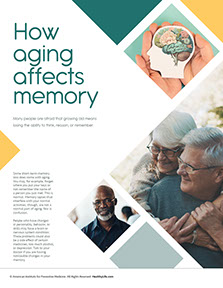
    Image of 2 elderly male friends hugging.

    Many people are afraid that growing old means losing the ability to think, reason, or remember.

    Some short-term memory loss does come with aging. You may, for example, forget where you put your keys or not remember the name of a person you just met. This is normal. Memory lapses that interfere with your normal activities, though, are not a normal part of aging. Nor is confusion.

    People who have changes in personality, behavior, or skills may have a brain or nervous system condition. These problems could also be a side effect of certain medicines, too much alcohol, or depression. This chapter gives information on common brain and nervous conditions in older persons.

    Health at Home Lifetime book by the American Institute for Preventive Medicine. www.HealthyLife.com. All rights reserved.

    © American Institute for Preventive Medicine

  • Memory Loss

    Brain & Nervous System

    With short-term memory loss, you can’t recall things learned in the past seconds to minutes. With long-term memory loss, you forget things learned in the distant past, such as in childhood. It is normal to have some memory loss as you age. It is common to forget where you put your eyeglasses or keys. You may have a hard time recalling the name of a person or place, and say, “It is on the tip of my tongue.” This memory loss is temporary and not severe. When it persists or interferes with your daily life, it can be a sign of a problem.

    Signs & Symptoms

    Signs and symptoms of serious memory loss, such as amnesia, depend on the cause. The memory loss can be partial or complete. It can occur for a short time or persist. It can also come on suddenly or slowly.

    Causes

    Other than the normal memory loss that comes with aging, causes include:

    *  Depression.

    *  Excess alcohol. Drug use.

    *  Side effects of some medicines.

    *  Alzheimer’s disease and other forms of dementia. Dementias result in a decline of all areas of mental ability. This includes learning, problem solving, language, behaviors, and memory loss.

    *  Mild cognitive impairment. This is a medical illness. With this, people have abnormal memory for their age and education. They have a harder time learning new information or recalling things.

    *  Posttraumatic stress disorder.

    *  Seizures. Head trauma.

    *  Stroke.

    *  Brain infections or tumors.

    Treatment

    Memory loss that persists, is severe, or that interferes with daily life needs a medical diagnosis. When another problem is the cause and is treated with success, memory loss improves. For other causes, such as Alzheimer’s disease, there is no cure. The goal is to treat symptoms and provide safety and comfort.

    Questions to Ask

    Self-Care / Prevention

    To Help Prevent Memory Loss

    *  Keep the brain active. Read, do puzzles, etc.

    *  Eat a balanced diet. Take vitamins and minerals, as advised by your doctor.

    *  Get regular exercise.

    *  Protect the head from injury.

    *  Follow tips under Prevention for Stroke (Brain Attack).

    *  Don’t smoke or use illegal drugs. Limit alcohol.

    *  Manage stress.

    *  Get regular eye exams. Get your hearing checked. If needed, wear eyeglasses and/or a hearing aid.

    To Help Remember Things

    *  Follow a routine for daily and weekly activities.

    *  Listen carefully. Link newly learned things to past memories.

    *  Repeat what you want to remember out loud. Write it down if you need to.

    *  Keep track of important things to do, phone numbers, etc. Use a calendar, planner, PDA, etc.

    *  Set up a system to remind you of daily medications to take, bills to pay, appointments to keep, etc.

    *  Put your keys, eyeglasses, etc. in the same place.

    Healthier at Home book by the American Institute for Preventive Medicine. www.HealthyLife.com. All rights reserved.

    © American Institute for Preventive Medicine

  • Remember This: You Can Improve Your Memory

    WELL-BEING

    Image of man with hand on his head.

    Worried because you searched a half hour before finding your reading glasses or car keys? Concerned that it took a couple minutes to remember the name of the familiar-looking woman who said hello to you in the restaurant?

    You probably don’t have much to worry about, said Dr. George Grossberg, an internationally recognized Alzheimer researcher and director of geriatric psychiatry at Saint Louis University School of Medicine. As annoying as it may be, temporary “tip of the tongue” forgetfulness is one of the changes that happens as we age.

    “If, on the other hand, the information is important to us, isn’t there when we want it, and doesn’t ever come back to us, that’s a more serious problem. The person who has Alzheimer’s disease and misplaces her reading glasses probably won’t even remember that she needs them to see. She knows the man next to her is familiar, but can’t remember that he’s her grandson and his name is Mark.”

    “In our society, we’re all on chronic systems overload. We’re multi-tasking – talking on our cell phones, listening for beepers to go off, walking into a store to shop,” he said. “It’s very easy for certain things to get lost in the shuffle. That’s not Alzheimer’s disease.”

    Dr. Grossberg offers this recipe for brain health:

    *  Try to figure out what is causing your forgetfulness. Did you make a wrong turn while driving while you were talking on a cell phone and listening to the radio? Maybe you’re trying to do too many things at once and need to put down the phone or turn off  the tunes.

    *  Exercise your body. Aerobic exercise improves your cardiovascular health. Exercise also increases your “feel-good” brain chemicals, which improve your mood and prevents depression which is a risk factor for Alzheimer’s disease.

    *  Exercise your mind. Research shows mental challenge can help rewire connections in the brain. So find a new hobby, learn to play chess, use your left hand if you’re right-handed, or study a foreign language.

    *  Take care of yourself. Control risk factors for cardiovascular disease such as high blood pressure, smoking, high cholesterol, and obesity to help decrease your risk.

    *  Get a good night’s sleep. Not getting enough deep, restful sleep causes mental impairment later in life. Besides, if you’re sleep deprived, you won’t think clearly and are more likely to forget in the present time.

    *  Feed your brain. Some research shows antioxidant vitamins have protective powers against Alzheimer’s disease. Some B vitamins, especially B-12 and folate, are very important in how brain cells function. Talk with your doctor about taking vitamin supplements.

    *  Check your meds. Discuss, with your doctor, if any prescribed and over-the-counter medications you take could cause memory or concentration problems.

    © American Institute for Preventive Medicine