
Tag: records

  • How To Make The Most Of A Doctor Visit

    Medical Care

    Image of doctor and patient talking.

    When a doctor knows how to really communicate well with a patient, it can make a big difference in how that patient responds. But communication is a two-way process. Listening as well as speaking to one another is something both doctor and patient must work on together. Being honest and open with each other is also important.

    What Your Doctor Should Know about You

    Aside from a general health history, it is important that your doctor ask certain questions about the following:

    *  Dietary habits (Are you a frequent junk-food eater? Are you especially fond of cheesecake, sour cream, or other fatty foods?)

    *  Your occupation (Do you work in a high-stress job? Are you exposed to nickel, nuclear power radiation, or other toxic substances?)

    *  Sleep habits (Do you frequently awaken before dawn or have problems getting to sleep?)

    *  Family problems (Are you currently going through a divorce?)

    *  Lifestyle (Do you get any exercise?)

    *  Stress (Do you work in a noisy environment?)

    *  Health attitude (Are you serious about quitting smoking?)

    *  History of family illness (Does heart disease, high blood pressure, diabetes, kidney problems, or cancer run in your family?)

    *  Major life events (Have you recently retired from work?)

    *  Living arrangements (Do you live alone?)

    Quizzing Your Doctor

    Often, patients feel rushed or uneasy during a doctor visit. And when you’re sick, there is a tendency to feel vulnerable and passive. But by heeding these suggestions, you can still make the most of your doctor-patient communications.

    *  Repeat back in your own words what the doctor has told you.

    *  Use simple phrases like “Do I hear you say that…  ?” or “My understanding of the problem is. . .”

    *  Plan ahead of time what you will say to your doctor about your problem. Your observations about a health problem can be invaluable in making a diagnosis.

    *  Take notes on what is wrong and what you need to do.

    *  If you are confused by medical terms, ask for simple definitions. There is no need to be embarrassed by this.

    *  When a medication is prescribed, ask about its possible side effects, its effectiveness, and how long it must be taken.

    *  If your doctor discusses surgery, ask about alternatives, risks, and a second opinion.

    *  Be frank with the doctor if any part of the office visit is annoying, such as lengthy waiting time or discourteous staff. Be tactful, but honest.

    *  Don’t be afraid to voice your fears or apprehensions about what you’ve heard. The doctor may be able to clarify any misconceptions.

    *  Discuss any self-care practices you’ve used that have relieved symptoms.

    *  Find out the best time for the doctor to receive your phone calls should any questions arise.

    Page from A Year of Health Hints book by the American Institute for Preventive Medicine. www.HealthyLife.com. All rights reserved.

    © American Institute for Preventive Medicine

  • Patient Rights

    Medical Care

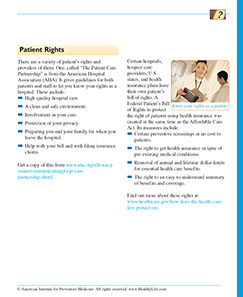
    Image of male patient.

    There are a variety of patient’s rights and providers of them. One, called “The Patient Care Partnership” is from the American Hospital Association (AHA). It gives guidelines for both patients and staff to let you know your rights in a hospital. These include:

    *  High-quality hospital care.

    *  A clean and safe environment.

    *  Involvement in your care.

    *  Protection of your privacy.

    *  Preparing you and your family for when you leave the hospital.

    *  Help with your bill and with filing insurance claims.

    Get a copy of this fromwww.aha.org/advocacy-issues/communicatingpts/pt-care-partnership.shtml.

    Certain hospitals, hospice care providers, U.S. states, and health insurance plans have their own patient’s bill of rights. A Federal Patient’s Bill of Rights to protect the right of patients using health insurance was created at the same time as the Affordable Care Act. Its measures include:

    *  Certain preventive screenings at no cost to patients.

    *  The right to get health insurance in spite of pre-existing medical conditions.

    *  Removal of annual and lifetime dollar limits for essential health care benefits.

    *  The right to an easy-to-understand summary of benefits and coverage.

    Find out more about these rights atwww.healthcare.gov/how-does-the-health-care-law-protect-me.

    Page from the Healthier at Home book by the American Institute for Preventive Medicine. www.HealthyLife.com. All rights reserved.

    © American Institute for Preventive Medicine
  • Review Your Patient Chart

    Medical Care

    Guess what every patient in a hospital has? No, we’re not speaking of those less-than-attractive hospital gowns or the plastic ID bracelets. The answer is a patient chart. Although the chart is legally the property of the hospital and generally kept at a nursing station, the patient should be aware of its content. Ask your doctor for an explanation. The chart may contain the following:

    *  Your medical history.

    *  Hospital laboratory results.

    *  Lists of medications (doses and schedules).

    *  Special treatments or therapy.

    *  Dietary restrictions or recommendations (low-sodium diet, for example).

    *  Scheduled diagnostic procedures (such as X-rays).

    *  Surgical notes (length of operation, assisting medical staff, type of anesthesia administered, recovery notes).

    If you suspect a problem or error-in how often you are being given medication, for instance-ask a nurse or your doctor to show you your chart and explain what is written there.

    Page from A Year of Health Hints book by the American Institute for Preventive Medicine. www.HealthyLife.com. All rights reserved.

    © American Institute for Preventive Medicine