Tag: recovery

  • Collecting Unclaimed Funds

    FINANCIAL HEALTH

    Young couple holding a jar with money in it.

    Could you have money waiting for you? Learn about unclaimed money or property from bank accounts, tax refunds, insurance policies or wages and pensions.

    You can find your unclaimed money for free. Here’s how:

    *  Search in every state where you have lived. Look up each state’s unclaimed property office. You can also try contacting the state treasurer’s office.

    *  Search the FDIC database. If your bank or credit union closed, you could have unclaimed deposits. You can also check out the National Credit Union Administration (NCUA) atwww.ncua.gov/support-services.

    *  Current or former VA life insurance holders can check for unclaimed life insurance funds. Go toinsurance.va.gov/UnclaimedFunds.

    *  Look for tax refunds from an FHA-insured mortgage. If you earned income but your wages were below the tax filing requirement, you might have a refund waiting. Go toirs.gov/refunds to check. If you bought mortgage insurance from the Federal Housing Administration (FHA), you might have a refund. Go toentp.hud.gov/dsrs/refunds.

    *  Do you have unclaimed back wages or pension money from a past employer? Go to the Workers Owed Wages (WOW) website atwebapps.dol.gov/wow. You can also check the Pension Benefit Guaranty Corporation atpbgc.gov.

    Notice that these websites include “gov.” They don’t have a “com” or “org.” The “gov” means it’s an official U.S. Government website. You should never have to pay any money to find or claim your unclaimed money. It’s FREE. Watch out for scammers and people who want to charge you for this service.

    Source: usa.gov

    © American Institute for Preventive Medicine

  • Sleep Tips

    Sleep Well

    Man sleeping.

    Nothing makes you feel better than a good night’s sleep.

    *  Do physical exercise daily.

    *  Follow a regular daily schedule for meals and snacks.

    *  Don’t have more than 1 alcoholic drink with or after dinner. Avoid large meals near bedtime.

    *  Plan to wake up about the same time everyday. Avoid long naps during the day.

    *  Get sunlight everyday, especially in the afternoon.

    *  Dim the lights in the house an hour or two before going to bed.

    *  Follow a bedtime routine. Keep your bedroom dark, quiet, and comfortable.

    *  Limit caffeine. Do not have any for 6 hours before bedtime.

    © American Institute for Preventive Medicine
  • Tips For Exercise After Knee Replacement

    BE FIT

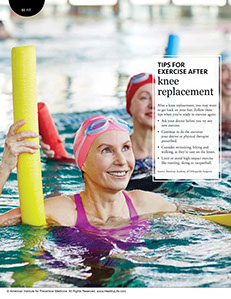
    Three older women doing water exercises.

    After a knee replacement, you may want to get back on your feet. Follow these tips when you’re ready to exercise again:

    *  Ask your doctor before you try any new exercise.

    *  Continue to do the exercises your doctor or physical therapist prescribed.

    *  Consider swimming, biking and walking, as they’re easy on the knees.

    *  Limit or avoid high-impact exercise like running, skiing or racquetball.

    Source: American Academy of Orthopaedic Surgeons

    © American Institute for Preventive Medicine

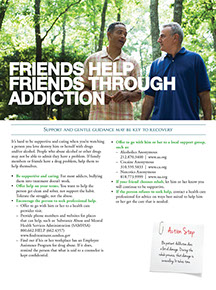
  • Friends Help Friends Through Addiction

    Substance Use & Abuse

    Image of 2 friends walking and talking.

    Support and gentle guidance may be key to recovery.

    It’s hard to be supportive and caring when you’re watching a person you love destroy him or herself with drugs  and/or alcohol. People who abuse alcohol or other drugs may not be able to admit they have a problem. If family members or friends have a drug problem, help them to help themselves.

    Be supportive and caring.

    For most addicts, bullying them into treatment doesn’t work.

    Offer help on your terms.

    You want to help the person get clean and sober, not support the habit. Tolerate the struggle, not the abuse.

    Encourage the person to seek professional help.

    *  Offer to go with him or her to a health care provider visit.

    *  Provide phone numbers and websites for places that can help, such as: Substance Abuse and Mental Health Services Administration (SAMHSA) – 800.662.HELP (662.4357)www.findtreatment.samhsa.gov

    *  Find out if his or her workplace has an Employee Assistance Program for drug abuse. If it does, remind the person that what is said to a counselor is kept confidential.

    If your friend chooses rehab, let him or her know you will continue to be supportive. If the person refuses to seek help, contact a health care professional for advice on ways best suited to help him or her get the care that is needed.

    Offer to go with him or her to a local support group.

    Alcoholics Anonymous

    212.870.3400

    www.aa.org

    Cocaine Anonymous

    310.559.5833

    www.ca.org

    Narcotics Anonymous

    818.773.9999

    www.na.org

    Action Step

    Be patient. Addiction does a lot of damage. During the rehab process, that damage is unraveling. It takes time.

    Page from Ways to Well-Being book by the American Institute for Preventive Medicine. www.HealthyLife.com. All rights reserved.

    © American Institute for Preventive Medicine
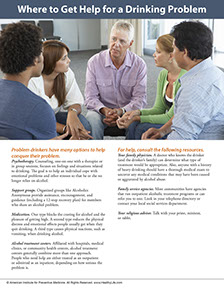
  • Where To Get Help For A Drinking Problem

    Substance Use & Abuse

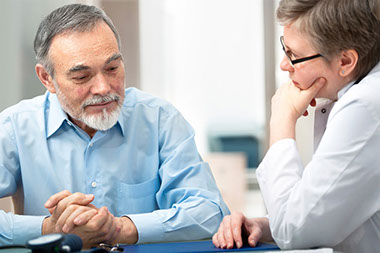
    Image of man seeking help.

    Problem drinkers have many options to help conquer their problem.

    *  Psychotherapy. Counseling, one-on-one with a therapist or in group sessions, focuses on feelings and situations related to drinking. The goal is to help an individual cope with emotional problems and other stresses so that he or she no longer relies on alcohol.

    *  Support groups. Organized groups like Alcoholics Anonymous provide assistance, encouragement, and guidance (including a 12-step recovery plan) for members who share an alcohol problem.

    *  Medication. One type blocks the craving for alcohol and the pleasure of getting high. A second type reduces the physical distress and emotional effects people usually get when they quit drinking. A third type causes physical reactions, such as vomiting, when drinking alcohol.

    *  Alcohol treatment centers. Affiliated with hospitals, medical clinics, or community health centers, alcohol treatment centers generally combine more than one approach. People who need help are either treated as an outpatient or admitted as an inpatient, depending on how serious the problem is.

    For help, consult the following resources.

    *  Your family physician. A doctor who knows the drinker (and the drinker’s family) can determine what type of treatment would be appropriate. Also, anyone with a history of heavy drinking should have a thorough medical exam to uncover any medical conditions that may have been caused or aggravated by alcohol abuse.

    *  Family service agencies. Most communities have agencies that run outpatient alcoholic treatment programs or can refer you to one. Look in your telephone directory or contact your local social services department.

    *  Your religious adviser. Talk with your priest, minister, or rabbi.

    Page from A Year of Health Hints book by the American Institute for Preventive Medicine. www.HealthyLife.com. All rights reserved.

    © American Institute for Preventive Medicine

  • Stretching And Rehabilitation

    Healthylife® Weigh

    Part 5

    Smiling women stretching.

    These exercises make your body more flexible. This helps you prevent injury during exercise and everyday activities. Stretching can also help you relax and is a tool for stress management. Tips:

    *  Stretch all muscle groups. Induce mild tension (not pain or burn) for 10 to 30 seconds.

    *  Don’t bounce while stretching. Make movements slow and controlled.

    *  Breathe slowly. Inhale while stretch is released. Exhale when moving into the stretch.

    *  Stretch after each cardio or resistance training workout.

    *  Stretch as a stand-alone workout or as a way to wind down at the end of the day.

    Examples of Stretching Exercises:

    Shoulder Shrug: Shrug your shoulders up toward your head. Then lower them. Repeat 4 times. Slowly circle your shoulders forward 8 times and then backward 8 times.

    Hamstring Stretch: Sit on the floor with your right leg straight. Bend your left leg and touch your foot against your straight leg. Stretch forward to touch the toes of your right foot. Hold for 4 counts. Then do this on the other side.

    © American Institute for Preventive Medicine
  • Back In Action

    MEDICAL NEWS

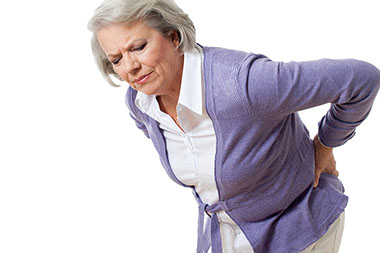
    Image of older women holding her back in pain.

    Back pain. In the last 3 months, about 1 in 4 adults has had at least one day of back pain, mostly in the lower back, according to NIH in Health.

    The good news is that most back pain goes away by itself-in time. If pain continues for more than 3 months, you have chronic back pain. If doctors can find out the source of your pain, you may be treated effectively with certain surgeries.

    But even chronic pain can clear up without surgery. Don’t let the pain take over. Doctors advise:

    *  Stay active and maintain a healthy weight.

    *  Stretch before exercise or other strenuous physical activity.

    *  Don’t slouch when standing or sitting.

    *  Make sure your work surface is at a comfortable height for you.

    *  Wear comfortable, low-heeled shoes.

    *  Lift, if you must, with your back straight, bend at the knees, and put the stress on your legs and hips.

    *  Don’t smoke.

    *  Talk with your doctor to make sure you’re getting enough calcium and vitamin D.

    © American Institute for Preventive Medicine
  • Chocolate Milk May Be The Best-Kept Secret

    HEALTHY EATING

    Image of young boy drinking chocolate milk.

    Chocolate milk may be the best-kept secret for making sure kids get the calcium they need every day. Contrary to popular myths, chocolate milk is nutrient-rich, adds only a few more calories and not much caffeine, and is kids’ number-one flavor pick. Kids have a limited time to build up their “bone bank.” The calcium in chocolate milk is one way to assure timely deposits, according to the National Dairy Council.

    © American Institute for Preventive Medicine