Tag: redness

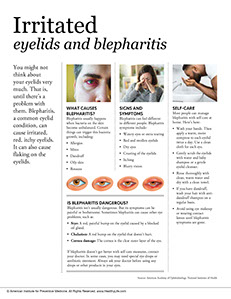
  • Irritated Eyelids And Blepharitis

    SELF-CARE CORNER

    Grandfather and grandson flexing arms.

    You might not think about your eyelids very much. That is, until there’s a problem with them. Blepharitis, a common eyelid condition, can cause irritated, red, itchy eyelids. It can also cause flaking on the eyelids.

    What causes blepharitis?

    Blepharitis usually happens when bacteria on the skin become unbalanced. Certain things can trigger this bacteria growth, including:

    *  Allergies

    *  Mites

    *  Dandruff

    *  Oily skin

    *  Rosacea

    Signs and symptoms

    Blepharitis can feel different to different people. Blepharitis symptoms include:

    *  Watery eyes or extra tearing

    *  Red and swollen eyelids

    *  Dry eyes

    *  Crusting of the eyelids

    *  Itching

    *  Blurry vision

    Self-care

    Most people can manage blepharitis with self-care at home. Here’s how:

    *  Wash your hands. Then apply a warm, moist compress to each eyelid twice a day. Use a clean cloth for each eye.

    *  Gently scrub the eyelids with water and baby shampoo or a gentle eyelid cleanser.

    *  Rinse thoroughly with clean, warm water and dry with a clean towel.

    *  If you have dandruff, wash your hair with anti-dandruff shampoo on a regular basis.

    *  Avoid using eye makeup or wearing contact lenses until blepharitis symptoms are gone.

    Is blepharitis dangerous?

    Blepharitis isn’t usually dangerous. But its symptoms can be painful or bothersome. Sometimes blepharitis can cause other eye problems, such as:

    *Stye:A red, painful bump on the eyelid caused by a blocked oil gland.

    *Chalazion:A red bump on the eyelid that doesn’t hurt.

    *Cornea damage:The cornea is the clear outer layer of the eye.

    If blepharitis doesn’t get better with self-care measures, contact your doctor. In some cases, you may need special eye drops or antibiotic ointment. Always ask your doctor before using any drops or other products in your eyes.

    Sources: American Academy of Ophthalmology, National Institutes of Health

    © American Institute for Preventive Medicine

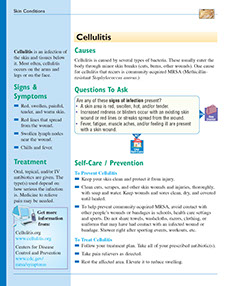
  • Cellulitis

    Skin Conditions

    Cellulitis is an infection of the skin and tissues below it. Most often, cellulitis occurs on the arms and legs or on the face.

    Signs & Symptoms

    *  Red, swollen, painful, tender, and warm skin.

    *  Red lines that spread from the wound.

    *  Swollen lymph nodes near the wound.

    *  Chills and fever.

    Causes

    Cellulitis is caused by several types of bacteria. These usually enter the body through minor skin breaks (cuts, burns, other wounds). One cause for cellulitis that recurs is community-acquired MRSA (Methicillin- resistant Staphylococcus aureus.)

    Treatment

    Oral, topical, and/or IV antibiotics are given. The type(s) used depend on how serious the infection is. Medicine to relieve pain may be needed.

    Questions to Ask

    Self-Care / Prevention

    To Prevent Cellulitis

    *  Keep your skin clean and protect it from injury.

    *  Clean cuts, scrapes, and other skin wounds and injuries, thoroughly, with soap and water. Keep wounds and sores clean, dry, and covered until healed.

    *  To help prevent community-acquired MRSA, avoid contact with other people’s wounds or bandages in schools, health care settings and sports. Do not share towels, washcloths, razors, clothing, or uniforms that may have had contact with an infected wound or bandage. Shower right after sporting events, workouts, etc.

    To Treat Cellulitis

    *  Follow your treatment plan. Take all of your prescribed antibiotic(s).

    *  Take pain relievers as directed.

    *  Rest the affected area. Elevate it to reduce swelling.

    Healthier at Home book by the American Institute for Preventive Medicine. www.HealthyLife.com. All rights reserved.

    © American Institute for Preventive Medicine

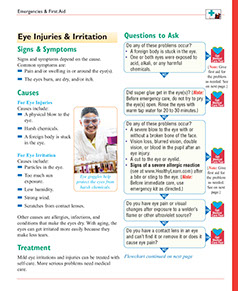
  • Eye Injuries & Irritation

    First Aid

    Signs & Symptoms

    Signs and symptoms depend on the cause. Common symptoms are:

    *  Pain and/or swelling in or around the eye(s).

    *  The eyes burn, are dry, and/or itch.

    Causes

    For Eye Injuries

    *  A physical blow to the eye.

    *  Harsh chemicals.

    *  A foreign body is stuck in the eye.

    For Eye Irritation

    *  Particles in the eye.

    *  Too much sun exposure.

    *  Low humidity.

    *  Strong wind.

    *  Scratches from contact lenses.

    Other causes are allergies, infections, and conditions that make the eyes dry. With aging, the eyes can get irritated more easily because they make less tears.

    Treatment

    Mild eye irritations and injuries can be treated with self-care. More serious problems need medical care.

    Questions to Ask

    Self-Care / Prevention

    For a Foreign Body Sticking Into the Eye

    *  Do not remove the object.

    *  Don’t press on, touch, or rub the eye.

    *  Cover the injured eye with a clean object, such as a paper cup that will shield, but not touch the eye or the foreign object. Use tape to hold the cup in place without putting pressure on the eye or the foreign object.

    *  Gently cover the uninjured eye with a clean bandage and tape, too. This helps to keep the injured eye still. Get Immediate Care!

    For Harmful Chemicals in the Eye(s)

    *  Flush the eye(s) with water immediately!

    *  Hold the injured eye open with your thumb and forefinger. At the faucet or with a pitcher or other clean container, flush the eye with a lot of water. Start at the inside corner and pour downward to the outside corner. This lets the water drain away from the body and keeps it from getting in the other eye.

    *  Keep pouring the water for 10 to 30 or more minutes. Flush the eye with water until you get medical help.

    *  If both eyes are injured, pour water over both eyes at the same time. Or, flush one eye at a time with water. Switch back and forth quickly to treat both eyes. Or, place the face in a sink or container filled with water. Tell the person to move his or her eyelids up and down and remove the face from the water to take breaths. Use this method if chemicals get in your eyes and you are alone.

    *  Loosely bandage the eye with sterile cloth and tape. Don’t touch the eye. Get Medical Care Right Away!

    For a Bruise from a Minor Injury that Surrounds the Eye, But Does Not Damage the Eye Itself

    *  Put a cold compress over the injured area right away. Do this for 15 minutes, every hour, for 48 hours.

    *  Take an over-the-counter medicine for the pain and swelling.

    *  After 48 hours, put a warm compress over the injured area.

    *  Seek medical care if these measures do not help.

    To Remove a Foreign Particle On the White of the Eye or Inside the Eyelids

    *  Do not remove an object stuck in the eye, a metal chip, or a foreign body over the colored part of the eye.

    *  Wash your hands.

    *  If the foreign object is under the upper lid, look down and pull the upper lid away from the eyeball by gently grabbing the eyelashes. Press a cotton-tipped swab down on the skin surface of the upper eyelid and pull it up and toward the brow. The upper lid will invert.

    *  Twist a piece of tissue. Moisten the tip with tap water (not saliva). Gently try to touch the speck with the tip. Carefully pass the tissue over the speck which should cling to the tip.

    *  Do not rub the eye or use tweezers or anything sharp to remove a foreign object.

    *  Gently wash the eye with cool water.

    For Dry, Irritated Eyes

    With your doctor’s okay, use over-the-counter artificial tear drops, such as Ocu-Lube. Refrigerate the solution, if needed. Wash your hands before using.

    For an Insect Bite Without a Severe Allergic Reaction

    *  Wash the eye(s) with warm water.

    *  Take an antihistamine if okay with your doctor.

    Prevention

    *  Wear safety glasses when your eyes are exposed to sawdust, etc. Wear sunglasses that block UV rays.

    *  When using harsh chemicals, wear rubber gloves and protective glasses. Don’t rub your eyes if you’ve touched harsh chemicals. Turn your head away from chemical vapors.

    *  To help prevent dry eyes, use a humidifier. Limit exposure to smoke, dust, and wind. Don’t drink alcohol.

    *  Use artificial tear drops with your doctor’s okay.

    *  Don’t stare directly at the sun, especially during a solar eclipse.

    *  Don’t use eye makeup when an allergy or chemical irritant bothers your eye(s).

    *  Don’t allow a child to stick his or her head out of the window of a moving car, etc. Sand, insects, and other flying objects can strike the eye and irritate or damage the cornea.

    *  Don’t let children play with or near sparklers, bottle rockets, and other fireworks.

    Healthier at Home book by the American Institute for Preventive Medicine. www.HealthyLife.com. All rights reserved.

    © American Institute for Preventive Medicine

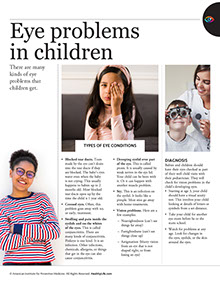
  • Eye Problems

    Children’s Health

    Signs, Symptoms & Causes

    There are many kinds of eye problems that children get. Here are some of them:

    *  Blocked tear ducts. Tears made by the eye can’t drain into the tear ducts if they are blocked. The baby’s eyes water even when the baby is not crying. This usually happens to babies up to 2 months old. Most blocked tear ducts open up by the time the child is 1 year old.

    *  Crossed eyes. Often, this problem goes away with no treatment.

    *  Swelling and pain inside the eyelids and on the whites of the eyes. This is called conjunctivitis. There are many kinds of conjunctivitis. Pinkeye is one kind. It is an infection. Other infections, chemicals, allergens, or things that get in the eye can also cause conjunctivitis.

    *  Drooping eyelid over part of the eye. This is called ptosis. It is usually caused by weak nerves in the eye lid. Your child can be born with it. Or it can happen with another muscle problem.

    *  Sty. This is an infection on the eyelid. It looks like a pimple. Most sties go away with home treatments.

    *  Vision problems. Here are a few examples:

    – Nearsightedness (can’t see things far away).

    – Farsightedness (can’t see things close up).

    – Astigmatism (blurry vision from an eye that is not shaped right, or from losing an eye).

    It’s hard to know if your child has vision problems until he or she is 3 years old. (The eye is still developing until then.)

    *  Take your child for their first  eye exam at 3 years old.

    *  Take your child for another eye exam before he or she starts school.

    *  Watch for problems at any age. Look for changes in the eyes, eyelids, or the skin around the eyes.

    Questions to Ask

    Self-Care

    A doctor should treat a hurt or infected eye. But you can treat some eye problems at home.

    *  For a blocked tear duct:

    1. Wash your hands.

    2. Press gently on the inner corner of the eye with a cotton swab. Press up, not down, for a few seconds to a few minutes.

    *  For dry eyes, try over-the-counter “tears.” Some kinds are Ocu-Lube®, Refresh®, or Liquifilm®. Wash your hands before you put drops in the eyes. If your child’s eyes don’t get better, take him or her to the doctor.

    *  To help with an insect bite, gently wash the eyes with warm water.

    *  To help the pain of a hurt eye that is not infected:

    – Put a warm (not hot), wet wash cloth on the eye for 5 minutes. Do this 2 or 3 times a day.

    – Use over-the-counter eye drops.

    – Don’t  let your child wear contact lenses or makeup until the eye is better.

    *  If the eye is infected:

    – Wash your hands and your child’s hands every time you touch the eye. (Pinkeye is very easy to catch.)

    – Don’t  share a towel with someone who has pinkeye.

    – Keep your child away from light if he or she got pinkeye from the measles.

    – Don’t  cover the eye. This can make the infection worse.

    *  Here’s how to get something out of your child’s eye: (Make sure you can see the speck before you try to get it out.)

    1. Wash your hands.

    2. Drip clean water into the eye to rinse it.

    3. Twist a piece of tissue at each end. Wet the tip with tap water, not spit. Gently touch the speck with the tip. The speck should stick to the tip.

    – Tell your child to look down if the speck is under the upper lid. Pull the upper lid away from the eye. Do this by gently pulling on the eyelashes. When you can see the speck, try to touch it with the tissue.

    – Don’t  rub the eye. And never use anything sharp to touch your child’s eye.

    4. Gently wash the eye with cool water.

    *  To help with pain from a sty:

    – Put a warm (not hot), wash cloth on the sty 3 or 4 times a day for 5 or 10 minutes each time.

    – Keep your child away from dust and dirt that can get in his or her eyes.

    – Don’t poke or squeeze the sty!

    Children's Self-Care book by the American Institute for Preventive Medicine. www.HealthyLife.com. All rights reserved.

    © American Institute for Preventive Medicine

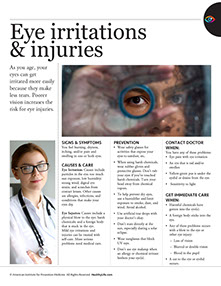
  • Eye Irritations & Injuries

    Eye Conditions

    As you age, your eyes can get irritated more easily because they make less tears. Poorer vision increases the risk for eye injuries.

    Signs & Symptoms

    You feel burning, dryness, itching, and/or pain and swelling in one or both eyes.

    Causes

    For Eye Irritation:

    Causes include particles in the eye; too much sun exposure, low humidity; strong wind; and scratches from contact lenses. Other causes are allergies, infections, and conditions that make your eyes dry.

    For Eye Injuries:

    Causes include a physical blow to the eye; harsh chemicals; and a foreign body that is stuck in the eye.

    Mild eye irritations and injuries can be treated with self-care. More serious problems need medical care.

    Treatment

    *  Wear safety glasses for activities that expose your eyes to sawdust, etc.

    *  When using harsh chemicals, wear rubber gloves and protective glasses. Don’t rub your eyes if you’ve touched harsh chemicals. Turn your head away from chemical vapors.

    *  To help prevent dry eyes, use a humidifier and limit exposure to smoke, dust, and wind. Avoid alcohol.

    *  Use artificial tear drops with your doctor’s okay.

    *  Don’t stare directly at the sun, especially during a solar eclipse.

    *  Wear sunglasses that block UV rays.

    *  Don’t use eye makeup when an allergy or chemical irritant bothers your eye(s).

    Self-Care / Prevention

    To Ease the Discomfort of Dry Eyes:

    With your doctor’s okay, use over-the-counter artificial tear drops, such as Ocu-Lube. Read the label. Refrigerate the solution, if needed. Wash your hands before using.

    To Treat an Insect Bite Without a Severe Allergic Reaction:

    *  Wash the eye(s) with warm water.

    *  Take an antihistamine if okay with your doctor.

    To Remove a Foreign Particle On the White of the Eye or Inside the Eyelids:

    *  Do not remove an object imbedded in the eye, a metal chip, or a foreign body over the colored part of the eye. (See “First Aid for Foreign Body Sticking Into the Eye” on this page.)

    *  Wash your hands.

    *  If the foreign object is under the upper lid, have the person look down and pull the upper lid away from the eyeball by gently grabbing the eyelashes. Press a cotton-tipped swab down on the skin surface of the upper eyelid and pull it up and toward the brow. The upper lid will invert. Touch and remove the debris with the tip of the tissue.

    *  Twist a piece of tissue, moisten the tip with tap water (not saliva) and gently try to touch the speck with the tip. Carefully pass the tissue over the speck, which should cling to the tip.

    *  Do not rub the eye or use tweezers or anything sharp to remove a foreign object.

    *  Gently wash the eye with cool water.

    To Treat a Bruise from a Minor Injury that Surrounds the Eye but Does Not Damage the Eye Itself:

    *  Put a cold compress over the injured area right away. Keep doing this for 15 minutes, every hour, for 48 hours.

    *  Take an over-the-counter medicine

    *  After 48 hours, put a warm compress over the injured area.

    *  Seek medical attention if these measures do not help.

    First Aid for Foreign Body Sticking Into the Eye Before Immediate Care:

    *  Do not remove the object.

    *  Don’t press on, touch, or rub the eye.

    *  Cover the injured eye with a paper cup or other clean object that will not touch the eye or the foreign object. Hold the paper cup in place with tape without putting pressure on the eye or the foreign object.

    *  Gently cover the uninjured eye with a clean bandage and tape, too, to keep the injured eye still.

    First Aid for Harmful Chemicals in the Eye(s) Before Immediate Care:

    *  Flush the eye(s) with water immediately!

    *  Hold the injured eye open with your thumb and forefinger.

    *  At the faucet or with a pitcher or other clean container, flush the eye with a lot of water. Start at the inside corner and pour downward to the outside corner. This lets the water drain away from the body and keeps it from getting in the other eye.

    *  Keep pouring the water for 10 to 30 or more minutes. Flush the eye with water until you get medical help.

    *  If both eyes are injured, pour water over both eyes at the same time or quickly alternate the above procedure from one eye to another. Or, place the victim’s face in a sink or container filled with water. Tell the victim to move his or her eyelids up and down and remove the face from the water at intervals in order to breathe. Use this method on yourself if you are the victim and are alone.

    *  Loosely bandage the eye with sterile cloth and tape. Don’t touch the eye.

    When to Seek Medical Care

    Contact Doctor When:

    You have any of these problems:

    *  Eye pain with eye irritation

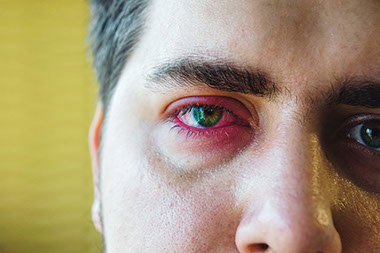
    *  An eye that is red and/or swollen

    *  Yellow-green pus is under the eyelid or drains from the eye.

    Get Immediate Care When:

    *  Harmful chemicals have gotten into the eye(s). {Note: Before you get immediate care, give “First Aid for Harmful Chemicals in the Eye(s) Before Immediate Care” on this page.}

    *  A foreign body sticks into the eye. {Note: See “First Aid for Foreign Body Sticking Into the Eye Before Immediate Care” on this page.}

    *  A cut to the eye or eyelid occurs.

    *  Any of these problems occurs with a blow to the eye or other eye injury:

    – Loss of vision

    – Blurred or double vision

    – Blood in the pupil

    Healthier at Home book by the American Institute for Preventive Medicine. www.HealthyLife.com. All rights reserved.

    © American Institute for Preventive Medicine

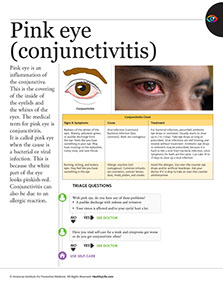
  • Pink Eye (Conjunctivitis)

    Eye Conditions

    Pink eye is an inflammation of the conjunctiva. This is the covering of the inside of the eyelids and the whites of the eyes. The medical term for pink eye is conjunctivitis. It is called pink eye when the cause is a bacterial or viral infection. This is because the white part of the eye looks pinkish-red. Conjunctivitis can also be due to an allergic reaction.

    Signs & Symptoms

    Questions to Ask

    Self-Care / Prevention

    For Pink Eye

    *  Wash your hands often. Don’t share towels, washcloths, etc.

    *  Avoid contact with other people as much as you can until you have used the prescribed antibiotic eye drops, etc. for 24 hours. Follow the rules of your workplace about pink eye. For children, follow the rules of their school.

    *  With your eyes closed, apply a cotton ball soaked in warm (not hot) water to the affected eye 3 to 4 times a day. Do this for at least 5 minutes at a time. Use a clean cotton ball each time.

    *  Throw away any makeup that could be contaminated. Don’t wear eye makeup until the infection is all cleared up. Don’t share makeup with others.

    *  Don’t share eye drops with others.

    *  Don’t put a cover or patch over the eye. This can make the infection grow.

    *  Don’t wear contact lenses while your eyes are infected. Replace contact lenses or disinfect them twice before re-using.

    For Allergic Conjunctivitis

    *  Avoid things you know you are allergic to.

    *  Use over-the-counter eye drops. These soothe irritation and help relieve itching.

    *  Apply a washcloth rinsed in cold water to the eyes. Do this several times a day.

    *  Use protective eyewear when you work with chemicals and fumes.

    Healthier at Home book by the American Institute for Preventive Medicine. www.HealthyLife.com. All rights reserved.

    © American Institute for Preventive Medicine

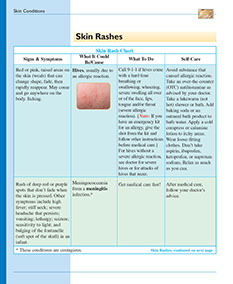
  • Skin Rashes

    Skin Conditions

    This is caused by the varicella-zoster virus. This condition is contagious.

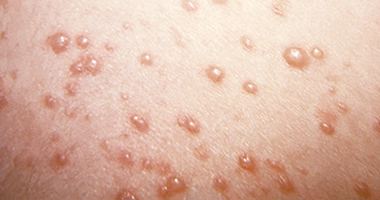
    Chickenpox

    Signs & Symptoms

    Flat, red spots that become raised and look like small pimples. These develop into small blisters that break and crust over. Fatigue and mild fever occur 24 hours before rash appears. Itching may be intense.

    What To Do

    See doctor or health care provider if it occurs in an adult; if self-care measures don’t bring relief in children; or if there are signs of infection (e.g., pus, increased redness, swelling, or pain). A vaccine is given to prevent this disease.

    Self-Care

    Keep from scratching affected areas. Apply cool, wet washcloths with baking soda or calamine lotion to affected areas. Take acetaminophen for fever. Take an OTC antihistamine as advised by your doctor if itching is intense. Chickenpox can be prevented with a chickenpox vaccine.

    Contact Dermatitis

    Causes are direct contact with poison ivy, oak, or sumac or contact with an irritant (cleaning product, cosmetic, jewelry, etc.).

    Signs & Symptoms

    Dry, red, itchy patches of skin. Blisters which may drain and then crust over.

    What To Do

    See doctor or health care provider if self- care measures don’t bring relief or if there are signs of infection (e.g., red streaks, fever, pus, increased redness, swelling, or pain).

    Self-Care

    Try to identify the irritant and avoid direct contact with it. Don’t scratch the rash. For itching, apply calamine lotion or OTC hydrocortisone cream to the affected area. Bathe in warm (not hot) water. Add an oatmeal product to the water. Pat (don’t rub) the skin dry. Take an OTC antihistamine as advised.

    Cradle Cap

    This is due to hormones that pass through the placenta before birth.

    Signs & Symptoms

    Scaly, crusty rash (in newborns) that starts behind the ears and spreads to the scalp.

    What To Do

    Use self-care.

    Self-Care

    Apply mineral oil to the scalp to soften the hard crusts, then use an antidandruff shampoo. Do this 2 to 3 times a week, massaging the scalp with a soft brush or washcloth for 5 minutes. Be sure to wash all of the oil out.

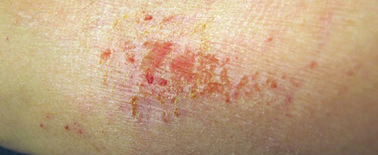
    Eczema (Atopic Dermatitis)

    Image of eczema rash.

    This tends to run in families. It is common in persons with asthma or allergies. Contact with irritants may worsen eczema.

    Signs & Symptoms

    Patches of skin that are dry, red, scaly, blistered, swollen, and sometimes thick, discolored, or oozing and crusting. Commonly occurs in the bend of the elbow or behind the knee.

    What To Do

    See doctor or health care provider if self- care measures don’t bring relief or if there are signs of infection (e.g., red streaks, fever, pus, increased redness, swelling, or pain).

    Self-Care

    Use an OTC hydrocortisone cream on the affected area. Don’t scratch. Don’t bathe too often. When you do, use warm (not hot) water and a mild soap (or no soap). Use a light, nongreasy, unscented lotion (without alcohol) after you wash. Avoid items that worsen the eczema.

    Heat Rash (Prickly Heat)

    Heat rash (prickly heat) or chafing. This occurs from too much sweating.

    Signs & Symptoms

    Rash with small red pimples, pink blotchy skin, and itching. Common sites are between skin folds (armpits, under the breasts, the groin).

    What To Do

    Use self-care.

    Self-Care

    Bathe in cool water without soap every couple of hours. Let your skin air dry. Put cornstarch in body creases or apply calamine lotion to very itchy spots. Don’t use ointments and creams that can block sweat gland pores. Stay in a cool, dry area.

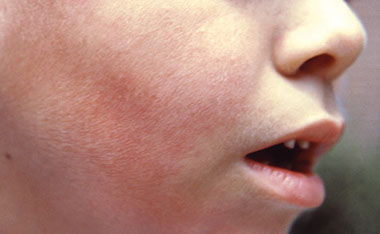
    Fifth Disease

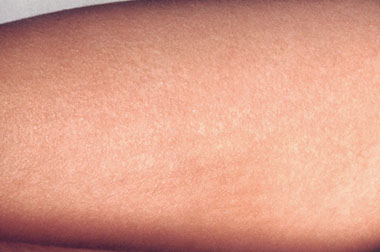
    Image of fifth disease rash.

    This is caused by the Human parvovirus B19. This condition is contagious.

    Signs & Symptoms

    Red rash of varying shades that fades to a flat, lacy pattern. Rash comes and goes. It usually starts on the facial cheeks and then on the arms and legs. This is a mild disease, usually with no other symptoms.

    What To Do

    Use self-care, but no special treatment is required.

    Self-Care

    Avoid hot or even warm baths or showers. Keep cool.

    Hives

    Hives, usually due to an allergic reaction.

    Signs & Symptoms

    Red or pink, raised areas on the skin (weals) that can change shape, fade, then rapidly reappear. May come and go anywhere on the body. Itching.

    What To Do

    Call 9-1-1 if hives come with a hard time breathing or swallowing, wheezing, severe swelling all over or of the face, lips, tongue and/or throat (severe allergic reaction). {Note: If you have an emergency kit for an allergy, give the shot from the kit and follow other instructions before medical care.} For hives without a severe allergic reaction, see doctor for severe hives or for attacks of hives that recur.

    Self-Care

    Avoid substance that caused allergic reaction. Take an over-the-counter (OTC) antihistamine as advised by your doctor. Take a lukewarm (not hot) shower or bath. Add baking soda or an oatmeal bath product to bath water. Apply a cold compress or calamine lotion to itchy areas. Wear loose-fitting clothes. Don’t take aspirin, ibuprofen, ketoprofen, or naproxen sodium. Relax as much as you can.

    Impetigo

    This is caused by a bacterial infection. This condition is contagious.

    Signs & Symptoms

    In infants, pus-filled blisters and red skin. In older children, golden crusts on red sores. Areas affected are the arms, legs, face, and around the nose first, then most of body. Sometimes fever. Occasional itching.

    What To Do

    See doctor or health care provider, especially if self-care measures don’t bring relief, if blisters are larger than 1 inch across, or if a red streak runs from the infection. An antibiotic may need to be prescribed.

    Self-Care

    Clean the area with an antibacterial soap several times a day. Apply an OTC antibiotic ointment 3 times a day after the scab falls off. Wash your hands after contact with the rash area. Don’t share towels, etc.

    Lyme Disease

    This is caused by a deer tick bite.

    Signs & Symptoms

    A fever and red rash 3 days to 2 weeks after a deer tick bite. The rash has raised edges with pale centers. It fades after a few days. Joint pain may develop later.

    What To Do

    See doctor or health care provider for diagnosis. Can be treated with an antibiotic.

    Self-Care

    Follow your doctor’s advice.

    Measles

    This is caused by a virus. This condition is contagious. MMR vaccines prevent measles.

    Signs & Symptoms

    Blotchy red rash that starts on the face and spreads to the rest of the body. Rash lasts about 7 days. These signs come before the rash: Fever; runny nose; sneezing; cough; eyes that look red and are sensitive to light; and blue-white spots in the mouth.

    What To Do

    Call doctor right away to be sure the problem is measles. If it is, follow the doctor’s advice. Let the child’s school and the local health department know.

    Self-Care

    Rest until fever and rash go away. Drink lots of liquids. For fever, take acetaminophen. Treat cough. Avoid lights, TV, reading, etc. while eyes are sensitive to light. Usually okay to return to school about 7 to 10 days after rash and fever are gone.

    Meningococcemia

    Meningococcemia from a meningitis infection. These conditions are contagious.

    Signs & Symptoms

    Rash of deep red or purple spots that don’t fade when the skin is pressed. Other symptoms include high fever; stiff neck; severe headache that persists; vomiting; lethargy; seizure; sensitivity to light; and bulging of the fontanelle (soft spot of the skull) in an infant.

    What To Do

    Get medical care fast!

    Self-Care

    After medical care, follow your doctor’s advice.

    Psoriasis

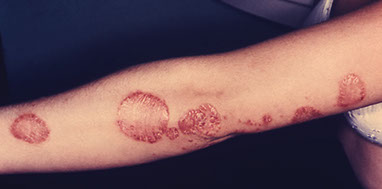
    Image of psoriasis.

    This is a chronic skin disease that tends to run in families. The exact cause is not known.

    Signs & Symptoms

    Itchy, red patches covered with silvery-white flaky skin. Common sites are the scalp, elbows, forearms, knees, and legs.

    What To Do

    See doctor or health care provider if psoriasis affects large areas of skin and/or if self-care measures don’t bring relief.

    Self-Care

    To prevent dryness, use a moisturizer. Use an OTC hydrocortisone or coal tar cream or ointment. If psoriasis affects your scalp, use an antidandruff shampoo. Take a bath with mineral salts or an oatmeal bath product.

    Ringworm

    This is caused by a fungal infection. This condition is contagious.

    Signs & Symptoms

    Redness, itchy, scaly patches on the skin or scalp that are round with distinct edges that grow outward as the infection spreads. Moistness in the folds of the skin (under the breasts or in the groin area). Bald spots may appear on the scalp.

    What To Do

    See doctor or health care provider for diagnosis and treatment, especially if you have not had this before or if ringworm occurs on the scalp or in several patches on the skin.

    Self-Care

    Follow your doctor’s advice.

    Rocky Mountain Spotted Fever

    Rocky mountain spotted fever, 1 to 14 days after a bite from an American dog tick or Rocky Mountain woodtick. These conditions are contagious.

    Signs & Symptoms

    Pink to red rash on the arms, legs, and palms of the hands. Often starts near the wrists and ankles, then spreads inward. Rash darkens in color, spreads, and can bleed. Sudden high fever with chills, severe headache, and delirium also occur.

    What To Do

    Contact doctor right away.

    Self-Care

    Follow your doctor’s advice.

    Rosacea (Adult Acne)

    The exact cause is not known. It may result from overuse of corticosteroid creams or alcohol use.

    Signs & Symptoms

    Red rash on the face. Red nose that looks swollen and puffy cheeks. May have pus-filled spots without blackheads or whiteheads.

    What To Do

    See doctor or health care provider if rosacea affects large areas of skin and/or if self-care measures don’t bring relief.

    Self-Care

    Avoid hot and/or spicy foods, alcohol, and caffeine. Don’t rub or massage the face. Avoid strong sunlight.

    Roseola

    This is caused by the Herpes type-6 virus.

    Signs & Symptoms

    Flat, rosy red rash on the chest and abdomen. A high fever occurs 2 to 4 days before the rash. The child feels only mildly ill when the fever is present.

    What To Do

    See doctor or health care provider if high fever causes febrile seizure.

    Self-Care

    Take acetaminophen for fever. Apply cool, wet washcloths or take baths with tepid (not cold) water.

    Scabies

    This is caused by skin parasites called itch mites. This condition is contagious.

    Signs & Symptoms

    Tiny red pimples that itch intensely, usually between the fingers, on the wrists and genitals; in the armpits; and along the belt line. Scabs and sores may form.

    What To Do

    See doctor or health care provider for diagnosis. Can be treated with a prescribed topical medicine.

    Self-Care

    Follow your doctor’s instructions. Wash clothing and bedding in hot water and detergent.

    Scarlet Fever

    Image of scarlet fever.

    This is caused by a bacterial infection. These conditions are contagious.

    Signs & Symptoms

    Rough, bright red rash (feels like sandpaper) on the face, neck, elbows, armpits, and groin. It spreads rapidly to entire body. A high fever and weakness occur before the rash. Other symptoms include sore throat, peeling of the skin, vomiting, and swollen tongue.

    What To Do

    See doctor or health care provider for diagnosis. Can be treated with an antibiotic.

    Self-Care

    Take acetaminophen for fever. Rest and drink plenty of fluids.

    Seborrhea

    This is a type of dermatitis. The glands in the skin make too much oil.

    Signs & Symptoms

    Scaly, oily rash with small, reddish-yellow patches. Areas affected are usually oily ones (the edge of the scalp, forehead, nose, and eyebrows) and the back and chest.

    What To Do

    See doctor or health care provider if self- care measures don’t bring relief or if there are signs of infection (e.g., red streaks, fever, pus, increased redness, swelling, or pain).

    Self-Care

    Use an OTC antidandruff shampoo with salicylic acid on the scalp area. Use OTC hydrocortisone cream on the affected skin areas. Handle the skin gently. Don’t scratch. Don’t use irritants like detergents.

    Shingles

    Image of the shingles.

    Shingles from the herpes zoster virus.* (Persons who have not had chicken pox or a vaccine for it can get chicken pox from exposure to shingles.) These conditions are contagious.

    Signs & Symptoms

    Rash of painful red blisters (most often on only one side and in only one area of the body). Pain, itching, burning, or tingling feeling before the rash appeared.

    What To Do

    See doctor or health care provider within 24 to 72 hours for an oral antiviral medicine. This can shorten the course of shingles and make symptoms less severe. {Note: All adults 60 years of age and older are advised to get a vaccine that can help prevent shingles and reduce the pain due to shingles.}

    Self-Care

    Take pain relievers as advised by your doctor. For itching, apply calamine lotion or a paste made of 3 teaspoons of baking soda mixed with 1 teaspoon of water to the affected area. Apply a cool, wet compress to blisters for 20 minutes at a time. Wash (don’t scrub) blisters until they crust over. Drink plenty of liquids.

    Syphilis

    This is a sexually transmitted disease caused by a specific bacterial infection. This condition is contagious.

    Signs & Symptoms

    Widespread red rash on the palms of the hands, soles of the feet, and sometimes around the mouth and nose. The small, red, scaly bumps do not itch. Other types of rashes, swollen lymph nodes, fever, and flu-like symptoms may also occur.

    What To Do

    See doctor or health care provider for diagnosis. Can be treated with an antibiotic.

    Self-Care

    Follow your doctor’s advice.

    West Nile Virus

    West Nile virus, 3 to 15 days after a bite from a mosquito infected with the virus.

    Signs & Symptoms

    Rash on the trunk of the body with fever, headache, bodyaches, and swollen lymph glands.

    What To Do

    See doctor right away.

    Self-Care

    Follow your doctor’s advice.
    Healthier at Home book by the American Institute for Preventive Medicine. www.HealthyLife.com. All rights reserved.

    © American Institute for Preventive Medicine

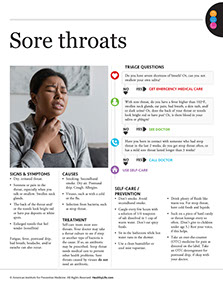
  • Sore Throats

    Ear, Nose & Throat Conditions

    Signs & Symptoms

    *  Dry, irritated throat.

    *  Soreness or pain in the throat, especially when you talk or swallow. Swollen neck glands.

    *  The back of the throat and/or the tonsils look bright red or have pus deposits or white spots.

    *  Enlarged tonsils that feel tender (tonsillitis).

    Fatigue, fever, postnasal drip, bad breath, headache, and/or earache can also occur.

    Causes

    *  Smoking

    *  Dry air

    *  Postnasal drip

    *  Cough

    *  Allergies

    *  Viruses, such as with a cold or the flu.

    *  Infection from bacteria, such as strep throat.

    Treatment

    Self-care treats most sore throats. Your doctor may take a throat culture to see if strep or another type of bacteria is the cause. If so, an antibiotic may be prescribed. Strep throat needs medical care to prevent other health problems. Sore throats caused by viruses do not need an antibiotic.

    Questions to Ask

    Self-Care / Prevention

    *  Don’t smoke. Avoid secondhand smoke.

    *  Gargle every few hours with a solution of 1/4 teaspoon of salt dissolved in 1 cup of warm water. Don’t eat spicy foods.

    *  Drink plenty of fluids like warm tea. For strep throat, have cold foods and liquids.

    *  Sit in the bathroom while hot water runs in the shower. Use a cool-mist vaporizer in the room where you spend most of your time.

    *  Suck on a piece of hard candy or throat lozenge every so often. (Don’t give to children under age 5.) Rest your voice, if this helps.

    *  Take an over-the-counter (OTC) medicine for pain as directed on the label. Take an OTC decongestant for postnasal drip, if okay with your doctor.

    Healthier at Home book by the American Institute for Preventive Medicine. www.HealthyLife.com. All rights reserved.

    © American Institute for Preventive Medicine

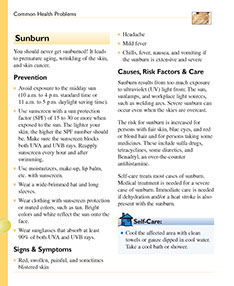
  • Sunburn

    Skin Conditions

    You should never get sunburned! It leads to premature aging, wrinkling of the skin, and skin cancer.

    Signs & Symptoms

    *  Red, swollen, painful, and sometimes blistered skin

    *  Headache

    *  Mild fever

    *  Chills, fever, nausea, and vomiting if the sunburn is extensive and severe

    Causes, Risk Factors & Care

    Sunburn results from too much exposure to ultraviolet (UV) light from: The sun, sunlamps, and workplace light sources, such as welding arcs. Severe sunburn can occur even when the skies are overcast.

    The risk for sunburn is increased for persons with fair skin, blue eyes, and red or blond hair and for persons taking some medicines. These include sulfa drugs, tetracyclines, some diuretics, and Benadryl, an over-the-counter antihistamine.

    Self-care treats most cases of sunburn. Medical treatment is needed for a severe case of sunburn. Immediate care is needed if dehydration and/or a heat stroke is also present with the sunburn.

    Prevention

    *  Avoid exposure to the midday sun (10 a.m. to 4 p.m. standard time or 11 a.m. to 5 p.m. daylight saving time).

    *  Use sunscreen with a sun protection factor (SPF) of 15 to 30 or more when exposed to the sun. The lighter your skin, the higher the SPF number should be. Make sure the sunscreen blocks both UVA and UVB rays. Reapply sunscreen every hour and after swimming.

    *  Use moisturizers, make-up, lip balm, etc. with sunscreen.

    *  Wear a wide-brimmed hat and long sleeves.

    *  Wear clothing with sunscreen protection or muted colors, such as tan. Bright colors and white reflect the sun onto the face.

    *  Wear sunglasses that absorb at least 90% of both UVA and UVB rays.

    Self-Care

    *  Cool the affected area with clean towels or gauze dipped in cool water. Take a cool bath or shower.

    *  Take an over-the-counter medicine for pain and/or fever.

    *  Apply aloe vera gel to the sunburned area 2 to 3 times a day.

    *  When you go in the sun again, wear sunscreen and cover sunburned skin so you don’t get burned more.

    *  Rest in a cool room. Find a position that doesn’t hurt the sunburn.

    *  Drink plenty of water.

    *  Don’t use local anesthetic creams or sprays that numb pain, such as Benzocaine or Lidocaine. If you must use them, use only a little, because they cause allergic reactions in some people.

    Signs & Symptoms

    Contact Doctor When:

    You have a fever of 102°F or higher and/or severe pain or blistering with a sunburn.

    Get Immediate Care When:

    You have signs of heat stroke.

    Health at Home Lifetime book by the American Institute for Preventive Medicine. www.HealthyLife.com. All rights reserved.

    © American Institute for Preventive Medicine