Tag: response

  • Relaxation Reflex 2

    Healthylife® QuitWell™

    Part 4

    Image of several people doing yoga.

    This skill involves relaxing 4 basic muscle groups. Tightening and releasing the muscles produces a soothing effect which helps you relax. Taking slow deep breaths and dropping the head and shoulders forward add to the effect.

    Practice every day for about 5-10 minutes. Divide the body into 4 muscle groups. Tense each group for 5-10 seconds, then release.

    *Arms and Hands– Lift arms, bend wrists and elbows, make fists, tighten upper arms.

    *Face and Neck– Squinch eyes, nose, cheeks, and brows, stretch mouth and grit teeth, point chin down toward chest.

    *Middle Torso– Push shoulders back, tighten stomach and small of back.

    *Legs and Feet– Lift legs off floor, hold straight out, point toes toward face, tighten thighs.

    When I will try this?

    (After) How did your body feel after this activity?

    (After) How did your stress level change after this activity?

    Practice this strategy regularly. It may not help you the first time you try it, but the next time it might. As you get better at it, it may become even more helpful to you.

    © American Institute for Preventive Medicine

  • How To Handle Criticism

    WORK LIFE

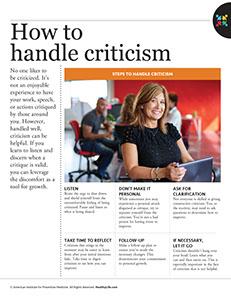
    Women at the office sitting in chair, smiling.

    No one likes to be criticized. It’s not an enjoyable experience to have your work, speech, or actions critiqued by those around you. However, handled well, criticism can be helpful. If you learn to listen and discern when a critique is valid, you can leverage the discomfort as a tool for growth.

    Steps to handle criticism

    Listen

    Resist the urge to shut down and shield yourself from the uncomfortable feeling of being criticized. Pause and listen to what is being shared.

    Don’t make it personal

    While sometimes you may experience a personal attack disguised as critique, try to separate yourself from the criticism. You’re not a bad person for having room to improve.

    Ask for clarification

    Not everyone is skilled at giving constructive criticism. You, as the receiver, may need to ask questions to determine how to improve.

    Take time to reflect

    Criticism that stings in the moment may be easier to learn from after your initial emotions fade. Take time to digest criticism to see how you can improve.

    Follow-up

    Make a follow-up plan to ensure you’ve made the necessary changes. This demonstrates your commitment to personal growth.

    If necessary, let it go

    Criticism shouldn’t hang over your head. Learn what you can and then move on. This is especially important in the face of criticism that is not helpful.

    © American Institute for Preventive Medicine
  • In Case Of Accidental Poisoning, Act Fast

    First Aid

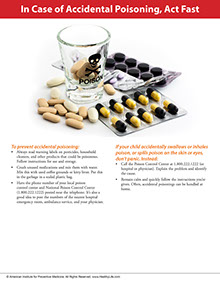
    Image of skull and bones that represent poison.

    To prevent accidental poisoning:

    *  Always read warning labels on pesticides, household cleaners, and other products that could be poisonous. Follow instructions for use and storage.

    *  Crush unused medications and mix them with water. Mix this with used coffee grounds or kitty litter. Put this in the garbage in a sealed plastic bag.

    *  Have the phone number of your local poison control center and National Poison Control Center (1.800.222.1222) posted near the telephone. It’s also a good idea to post the numbers of the nearest hospital emergency room, ambulance service, and your physician.

    If your child accidentally swallows or inhales poison, or spills poison on the skin or eyes, don’t panic. Instead:

    *  Call the Poison Control Center at 1.800.222.1222 (or hospital or physician). Explain the problem and identify the cause.

    *  Remain calm and quickly follow the instructions you’re given. Often, accidental poisonings can be handled at home.

    A Year of Health Hints book by the American Institute for Preventive Medicine. www.HealthyLife.com. All rights reserved.

    © American Institute for Preventive Medicine

  • Relaxation Reflex

    Healthylife® Weigh

    Part 6

    Man stretching at desk.

    This skill relaxes four basic muscle groups. Tightening and relaxing these muscles produces a soothing effect that helps you relax. Take slow, deep breaths, drop your head, and place your shoulders forward to add to the effect.

    Practice every day for about 5 to 10 minutes. Divide the body into 4 muscle groups. Tense each group for 5 seconds, then release.

    1.Arms and Hands– Lift your arms, bending them at your wrists and elbows. Make fists and tighten your upper arms.

    2.Face and Neck– Squinch your eyes, nose, cheeks, and brow. Stretch your mouth and grit your teeth. Point your chin down toward your chest.

    3.Middle Torso– Push your shoulders back. Tighten your stomach and the middle of your back.

    4.Legs and Feet– Lift your legs off the floor and hold them straight out. Point your toes toward your face. Tighten your thighs.

    © American Institute for Preventive Medicine