Tag: rest

  • Colds & Flu

    Children’s Health

    Colds and flu are infections of the nose and throat. Both are caused by viruses.

    It can be hard to tell if your child has a cold or the flu. Why? They both have the same type of symptoms. But symptoms for the flu are worse than ones for a cold. Flu symptoms come on fast. Ones for a cold come on slower.

    Signs & Symptoms
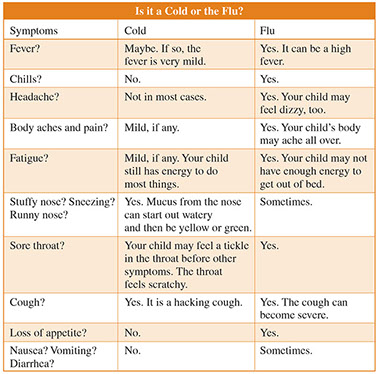
    Chart showing symptoms of a cold vs a flu.

    Prevention

    Antibiotics do not treat colds and flu. Most colds clear up in about a week. Sometimes, a cold lasts up to 2 weeks.

    Fever and most flu symptoms usually go away after 5 days, but coughing and feeling weak can last up to 2 weeks.

    To Help Prevent Colds and Flu

    *  Take your child for a yearly flu vaccine as advised.

    *  Don’t smoke or let your child smoke.

    *  Keep your child away from persons who have the flu or a cold.

    *  See that your child eats and sleeps well and gets lots of exercise.

    Tell your child to do these things:

    *  Wash your hands often. Keep them away from your nose, eyes, and mouth.

    *  Cover your nose when you sneeze. Use a handkerchief or tissues when you sneeze, cough, or blow your nose. This helps prevent passing germs to others.

    Questions to Ask

    Self-Care

    Have your child do these things:

    *  Rest.

    *  Drink lots of liquids. They help clear out the respiratory tract. This can help prevent other problems, like bronchitis.

    *  Eat chicken soup. It helps clear out mucus.

    If your child’s throat is sore, have him or her do these things:

    *  Gargle every few hours with 1/4 teaspoon of salt in 1/2 cup of warm water, if able to. (A child can usually do this starting at age 6.)

    *  Suck on a piece of hard candy or cough drop once in a while. (Don’t  give these to children under 5 years old.)

    Things you can do:

    *  Try to clear your child’s nose. This is very important in babies under 6 months old, because some can’t breathe through their mouths yet. Also, they can’t breast or bottle-feed if they can’t breathe through the nose. To clear your child’s nose:

    – Use an over-the-counter spray or drops for the nose made of salt and water. An example is Ocean® brand. Follow the label’s advice or that of your child’s doctor.

    – For a baby who can’t blow his or her nose, leave the salt drops in for 1 minute. Then use a soft rubber suction bulb to draw out the mucus. Lie the baby on his or her back. Aim the bulb straight down, not at an angle! (You can get a suction bulb at the drug store.) Or use a cotton swab to wipe the mucus out. Don’t put the suction bulb or cotton swab too far into the nose. You could cause a nosebleed.

    – For a child who can blow his or her own nose, have the child do it 1 minute after the salt drops are in.

    *  Put a cool-mist vaporizer or humidifier in your child’s room. Use distilled (not tap) water. Clean it every day.

    *  For fever and muscle aches, give your child acetaminophen or ibuprofen. Make sure you give the right kind and dose for your child’s weight. (Note: Do not give aspirin. Aspirin and other medicines that have salicylates have been linked to Reye’s Syndrome.

    *  Check with your child’s doctor about using over-the-counter medicines for colds and flu for children under  age 2.

    *  Call your child’s doctor if he or she gets a fever after a cold or after the flu has gone away.

    *  Washing the hands often helps stop spreading the flu. Have your child wash his or her hands:

    – After playing with others.

    – When he or she gets home from school.

    – After blowing his or her nose.

    – After touching toys or other people’s things.

    Signs of Reye’s Syndrome

    Be on the lookout for Reye’s Syndrome after the flu or chickenpox. Reye’s Syndrome does not happen very often. But you should know about it. Look for these signs:

    *  Vomiting over and over again. Or vomiting that does not stop.

    *  Loss of pep and energy.

    *  Acting very, very sleepy.

    *  Acting very, very cranky.

    *  Striking out at others.

    *  Acting strange.

    *  Convulsions.

    (Note: If your child shows signs of Reye’s Syndrome, get medical care fast!)
    Children's Self-Care book by the American Institute for Preventive Medicine. www.HealthyLife.com. All rights reserved.

    © American Institute for Preventive Medicine
  • Laryngitis

    Ear, Nose & Throat Conditions

    Laryngitis is when your larynx (voice box) is irritated or swollen.

    Signs & Symptoms

    *  Hoarse, husky, and weak voice or loss of voice.

    *  Cough.

    *  Sore throat, fever, and/or trouble swallowing.

    Causes

    Common causes are allergies and irritants like smoke; bacterial or viral infections; and strained vocal cords. Smoking, drinking alcohol, breathing cold air, and using already distressed vocal cords can make the problem worse. Growths on the vocal cords or nerve damage to the vocal cords can also cause hoarseness.

    Treatment

    Self-care treats most cases of laryngitis. If needed, your doctor may prescribe an antibiotic for a bacterial infection.

    Questions to Ask

    Self-Care / Prevention

    *  Don’t smoke. Avoid secondhand smoke.

    *  Don’t talk if you don’t need to. Write notes, instead.

    *  Use a cool-mist humidifier in your bedroom.

    *  Drink a lot of fluids. Drink warm drinks, such as weak tea, with honey and/or lemon juice.

    *  Gargle every few hours with warm salt water (1/4 teaspoon of salt in 1 cup of warm water).

    *  Run hot water in the shower to make steam. Sit in the bathroom and breathe the moist air.

    *  Suck on cough drops, throat lozenges, or hard candy. (Don’t give to children under age 5.) Take an over-the-counter medicine for pain as directed on the label.

    Resources

    American Academy of Otolaryngology –

    Head and Neck Surgery

    www.entnet.org

    Healthier at Home book by the American Institute for Preventive Medicine. www.HealthyLife.com. All rights reserved.

    © American Institute for Preventive Medicine
  • Sleep Disorders & Snoring

    General Health Conditions

    Not getting enough sleep can cause you to be sleepy during the day. It can make you less able to function. Snoring and sleep disorders can cause these problems, too.

    Insomnia

    Signs & Symptoms

    *  Having trouble falling asleep. Waking up in the middle of the night. Waking up too early and not being able to get back to sleep.

    *  Feeling like you didn’t get enough sleep.

    Causes

    *  Too much caffeine. Drinking alcohol and/or smoking before bedtime.

    *  Too much noise when falling asleep.

    *  Emotional stress. Depression. Anxiety. The manic phase of bipolar disorder.

    *  Fibromyalgia.

    *  Over active thyroid gland.

    *  Any condition, illness, injury, or surgery that causes enough pain or discomfort to interrupt sleep. Heart or lung conditions that cause shortness of breath when lying down. Side effects of some medicines, such as over-the-counter diet pills or decongestants.

    *  Changes in sleep/wake schedules, such as with work shift changes and jet lag.

    *  In children, nightmares or bed-wetting.

    Treatment

    *  Self-care and prevention tips.

    *  Treating the problem.

    *  Prescribed short-acting sleeping pills.

    Self-Care / Prevention

    *  Avoid caffeine for 8 hours before bedtime.

    *  Avoid long naps during the day.

    *  Have no more than 1 alcoholic drink with or after dinner.

    *  Avoid using electronic devices, such as a laptop computer before falling asleep and in the middle of the night. The type of light that emits from these devices makes it hard to fall asleep.

    *  Avoid nicotine. Don’t smoke. Stay away from secondhand smoke.

    *  Get regular exercise, but not within a few hours of going to bed.

    *  Before bedtime, take a warm bath or read a book, etc. Avoid things that hold your attention, such as watching a suspense movie.

    *  Keep your bedroom quiet, dark, and comfortable.

    *  Follow a bedtime routine. Lock or check doors and windows, brush your teeth, etc.

    *  Count sheep! Picture a repeated image. Doing this may bore you to sleep.

    *  Listen to recordings that help promote sleep.

    *  Take over-the- counter sleep aids, (e.g., melatonin, Tylenol PM, etc.) as advised by your doctor. Don’t take anyone else’s sleeping pills.

    *  If you wake up and can’t get back to sleep or can’t fall asleep, after 30 minutes, get out of bed. Read a relaxing book or sit quietly in the dark. In about 20 minutes, go back to bed. Do this as many times as needed.

    Restless Leg Syndrome (RLS) and Periodic Limb Movements in Sleep (PLMS)

    Signs & Symptoms

    *  Creeping, crawling, pulling and/or painful feelings in one or both legs.

    *  Jerking or bending leg movements that you can’t control during sleep.

    Causes

    The cause is not known. These factors play a role:

    *  Family history of RLS.

    *  The last months of a pregnancy.

    *  Chronic diseases, such as kidney failure, diabetes, and rheumatoid arthritis.

    Treatment

    *  Self-care and prevention tips.

    *  Prescribed medicines to control symptoms.

    *  A type of electric nerve stimulation.

    Self-Care / Prevention

    *  Take medications as prescribed. Let your doctor know if the medicine no longer helps.

    *  For relief, move the legs. Walk, rub, or massage them or do knee bends.

    *  Limit or avoid caffeine.

    *  Take a warm bath before bedtime.

    Sleep Apnea

    Signs & Symptoms

    *  Loud snoring and snorting sounds while sleeping on the back.

    *  Repeated periods when breathing stops 10 or more seconds during sleep.

    *  Waking up many times during the night. Excessive daytime sleepiness.

    *  Exhaustion. Hard time concentrating. Acting very cranky. Depression or other mental changes.

    *  Early morning headaches.

    Causes

    *  Too much muscle tissue is in the airway or the tissue relaxes and sags. These things narrow or block the airway. Persons who snore loudly and are overweight are more prone to these problems.

    *  A physical problem in the nose or upper airway.

    Treatment

    The goal is to keep the airway open during sleep. This is done with self-care measures and one of these treatments:

    *  A mouth guard dental device custom made by a dentist. This is worn during sleep. It pushes the lower jaw forward to open the air passage behind the tongue.

    *  A nasal continuous positive airway pressure (CPAP) device. Pressure from an air blower forces air through the nasal passages using a mask worn over the nose during sleep.

    *  Surgery to correct the cause of the airway obstruction.

    Self-Care / Prevention

    *  Lose weight, if you are overweight.

    *  Don’t drink alcohol. Don’t use tobacco products.

    *  Don’t take sleeping pills or sedatives.

    *  Use methods, such as those listed under Self-Care / Prevention – For Snoring to keep from sleeping on your back.

    Snoring

    Signs & Symptoms

    *  Loud sounds. Harsh breathing. Snorting sounds. These occur during sleep.

    Causes

    *  Sleeping on the back. The tongue falls back toward the throat and partly closes the airway.

    *  Nasal congestion from allergies or colds. Smoking. Drinking alcohol. Taking sedatives. Overeating (especially before bedtime).

    *  Sleep apnea or chronic respiratory disease.

    *  An obstructed airway. This can be due to enlarged tonsils or being overweight.

    *  Changes in hormones, such as during menopause or the last month of pregnancy.

    Treatment

    Self-care treats most cases. Other options are:

    *  Wearing a dental device that holds the jaw in a forward position.

    *  Surgery, if needed, to correct the problem.

    *  Treatment for sleep apnea, if needed.

    Self-Care / Prevention

    *  Sleep on your side. Prop an extra pillow behind your back so you won’t roll over. Sleep on a narrow sofa for a few nights to get used to staying on your side.

    *  Sew a large marble or tennis ball into a pocket on the back of your pajamas. This can help you stay on your side when you sleep.

    *  If you must sleep on your back, raise the head of the bed 6 inches on bricks or blocks. Or buy a wedge that is made to be placed between the mattress and box spring to elevate the head section.

    *  Lose weight, if you are overweight. Excess fatty tissue in the throat can cause snoring. Losing 10% of your body weight will help.

    *  Don’t smoke. If you do, quit. Limit or don’t have alcohol, sedatives, or a heavy meal within 3 hours of bedtime.

    *  To relieve nasal congestion, try a decongestant before you go to bed.

    *  Get rid of allergens in the bedroom. These include dust, down-filled (feathered) pillows, and down-filled bed linen.

    *  Try over-the-counter “nasal strips.” These keep the nostrils open and lift them up. This helps lessen congestion in nasal passages.

    Questions to Ask

    How Much Sleep is Needed?

    *  Adults need between 7 and 9 hours of sleep each night.

    *  Teens need at least 8-1/2 to 9-1/4 hours of sleep each night.

    *  After 6 months of age, most children sleep between 9 and 12 hours at night. Up to age 5, children may also take daytime naps for a total of 1/2 to 2 hours a day.

    Resources

    National Center on Sleep Disorders Research (NCSDR)

    301.435.0199

    www.nhlbi.nih.gov/about/ncsdr

    National Sleep Foundation

    703.243.1697

    www.sleepfoundation.org

    Healthier at Home book by the American Institute for Preventive Medicine. www.HealthyLife.com. All rights reserved.

    © American Institute for Preventive Medicine

  • Tips For A Healthier, Easier Pregnancy

    Pregnancy & Prenatal Care

    Close up image of 4 pregnant bellies.

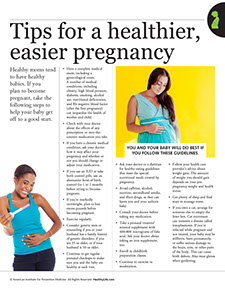
    Healthy moms tend to have healthy babies. If you plan to become pregnant, take the following steps to help your baby get off to a good start.

    *  Have a complete medical exam, including a gynecological exam. A number of medical conditions, including obesity, high blood pressure, diabetes, smoking, alcohol use, nutritional deficiencies, and Rh negative blood factor (after the first pregnancy) can jeopardize the health of mother and child.

    *  Check with your doctor about the effects of any prescription or over-the-counter medication you take.

    *  If you have a chronic medical condition, ask your doctor how it may affect your pregnancy and whether or not you should change or adjust your medication.

    *  If you use an IUD or take birth control pills, use an alternative form of birth control for 1 to 2 months before trying to become pregnant.

    *  If you’re markedly overweight, plan to lose excess pounds before becoming pregnant.

    *  Exercise regularly.

    *  Consider genetic tests or counseling if you or your husband has a family history of genetic disorders, if you are 35 or older, or if your husband is 50 or older.

    You and your baby will do best if you follow these guidelines.

    *  Ask your doctor or a dietitian to outline a meal plan that meets the special nutritional needs created by pregnancy.

    *  Avoid caffeine, alcohol, nicotine, and illicit drugs, as they can harm you and your unborn baby.

    *  Consult your doctor before taking any medication.

    *  Ask your doctor what prenatal vitamin/mineral supplement you should take.

    *  Follow your health care provider’s advice about weight gain. The amount of weight you gain should depend on your pre-pregnancy weight and health status, as well as your ethnic background. If you are very overweight, plan to lose excess pounds before you get pregnant.

    *  Continue to exercise in moderation.

    *  Practice relaxation and other stress management techniques. (Doctors think emotional stress may constrict the blood supply to the uterus and placenta, the baby’s only source of oxygen and nutrients.)

    *  Enroll in childbirth preparation classes.

    *  If you own a cat, arrange for someone else to empty the litter box. Cat excrement can transmit a disease called toxoplasmosis. If you’re infected while pregnant, your baby may be stillborn, born prematurely, or suffer serious damage to the brain, eyes, or other parts of the body.

    A Year of Health Hints book by the American Institute for Preventive Medicine. www.HealthyLife.com. All rights reserved.

    © American Institute for Preventive Medicine
  • Avoid Drowsy Driving

    Healthylife® Weigh

    Part 3

    Alert driver.

    Driving while sleepy can severely impair your driving and cause an accident. Studies have linked sleepiness and fatigue to decreases in reaction time, decision-making, and mind and body coordination. All of these factors are very important for safe driving.

    According to estimates from the National Safety Council in 2017, one out of every five deadly traffic crashes is due to drowsy driving.

    Drive when you feel alert. On long drives, plan 15-minute breaks to get out and stretch your legs every 2 hours. Avoid using food to stay alert. Closing your eyes for even a second (called microsleep) can be enough to travel blindly down the road (or off the road). If you drive while you are fatigued, you and anyone around you is at serious risk.

    Signs of Fatigue

    *  You can’t stop yawning.

    *  You have trouble keeping your head up.

    *  Your eyes close for a moment or go out of focus.

    *  You have wandering, disconnected thoughts.

    *  You have no memory of driving the last few miles.

    *  You miss seeing a sign or your exit.

    *  You slow down when you don’t mean to or brake suddenly or too late.

    *  You drift across the road or veer off onto rumble strips.

    What to do:

    *  Pull to the side of the road or go to a rest stop.

    *  Take a 15-20-minute nap. If you can, have 250-300 mg of caffeine (about 2 cups of coffee) before the nap.

    *  Get a non-drowsy person to drive or find some way of getting to your destination without driving yourself.

    *  Drive to a motel or place where you can sleep.

    © American Institute for Preventive Medicine

  • Exercise And Sleep

    Healthylife® Weigh

    Part 5

    Women sleeping.

    Physical activity can help you sleep better. After your body has worked hard, deep sleep is triggered to help your body recover, repair, and get ready for more activity. This natural drive helps you fall asleep and sleep more restfully.

    Be active outdoors, when possible. Outdoor physical activity increases exposure to sunlight. This helps to strengthen your body’s circadian rhythm (natural sleep clock). A stronger circadian rhythm helps you feel sleepy when it’s time to rest.

    Sleep Helps You Recover from Exercise

    Physical activity triggers a cycle of muscle break-down and repair. The repair process depends on sleep. Without enough sleep, repair is limited. This can increase the risk of injury and limit athletic goals (e.g., running or walking farther or lifting more weight).

    Severe sleep restriction (less than four hours per night) can cause dramatic increases in your heart rate and blood pressure. This strains your heart. Not only does this limit your ability to exercise, but your risk for heart attack and cardiovascular problems increases.

    Timing Exercise with Sleep

    Physical activity increases adrenaline in the body. This hormone increases your heart rate and alertness. Plan vigorous exercise at least four to six hours before bedtime. Light exercise and mild activities should end at least two to four hours before bedtime.

    © American Institute for Preventive Medicine
  • Get Enough Sleep

    Healthylife® Weigh

    Part 3

    Man sleeping.

    Not getting enough sleep can affect your appetite and make it harder to manage your blood sugar. A shortage of sleep also:

    *  Triggers ghrelin, a hunger hormone. Ghrelin increases appetite, especially for sweets, salty foods, and starches.

    *  Decreases another hormone, leptin. Leptin helps your body know when you are full.

    *  Increases anxiety and negative feelings, which can lead you to eat unhealthy snacks and overeat “comfort foods.”

    *  Decreases energy to exercise.

    Tips for Improving Sleep

    *  Create a comfortable place to sleep. Make sure your bed, pillows, and bedding are comfortable.

    *  Maintain a slightly cool temperature in the bedroom.

    *  Avoid looking at a screen (TV, laptop, smartphone, tablet, etc.) 30 minutes before bed.

    *  Create a bedtime and waking routine.

    *  Reserve the bed for sleep and sex. Avoid doing other activities in bed, like work or having an argument.

    *  Have a small snack before bed if you are hungry.

    *  Avoid foods high in sugar or refined carbohydrates just before bed. The rise in blood sugar can provide a burst of energy that keeps you alert and makes it difficult to go to sleep.

    *  Avoid foods that are likely to cause acid reflux (heartburn), gas, cramping, or indigestion if you are prone to these problems. Fatty or spicy foods, beans, garlic, peanuts, and dairy foods may cause discomfort for some people.

    © American Institute for Preventive Medicine

  • Seek Downtime Daily

    Healthylife® Weigh

    Part 6

    Women on park bench reading and drinking coffee.

    Downtime is idle time between activities. Examples are the moments you have waiting at a red light, the time spent riding in an elevator, or the extra time you have during a lunch break.

    Idle time allows your brain to rest, process, and store information (how you learn and form memories). If you’ve ever had a great idea come to you in the shower, you know how creative your mind is during this time. Appreciate downtime to reduce feelings of boredom.

    Often, multi-tasking or a feeling that you must always be doing something steals this time away. The resulting “addiction to activity” does not let your mind rest during the day. The result can be a feeling of being busy all the time. You may feel like you need “time to think.” If you go all day without downtime, it can be harder to quiet your mind at night and go to sleep.

    Practice letting your mind rest every day. If you are used to filling   your time with multiple tasks at once, the following exercise may be  eye-opening!

    Try This: Sit in a room or outside for 15 minutes and do nothing. Don’t look at your phone or seek any other distractions. Let thoughts enter your mind.

    Reflect: How did you feel at the end of 15 minutes?

    Ways to Include Downtime Daily

    *  Turn off notifications on your phone. Set aside time for social media during the day-and avoid it at other times.

    *  Listen to music instead of the news or talk radio while driving. Or, sit in silence and let your mind wander.

    *  Set an alarm on your phone to remind you to take at least five minutes of “blank space” time during your day.

    © American Institute for Preventive Medicine
  • Caregivers: Take Time For Yourself

    FAMILY LIFE

    Image of elderly female in wheechair with two caregivers.

    There’s no doubt: caregiving is a stressful job. If you help take care of an aging, ill, or disabled loved one, you are a caregiver. And although caregiving may take up a lot of your time, you need to make time for yourself too, says the Family Caregiving Alliance.

    If you’ve been trying to juggle caregiving with your other commitments, it’s time to take a moment and think about your own needs. If you keep doing things for others without taking time for yourself, your health and entire life could suffer. Caregivers of all ages can be prone to the following problems:

    *  Depression or anxiety

    *  High stress levels

    *  Poor quality sleep or not sleeping enough

    *  Unhealthy diet choices

    *  Lack of exercise

    *  Not getting needed health care for themselves

    *  Financial problems

    *  Feeling isolated and alone

    These factors together can create health and personal problems. Before you reach the point of burnout, try to find a way to get a break from caregiving. Think about what would relax you and help you recharge. Is it a lunch date with a friend? An aerobics or yoga class? A walk through the park? A soak in the tub? Whatever it is, you deserve the time to do it.

    How to find the time

    Not sure how to find time for yourself? Talk to others who can help out. Ask friends, neighbors, or family members to step in for just an hour or two so you can have a break. Or, if you can, have your loved one spend some time at an adult day care or respite center. If others have offered to help in any way, learn how to say, “Yes, that would be great,” and accept their offer. Many caregivers mistakenly think they need to do it all themselves – don’t!

    Many people feel guilty leaving their loved one for even a short while. But remember, you need to recharge yourself so you can be the best caregiver possible. You’re doing it for others just as much as for yourself.

    Talk to others

    Many caregiver support groups are available online and in local communities. Connecting with others who understand can go a long way in helping you feel better. The local Area Agency on Aging (AAA) is a good place to start. Some support groups are online, while others offer in-person meetings. Choose what is right for you.

    Remember:Taking time for you is not being selfish. It’s a necessity. You deserve some time to take care of your own needs. It will allow you to be the best you can be in all areas of your life.

    © American Institute for Preventive Medicine

  • If You Have A Cold, Should You Exercise?

    BE FIT

    Image of women sick in bed.

    Yes and no. Moderate exercise (30 minutes a day, on most, if not all, days of the week) actually lowers your risk for respiratory infections, said David C. Nieman from the American College of Sports Medicine. But prolonged, intense exercise, on the other hand, can weaken your immune system and allow viruses to gain a foothold and spread. If you’re already sick with a respiratory infection (common cold or flu), approach exercise cautiously during your illness. To help you decide whether to hit the gym or stay in bed, Dr. Nieman says this:

    DOexercise moderately if your cold symptoms are confined to your head. If you’re dealing with a runny nose or sore throat, moderate exercise is okay. Intense exercise can be continued a few days after symptoms go away (in cases of the common cold).

    DON’Tsweat out your illness. Exercise during an illness does NOT help cure it.

    DOstay in bed if your illness has spread beyond your head. Respiratory infections, fever, swollen glands, and extreme aches and pains all indicate that you should rest up, not work out.

    DON’Tjump back in too soon. If you’re recovering from a more serious bout of cold or flu, gradually ease back into exercise after at least 2 weeks of rest.

    “In general, if your symptoms are from the neck up, go ahead and take a walk,” said Dr. Nieman. “But if you have a fever or general aches and pains, rest up and let your body get over the illness.”

    © American Institute for Preventive Medicine