Tag: rights

  • A Dozen Rights Every Patient Should Expect

    Medical Care

    Image of doctor talking to patient.

    What rights and privileges can you expect from a hospital when you become a patient? According to the American Hospital Association (AHA), there are specific standards of care that all patients are entitled to. The AHA has developed a voluntary code-the Patient’s Bill of Rights-that presents guidelines for both staff and patients.

    1.  You have the right to considerate and respectful care.

    2.  You have the right to obtain from your physician complete, current information concerning your diagnosis, treatment, and prognosis in terms you can reasonably be expected to understand.

    3.  You have the right to receive from your physician information necessary to give informed consent prior to the start of any procedure and/or treatment.

    4.  You have the right to refuse treatment to the extent permitted by law, and to be informed of the medical consequences of your action.

    5.  You have the right to privacy concerning your own medical care program.

    6.  You have the right to expect that all communications and records pertaining to your care should be treated as confidential.

    7.  You have the right to expect that, within its capacity, a hospital must make a reasonable response to your request for services.

    8.  You have the right to obtain information about any relationship of your hospital to other health care and educational institutions insofar as your care is concerned.

    9.  You have the right to be advised if the hospital proposes to engage in or perform human experimentation affecting your care or treatment.

    10. You have the right to expect reasonable continuity of care.

    11. You have the right to examine and receive an explanation of your bill regardless of the source of payment.

    12. You have the right to know what hospital rules and regulations apply to your conduct as a patient.

    Page from A Year of Health Hints book by the American Institute for Preventive Medicine. www.HealthyLife.com. All rights reserved.

    © American Institute for Preventive Medicine

  • When To Refuse Tests Or Surgery

    Medical Care

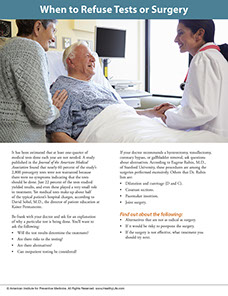
    Image of doctor talking to hospital patient and spouse.

    It has been estimated that at least one-quarter of medical tests done each year are not needed. A study published in the Journal of the American Medical Association found that nearly 60 percent of the study’s 2,800 pre-surgery tests were not warranted because there were no symptoms indicating that the tests should be done. Just 22 percent of the tests studied yielded results, and even these played a very small role in treatment. Yet medical tests make up about half of the typical patient’s hospital charges, according to David Sobel, M.D., the director of patient education at Kaiser Permanente.

    Be frank with your doctor and ask for an explanation of why a particular test is being done. You’ll want to ask the following:

    *  Will the test results determine the treatment?

    *  Are there risks to the testing?

    *  Are there alternatives?

    *  Can outpatient testing be considered?

    If your doctor recommends a hysterectomy, tonsillectomy, coronary bypass, or gallbladder removal, ask questions about alternatives. According to Eugene Rubin, M.D., of Stanford University, these procedures are among the surgeries performed excessively. Others that Dr. Rubin lists are:

    *  Dilatation and curettage (D and C).

    *  Cesarean sections.

    *  Pacemaker insertion.

    *  Joint surgery.

    Find out about the following:

    *  Alternatives that are not as radical as surgery.

    *  If it would be risky to postpone the surgery.

    *  If the surgery is not effective, what treatment you should try next.

    Page from A Year of Health Hints book by the American Institute for Preventive Medicine. www.HealthyLife.com. All rights reserved.

    © American Institute for Preventive Medicine
  • Be Assertive 2

    Healthylife® QuitWell™

    Part 5

    Image of cigarettes and money.

    Learn the differences between passive, aggressive, and assertive communication.

    Passive

    *  You lack expression for yourself.

    *  You do not stand up for your rights and needs.

    Result: You usually do not achieve your goal. You may feel like someone is walking all over you.

    Aggressive

    *  You stand up for your rights and needs, but at the expense of someone else.

    Result: You usually put down or hurt someone else. You gain no respect and may even start a conflict.

    Assertive

    *  You stand up for your rights and needs without putting down or hurting someone else.

    Result: You build self-respect and feel good about yourself. You are likely to achieve your goal.

    Example

    Your co-worker offers you a cigarette, saying that you can have just one, even though you recently quit. This person wants to smoke with you for old time’s sake. You know this could send you back to using tobacco.

    Passive Response:“All right, I’ll have a cigarette with you, but just this one.”

    Aggressive Response:“You really have some nerve offering me a cigarette. I hate cigarettes and I think it’s disgusting that you smoke. You should smell your breath. Don’t ever come near me with a cigarette again.”

    Assertive Response:“No, thank you. I have quit smoking and I plan to stay that way. Even one can trigger my old addiction. You can help me remain an ex-smoker by not offering me any.”

    © American Institute for Preventive Medicine

  • Be Assertive 3

    SleepWell® Program

    Week 5

    Image of man practicing speech in mirror.

    Passive

    *  You lack expression for yourself.

    *  You do not stand up for your rights and needs.

    Result: You usually do not achieve your goal.

    Aggressive

    *  You stand up for your rights and needs, but at the expense of someone else.

    Result: You usually put down or hurt someone else. You gain no respect.

    Assertive

    *  You stand up for your rights and needs without putting down or hurting someone else.

    *  You increase the chance of achieving your goals.

    *  You express your feelings without becoming victim to them.

    Result: You build self-respect and feel good about yourself.

    What Assertive Looks Like

    Body Posture: Be relaxed and natural. Avoid slouching, putting your hands in your pockets, and facing away from the person you are speaking with.

    Eye Contact: Good eye contact is vital to convey self-confidence and interest. Don’t stare at the other person; this comes across as a challenge.

    Voice, Tone, and Quality: Use a strong, varied tone. Speak clearly and firmly. Don’t shout or speak too softly. Don’t whine.

    Distance from the Person: Don’t position yourself too far or too close.

    Facial Expression: Let your face convey the same message as what you are saying.

    Content: Use short sentences. Be specific, clear, and firm.

    Benefits of Being Assertive

    *  You can feel comfortable saying “no.”

    *  You have more confidence to ask others for help.

    *  You gain more respect from others.

    *  You feel less angry with yourself and with others.

    *  You feel justified to say what you want to say.

    *  You feel comfortable to request clarification.

    *  You accept compliments graciously.

    *  You can change your mind without feeling guilty.

    Practice First

    Plan or write down what you want to say. Have responses ready ahead of time to deal with questions and comments. Reinforce your remarks by saying what positive outcomes will occur for you and the other person. Practice in front of a mirror or with a friend.

    Use the L.A.D.D.E.R. Technique

    This is a step-by-step way to be more assertive.

    *Look at your needs, wants, rights, and feelings about the situation.

    *Arrange a meeting that is convenient for you and the other person to talk.

    *Define the problem or issue clearly to the other person.

    *Describe your feelings using “I messages.” I messages let you take charge of your feelings.

    *Express your needs and desires in an assertive manner using a few clear sentences. Be aware of your eye contact, hand gestures, posture, voice and facial expression.

    *Reinforce your remarks by saying what positive outcomes will occur for you and the other person.

    Example:

    L – I wish my partner would help with household chores so I don’t stay up so late at night finishing what needs to get done.

    A – I’ll plan to talk with him or her after dinner tomorrow.

    D – Tell your partner, “When I stay up late doing household chores, I do not get enough sleep at night. I don’t have enough energy to be alert and productive at work the next day.”

    D – “I feel I could get more sleep with your help.”

    E – “I would like to divvy up household to-dos between us. I know we are each better at different tasks.

    R – “This change would help me get more sleep at night and I will have more energy when we spend time together.”

    © American Institute for Preventive Medicine
  • Be Assertive

    Healthylife® Weigh

    Part 4

    Women with arms crossed looking convinced and confident.

    Learn the differences between passive, aggressive, and assertive communication.

    Passive

    *  You lack expression for yourself.

    *  You do not stand up for your rights and needs.

    Result: You usually do not achieve your goal.

    Aggressive

    *  You stand up for your rights and needs, but at the expense of someone else.

    Result: You usually put down or hurt someone else. You gain no respect.

    Assertive

    *  You stand up for your rights and needs without putting down or hurting someone else.

    *  You express your feelings without becoming victim to them.

    Result: You build self-respect and feel good about yourself.

    Example: Your aunt offers you a large piece of cherry pie that she said she made especially for you. You know that you have eaten enough for the meal and eating the piece of pie does not fit your eating goals.

    *  Passive Response: “Thank you. It’s delicious!” Thinking… “I really don’t want to eat this right now, but I don’t want to hurt her feelings.”

    *  Aggressive Response: “I can’t believe you’re offering me cherry pie when you know I’m trying to lose weight. You’re going to ruin my diet!”

    *  Assertive Response: “I appreciate that you went to the trouble of making this pie for me! It looks great and I’m sure it tastes great. I am very serious about losing weight so I’d like to split that piece with someone.”

    What Assertive Looks Like

    *  Body Posture: Be relaxed and natural. Avoid slouching, putting your hands in your pockets, and facing away from the person you are speaking with.

    *  Eye Contact: Good eye contact is vital to convey self-confidence and interest. Don’t stare at the other person; this comes across as a challenge.

    *  Voice, Tone, and Quality: Use a strong, varied tone. Speak clearly and firmly. Don’t shout or speak too softly. Don’t whine.

    *  Distance from the Person: Don’t position yourself too far or too close.

    *  Facial Expression: Let your face convey the same message as what you are saying.

    *  Content: Use short sentences. Be specific, clear, and firm.

    Practice First

    Plan or write down what you want to say. Have responses ready ahead of time to deal with questions and comments. Reinforce your remarks by saying what positive outcomes will occur for you and the other person. Practice in front of a mirror or with a friend.

    Benefits of Being Assertive

    *  You can feel comfortable saying “no.”

    *  You have more confidence to ask others for help.

    *  You gain more respect from others.

    *  You feel less angry with yourself and with others.

    *  You feel justified to say what you want to say.

    *  You feel comfortable requesting clarification.

    *  You accept compliments graciously.

    *  You can change your mind without feeling guilty.

    © American Institute for Preventive Medicine

  • Avoid Dubious Debt Collectors

    FINANCIAL HEALTH

    Wife on phone while husband sits besides her.

    Have you ever received a call from a debt collector that did not seem quite right? Perhaps it was for a debt you already paid or for one you did not recognize. Either way, the call may have given you a moment’s hesitation, wondering if they had the right person or if the call was legitimate. Scams like this are on the rise across the nation, and it is important for you to protect yourself from any debt collection scam.

    Ask who is calling

    Ask for the collector’s name, the company’s name, its address and phone number. If they cannot answer any of that information, hang up.

    Keep personal information to yourself

    If the collector asks for you to confirm personal information, do not correct them if they give out wrong information. Do not volunteer any additional personal information.

    Demand a validation notice

    Collectors must provide a validation notice and tell them you will not discuss the debt until you have received it. This notice will tell you how much money you owe, the name of the creditor and what to do if you don’t think you owe the money. The debt should also appear on a free, annual credit report.

    Do not respond to threats

    If the collector threatens to have you arrested or take away your driver’s license, hang up and report the collector to the FTC atftc.gov/complaint.

    Do detective work

    Contact the original creditor yourself to get to the bottom of it. They should be able to confirm whether the debt is legitimate.

    Dispute the debt

    If you do not think you should owe anything, even if you got validation information, dispute it with the collector by mail or online.

    Source: Federal Trade Commission

    © American Institute for Preventive Medicine