Tag: risks

  • Know The Different Heart Disease Types

    MEDICAL NEWS

    Heart on a blue background.

    You’ve probably heard the terms cardiovascular disease, heart disease and coronary heart disease. But did you know each of these terms means something different?

    Let’s learn some of these “heart” terms and what they mean for your health. If you have a type of cardiovascular disease, work with your doctor to come up with a heart health plan. Your plan might include a healthy diet, exercise and medications.

    What is cardiovascular disease?

    Cardiovascular disease is any type of disease that affects the heart or blood vessels. “Cardio” refers to the heart, and “vascular” refers to the blood vessels.

    Types of cardiovascular disease include:

    *  Coronary heart disease

    *  High blood pressure

    *  Stroke

    *  Heart failure

    *  Peripheral artery disease

    What is heart disease?

    Heart disease is any type of condition that affects the heart’s function or structure. The most common type of heart disease is coronary heart disease. Heart disease also includes:

    *  Heart rhythm disorders known as arrhythmias

    *  Cardiomyopathy

    *  Congenital (present at birth) heart defects

    *  Coronary artery disease (CAD)

    *  Heart failure

    Heart disease is a type of cardiovascular disease.

    What is coronary heart disease?

    Coronary heart disease is also called coronary artery disease (CAD). Coronary heart disease happens when a fatty substance called plaque builds up in the arteries. Sometimes people call this clogged arteries or atherosclerosis.

    The plaque reduces the amount of blood getting to the heart. This can cause angina, or chest pain. It can also cause blood clots and can lead to a heart attack.

    Sources: American Heart Association and National Heart, Lung, and Blood Institute

    © American Institute for Preventive Medicine

  • Informed Consent

    Medical Care

    Image of person filling out forms.

    Informed consent means that you agree to treatment only after it has been explained to you and that you understand it. You should know the nature of the treatment, its benefits and risks, and the likelihood of its success. You should also be told if your treatment is an experimental one.

    The doctor should review any alternatives to surgery or other procedures. There are no guaranteed outcomes in medicine, but informed consent enables YOU to make a rational and educated decision about your treatment.

    With Informed Consent

    *  You cannot demand services that go beyond what are considered “acceptable” practices of medicine or that violate professional ethics.

    *  You must recognize that you may be faced with some uncertainties or unpleasantness.

    *  You should, if competent, be responsible for your choices. Don’t have others make decisions for you.

    Page from the Healthier at Home book by the American Institute for Preventive Medicine. www.HealthyLife.com. All rights reserved.

    © American Institute for Preventive Medicine

  • Bleeding

    Pregnancy & Prenatal Care

    Pregnant women sometimes have light spotting. That’s when a tiny bit of blood leaks from the vagina or the surface of the cervix. It may happen after a vaginal exam. It may also happen after sex. If the blood starts out pink or red and turns dark brown, it is not active bleeding. This is not usually a problem. But let your health care provider know when there is any bleeding. He or she will decide what to do. Bleeding can be a sign of a problem if:

    *  The blood is bright red.

    *  Pain or cramps are present, too.

    *  The bleeding is heavy. Heavy means the bleeding soaks a sanitary pad.

    *  The spotting keeps going on.

    Causes

    Before the 20th week, bleeding could be, but is not always, a sign of miscarriage. Other causes of bleeding include:

    *  Loss of the mucus plug

    *  Kidney infection

    *  Preterm labor

    *  Placenta previa and other problems called vasa previa and marginal previa

    *  Placenta abruptio

    *  Swollen cervix

    Placenta Previa

    The placenta carries oxygen and food to the baby. In most pregnancies, the placenta attaches high in the uterus. In placenta previa, it attaches low, over the cervix. The lower uterus stretches during late pregnancy. Parts of the placenta tear from the wall. That causes bleeding.

    Placenta previa is rare. It happens in only 1 in 200 pregnancies. Its cause is not known. Falls and injuries are not factors. Symptoms of placenta previa are:

    *  Bright red vaginal bleeding. This could start as early as the 24th week. Often, it starts during the 34th or 35th week.

    *  Usually, there is no pain or cramping.

    A woman may not know that she has placenta previa until bleeding happens. Then an ultrasound test can show the problem.

    Women with placenta previa have to spend a lot of time in bed. Bed rest may last late into the pregnancy. Bed rest gives the baby time to grow. It prevents stress to the uterus. The goal is to keep blood loss down. A lot of blood loss means danger for both mother and baby. In severe cases, the mother may have to go to the hospital for treatment.

    In some cases, the bleeding stops, but the placenta blocks the cervix. The mother will need a Cesarean section (C-section) delivery if the placenta completely blocks the cervix. The mother may need a C-section if the placenta only partly blocks the cervix. When this happens, the mother may have more bleeding after she delivers the baby.

    {Note: Some pregnant women may have a “low lying placenta.” This means the placenta lies at the bottom of the uterus (not higher where it should be). An ultrasound can show a “low lying” placenta. If it is found before the 24th week, the placenta can move upward and out of the way of the cervix. If so, there is no longer a problem.}

    Placenta Abruptio

    There is a right time for delivery of the placenta. That’s after the baby is born. But sometimes it happens another way. The placenta starts to leave the wall of the uterus too early. It starts before the baby is born. This can happen whether the placenta is attached high or low.

    Placenta abruptio happens in about 1 in 200 pregnancies. Some cases are more serious than others. Causes might be high blood pressure or a serious blow to the belly. An older mother may be more apt to have placenta abruptio. So are women who use cocaine during pregnancy. Symptoms of placenta abruptio are:

    *  Bright red vaginal bleeding

    *  Severe pain in the abdomen. The pain lasts. It doesn’t come and go.

    There are no tests for placenta abruptio. Even ultrasound may not show it. Regular prenatal visits help. The health care provider looks for blood in the mother’s vagina. The provider finds out if the uterus is tender.

    Women with placenta abruptio need to go to the hospital right away. Some women can have a vaginal delivery. That’s if labor begins on its own and the baby is healthy. Otherwise, a C-section is done. The mother may be given blood.

    Questions to Ask

    Self-Care / Prevention

    *  Watch closely for bleeding. If you see any, call your health care provider.

    *  Rest in bed for light bleeding.

    *  Avoid doing things that could injure you. Examples: heavy lifting, hard exercise. Don’t do work, sports, or exercises that could give you a blow to the belly.

    *  Wear a special seat belt when you drive. You can get one that protects a pregnant woman’s belly.

    *  Don’t smoke.

    *  Don’t be exposed to other people’s smoke.

    *  Follow your health care provider’s advice about sex. You may be told to:

    – Avoid sex.

    – Use extra caution during sex:

    – Your partner can focus on more gentle touching.

    – Limit how deeply the penis enters the vagina. Use positions that help control the depth.

    Prenatal Self-Care book by the American Institute for Preventive Medicine. www.HealthyLife.com. All rights reserved.

    © American Institute for Preventive Medicine

  • Bleeding 2

    First Aid

    Most adults can donate a pint of blood without harmful side effects, but losing a quart of blood, quickly, can lead to shock and even death. In a child, losing a pint (or less depending on the child’s size) can put the child in extreme danger.

    Signs & Symptoms

    For External Bleeding

    *  A skin wound.

    *  Dark red blood gushes or flows from veins.

    *  Bright red blood spurts from arteries.

    *  Blood oozes from capillaries. The bleeding usually clots off by itself.

    For Internal Bleeding

    *  Vomiting or coughing up true, red blood. This includes blood-tinged sputum.

    *  A bruise on the skin of the chest or abdomen, especially if it is in a place where no blow was struck.

    *  Fractured ribs.

    *  Dizziness. Fainting. Weakness.

    *  Lethargy. Excessive sleepiness. Mental status changes. These can occur with trauma to the head, even if it is mild.

    *  Fast pulse. Cold, moist skin.

    *  Stools contain bright red blood or are black (not due to taking iron).

    Causes

    For External Bleeding

    *  Abrasions (scraped skin). Lacerations (cut skin with jagged edges). Punctures.

    *  Knife, gunshot, or other wounds can graze or penetrate the skin. These can damage internal blood vessels and body organs.

    *  Injury wounds.

    For Internal Bleeding

    *  A bruise. This is bleeding from and damage to tissues beneath the skin.

    *  Damage to blood vessels and/or internal structures. This includes a blunt injury that does not break the skin, a bleeding ulcer, and an aneurysm.

    *  Bleeding disorders.

    Taking blood-thinning drugs can result in both internal and external bleeding.

    Treatment

    When bleeding occurs, the goal is to find the source, stop or lessen the bleeding, and help the body cope with the loss of blood.

    *  For severe bleeding, treatment includes first aid measures and emergency medical care.

    *  For minor bleeding, treatment depends on the cause and other medical conditions present.

    *  Bleeding disorders need to be treated by a doctor.

    Questions to Ask

    Self-Care / First Aid

    For Severe Bleeding

    *  Without delay, apply direct pressure to the wound using a sterile dressing or clean cloths. {Note: If the cut is large and the edges of it gape open, pinch the edges of the wound while you apply pressure.}

    *  Call 9-1-1 or take the person to nearest hospital emergency department.

    *  Do not remove an object that is stuck in a wound. Pack it in place with padding. Put tape around the padding so it doesn’t move.

    *  If bleeding continues before getting medical help, put extra cloths, etc. on top of existing ones. Keep putting pressure on the wound until bleeding stops or until medical help takes over.

    *  The most important thing to do is to apply direct pressure on the bleeding site. Some health experts advise to do these things, too, if needed:

    – Elevate the wounded area higher than heart level while applying pressure. Do this if no bone is broken.

    – Apply pressure to a “pressure point” if bleeding still continues after 15 to 20 minutes of direct pressure. Use the pressure point closest to the bleeding site that is between the wound and the heart. (See Pressure Points.)

    *  Don’t apply a tourniquet except to save a life.

    *  While giving first aid for bleeding, keep looking for signs of shock.

    For an Amputation

    *  Control bleeding.

    *  Wrap the severed part in a clean, dry (not wet) cloth or sterile gauze. Place the wrapped part in a plastic bag or other waterproof container. Put these on a bed of ice. Do not submerge the severed part in cold water or ice.

    For Bleeding from the Scalp

    *  Use a ring pad to apply pressure around the edges of the wound, not on the wound. Make a ring pad (shaped like a doughnut) with a bandage of narrow, long strips of cloth. Start with one end of the narrow bandage and wrap it around all four fingers on one hand until you form a loop. Leave a long strip of the bandage material to weave in and around the loop so it doesn’t unravel.

    Healthier at Home book by the American Institute for Preventive Medicine. www.HealthyLife.com. All rights reserved.

    © American Institute for Preventive Medicine

  • Ectopic Pregnancies

    Pregnancy & Prenatal Care

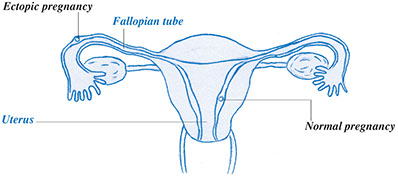
    An ectopic pregnancy is when an embryo starts to develop outside the uterus. (Ectopic means out of place.) This happens less than 2 percent of the time.

    In normal pregnancies, an egg travels from a woman’s ovary to the uterus. It travels down the fallopian tube to get there. Somewhere along the way, the egg gets fertilized by a male sperm. Once inside, the egg attaches to the wall of the uterus. It becomes an embryo and then a fetus. Nine months later, a baby is born.

    In ectopic pregnancies, the fertilized egg does not reach the uterus. It starts to grow somewhere else. Most often, that’s in the fallopian tube.

    The embryo can’t survive for long outside the uterus. But it can put the mother in danger if it gets too big. It can rupture an organ or cause internal bleeding. Medical steps must be taken right away.

    Symptoms

    Some women may have no symptoms. They may not even know that they are pregnant. When there are symptoms, they usually come within 8 weeks of conception. Symptoms may include:

    *  Pain in the lower belly

    *  Pain on one side of the body

    *  Vaginal spotting and bleeding

    *  Pain in the rectum (rear end) or shoulder

    *  Feeling like throwing up

    *  Throwing up

    *  Feeling weak

    *  Fainting

    Diagnosis

    Ultrasound can sometimes locate the embryo. Laparoscopy is another option. That’s when a tiny camera with a light is put in the mother’s body. It goes in through a very small incision (cut).

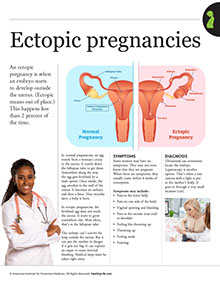
    Illustration of normal vs ectopic pregnancy.

    Causes

    There are many causes for ectopic pregnancies:

    *  Damage to the ovary or fallopian tube

    *  Scarring of the ovary or fallopian tube. Scarring can result from endometriosis, pelvic inflammatory disease or an STD.

    Also, the risk for an ectopic pregnancy is higher for women who:

    *  Have had an ectopic pregnancy in the past

    *  Have had fallopian tube surgery

    *  Have had problems getting pregnant

    *  Have used an IUD for birth control

    These women should call their health care provider when they miss a menstrual period.

    Treatment

    Medicines may be used. But if some time has passed, surgery may be needed. The embryo is removed. Any damage to the mother’s body is repaired. In some rare cases, a fallopian tube or ovary must be removed. But women have another set of these. So the mother may become pregnant again.

    Questions to Ask

    Self-Care / Prevention

    Tips to Lower the Risk of an Ectopic Pregnancy

    *  Talk to your health care provider about your risks for damage to your fallopian tubes from:

    – STDs

    – Pelvic Inflammatory Disease

    – Endometriosis

    *  Ask if you need to get tested for these and how often. Find out, too, if your health plan pays for these tests.

    *  Schedule any tests needed with your health care provider.

    Prenatal Self-Care book by the American Institute for Preventive Medicine. www.HealthyLife.com. All rights reserved.

    © American Institute for Preventive Medicine

  • High Blood Pressure

    Heart & Circulation Problems

    The medical name for high blood pressure is hypertension (hy-puhr-TEHN-shun). High blood pressure (HBP) is when blood moves through the arteries at a higher pressure than normal. The heart strains to pump blood through the arteries.

    Signs & Symptoms

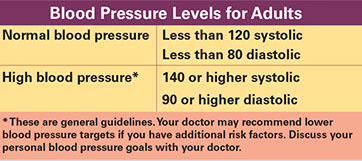
    High blood pressure (HBP) is a “silent disease.” Often there are no signs or symptoms. A lot of adults with HBP do not know they have it. So, get your blood pressure checked at each doctor’s office visit, at least every 2 years, or as often as your doctor advises. When blood pressure is 180 or higher (top number) or 120 or higher (bottom number), these signs of a hypertensive crisis may occur:

    *  Severe chest pain

    *  Severe headache with confusion and blurred vision

    *  Severe anxiety

    *  Shortness of breath

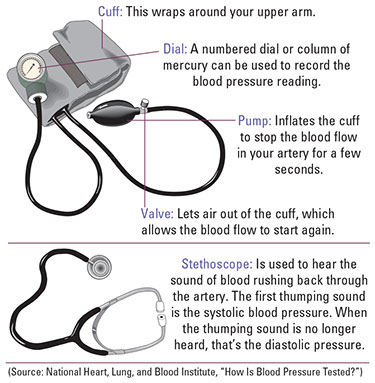
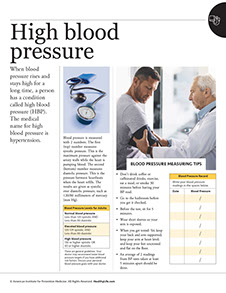
    Blood pressure is measured with 2 numbers. The first (top) number measures systolic pressure. This is the maximum pressure against the artery walls while the heart is pumping blood. The second (bottom) number measures diastolic pressure. This is the pressure between heartbeats when the heart refills. The results are given as systolic over diastolic pressure, such as 120/80 millimeters of mercury (mm Hg).

    Tips When You Have Your BP Measured

    *  Don’t drink coffee or smoke 30 minutes before having your BP read. (Don’t smoke at all!)

    *  Go to the bathroom before you get it checked.

    *  Before the test, sit for 5 minutes.

    *  Wear short sleeves so your arm is exposed.

    *  When you get tested: Sit; keep your back and arm supported; and keep your arm at heart level.

    *  An average of 2 readings from BP tests taken at least 5 minutes apart should be done.

    Causes, Risk Factors & Care

    The exact cause is not known.

    Risk factors include:

    *  Family history of HBP

    *  Aging. More than half of older adults have HBP.

    *  Smoking cigarettes

    *  Race. African Americans are more likely to have HBP than Caucasians.

    *  Gender. Men are more likely to have HBP than women (until women reach menopause).

    *  Being inactive. Obesity. Sleep apnea.

    *  Drinking too much alcohol

    *  Too much sodium intake in some persons

    *  Emotional distress

    High blood pressure could be caused by another medical problem or be a side effect of some medicines. This is called secondary hypertension. This can usually be reversed when the problem is treated.

    Diagnosis

    Blood pressure readings tell if your blood pressure is high. A health care professional measures blood pressure during an office visit with a manual or automated device called a sphygmomanometer (sfig’-mo-ma-nom-e-ter). The numbers on the gauge measure your blood pressure in millimeters of mercury (mm Hg).

    You should get 2 or more readings at different times. To confirm a diagnosis of HBP, your doctor may have you wear a device that records your blood pressure every 20-30 minutes over a period of 24 to 48 hours. This is called ambulatory blood pressure monitoring (ABPM).

    Note: Sometimes just being at the doctor’s office is enough to raise some people’s blood pressure. This is called “white-coat hypertension.” If you think this affects you, tell your doctor. You may be advised to check your blood pressure with a home testing device. Your doctor may have you wear a device that records your blood pressure for 24 hours. This will give accurate readings of your blood pressure.

    Health Problems Related to HBP

    High blood pressure plays a major role in these health problems:

    *  Stroke. Dementia. Brain damage.

    *  Heart disease. A person with HBP is 5 times more likely to have a heart attack than a person without HBP. It can also cause the heart to enlarge. This could cause (congestive) heart failure.

    *  Chronic kidney disease

    *  Kidney failure

    *  Vision loss. This includes blindness.

    Why is ambulatory blood pressure monitoring (ABPM) done?

    During an office visit, a short-term rise in blood pressure can be due to:

    *  Emotions or stress

    *  Pain or physical activity

    *  Caffeine or nicotine

    *  “White-coat hypertension.” With this, just being at a doctor’s office or in the presence of medical staff is enough to raise blood pressure.

    Getting blood pressure readings over 1-2 days during normal activity and sleep gives a more accurate measurement of your blood pressure.

    Self-Care / Prevention

    For blood pressure control, follow a healthy lifestyle.

    *  Get your blood pressure checked at each office visit, at least every 2 years, or as often as your doctor advises.

    *  Get to and/or stay at a healthy weight. Aim for a body mass index (BMI) between 18.5 and 24.9. Find your BMI using the table below or from:www.nhlbisupport.com/bmi.

    *  Don’t smoke. If you smoke, quit.

    *  Limit alcohol to 2 drinks or less a day if you are male and 1 drink or less a day if you are female or age 65 or older.

    *  Limit caffeine.

    *  Exercise. Try to do at least 60 minutes a day.

    *  Learn to handle stress. Take classes. Learn relaxation techniques, etc.

    *  Take medicine as prescribed. Tell your doctor if you have any side effects, such as dizziness, faintness, or a dry cough without having a cold. Don’t stop taking your prescribed medicine or change the dose(s) unless your doctor tells you to.

    *  Talk to your doctor or pharmacist before you take antihistamines and decongestants. Discuss all prescribed and over-the-counter medicines with your doctor and pharmacist before you take them to avoid harmful drug interactions. Find out about drug and food interactions, too. Ask if grapefruit juice can cause harmful effects with the medicine(s) you take.

    *  Keep track of your blood pressure using a home testing device. Do this if advised by your doctor.

    Medical Care

    High blood pressure usually lasts a lifetime, but can be treated and controlled. If you are diagnosed with high blood pressure, follow your doctor’s advice. Medical treatment includes:

    *  A physical exam and lab tests. These check for damage to your heart, kidneys, and other organs. They also identify risk factors you have for heart, kidney, and other diseases. Your treatment plan is based on your needs.

    *  Follow-up blood pressure checks and other tests as needed.

    *  Healthy lifestyle changes.

    *  Medications. Most persons need more than 1 medicine to treat high blood pressure.

    Your doctor will decide if and what medication(s) you need. This is based on your blood pressure level, age, race, other conditions you have, heart disease risk factors, etc. Common medicines used to treat HBP are:

    *  Diuretics (water pills)

    *  Calcium channel blockers

    *  ACE inhibitors

    *  Angiotensin II receptor blockers

    *  Beta-blockers

    *  Alpha blockers. Alpha-beta blockers.

    *  Nervous system inhibitors

    *  Vasodilators

    Reasons to Get Medical Care

    *  You have signs or symptoms of a hypertensive crisis. Get medical care right away.

    *  You need to schedule office visit appointments to get your blood pressure checked. Do this as often as your doctor advises.

    *  You have adverse side effects from taking medicine(s) to lower blood pressure. Examples are:

    – You feel lightheaded or dizzy.

    – You feel weak, sleepy, and/or drowsy.

    – Your heart races.

    – You get a skin rash.

    Resources

    American Heart Association

    800.242.8721

    www.heart.org

    National Heart, Lung, and Blood Institute

    www.nhlbi.nih.gov

    High Blood Pressure brochure by the American Institute for Preventive Medicine. www.HealthyLife.com. All rights reserved.

    © American Institute for Preventive Medicine

  • High Blood Pressure 2

    Pregnancy & Prenatal Care

    A blood pressure reading concerns the blood in the arteries. The top number in the reading is the systolic pressure. That’s the pressure when the heart muscle contracts. The bottom number is the diastolic pressure. That’s the pressure when the heart muscle relaxes.

    An example of a blood pressure reading is 120/80. This is measured in millimeters of mercury (mm Hg). A blood pressure reading should be taken before pregnancy or at its start. This is called a baseline blood pressure. The baseline reading shows what is normal for that woman. During the first several months of pregnancy, blood pressure may drop a little. It often rises slightly later in the pregnancy. That’s because of the extra work the mother’s body is doing. A slight rise is normal then. High blood pressure in pregnancy is when there is an increase of 30 or more in the systolic pressure (top number). An increase of 15 or more in the diastolic pressure (bottom number) is also a sign of high blood pressure.

    Causes

    Preeclampsia

    A common cause of high blood pressure in pregnancy is preeclampsia. This used to be called toxemia. Three things usually come with preeclampsia:

    *  High blood pressure

    *  Swelling of the face, hands, fingers, or feet

    *  Protein in the urine

    Other symptoms of preeclampsia are:

    *  Sudden weight gain or gaining more than 2 pounds a week

    *  Headaches

    *  Vision problems like spots before the eyes or blurry vision

    *  Pain in upper belly

    *  Severe indigestion that doesn’t go away

    Preeclampsia affects about 7 out of 100 pregnant women. It happens most often during a first pregnancy, but can occur again, especially with a new partner. And, it only happens during pregnancy. It goes away after delivery. Preeclampsia can lead to eclampsia. That’s when convulsions also occur. Eclampsia can result in a coma for the mother.

    Risk Factors

    The cause of preeclampsia is not known. High blood pressure does not have to be present before pregnancy. The things listed below may increase the risk for preeclampsia:

    *  First pregnancy or first pregnancy with a new partner

    *  Chronic high blood pressure or kidney disease

    *  Diabetes or lupus before the pregnancy

    *  Being overweight

    *  Being African American

    *  Pregnancy before age 20 or after age 35

    *  Being pregnant with more than one baby

    *  Preeclampsia in a past pregnancy or in a mother or sister

    Pregnancy Induced Hypertension (PIH)

    High blood pressure can develop during pregnancy without other symptoms. This is called pregnancy induced hypertension (PIH). This type of high blood pressure often happens after the 20th week. After delivery, blood pressure usually goes back to normal.

    Treatment

    High blood pressure and preeclampsia can range from mild to severe. They can be treated with medical help and home care. But if serious symptoms are present, medicine and/or hospital care may be needed. The health care provider may induce labor (bring on labor). Or a Cesarean section (C-section) may be done.

    When blood pressure remains high, not enough blood reaches the placenta. The fetus doesn’t get enough oxygen and nutrients. That can cause:

    *  Growth problems for the fetus

    *  Placenta abruptio.

    *  A baby that is born preterm, that has mental problems, is underweight, or stillborn

    Questions to Ask

    Self-Care

    *  Get a lot of rest. Sleep 8 to 12 hours at night. Take 2 naps during the day, if you can. When you sleep or rest, lie on your left side, as much as you can. This helps blood flow to the placenta. When you tire of lying on your left side, lie on your right side.

    *  Take medicine for high blood pressure as prescribed. If told to do so, take regular blood pressure readings at home. Ask your health care provider how to get a home test kit.

    *  Follow your health care provider’s advice about exercise.

    *  Do things to relax. Examples: listen to soft music, put your feet up, take a nap. Watch a TV show that makes you laugh. Put your hand on your belly to feel your baby move.

    *  Don’t take any medicine without your health care provider’s okay. That includes cold or sinus medicines and antacids.

    Prenatal Self-Care book by the American Institute for Preventive Medicine. www.HealthyLife.com. All rights reserved.

    © American Institute for Preventive Medicine